Customer Relationship Management presents a ground-breaking strategic framework for successful CRM policy. Built around Professor Payne's five key processes, the book demonstrates a systematic management progression that will guarantee the maximum impact and efficiency of a CRM programme.
The book backs up these five processes - strategy development, value creation, channel and media integration, information management and performance assessment - with 16 best practice case studies which set the universal theory in a specific practical context. These feature a range of companies, including Orange, Brittania, Homebase, Canada Life, Sun Microsystems, Natwest, Sears, Roebuck & Co., Nortel Networks and Siemens. The book concludes with interviews from four thought leaders, offering a 'futures' vision forum for CRM.
Customer Relationship Management is a vital instrument for anyone who needs to know how to develop and measure effective CRM within an organization. It includes overviews and key learning points preceding each case study, and a summary chapter to draw out the most salient lessons from CRM best practices. For practitioner or academic alike, this is essential reading.
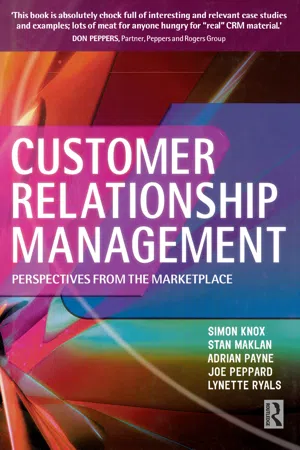
eBook - ePub
Customer Relationship Management
- 302 pages
- English
- ePUB (mobile friendly)
- Available on iOS & Android
eBook - ePub
Customer Relationship Management
About this book
Chapter 1
CRM top of the management
agenda
In an era of increasingly transient management themes, few board agenda items are attracting the sustained attention of Customer Relationship Management, or CRM. To provide some measure of the explosion of management interest in CRM, UK market research company Forrester Research searched the Dow Jones’ content base of more than 6000 management publications for references about CRM and found 6048 articles in 2000, up from 442 articles in 1998 (Chatham et al. 2001).
This sudden proliferation of references can be partly explained by the lack of a widely accepted definition for CRM: consequently managers and writers use the term broadly to describe all forms of transactions between customers and their suppliers. In this book, we look at CRM as an organization-wide process, which focuses its activities on treating different customers differently to increase value for both customer and organization. In an article on its web site, the European Centre for Customer Strategies quotes Hewson Consulting's definition of CRM as ‘a business strategy focusing on winning, growing and keeping the right customers’ (European Centre for Customer Strategies 2001). A recent CRM report published by the Financial Times (Ryals et al. 2000) suggests that CRM consists of three main elements:
1. identifying, satisfying, retaining and maximizing the value of the firm's best customers;
2. wrapping the firm around the customer to ensure that each contact with the customer is appropriate and based upon extensive knowledge both of the customer's needs and profitability;
3. creating a complete picture of the customer.
The Financial Times report identifies the major components for the successful implementation of CRM as:

Developing a consistent approach to managing customer relationships has been a core objective for the Royal Bank of Canada in implementing its CRM strategy:
EXAMPLE
The Royal Bank of Canada began collecting customer data in 1978 and by the early 1990s had implemented client segmentation in its data warehouse, dividing its customers into three distinct profitability segments. While this provided front-line staff with segmentation codes, these were often interpreted subjectively, resulting in an inconsistent approach at corporate level.
Following research, the bank set about implementing a CRM strategy which allowed it to offer customers an integrated service across its entire product range. To achieve this it needed to measure client offerings, cost management, pricing initiatives and marketing spend. The bank uses five criteria to analyse customer information: income, expense and risk (net interest revenue); other revenue (fees, commission); direct expense (variable cost); indirect expense (overheads); and risk provision. The bank also recognized that profitability was affected by the type and frequency of customer events, their balances and the channels they use.
The Royal Bank of Canada's nine million customers are segmented, however, it has developed strategies not only for these segments but also for hundreds of micro-segments, as it moves towards its objective of one-to-one marketing. It plans to develop individual treatment strategies on small cells of customers to establish what works and what doesn't, and to test refinements on an ongoing basis.
The customer data are also allowing it to move from assessing current customer value to potential value, by taking into account factors such as lifestyle changes. The bank has also recognized that ‘there is no such thing as an unprofitable customer’ and is tailoring its product offerings to suit what are normally considered to be unprofitable customers. One of the immediate gains was discovering from recalculating customer profitability that its previous measurement metrics had been inaccurate for as many as 75 per cent of its customers.
CRM is not only being written about; big businesses are actively investing in CRM initiatives and technologies. A Forrester report (Callinan et al. 2001) quotes from its first quarter 2001 North America Benchmark study that 82 per cent of firms in the study have CRM implementations planned or in progress. This result is consistent with other published surveys and suggests that most big businesses are actively implementing some facets of one-to-one or relationship marketing.
Popular three-letter acronyms come and go, but we believe that the core of CRM will continue as an enduring foundation of most businesses. Creating satisfied customers at a profit has been espoused as the prime role of business since Peter Drucker first wrote about it almost 50 years ago (Drucker 1954: ‘it is the customer who determines what a business is … the purpose of a firm is to create and keep customers’). However, operationally, the traditional focus of business is improving efficiencies. This focus on efficiency has its roots deep in economic thought. Adam Smith did not write about customer satisfaction, retention and relationships; he developed theories of specialization, division of labour and production efficiencies. Economic theory that originates from his model of perfect markets assumes that competition for undifferentiated products drives prices down to a level necessary merely to sustain investment in continued production. In this model, there are no brands, product differentiation, loyal customers or excess profits. In Adam Smith's world, merely being an efficient producer of commodities, accepting the price and volume dictated by the market satisfies the firm.
Our professional and personal experience suggests that firms in a competitive market are anything but passive price and volume takers. Firms innovate in product design, product function, manufacturing processes, distribution, service and communications to differentiate their offers from those of competitors. Much of this innovation focuses upon creating new and improved products (and services) and reducing costs. Efficiency, coupled with product innovation, drives competitive strategy for most firms.
Long-term social, business and economic trends are having an impact on this efficiency drive and organizations no longer focus exclusively upon making better products at lower cost. We observe that many firms strive to help customers in both consumer and business markets become more effective through the goods and services they sell them. For example, improving effectiveness for consumers of financial services may not just be about creating an innovative investment product, it is more likely to centre around helping consumers achieve important life goals such as financial security and increased leisure time. Many financial services providers have segmented their customer base by life stage in order to talk to consumers about these life goals in addition to the products they offer.
A business-to-business equivalent example is found in information technology. Effective use of IT is not delivered through faster computers and new software applications alone; it is more likely to be delivered by helping firms improve their businesses by measures such as moving fixed costs to variable costs, quickly growing the business to scale and developing global reach. Efficiency-driven firms focus on the products and services they sell, whereas effective firms focus on their ability to understand and fulfil individual customers’ most important needs. Efficiency-driven firms seek competitive advantage in scale, experience and creating barriers to entry. Effective firms seek competitive advantage in customer involvement, service and superior knowledge of customer motivations and behaviour. Their customers, rather than their technology and production, drive effective businesses. Moving from efficiency to effectiveness represents a big shift in business emphasis, and is one of the drivers behind the surge of attention and investment in CRM.
Long-term forces
Much has been written about the emerging social and economic environment that is enabling this shift in business focus. For the purposes of introducing CRM and current best practice in the area, we wish to concentrate on the three factors we believe are most responsible for creating customer-driven businesses. These are:
1. the evolution of the relationship marketing concept;
2. the impact of information technology;
3. changing customer behaviour and motivation.
Evolution of relationship marketing
Since the early 1990s, academics and consultants have promoted the idea that marketing practice should focus upon identifying and serving the organization's best customers and prospective customers. This may sound highly intuitive, but ten years ago it represented a radical departure from the tradition of marketers identifying and dominating the most attractive product markets. Traditional marketing focuses on resegmenting markets to create and dominate defensible product positions. Product portfolio tools, such as the Boston Consulting Group Matrix, helped firms balance investments across product ranges to maximize profit and long-term growth. Firms allocated scarce resources against competing product investments to ensure that there was a balance of cash generated and attractive investments. In most industries, each product investment was considered on its own merits in accordance with financial analysis tools that tie investment decisions to shareholder value. Firms were free to pick and choose in which market segments they wished to compete on the basis of market and financial attractiveness.
Proponents of relationship marketing challenged the customer and economic logic behind product portfolio management. They argue that:
1. Differences in customer profitability are at least as important as differences in product/market profitability to shareholder value.
2. Customer value is created by customers effectively using goods and services as individuals, as much as by the intrinsic qualities of the goods and services themselves.
In other words, they support the effectiveness versus efficiency argument.
Reicheld's work at Bain Consulting led him to publish findings from research and practice suggesting that differences in the performance of insurance brokers were better explained by examining customer loyalty and retention than by market share, unit cost and scale (Reichheld 1996). He argued that customers become increasingly profitable over time because:
1. customer acquisition costs spread over a larger turnover;
2. customer spending tends to accelerate over time;
3. operating costs fall as customers know the firm's products, services and policies better;
4. satisfied customers make referrals; and
5. loyal customers are less price sensitive, allowing the firm to maintain if not improve its margin.
Garth Hallberg reminds us in the title of his book that All Consumers are Not Created Equal (Hallberg 1995). He presents research, which shows that, in most industries, a minority of customers (10–15 per cent) generate the majority of profits. So not only does customers’ profitability increase over time, but some customers are potentially far more profitable than others. Peppers and Rogers popularized the expression ‘one to one’, by suggesting that when considering the differences between customers’ profitability and needs, companies must ‘differentiate customers, not just products’ (Peppers and Rogers 1994). Attracting and retaining the right customer will have a dramatic impact on the business.
Aside from the commercial logic of becoming customer centric, organizations that move beyond short-term, transactional customer relationships can address customers’ deeper and broader needs. If customers teach a firm about their motivations and behaviours and the firm responds to this knowledge, the firm can make the customer more effective at the task at hand whilst differentiating and extending its own offer. Over time, this positive cycle of learning and doing ‘locks in’ loyalty and allows the firm to capture more of the economic value in its value chain. Good products are no longer sufficient to compete. Today, firms must create customized solutions to customers’ more profound problems. Reprising the effectiveness argument, companies today must create effective solutions to individual customers’ problems, not simply improve their efficiency.
Impact of information technology
The theory of relationship marketing is intuitively appealing, but its widespread implementation has been facilitated by new information technology that permits organizations to identify and manage large numbers of individual customers. New technologies have enabled firms to implement CRM by:
Table of contents
- Front Cover
- Half Title
- Title
- Copyright
- Contents
- Foreword
- About the Authors
- Acknowledgements
- Chapter 1 CRM top of the management agenda
- Chapter 2 A strategic framework for CRM
- Chapter 3 The strategy development process
- Chapter 4 The value creation process
- Chapter 5 Channel and media integration process
- Chapter 6 Information management process
- Chapter 7 Performance assessment process
- Chapter 8 CRM investments and shareholder value
- Chapter 9 The future of CRM: What opinion leaders think
- Index
Trusted by 375,005 students
Access to over 1.5 million titles for a fair monthly price.
Study more efficiently using our study tools.
Frequently asked questions
Yes, you can cancel anytime from the Subscription tab in your account settings on the Perlego website. Your subscription will stay active until the end of your current billing period. Learn how to cancel your subscription
No, books cannot be downloaded as external files, such as PDFs, for use outside of Perlego. However, you can download books within the Perlego app for offline reading on mobile or tablet. Learn how to download books offline
Perlego offers two plans: Essential and Complete
- Essential is ideal for learners and professionals who enjoy exploring a wide range of subjects. Access the Essential Library with 800,000+ trusted titles and best-sellers across business, personal growth, and the humanities. Includes unlimited reading time and Standard Read Aloud voice.
- Complete: Perfect for advanced learners and researchers needing full, unrestricted access. Unlock 1.5M+ books across hundreds of subjects, including academic and specialized titles. The Complete Plan also includes advanced features like Premium Read Aloud and Research Assistant.
We are an online textbook subscription service, where you can get access to an entire online library for less than the price of a single book per month. With over 1.5 million books across 990+ topics, we’ve got you covered! Learn about our mission
Look out for the read-aloud symbol on your next book to see if you can listen to it. The read-aloud tool reads text aloud for you, highlighting the text as it is being read. You can pause it, speed it up and slow it down. Learn more about Read Aloud
Yes! You can use the Perlego app on both iOS and Android devices to read anytime, anywhere — even offline. Perfect for commutes or when you’re on the go.
Please note we cannot support devices running on iOS 13 and Android 7 or earlier. Learn more about using the app
Please note we cannot support devices running on iOS 13 and Android 7 or earlier. Learn more about using the app
Yes, you can access Customer Relationship Management by Simon Knox,Adrian Payne,Lynette Ryals,Stan Maklan,Joe Peppard in PDF and/or ePUB format, as well as other popular books in Business & Business General. We have over 1.5 million books available in our catalogue for you to explore.