- 264 pages
- English
- ePUB (mobile friendly)
- Available on iOS & Android
eBook - ePub
Strategic Career Management
About this book
Organizations need to develop and retain their talent, and managing careers in a strategic fashion is critical to achieving this.
This book takes a practical approach to help you make strategic career management work both for the talent you want to retain and for the organization they work in.
It will help you to:
- Improve your strategic career management
- Improve employee retention
- Develop a business case for careers
- Design and develop critical processes to support your strategy
- Explore best practice examples from other organizations
- Evaluate your progress
Other titles in the HR Series:
Organization Design (Stanford)
Transforming HR (Reddington, Williamson and Withers)
HR - The Business Partner (Kenton and Yarnall)
The Changing World of the Trainer (Sloman) publishing March 2007
Change, Conflict and the Corporate Community (Kenton and Penn) publishing June 2007
1
An Overview of Career Strategy
Career strategies have evolved considerably over time, partly in response to the changing working environment and partly due to the increased sophistication of companies aiming to attract and retain high quality employees. This chapter aims to provide an overview of the topic and sets a context for the remainder of this book. Reading this chapter will enable you to understand what is meant by the various terms used in connection with career strategies and will help you to answer questions such as:

| What is a Career? |
It wouldn’t be right to start a book such as this without defining some of the terms being used. The first, and most fundamental of these, is the word career.
I would love to define the word career as all encompassing, meaning that it incorporates both work and outside work experiences that shape your path through life. In this definition, your goals are met and you achieve satisfaction with your career by discovering your best fit with the world. Sadly though, my experience tells me that employees, and in particular young high potential employees, consider that to have a career you need to be employed. Whilst there is an acknowledgement that your career may be influenced by circumstances and interests outside of work, the essence of the career is viewed as organisational development and progression, rather than personal growth. Interestingly, for many talented individuals, this view may change over time, and leads to some interesting challenges for organisations in the way they manage the careers of their talent group, a topic we will return to later in this book.
So for the purposes of this book, the definition of a career put forward by Arthur et al. (1989), the evolving sequence of a person’s work experience over time, still holds true, in that it incorporates the possibility of different types of employment, from self-employment through to temporary roles, as well as the sense of a sequence of roles, not necessarily involving promotion. This last point is critical, in that careers often take unusual routes, including sideways and even downward steps in hierarchies and across organisational boundaries.
Career Management
What then is career management? Obviously, it is about how careers are managed, and if it is effective it should enable an organisation to attract and retain high quality staff, as well as add to the skill base of the company to help ensure long-term survival and growth. However, the purpose and responsibility for career management has changed considerably over time.
In the 1960s, career management was viewed as a way of helping individual employees realise their goals, through interventions such as career planning workshops and counselling. By the 1980s, the business environment had changed and career management was seen as a tool for addressing business needs, through improved succession planning and high-flyer programmes for key groups of staff. Individuals marked career progress by looking at the stage they had reached against their age and grade and progressing up a career ladder. Since the 1990s, the focus has changed once again, and career management is now more often seen as requiring an alignment between both individual and business requirements, as age-grade progression opportunities are no longer realistic for organisations, but maximising individual potential is still viewed as crucial to business success.
Much has been written in recent years about the nature of this partnership in career management and throughout this book we will be exploring the balance needed for successful career strategies, particularly when they are focused on pools of talent.
Career Development or Career Management?
What then is the difference between a career development strategy and a career management strategy? To an extent, the difference is semantics and either term would suffice if you define your terms clearly within your strategy to ensure you have the meaning you require.
However, with the pace of change in organisations and unpredictability of the future of many companies, the concept of managing careers, even if this is a shared responsibility between employees and employer, is often seen as a rather unrealistic aim. Career management suggests a planned series of steps with an end goal. Such plans are likely to become quickly out of date in the current environment, and lead to frustration from unfulfilled expectations. Career planning, which from an organisational perspective often means succession planning, still exists, but approaches are changing and replacement succession planning is no longer seen as the answer to all problems. Later in this book, we will be looking at how some organisations are now starting to deal with the issue of succession and are moving towards developing generic pools of talent.
Career development however, implies opportunities for growth and enhanced skills, which will open up the possibilities of progression. It implies more of a role for the individual and moves the focus away from jobs, to progression within roles. Consequently, career development is about individuals taking responsibility for developing and progressing their career with support from the organisation. Some of the key requirements for organisations currently are speed and agility of response; adaptability to customers; the ability to deal with ambiguity and I could go on. All of these things require a more flexible and fluid career strategy, where risks are able to be taken. Career development then is more about the means by which people achieve their career goals.
For me, it is a little like comparing the classic, planned model of change with radical or emergent change (Figure 1.1a, b). Both are about managing change, but each takes a different approach.
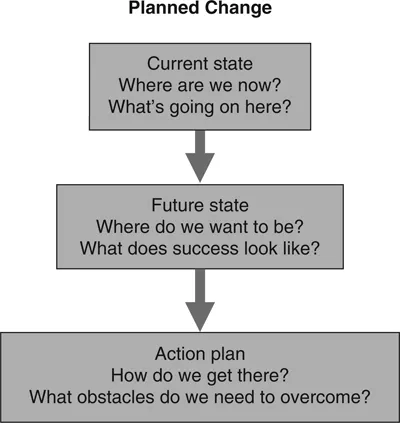
Figure 1.1a Planned change
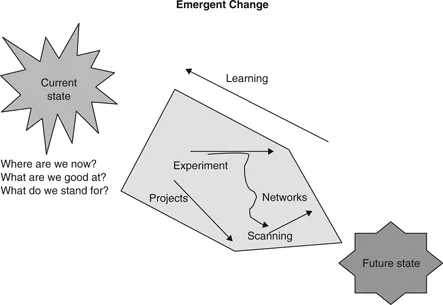
Figure 1.1b Emergent change
Career management assumes a more planned model of change, where the company can grow and develop employees towards a predicted future. Whereas career development involves growth in a slightly more haphazard way, with the end goal more uncertain.
The difference between the terms is also sometimes explained by where the responsibility for development lies. Hirsh and Jackson (1996) have drawn a useful continuum of career strategies, which is replicated in Figure 1.2.
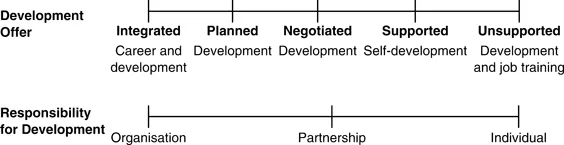
Figure 1.2 The career continuum
This continuum illustrates some of the shifts that have occurred over time in career strategies, from more organisationally led approaches, where there is planned development managed by the company, through to individual-led approaches, where there is unsupported development and the focus is on the current job. It is interesting to consider where the current trend towards talent management strategies sits on this continuum. Whilst many companies might argue that talent management reflects a partnership approach to careers, my sense is that there is quite a strong shift back towards planned development and more managed careers.
Career Management or Talent Management?
A key theme for this book, and something that I will return to in more detail in the next chapter, is the extent to which career management strategies and talent management differ. Talent management strategies are undergoing a surge in popularity within organisations at present as the pressure to attract and retain high potential staff increases. But is this focus on talent just a new career strategy for the 21st century?
Whilst there are some obvious differences in the types of intervention stemming from talent management, such as the forming of pools of high potential employees, it is questionable whether even this is not just a modern-day approach to high-flyer schemes of old. The more global nature of talent management is often sighted as a differentiator, as this brings with it economies of scale from surplus talent being utilised in other regions, rather than relying solely on a country supply. This global movement also has the added bonus of increasing diversity and knowledge transfer across the business, but yet again could be said to have been in existence with ex-pat strategies.
For the purposes of definitions, I find it hard to make a distinction between the two terms and have a strong sense that talent management is a re-badged and re-packaged career strategy which is more closely aligned to the needs of business today. In writing this book, I considered whether to focus more exclusively on talent management, but for me, ...
Table of contents
- Cover
- Half Title
- Title Page
- Copyright
- Contents
- Foreword
- Preface
- Acknowledgements
- List of Figures
- List of Tables
- 1. An Overview of Career Strategy
- 2. Focusing in on Your Talent: Getting the Balance Right
- 3. Building the Business Case
- 4. Revitalising Your Succession Management
- 5. The Practicalities of Career Acceleration Pools
- 6. Developing the Key Roles
- 7. Fostering Opportunities for Growing Careers
- 8. Developing Career Self-Reliance amongst Your Talent
- 9. Final Reflections
- Appendix
- References
- Index
Trusted by 375,005 students
Access to over 1.5 million titles for a fair monthly price.
Study more efficiently using our study tools.
Frequently asked questions
Yes, you can cancel anytime from the Subscription tab in your account settings on the Perlego website. Your subscription will stay active until the end of your current billing period. Learn how to cancel your subscription
No, books cannot be downloaded as external files, such as PDFs, for use outside of Perlego. However, you can download books within the Perlego app for offline reading on mobile or tablet. Learn how to download books offline
We are an online textbook subscription service, where you can get access to an entire online library for less than the price of a single book per month. With over 1.5 million books across 990+ topics, we’ve got you covered! Learn about our mission
Look out for the read-aloud symbol on your next book to see if you can listen to it. The read-aloud tool reads text aloud for you, highlighting the text as it is being read. You can pause it, speed it up and slow it down. Learn more about Read Aloud
Yes! You can use the Perlego app on both iOS and Android devices to read anytime, anywhere — even offline. Perfect for commutes or when you’re on the go.
Please note we cannot support devices running on iOS 13 and Android 7 or earlier. Learn more about using the app
Please note we cannot support devices running on iOS 13 and Android 7 or earlier. Learn more about using the app
Yes, you can access Strategic Career Management by Jane Yarnall in PDF and/or ePUB format, as well as other popular books in Business & Business General. We have over 1.5 million books available in our catalogue for you to explore.