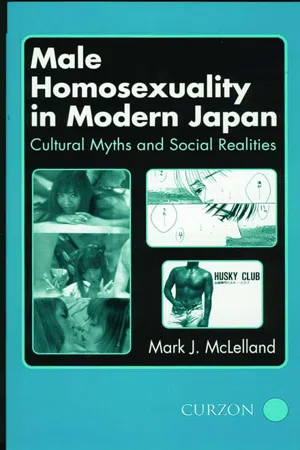
This book is the first to look at the wide range of contrasting images of the gay male body in Japanese popular culture, both mainstream and gay, and relate these images to the experience of an interview sample of Japanese gay men. In so doing, it touches on a number of important issues, including whether there can be a universal 'gay identity' and whether or not strategies developed for increasing gay and lesbian visibility in western countries are appropriate to the social situation in Japan
- 268 pages
- English
- ePUB (mobile friendly)
- Available on iOS & Android
eBook - ePub
About this book
Information
Chapter 1
Introduction
Whose homosexuality?
The subject of this book is elusive as it is by no means clear who, exactly, is to be included in the concept of ‘male homosexual’ even in English; in Japanese, as will be described below, problems with terminology are even more serious. In the west, recent developments in lesbian and gay studies (see for example, Dorenkamp and Henke 1995) as well as in the study of sexuality generally have led towards the increasing problematisation of all terms used in a nominalising manner which try to name a person in terms of the gender of his or her preferred sexual partner. This shift has largely been due to the influence of postmodern ideas which have entered academia via feminism and gender studies, and yet it is not new. Even in the late 1940s, Alfred Kinsey, in the first large-scale empirical survey of the sex life of American men ever conducted, was warning against the use of terms like ‘homosexual’ and ‘heterosexual’ as nouns describing distinct types of people. He writes:
Males do not represent two discrete populations, heterosexual and homosexual. The world is not divided into sheep and goats… It is a fundamental of taxonomy that nature rarely deals with discrete categories. Only the human mind invents categories and tries to force facts into separate pigeon-holes. The living world is a continuum in each and every one of its aspects. The sooner we learn this concerning human behavior the sooner we shall reach a sounder understanding of the realities of sex (1948:639).
Although I endorse Kinsey's warning against the desire to organise human sexuality into tidy categories, I am sceptical that the ‘realities of sex’ can ever be fully understood, not because of deficiencies in our methods of approach which are, after all, humanly produced and therefore culturally encoded, but because ‘sex’ is an ideological and not an empirical concept. In coming to this understanding, I have been much influenced by the historical work of Michel Foucault who has argued that in the nineteenth century in western cultures, ‘sex’ came to be constructed as a distinct category of acts which held the secret to understanding human behaviour. He says:
All along the great lines which the development of the deployment of sexuality has followed since the nineteenth century, one sees the elaboration of this idea that there exists something other than bodies, organs, somatic localizations, functions, anatamo-physiological systems, sensations, and pleasures; something else and something more, with intrinsic properties and laws of its own: ‘sex’ (1990:152–3).
Arising from this increased attention paid to sex was the new division of people into two opposite and mutually exclusive sexual types, the homo- and heterosexual. As Foucault argues, sodomy, which had previously been understood as simply a category of forbidden acts, at the end of the nineteenth century became transposed onto a certain kind of person or body: the homosexual. He comments that ‘the sodomite had been a temporary aberration; the homosexual was now a species’ (1990:42). This has resulted in a situation, common throughout Anglo-American culture where ‘of the very many dimensions along which the genital activity of one person can be differentiated from that of another…precisely one, the gender of object choice…has remained as the dimension denoted by the now ubiquitous category of “sexual orientation”’ (Sedgwick 1990:8). However, I shall be arguing that although this binary division of people into two sexual types according to the gender of their sexual partners has, for many people, established itself as the primary paradigm for understanding human sexuality in most western societies, its applicability is questionable in Japan which has not, until very recently, entertained the notion that ‘sexuality’ connotes an ‘identity.’
Foucault's insight is fundamental to the approach I take to (homo)sexuality throughout this book. I do not try to explain, in terms of a grand meta-narrative, the ‘meaning’ of the various representations of homosexuality in modern-day Japan; nor do I contrast representations of homosexual men created by the media with actual homosexual men whose self-understanding is somehow more ‘real.’ Instead, I try to show how the many different understandings of the implications of same-sex love between men are caught up in a number of ‘discourses’ which variously position them as more or less personally and socially desirable. For instance, I found that the popular media represent ‘homosexual’ men as simultaneously funny and sympathetic and dangerous and despicable; they are sometimes represented as a threat to the family and society and then, in other discourses, reinscribed as women's best friends and ideal partners. In certain contexts, homosexual sex is spoken of as ‘disgusting’ (kimochi warui) and yet graphic representations of love between beautiful boys (bishōnen) are often represented as more romantic and pure than relationships between men and women. Similarly, men who experience same-sex attraction themselves also give contradictory accounts of its significance. Some feel themselves to be part of an oppressed minority, others feel that their sex lives have no impact on the roles they play in everyday life. It is clear that the myriad representations of homosexuality in Japanese culture cannot be judged in terms of a pre-existent, unitary, empirical sexual experience shared by all homosexual men equally. In the realm of human sexual relations, there are no ideal types, either homo- or heterosexual.
Throughout the book I have had to resist the temptation to oppose the relatively fluid understandings of sexuality held by many of my Japanese interviewees with a monolithic ‘gay identity’ supposedly held by western homosexual men and women. Although intellectually I know that none of the terms ‘gay identity,’ ‘homosexual identity’ or ‘lesbian identity’ can be found in writing prior to the mid-1970s (Epstein 1998:134) and are therefore very culturally and historically specific, the amount of media discussion given to ‘gay pride’ and its inverse, the ‘gay threat’ in many western societies does encourage a rather essentialist reading of sexual identity (see Signorili 1994). As Knopp (1990) points out ‘most of North America's large cities (and many smaller ones) now contain at least one predominantly gay neighbourhood.’ This visibility of lesbian and gay people living in close association in large urban areas does suggest parallels with ethnic communities who also choose to live with other members of their ‘minority group.’ The idea of a lesbian and gay minority identity is also encouraged by ‘an anti-gay counter movement’ (Knopp 1990) which encourages an us-against-them mentality on both sides of the homo/hetero divide.
Yet, although it was clear by the mid-1980s that, as Gayle Rubin famously pointed out ‘in modern, western, industrial societies, homosexuality has acquired much of the institutional structure of the ethnic group’ (1998:112), empirical studies of so-called ‘gay communities’ have failed to give coherent content to the notion of a ‘gay’ or ‘homosexual’ identity. In fact, studies of homosexuality and AIDS transmission such as those carried out by Dowsett (1996) in Australia and Coxon (1996) in Britain question the usefulness of identity labels such as ‘gay’ altogether and instead speak of ‘men who have sex with men.’ In their extensive interviews with partners in ‘non-heterosexual relationships’ Heaphy et al. (1998) also found that the terms ‘lesbian,’ ‘gay,’ and ‘bisexual’ were often resisted by their interviewees and that the understandings of these terms sometimes differed between interviewee and interviewer. They also discovered that the different partners in a relationship also sometimes differed in their acceptance of labels. That these differences in interpretation can arise in a context in which both the interviewee and researcher share, to a large extent, a common culture, should draw attention to the problems which arise when ‘sexuality’ is analysed across cultures.
Although the ‘ethnic’ self-characterization of lesbians and gays in the US may have made sense given that society's long history of civil-rights struggles and widespread legal restrictions on the expression of same-sex sexuality, there is no reason to assume that this particular formulation will endure. As Altman states, ‘the idea of “gay/lesbian” as a sociological category is only about one hundred years old, and its survival even in Western developed countries cannot be taken for granted’ (1996:79) (see also Altman et al. 1988). As Neil Miller (1993) comments in his journalistic account of ‘gay life’ around the world ‘the terms “gay” and “straight” revealed themselves to be Western cultural concepts that confused more than they elucidated’ (1993:68–9). It is therefore ironic that some Japanese gay-rights activists look to western models, the efficacy of which are already widely disputed in some western societies. The role of these imported models in Japan is unclear: ‘America’ serves as a sign of liberation for many Japanese homosexual men whilst simultaneously being rejected by others. It is misleading, then, to set up ‘gay identity’ as something that the west has developed which Japan somehow lacks, despite the fact that some Japanese homosexual men, gay rights activists in particular, do present this argument.
The lexicon of same-sex love
At this point it is important to explain the terms I will be using to discuss homosexuality in Japan. By ‘homosexuality’ I mean, simply, same-sex sexual desire. When I speak of homosexual men, I am therefore referring to men who experience sexual desire primarily directed at other men. However, I do not accept the binary homo/hetero division which suggests that ‘homosexual’ men do not or cannot express themselves sexually with women. It became clear during my fieldwork in Japan that many of my interviewees had experienced sexual relations with women and several of them anticipated resuming sexual relations with women at some point in the future. I avoid the use of the term ‘bisexual’ as a default category to tidily file away all those men whose sexual activity cannot be neatly described as hetero- or homosexual as the notion of bisexuality, attending as it does only to the sex of the genitals involved, is insensitive to motivation. For instance, some of my interviewees initiated sexual interactions with women whereas others simply responded to the sexual initiative of their female partners. Some enjoyed the experience and sought out opportunities to repeat it, others didn't. What was enjoyable about the experience was also different for many. For several men it was not orgasm which was most pleasurable, but the sense of emotional empathy and sharing which they established with their female partners, an empathy which they stressed was generally lacking with male partners, although the sex with men was often more intense. It may be possible to describe men like this as fcomosexual but hetero-emotional. I also came across stories about homosexual men visiting female prostitutes and enjoying, not the sex per se, but the experience of being able to order (or being ordered) to perform certain acts (such as licking feet). Also, some men manage to perform sexually with women, but only by fantasizing that their partner is a man: is this interaction therefore really homosexual?
Hence, I am reticent throughout about the use of all sexual nomenclature which attempts to establish fixed categories. I will, however, say that all the men I interviewed were, for the purposes of orgasmic satisfaction, more inclined to seek out male partners and none of them was, at the time of interview, sexually involved with a woman. To this extent, then, I speak of them as ‘homosexual.’ In so doing, I am aware that I am crowding together a host of different experiences and developmental life-cycles under a single term. As recent research has shown ‘developmental sequences vary tremendously’ (Epstein 1998:146) with regard to when, how and if a man who engages in same-sex sexual acts comes to identify as ‘homosexual.’ Goode also points out that ‘regarding oneself as gay—in the vocabulary of some, recognising that one is a homosexual—is not something that happens automatically,’ adding that ‘there is a considerable independence between engaging in homosexual behavior—and even recognizing that what one is doing, is, in fact, “homosexual behavior”—and adopting a homosexual identity’ (1997:262). The biographies of the men I interviewed problematise the use of fixed categories for describing an individual in terms of his sexual behaviour.
For the sake of variety, I also use the terms ‘gay men’ and ‘same-sex desiring men’ although by these terms I mean nothing other than men who predominantly experience sexual desire towards other men. When the gay men I cite refer to themselves, I generally include in parentheses their preferred Japanese term for describing themselves so that the nuance attached can be assessed by the reader. For non-Japanese speaking readers, I discuss in the next section of this chapter the various lexical items used at present in Japan to describe same-sex desiring men and outline the problems that an English speaker faces when trying to render these terms, which have been produced in a sexual culture quite different from that of Anglo-American societies, into English.
Closely connected with the idea that each individual possesses a sexual identity is the notion that he or she also has a gender identity. The common-sense understanding of this term involves the correlation between certain biological features (the possession of male or female sexual organs) with a diverse complex of dress codes, speech patterns and mannerisms, as well as ways of thinking, feeling and acting which are understood to be either ‘masculine’ (i.e. characteristic of male bodies) or ‘feminine’ (i.e. characteristic of female bodies). I follow postmodern feminist writers such as Judith Butler (1990), Eve Kosofsky Sedgwick (1990) and Monique Wittig (1992) as well as Queer theorists such as Jonathan Dollimore (1991) in arguing that ‘gender,’ like ‘sex’ is a social fiction. These theorists argue that the notion ‘woman’ is the binary opposite of ‘man’ and fixes the place of both in the field of gender relations which are based on ideology not biology. Dollimore, in particular, has argued that this binary opposition is ultimately unstable and as such is the site of considerable anxiety and paranoia, particularly on the part of men who have the most to lose if gender can be shown to be negotiable as opposed to natural. I use these ideas when I show that it is the sexuality of Japanese women which has traditionally been a site of anxiety for men, as illustrated in the negative attention female sexuality is given in the popular press, television and manga. Male sexuality is very much tied in with male gender role and is represented as dominating and controlling female responses in much the same way that men dominate and control women in the public sphere. It is therefore problematic in a male-dominated society like Japan to represent men as sexual in relation to other men without radically re-examining what it means to be gendered male. Popular culture deals with this problem by representing homosexual men as essentially women manqué; since they fail convincingly to ‘pass’ as women, they are not represented as sexually active as no ‘real’ man would find them desirable. I wish to show that the pervasive representation of homosexual men as ‘feminine’ is ideologically motivated as it is not possible to show two gender-normative men in a sexual interaction without bringing into doubt the ‘natural’ ground of male gender which is maintained through the sexual domination of women.
It is perhaps not surprising then, that it is in women's comics that men are most often represented as sexually involved with other men, but, as I argue in chapter 4, this is made possible only to the extent that these characters are not really ‘men’ but bishōnen (beautiful youths) who are in fact regendered, uniting the best of ‘masculine’ and ‘feminine’ in a kind of androgynous ideal. These youths are biologically male but the gender they ‘perform’ is not characteristically masculine. I argue that the figure of the homosexual bishōnen, the creation of women manga artists, is one example of gender ‘performativity’ as outlined by Judith Butler (1990), a key concept to which I will return in later chapters.
Japanese terms describing same-sex attraction
There has been a marked change over time in the nature of the vocabulary used to describe male same-sex attraction. During the Tokugawa period (1600–1867), the nanshoku (sometimes transcribed as danshoku and meaning ‘male eroticism’) code contained a wide variety of terms for describing the partners involved in homosexual acts depending upon such factors as age (their junior or senior role), status, and the context in which the acts took place. These terms were gradually replaced by translations of sexological terminology derived from European languages which focused on homosexual identity such as ‘Urning’ and dōseiaisha (same-sex-love person) or homosexual acts such as dōsei kōsatsu (same-sex intercourse). The novelist Mishima Yukio ([1951–3] 1973, vol. 5), writing just after the war, was still using the traditional term danshoku which he neologises as danshokuka (or danshoku-ist) to denote male homosexuals, although he does refer to the American usage of the word ‘gay.’ Older informants among my interviewees such as Sato and Hara informed me that as late as the early-1970s, vocabulary derived from the nanshoku code was still in use to desc...
Table of contents
- Front Cover
- Half Title
- Title Page
- Copyright
- Contents
- Acknowledgements
- Illustrations
- 1 Introduction
- 2 Homosexuality in Japanese History
- 3 Just Like a Girl: Images of Homosexual Men as Feminine
- 4 The Love between ‘Beautiful Boys’ in Women’s Comics
- 5 Gay Men as Women’s Best Friends and Ideal Marriage Partners
- 6 Images of Homosexuality in the Gay Media
- 7 Interviews with Japanese Gay Men
- 8 Japanese Gay Men’s Self-Understanding
- 9 Is there a Japanese Gay Identity?
- Afterword
- Notes
- References
- Index
Trusted by 375,005 students
Access to over 1.5 million titles for a fair monthly price.
Study more efficiently using our study tools.
Frequently asked questions
Yes, you can cancel anytime from the Subscription tab in your account settings on the Perlego website. Your subscription will stay active until the end of your current billing period. Learn how to cancel your subscription
No, books cannot be downloaded as external files, such as PDFs, for use outside of Perlego. However, you can download books within the Perlego app for offline reading on mobile or tablet. Learn how to download books offline
Perlego offers two plans: Essential and Complete
- Essential is ideal for learners and professionals who enjoy exploring a wide range of subjects. Access the Essential Library with 800,000+ trusted titles and best-sellers across business, personal growth, and the humanities. Includes unlimited reading time and Standard Read Aloud voice.
- Complete: Perfect for advanced learners and researchers needing full, unrestricted access. Unlock 1.5M+ books across hundreds of subjects, including academic and specialized titles. The Complete Plan also includes advanced features like Premium Read Aloud and Research Assistant.
We are an online textbook subscription service, where you can get access to an entire online library for less than the price of a single book per month. With over 1.5 million books across 990+ topics, we’ve got you covered! Learn about our mission
Look out for the read-aloud symbol on your next book to see if you can listen to it. The read-aloud tool reads text aloud for you, highlighting the text as it is being read. You can pause it, speed it up and slow it down. Learn more about Read Aloud
Yes! You can use the Perlego app on both iOS and Android devices to read anytime, anywhere — even offline. Perfect for commutes or when you’re on the go.
Please note we cannot support devices running on iOS 13 and Android 7 or earlier. Learn more about using the app
Please note we cannot support devices running on iOS 13 and Android 7 or earlier. Learn more about using the app
Yes, you can access Male Homosexuality in Modern Japan by Mark J. McLelland in PDF and/or ePUB format, as well as other popular books in Social Sciences & Ethnic Studies. We have over 1.5 million books available in our catalogue for you to explore.