eBook - ePub
Plumbing
About this book
Students setting out for a career in plumbing need a clear, concise and comprehensive textbook to help them study for their Technical Certificate and Level 2 NVQ – and this book meets all those needs.
Steve Muscroft expertly guides you through each of the key areas and processes in plumbing, from the basics through cold and hot water systems to health and safety and best practice on site.
The best way to learn something is to do it for yourself – so along with the theory this book is full of practical advice and guidance on how to get the job done. Every chapter is packed with colour photographs and diagrams to make learning easier. To help reinforce understanding each section features self-test exercises based on the standard City and Guilds assessment method.
Steve Muscroft's Plumbing isn't just a guide to passing the exam – it goes into much more detail than other textbooks, Extra material on key topics outside the core syllabus, and references to additional resources and organisations make this book a handy companion as you begin your plumbing career. For the price of a spanner, can you afford to be without it!
Information
UNIT 1
WELCOME TO PLUMBING
Summary
• An overview of the plumbing industry:
– What is plumbing?
– The plumbing industry and its links with the construction industry and the building engineering services sector
– About the plumbing industry
– Industry organisations and how to find them.
• The plumbing training scheme:
– Technical Certificates
– NVQs and SVQs
– Modern apprenticeships (MAs)
– Training and assessment
– Career opportunities.
About plumbing
Introduction
You have made the decision to learn about plumbing and you are probably looking forward to working in the industry. In this section, we explore what a plumber actually does and give you an insight of what to expect on site.
The section will also provide an overview of the industry structure, and information about the key organisations; this will be a useful reference as you work through the course material because they provide a wealth of information and further contacts.
What do we mean by ‘plumbing’?
Anyone new to the industry will probably have a view of what a plumber does. How would you describe plumbing? Think about this for a while and jot down a few notes.
We tend to find when speaking with people that their view of plumbing is of someone clearing a blocked drain, or repairing burst pipes. Whilst a plumber does this work, the job is much more involved than that.
Generally, we think that plumbing meets people’s basic requirements by:
• Keeping them healthy and clean by providing cold water for drinking, hot water for washing and sanitation systems for the removal of waste products
• Keeping them warm with the help of hot water heating systems
• Meeting the above requirements together to ensure maximum comfort and convenience for them by providing heating, hot and cold water systems and sanitation 365 days a year, and 24 h a day.
Explore the plumber’s role a little further and you will see that most plumbers usually carry out the:
• Installation
• Service
• Maintenance
of a wide range of domestic systems such as:
• Cold water, including underground services to a dwelling
• Hot water
• Heating systems fuelled by gas, oil or solid fuel
• Sanitation (or above ground drainage) including the installation of baths, hand wash basins, water closets (WCs) and sinks
• Rainwater systems, gutters and fall pipes
• Associated electrical systems
• Sheet lead weatherings (at Level 2, this includes things, such as chimney weatherings, and soil vent pipe weatherings).
In fact, you will see that the above list matches the content of the Technical Certificate.
In addition to the systems, the plumber will also have to work on the appliances and components contained within them. Here are a few examples:
• Storage vessels, cylinders, cisterns
• Sanitary appliances, sinks, baths, WCs, washbasins
• Domestic appliances including washing machines and dishwashers
• Heat exchangers, boilers, radiators
• Pumps, accelerators and motorised/isolating valves
• Gas appliances (natural or Liquefied Petroleum Gas (LPG), boilers, water heaters, cookers and fires)
• Pipe materials, fittings, fixings, controls that constitute the above systems.
Plumbers also work on:
• Cabling and electrical components, only if qualified to do so
• Sheet weatherings, aprons, back gutters, step flashings, soakers, lead slates.
The Level 2 Technical Certificate focuses on all aspects of domestic plumbing work. Some plumbing companies, however, specialise in specific work such as central heating, or industrial/commercial, which is basically working on much bigger systems in non-domestic premises.
So, we are now beginning to build up a picture of the extent of a plumber’s job. What skills and knowledge do you think a plumber needs in order to be able to carry out the job competently?
Here are our thoughts on what a competent plumber should be able to do:
• Follow health and safety legislation and guidance at all times
• Thoroughly plan the job including making sure that all the tools, materials and equipment are present on the job
• Agree a schedule of work with the customer or client
• Provide a cost estimate for the job
• Prepare the work location, making sure that there is adequate access
• Protect the customer’s property
• Mark out, measure and work out the installation requirements
• Fabricate, position and fix system components
• Pre-commission (including testing), commission and de-commission systems
• Service and maintain system components
• Work effectively with customers, workmates and other site visitors
• Work in an environmentally friendly manner
• Promote the products and services of the plumbing business.
Can you think of anything else?
We also think that the plumber should have a working knowledge of:
• Regulations
• Codes of practice
• Principles of plumbing systems including basic design
• Where to find manufacturers’ technical data
• Health and safety legislation and guidance
• Commercially agreed standards.
A plumber must also be able to read and interpret details contained within a number of information sources including drawings, specifications and manufacturers’ catalogues.
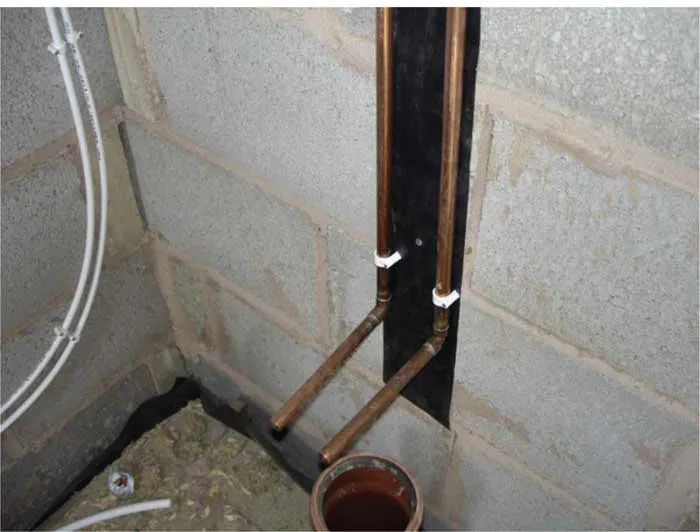
Finally, plumbers have to work with a range of materials and fittings. Figure 1.1 on the previous page shows plastic and copper pipework in a first fix situation. First fix means installing all the pipework runs prior to the wall and floor surfaces being completed.
Figure 1.1 Examples of typical plumbing materials. Hot and cold feed in copper to the right, plastic heating pipes to the left, and plastic drain connection below copper pipes
Try this
Now that you are beginning to pick up a good knowledge of the work carried out by domestic plumbers, it is time for a little bit of practical application. Consider your place of residence, draw up a table detailing all the plumbing connections (cold and hot water connections, appliances, central heating components, etc) within your place of residence. This should help to dispel the notion that all plumbers do is to clear blocked drains!
Next we will take a look at the overall structure and some of the key organisations within the plumbing industry.
The plumbing industry
Plumbing, building engineering services and construction
In Unit 12, Effective Working Relationships, we will look at how the construction industry is structured in more detail.
Primarily, the plumbing industry comes under the Building Engineering Services (BES) industry umbrella, which includes heating, ventilating, air conditioning and refrigeration and electrical sectors. The gas supply from the consumers’ meter to the appliances is also seen as being a part of the plumber’s job. Similarly BES is further classified as part of the construction sector.
Activity 1.1
What are the main trades that you think are covered within the construction sector? Jot down your thoughts on a separate piece of paper and check out the answer at the end of this book.
Your list will not cover all the trades, but it should give you an idea of the main ones. The training and development needs of the sector are looked after by an organisation called the Construction Industry Training Board or CITB. You will be doing a bit of research about CITB and other sector-related bodies later.
There is also an organisation that looks after the training and development needs of the building engineering servic...
Table of contents
- Cover
- Halftitle
- Title
- Copyright
- Contents
- Preface
- Acknowledgements
- Unit 1. Welcome to Plumbing
- Unit 2. Health and Safety
- Unit 3. Common Plumbing Processes
- Unit 4. Key Plumbing Principles
- Unit 5. Cold Water Supply
- Unit 6. Hot Water Supply
- Unit 7. Above Ground Discharge Systems
- Unit 8. Central Heating Systems
- Unit 9. Electricity
- Unit 10. Sheet Lead Work
- Unit 11. Environmental Awareness
- Unit 12. Effective Working Relationships
- Answers to Activities, Test yourself questions, Check your learning and Case study
- Index
Trusted by 375,005 students
Access to over 1.5 million titles for a fair monthly price.
Study more efficiently using our study tools.
Frequently asked questions
Yes, you can cancel anytime from the Subscription tab in your account settings on the Perlego website. Your subscription will stay active until the end of your current billing period. Learn how to cancel your subscription
No, books cannot be downloaded as external files, such as PDFs, for use outside of Perlego. However, you can download books within the Perlego app for offline reading on mobile or tablet. Learn how to download books offline
Perlego offers two plans: Essential and Complete
- Essential is ideal for learners and professionals who enjoy exploring a wide range of subjects. Access the Essential Library with 800,000+ trusted titles and best-sellers across business, personal growth, and the humanities. Includes unlimited reading time and Standard Read Aloud voice.
- Complete: Perfect for advanced learners and researchers needing full, unrestricted access. Unlock 1.5M+ books across hundreds of subjects, including academic and specialized titles. The Complete Plan also includes advanced features like Premium Read Aloud and Research Assistant.
We are an online textbook subscription service, where you can get access to an entire online library for less than the price of a single book per month. With over 1.5 million books across 990+ topics, we’ve got you covered! Learn about our mission
Look out for the read-aloud symbol on your next book to see if you can listen to it. The read-aloud tool reads text aloud for you, highlighting the text as it is being read. You can pause it, speed it up and slow it down. Learn more about Read Aloud
Yes! You can use the Perlego app on both iOS and Android devices to read anytime, anywhere — even offline. Perfect for commutes or when you’re on the go.
Please note we cannot support devices running on iOS 13 and Android 7 or earlier. Learn more about using the app
Please note we cannot support devices running on iOS 13 and Android 7 or earlier. Learn more about using the app
Yes, you can access Plumbing by Steve Muscroft in PDF and/or ePUB format, as well as other popular books in Technology & Engineering & Study Guides. We have over 1.5 million books available in our catalogue for you to explore.