eBook - ePub
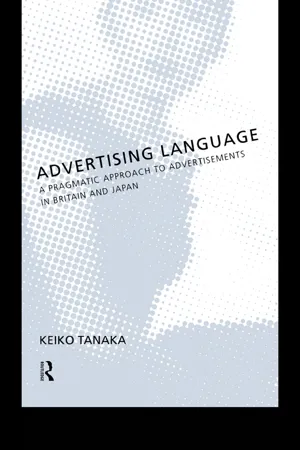
Advertising Language
A Pragmatic Approach to Advertisements in Britain and Japan
- 168 pages
- English
- ePUB (mobile friendly)
- Available on iOS & Android
eBook - ePub
About this book
Keiko Tanaka offers an analysis of the linguistic devices that are used in advertisements, looking at the strategems which advertisers employ to gain and retain the attention of their audience. Using relevance theory as a framework, she sets out its key aspects and applies them to the language of written advertising in Britain and Japan. Particular emphasis is placed on `covert communication', puns and metaphors, and the book contains a unique chapter on images of women in Japanese advertising. It is fully illustrated throughout with recent contrasting advertisements drawn from the two countries.
The book provides a compelling analysis of the language of advertising, and an exploration of Relevance Theory that will be of interest to scholars in many fields.
Information
1
ADVERTISING AND COMMUNICATION
INTRODUCTION
There has long been interest in the means employed by advertisers to communicate with their audience. This chapter assesses how the problems raised by the language of advertising have been approached. It is my contention that those who have written on this subject have not dealt adequately with the question of the context within which an audience processes an advertisement. Conversely, they have relied too much on ‘system of signs’ in the text. This chapter reviews a selection of theories in semiotics and linguistics which provides insights into the problem. At the same time, the defects of these theories are examined from the point of view of the contribution made by Relevance Theory (Sperber and Wilson 1986a, 1995).
SOME SEMIOTIC APPROACHES
Semiotic approaches are based on the assumption that communication is achieved by encoding and decoding a message, and Barthes is one of the most distinguished scholars to have tackled the language of advertising from such a perspective. His ‘Rhetoric of the image’ (1984b) is claimed by Dyer (1982:224) to be a major essay on semiotics and its application to the analysis of an advertising message. In this stimulating but ultimately unsatisfactory text Barthes studies the interrelationships between the image and the advertising message, using as an example an advertisement for a kind of pasta called Panzani.
Barthes argues that there are three kinds of message: the linguistic message, the coded iconic message, and the non coded iconic message. The linguistic message consists of the caption and the labels. Barthes points out that there exist two levels of interpretation of the linguistic message, namely, denotational and connotational. The name of the advertised product denotes the pasta, and connotes ‘Italianicity’. Putting aside the linguistic message, Barthes argues that we are left with the pure image. This is divided into two categories, which are the iconic equivalents of connotation and denotation. The former is also categorised as a coded, symbolic, and cultural message, while the latter is said to be the non-coded, perceptual and literal message. Barthes’ insight that one can derive different pieces of information from a single advertisement is valuable, but the way in which he sets out to analyse it is problematic.
The denotation-connotation distinction is not clear-cut, at either the linguistic or the iconic level, because perceptual information is not independent of cultural knowledge. As Fodor (1983) points out, a distinction between ‘central’ thought processes and ‘perceptual’ processes is assumed in current cognitive psychology. Perceptual systems are said to transform information from sensory representations into conceptual representations. The information received by such input systems, however, ‘underdetermines’ (Fodor 1983:68) the information derived from them by the central thought processes. In other words, the central thought processes integrate information derived from the senses with information stored in memory to determine what is actually perceived. Thus, even the processing of information derived from the senses is affected by cultural knowledge.
The thesis that different messages are disentangled solely by reading systems of signs runs up against the problem that there exist a potentially infinite number of different messages carried by a finite number of signs. Barthes is clearly aware of this difficulty. He attempts to resolve it by arguing that the linguistic message has a function vis-à-vis the iconic message, a function which he calls ‘anchorage’, that is the determination of the selection of the intended message:
…all images are polysemous…[which] poses a question of meaning and this question always comes through as a dysfunction even if this dysfunction is recuperated by society as a tragic…or a poetic game…[The caption] helps me to choose the correct level of perception, permits me to focus not simply my gaze but also my understanding.
(Barthes 1984b:38–9, author's italics)
The problem with this proposed solution is that linguistic messages are also polysemous. However much we would like them to be clear and straightforward, linguistic codes are not devoid of ambiguity. Reference assignment, disambiguation and enrichment are part of the normal process of utterance interpretation (Sperber and Wilson 1986a:185).
Moreover, Barthes' account fails to explain the popularity in advertising of such linguistic devices as the pun, where the linguistic message is intentionally polysemous. Indeed, it is doubtful whether advertisers in Britain and Japan regard the polysemous nature of linguistic and non-linguistic messages as a ‘tragedy’. On the contrary, as is argued in Chapter 4, the advantage of puns, which are frequently exploited in advertising, lies in their potential multiplicity of meanings. They are eye-catching and can thus sustain an audience's attention for a longer period of time.
The emphasis which Barthes (1984b:34–5) places on the discontinuity between different signs causes further problems. He concludes that there are four discontinuous connotational signs in the advertisement in question: (a) a suggestion of a return from the market implies the freshness of the products and domestic preparation; (b) the colours used in the poster mean ‘Italianicity’; (c) the serried collection of different objects suggests the idea of a total culinary service; (d) the composition of the objects implies the image of a still-life painting. But why are the freshness of the products and the domestic preparation categorised as one message, while the idea of a culinary service is placed in a separate category? The division seems arbitrary. The number of signs attributed by Barthes to the illustration appears equally arbitrary, for he does not provide any criteria for determining how many signs there might be. It would surely be possible for an audience to derive further messages from the advertisement in question, for example ideas of harvest and abundance.
Moreover, Barthes' analysis would completely fail to provide an adequate account for other advertisements. How would he ‘read’ the discontinuous connotational messages of the adver tisements in a controversial Benetton series, which show, inter alia, a dying Aids patient, a victim of the Mafia, an electric chair, and a blazing car? These illustrations have no obvious connection with Benetton clothes. Many advertisements for Silk Cut cigarettes in Britain do not even show the brand name, and the only linguistic message is the government health warning at the bottom. The appreciation of such advertisements involves more than decoding their linguistic and iconic messages.
As for Barthes' contention that it is possible to talk of explicit, discontinuous messages, this stems from a more general claim that language is the prime example of a semiological system (Culler 1983a:73), whereas Sperber and Wilson (1986a:55) maintain that the kind of explicit communication that can be achieved by the use of language is not a typical but a limiting case. While it is reasonable to argue that linguistic communication is capable of achieving a degree of precision and complexity unattainable by non-linguistic communication, the communicator does not always intend to communicate a finite number of explicit and precise messages. Instead, he provides evidence for a range of conclusions, which become more accessible to the audience to varying degrees. The thoughts which are communicated by advertisements seem to be as richly structured as the sentences used to communicate them, and much more so than the systems of signs proposed by semioticians.
Another semiotician who provides a stimulating but problematic approach to the language of advertising is Judith Williamson (1983). She analyses a Goodyear tyre advertisement, which shows a jetty on which a car is apparently being tested for its braking performance. She argues that, on the ‘manifest’ level, the jetty signifies the test of braking power and connotes ‘risk’, but on the latent’ level, it signifies ‘tyre’ because of their similarity in appearance, and connotes ‘safety’ (Williamson 1983:19). She goes on to say:
this transference of significance does not exist as completed in the ad, but requires us to make the connection: it is nowhere stated that the tyre is as strong as the jetty, therefore this meaning does not exist until we complete the transference ourselves.
(Williamson 1983:19, author's italics)
Williamson has nearly stumbled on the fact that advertising messages are not fully encoded and that interpreting advertisements takes more than just decoding. They need the audience to make appropriate connections.
Williamson's way of resolving the dilemma is unsatisfactory, although she begins to seize the importance of context. She presents an additional system of meaning, arguing that the ‘transference’ is ‘based on the fact that the first object (jetty) has a significance to be transferred’ (Williamson 1983:19, author's italics):
the advertisement does not create meaning initially but invites us to make a transaction where it is passed from one thing to another. A system of meaning must already exist in which jetties are seen as strong, and this system is exterior to the ad—which simply refers to it, using one of its components as a carrier of value (in the case of [the example above], strength, durability)—i.e. as a currency.
(Williamson 1983:19, author's italics)
She calls this mechanism the ‘referent system’ (1983:19) and goes on to define ‘currency’ as follows:
Currency is something which represents a value and in its inter-changeability with other things, gives them their ‘value’ too.
(Williamson 1983:20)
Pateman (1983) correctly rejects Williamson's argument as unsound. For a currency which allows the jetty-strength connection to exist, there have to be an infinite number of such systems. Williamson herself notes that the jetty represents risk as well as strength. She may well be right in saying that the jetty in the advertisement represents both risk and strength. However, she does not explain how an audience will know which system is valid, the jetty as risk, the jetty as strength or indeed yet another system.
This is especially problematic when, according to Williamson, the jetty as risk system is used on the ‘manifest’ level and the jetty as strength system on the ‘latent’ level. How is an audience to know which system is to be used and when? She points out herself that there is nothing in the advertisement written to the effect that the jetty stands for anything. It is not clear how an audience is supposed to select these two valid systems out of all the possible systems and use them at the right level. Nor are the criteria clear which an audience has to employ in choosing the correct currency. Williamson fails to come to grips with these essential questions.
Certainly, Williamson is aware that, for communication to succeed, the audience must be involved in carrying out a task of processing, and that there is a gap between the message which is obtained by decoding and the message which the audience actually recovers. She argues that the gap is filled by the audience's knowledge, and she goes on to assert that ‘systems of knowledge’ (Williamson 1983:99) are themselves governed by rules:
To fill in gaps we must know what to fill in, to decipher and solve problems we must know the rules of the game. Advertisements clearly produce knowledge…but this knowledge is always produced from something already known, that acts as a guarantee, in its anteriority, for the ‘truth’ in the ad itself.
(Williamson 1983:99, author's italics)
According to Williamson (1983:100), ‘the assumption of preexisting bodies of knowledge’ allows the reference system to work. However, the question is what criteria does the audience use in order to choose relevant information from the whole range of knowledge it has? Williamson adds that her concern is to discover which precise references to pre-existing bodies of knowledge are applied in advertising. It is certainly worth investigating what ideologies advertisers employ, and Williamson's analysis is pertinent from this perspective. However, she is unable to answer her own crucial question as to how pre-existing bodies of knowledge play a role in determining the way in which advertisements are understood.
SOME LINGUISTIC APPROACHES
Vestergaard and Schrøder's The Language of Advertising (1985) is a recent work which illuminates one aspect of the question by arguing that advertisers take a certain behaviour or attitude as the norm, without explicitly saying so. They illustrate this with the following example, which is a caption for a foot deodorant advertisement:
- (1) There was a time when no one used an underarm deodorant either.
(Vestergaard and Schrøder 1985:141)
This advertisement tries to establish that the use of foot deodorants should be as necessary and normal as the use of underarm deodorants by drawing a parallel between them.
According to Vestergaard and Schrøder, the caption in (1) not only illustrates the phenomenon of ‘implied behavioural nomalcy’ (Vestergaard and Schrøder 1985:142), but also provides a clear example of ‘problem reduction’. Rather than solving the problem of smelly feet by dealing with the source of the smell, the caption offers a product which neutralises the symptoms and makes the audience dependent on the product. Vestergaard and Schrøder go on to argue that advertisers need both mechanisms in their endeavour to persuade their audiences that needs can be fulfilled and problems solved through consumption.
The problem is that Vestergaard and Schrøder call these mechanisms ‘semantic processes’ (Vestergaard and Schrøder 1985:145) whereas they are really pragmatic ones. Here it is necessary to consider the distinction between semantics and pragmatics. Within the framework of Relevance Theory (Blake-more 1987, 1992, and Carston, forthcoming), semantics is defined as having to do with elements of meaning which can be directly obtained from the linguistic content alone, that is, the grammar and the lexicon. Semantic meaning is obtainable by decoding linguistic expressions, and it remains valid independently of context. Pragmatics, in contrast, has to do with elements which depend on extra-linguistic contextual information and the hearer's inferential abilities.
Pateman, whose critique of Williamson was noted above, favours a pragmatic approach over one based on semiotics. He argues that semioticians take for granted ‘important conditions of possibility of the routine accomplishment’ (1983:187). By ‘the routine accomplishment’, he means not only the audience's linguistic knowledge, but also assumptions about the communicator's intention, the principles of conversation, activity type, and the point or purpose of particular forms of communication. He notes that advertisements are ‘rarely identified in isolati...
Table of contents
- COVER PAGE
- TITLE PAGE
- COPYRIGHT PAGE
- ADVERTISING LANGUAGE
- PLATES
- PREFACE TO THE PAPERBACK EDITION
- ACKNOWLEDGEMENTS
- PRELIMINARY NOTES
- 1: ADVERTISING AND COMMUNICATION
- 2: COMMUNICATION
- 3: COVERT COMMUNICATION
- 4: PUNS
- 5: METAPHORS
- 6: IMAGES OF WOMEN
- CONCLUSION
- BIBLIOGRAPHY
Trusted by 375,005 students
Access to over 1.5 million titles for a fair monthly price.
Study more efficiently using our study tools.
Frequently asked questions
Yes, you can cancel anytime from the Subscription tab in your account settings on the Perlego website. Your subscription will stay active until the end of your current billing period. Learn how to cancel your subscription
No, books cannot be downloaded as external files, such as PDFs, for use outside of Perlego. However, you can download books within the Perlego app for offline reading on mobile or tablet. Learn how to download books offline
We are an online textbook subscription service, where you can get access to an entire online library for less than the price of a single book per month. With over 1.5 million books across 990+ topics, we’ve got you covered! Learn about our mission
Look out for the read-aloud symbol on your next book to see if you can listen to it. The read-aloud tool reads text aloud for you, highlighting the text as it is being read. You can pause it, speed it up and slow it down. Learn more about Read Aloud
Yes! You can use the Perlego app on both iOS and Android devices to read anytime, anywhere — even offline. Perfect for commutes or when you’re on the go.
Please note we cannot support devices running on iOS 13 and Android 7 or earlier. Learn more about using the app
Please note we cannot support devices running on iOS 13 and Android 7 or earlier. Learn more about using the app
Yes, you can access Advertising Language by Keiko Tanaka in PDF and/or ePUB format, as well as other popular books in Languages & Linguistics & Linguistics. We have over 1.5 million books available in our catalogue for you to explore.