Institutional Abuse brings together a number of different research studies and accounts of institutional abuse from leading academics and researchers.
Public enquiries and court cases concerning institutional abuse in a range of settings have generated considerable media interest and have highlighted the need for preventative strategies and appropriate responses. Four areas of abuse are covered:
*the abuse of children
*the abuse of adults with mental health problems
*the abuse of adults with learning difficulties
*the abuse of older people.
Each section includes a chapter which reports on users' experiences of abuse and their views as to how institutional abuse can be prevented and survivors' needs met.
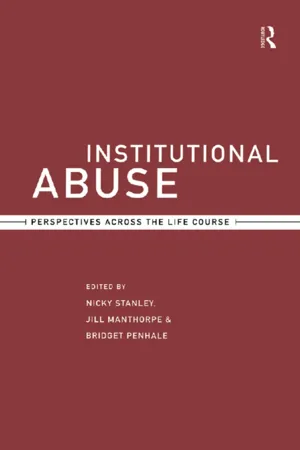
eBook - ePub
Institutional Abuse
Perspectives Across the Life Course
- 256 pages
- English
- ePUB (mobile friendly)
- Available on iOS & Android
eBook - ePub
About this book
Information
1 The institutional abuse of children
An overview of policy and practice
Nicky Stanley
The abuse of children in residential settings has sprung to the fore of public consciousness in the 1990s through a series of inquiries and court cases that have been reported in detail by the media. The press and television coverage has served to bring the often vivid testimonies of those who experienced abuse in places where they might have expected to feel safe to the attention of a large audience, and has exposed both local authorities and voluntary organisations to the charge of failing to protect those most in need of care. The identification of residential care as a locus for the abuse of children has led to a crisis of confidence that is not confined to residential services for children, but has spread to embrace child protection services as a whole. The Government has responded to this crisis with a series of policy initiatives backed up by exhortations to social services departments and local politicians to meet identified targets (Secretary of State for Health 1998; Department of Health 1998a). At the level of practice, concerns about abuse in out-of-home-care settings can have the effect of making the use of care orders seem as risky a strategy as leaving children in abusive home situations.
Not only has public confidence in the capacity of residential care to protect children been undermined, but the whole concept of institutional care for children appears alien to the current orthodoxy of child care theory. The Children Act, 1989 explicitly identifies ‘normal family life’ (Department of Health 1989:8) in the birth family as the ideal system of care, and places duties on local authorities to promote the care of children by their families. Gooch points out that the decline in the popularity of residential care for children has a long history and argues that residence has long been a ‘pragmatic’ rather than an ideological response to poverty (Gooch 1996:25).
In the absence of a supportive ideology, residential care for children, long characterised as a poor relation, has become an increasingly marginalised service and the influential Government review, People Like Us (Utting 1997), notes the shrinkage of places in residential homes from 40,000 children in 1975 to 8,000 in 1995. This sharp drop is explained in part by an overall reduction in the numbers of children looked after by English local authorities but also by the development of foster care services, which have suffered only a slight decrease in numbers by comparison (Berridge 1997). However, it is also important to recognise the phenomenon of the increasingly fast turnover of places in residential homes. Berridge and Brodie’s (1998) two-part study of children’s homes allows for a comparison of the characteristics of two sample populations with a ten-year gap between them. They found a reduction in the average length of stay in the current home from nearly two years in 1985 to ten months in 1995. While the average length of stay in care had dropped significantly between the two samples, the children in the 1995 sample were still experiencing multiple placements, with adolescents being particularly likely to have had more than one residential placement (Berridge and Brodie 1998). Berridge and Brodie also note that a sixth of the total population of children’s homes are placed there on respite care. While the number of places in residential homes have clearly shrunk dramatically, large numbers of children are passing through them.
Boarding schools now represent the largest form of institutional provision for children with 110,000 places in England and Wales in 1996 (Utting 1997). Eighty thousand of these are in independent boarding schools where children have been placed by their parents’, if not their own, choice. The remaining places are mainly in boarding schools for children with special needs, the majority of whom are placed there by local authorities. While the number of children boarding in independent schools has declined significantly over the last twenty years, the reduction is less steep in the number of places in special boarding schools. Gooch (1996) argues that the underlying trend behind these changes is a shift to children entering boarding school at a later stage so that boarding in special schools is now virtually confined to children of secondary-school age. He notes also the success of the independent day schools in mounting a challenge to the hegemony of the independent boarding school. However, Utting (1997) points out that, in respect of special boarding schools, the numbers in local authority and voluntary establishments (which together provide 84 per cent of the sector) have changed little in recent years and are unlikely to do so.
This chapter will focus primarily on institutional care in children’s homes, since it is this sector that has given rise to most of the accounts of abuse. The number of children accommodated in secure units is small: 246 at March 1996 (Utting 1997). However, such units, which are run by local authorities for children likely to cause serious injury to themselves or others, are of particular importance when the issue of bullying is under discussion. Boarding schools have also been the subject of some major inquiries and the children in special boarding schools might be considered particularly vulnerable to abuse. Utting (1997) comments on the lack of evidence concerning children in adolescent and mental health units. While Westcott (1991a) has usefully collated some of the American research into the institutional abuse of children, much of the evidence in the United Kingdom is derived from inquiry reports although ChildLine’s telephone line service has produced an impressive series of accounts from children themselves (see Chapter 2 in this volume). This chapter will discuss some of the major inquiries and reviews before looking in more detail at the current nature of institutional care for children. A number of issues arising from accounts of institutional abuse will be considered; these will cover, first, aspects of abuse and, second, responses to institutional abuse.
Inquiry reports and reviews
Over the last ten years a pattern has emerged whereby the public outrage evoked by media reporting of cases of institutional abuse is assuaged, first, by an inquiry into the institution concerned and, second, by a Government review providing a broader context for the inquiry and recommending new policy initiatives. The Pindown Inquiry attracted a high level of public attention and the inquiry team were appointed in the immediate wake of a Granada Television programme in 1990 that featured the system used to control children in a number of residential homes in Staffordshire in the 1980s. The inquiry report (Levy and Kahan 1991) provides detailed accounts of ‘Pindown’ that entailed the isolation of children, the removal of their clothes and personal possessions, and the loss of direct access to education, leisure and hygiene facilities. The architect of the system, which appears to have been based on a very crude understanding of behavioural programmes, was Tony Latham, a trained social worker who rose to the position of Area Manager in the social services hierarchy. His methods were readily adopted by those who worked in institutions that he managed and were open to scrutiny by managers who found nothing to criticise.
The inquiry report was unequivocal in judging the ‘isolation, humiliation and confrontation’ of children that Pindown entailed to be ‘intrinsically unethical, unprofessional and unacceptable’ (Levy and Kahan 1991:127). Middle management was heavily criticised in the report and, as well as a number of procedural recommendations, issues concerning staffing policies, supervision and training for basic-grade workers were given prominence.
The inquiry report resulted in the Government commissioning Sir William Utting’s first review of residential childcare. This review, Children in the Public Care (Utting 1991), was confined to England, but companion reviews were undertaken in Wales (Social Services Inspectorate, Wales and Social Information Systems 1991) and Scotland (Skinner 1992). These reviews acknowledge residential care’s role as a residual service: Utting’s definition of the task of residential homes for children makes it clear that the main role of the service is to back up foster care. Residential care’s purpose is to provide a home for children who
- have decided that they do not wish to be fostered;
- have had bad experiences of foster care;
- have been so abused within the family that another family placement is inappropriate;
- are from the same family and cannot otherwise be kept together.
(Utting, 1991:8)
The review of children’s homes in Wales was even more explicit in describing residential care for children as ‘a marginal unspecific activity taking those whose needs the rest of the system fails to meet’ (Social Services Inspectorate, Wales and Social Information Systems 1991:11). This report proposed that a clear distinction should be made between homes for children displaying challenging behaviour and homes for those whose need for residential care was based on circumstance rather than behaviour. While confirming that residential care for children was in decline, Utting asserted that residential care was, nevertheless, an ‘indispensable service’ (Utting 1991:62) and a similarly revivalist tone is discernible in the Scottish review’s argument that residential childcare should be seen as ‘a positive means of meeting the needs of particular children, not simply as a last resort’ (Skinner 1992). Kahan, in Growing Up in Groups (1994), a publication that sprang out of an interprofessional working group that aimed to define good practice, identifies a call to reintegrate residential child care into mainstream services as a common message of all three reviews.
In 1991 Frank Beck received five life sentences for sexual and physical assaults against children in homes in Leicestershire between 1973 and 1986. These included offences of buggery and rape. The inquiry chaired by Andrew Kirkwood QC reported in 1993 and found that many complaints had been made over a number of years concerning physical and sexual assaults, and the ‘regression therapy’ practised by Beck and his staff. This ‘therapy’ involved the humiliation and aggressive confrontation of children in order to provoke angry tantrums that were responded to with physical restraint. The report attributes the failure of social services managers to respond to these complaints to ‘A general predisposition not to believe children’, an ‘out of sight, out of mind’ attitude and a fear of challenging Beck on the grounds of his claims to expertise and to the irreplaceability of his service (Kirkwood 1993:312).
Both Pindown and the regime promoted by Beck provide illustrations of the way in which theoretical labels and concepts were used to confer credibility and intellectual respectability on abusive practices. It seems as though a few vague references to theoretical models, derived in the one case from learning theory, in the other from the psychoanalytic tradition, were sufficient to reassure managers and other professionals (which in Beck’s case included psychiatrists) that the radical model of care employed constituted sound and effective practice. Social work’s relationship to theory has always been problematic and the translation of psychological theory into social work practice has at times entailed crude appropriation rather than informed application of complex theoretical models. However, as Payne (1997) notes, the theoretical base of residential social work is particularly undeveloped by comparison with other forms of social work and much of the residential care literature is pragmatic rather than theoretical in its approach. This theoretical vacuum allows pseudo-theories to go unchallenged. The Kirkwood report also stresses the lack of childcare expertise and knowledge among Beck’s managers.
The committee of inquiry, established by the Secretary of State for Health in response to the conviction of Beck, reported before the inquiry report was published. Chaired by Norman Warner, the committee’s remit centred on staff selection and recruitment but also embraced management and other issues. The report was also able to draw on the findings of the inquiry into Ty Mawr Community Home in Gwent (Williams and Macreadie 1992) that were published shortly before the committee reported. At Ty Mawr, the adolescent male residents appeared to be out of control and there were a worrying number of suicide attempts and incidents of self-harm. This report had drawn attention to the largely unqualified nature of the staff and identified the inappropriate involvement of elected members in the appointment of staff. The Warner report, Choosing With Care, identified ‘low self-esteem’ as a problem both for the residential sector and for the staff working there, and argued that ‘Children’s homes now need their place in the managerial sun’ (Warner 1992:8). The report outlined a new, comprehensive strategy for the training of staff in residential care which would embrace all levels of staff, not just officers-in-charge. The emphasis was to be on workplace-based training that would be identified and monitored through a Personal Development Contract. Warner also questioned the relevance of the traditional Diploma in Social Work curriculum for residential social work and proposed the introduction of a new diploma. The report made detailed proposals on recruitment, selection and appointment procedures for staff in residential settings.
In response to the Utting and Warner Reports, the Department of Health launched a number of initiatives that included the long-awaited review of pay in residential care (Local Government Management Board 1992) and the establishment of the Department of Health Support Force for Children’s Residential Care. Measures were introduced to increase the number of professionally qualified staff in children’s homes and progress was made towards defining quality standards for residential child care (Central Council for Training in Social Work [CCETSW] and Department of Health Expert Group 1992). The Government also commissioned a series of research studies into the management and practice of residential childcare, a number of which are reported on below. However, public attention since 1993 has shifted from the issue of the abusive regime to the question of the sexual abuse of children in residential settings by individuals labelled as career paedophiles.
Frank Beck remains the most notorious of these cases but the Kirkwood report had been preceded by the publication of the inquiry into the sexual abuse of children by Ralph Morris, head of Castle Hill School, a non-maintained special school in Shropshire (Brannen et al. 1992). This inquiry report was published, at the suggestion of the Departments of Health and Education, as a guide to good practice in such investigations. As with Beck, a number of complaints made by children from the school against Morris met with no response and the report made various recommendations concerning complaints procedures. The independent educational status of Castle Hill raised issues concerning registration and inspection procedures as well as the question of the use of the institution for placements by several different local authorities.
Since 1993, there have been a number of cases of abuse of children in institutional settings that have come to the public attention through media coverage of the investigations and trials of individuals, rather than through publications of inquiry reports. These cases have been based on allegations of abuse from adults against those who cared for them in the past. The majority of these cases have involved sexual assaults on boys and a string of convictions have resulted from a proactive police approach which has involved police forces in different parts of the United Kingdom seeking out and interviewing potential victims subsequent to an initial allegation. The investigations have identified a string of men who have been found guilty of sexually assaulting children they cared for in a number of institutions during their careers. While some of these individuals worked in the same institutions, there has as yet been no convincing evidence of ‘organised abuse’. The scale of the abuse identified, that occurred in children’s homes and schools in Merseyside, Cheshire, North Wales, South Wales, Doncaster and Sunderland, has been such as to prompt the comment in a broadsheet newspaper that:
It is now clear that during the last 30 years, children’s homes in Britain suffered an epidemic of rape and violent assault.(Davies 1998:6)
The cumulative effect of this recent series of cases has been to shift the focus away from abusive regimes to a focus on the detection and control of individual paedophiles.
At the time of writing, the publication of the report of the North Wales Tribunal is imminent. The Tribunal, which sat from 1997 to 1998 under the chairmanship of Sir Ronald Waterhouse QC, was set up by Parliament in response to dissatisfactions with internal local authority inquiries and investigations. Seven men had already been convicted of offences against children in residential homes and schools in Clwyd and Gwynedd; these cases and allegations connected with them involved 650 complainants identified by the police. As a counterbalance to some of the criticisms made of police methods that relied on seeking out incriminating evidence from adults who stood to benefit from compensation claims and who themselves might have criminal convictions (Webster 1998), the Tribunal has traced and interviewed a random sample of former residents, some of whom have voluntarily added to the accounts of abuse experienced in the homes under consideration.
The Department of Health, however, had already responded to the increasing number of cases of abuse of children in out-of-home-care by commissioning a second review from Sir William Utting. The publication of People Like Us: The Report of the Review of the Safeguards for Children Living Away from Home in 1997 can be seen as an attempt to reassure the public at a point when the image of institutional care for children had sunk to an all-time low. Many of the messages of the review reiterate the themes of earlier reports; for instance, Warner’s recommendation that the Government establish a Development Action Group for residential care for children is revived by Utting. This proposal has finally been translated into Government policy with the announcement of a Ministerial Task Force (Secretary of State for Health 1998) that will monitor the programme of action conceived in response to People Like Us. Utting’s 1997 review includes a focus on career abusers and a concern about the low rate of convictions in cases of child sex abuse, and the review recommends the full implementation of the Advisory Group on Videorecorded Evidence (1989) on video evidence as well as a general review of the current arrangements for the prosecution of alleged sex offenders against children. Utting also argues strongly that the current level of provision in residential childcare has shrunk to the point where a child’s safety cannot be assured as there is no choice of placements available, and the Social Services Inspectorate (SSI) report, Someone Else’s Children (1998) reiterates the theme of limited placement choice. However, it may be misleading to argue that more places will result in a choice of placements being available. The high cost of places in residential care tends to have the effect of ensuring full occupancy in institutions. Sinclair and Gibbs (1998) find no reason for increasing the size of residential care provision for children and maintain that, as the main argument for residentia...
Table of contents
- Cover Page
- Title Page
- Copyright Page
- Tables
- Contributors
- Foreword
- Introduction
- 1 The institutional abuse of children
- 2 The abuse of children in institutional settings
- 3 Independent investigations into institutional child abuse
- 4 Abuse of people with learning disabilities
- 5 Users’ perceptions
- 6 The abuse of adults in mental health settings
- 7 Institutional abuse in mental health settings
- 8 The abuse of older people in institutional settings
- 9 The abuse of older people in institutional settings
- 10 The abuse of older people in institutional settings
- 11 Conclusion
Trusted by 375,005 students
Access to over 1.5 million titles for a fair monthly price.
Study more efficiently using our study tools.
Frequently asked questions
Yes, you can cancel anytime from the Subscription tab in your account settings on the Perlego website. Your subscription will stay active until the end of your current billing period. Learn how to cancel your subscription
No, books cannot be downloaded as external files, such as PDFs, for use outside of Perlego. However, you can download books within the Perlego app for offline reading on mobile or tablet. Learn how to download books offline
Perlego offers two plans: Essential and Complete
- Essential is ideal for learners and professionals who enjoy exploring a wide range of subjects. Access the Essential Library with 800,000+ trusted titles and best-sellers across business, personal growth, and the humanities. Includes unlimited reading time and Standard Read Aloud voice.
- Complete: Perfect for advanced learners and researchers needing full, unrestricted access. Unlock 1.5M+ books across hundreds of subjects, including academic and specialized titles. The Complete Plan also includes advanced features like Premium Read Aloud and Research Assistant.
We are an online textbook subscription service, where you can get access to an entire online library for less than the price of a single book per month. With over 1.5 million books across 990+ topics, we’ve got you covered! Learn about our mission
Look out for the read-aloud symbol on your next book to see if you can listen to it. The read-aloud tool reads text aloud for you, highlighting the text as it is being read. You can pause it, speed it up and slow it down. Learn more about Read Aloud
Yes! You can use the Perlego app on both iOS and Android devices to read anytime, anywhere — even offline. Perfect for commutes or when you’re on the go.
Please note we cannot support devices running on iOS 13 and Android 7 or earlier. Learn more about using the app
Please note we cannot support devices running on iOS 13 and Android 7 or earlier. Learn more about using the app
Yes, you can access Institutional Abuse by Jill Manthorpe,Bridget Penhale,Nicky Stanley in PDF and/or ePUB format, as well as other popular books in Social Sciences & Health Care Delivery. We have over 1.5 million books available in our catalogue for you to explore.