eBook - ePub
Early Years Play
A Happy Medium for Assessment and Intervention
- 128 pages
- English
- ePUB (mobile friendly)
- Available on iOS & Android
eBook - ePub
About this book
First Published in 2000.This book provides a description and analysis of play and its use in helping young children to reach their potential. It is especially for professionals working with young children with special educational needs and from a range of cultural and linguistic backgrounds. It is also an appropriate text for interested parents. The authors have sought to make sense of play from theoretical and practical sources to promote an interactive perspective. Included in the book is the authors' model of Play Based Assessment, a framework that can be used to assess and mediate children's learning and development.
Information
Chapter 1
They’re Only Playing
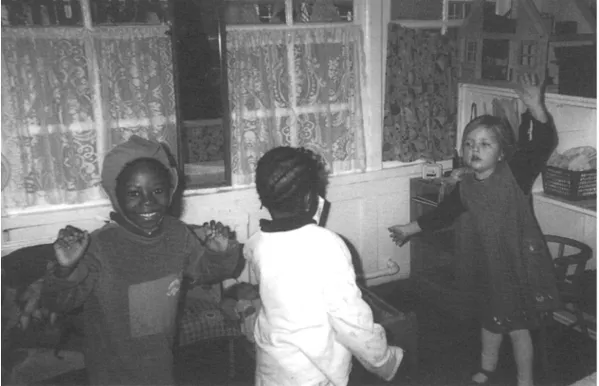
Figure 1.1 They’re only playing
Man only plays when he is in the fullest sense of the word a human being and he is only a fully human being when he plays.
Schiller (in Sutton-Smith 1985. p.64)
The word ‘play’ conjures up images of laughter, enjoyment, indulgence and sharing. For adults play is an optional and conscious activity where leisure-time is used to balance the trials and tribulations of everyday modern living. In the case of children play is an essential and integral part of their existence which constitutes a right. If it is accepted that play is central to the life of a child then as adults we must ask how well we understand play, and how much we value play for our children. Although much has been written on the subject of children’s play this anomaly continues to pose challenges for parents, professionals and wider society that generally recognise its importance but struggle to find a place for play. The authors will endeavour to explore the meaning of children’s play and locate it in a context where it can be valued and understood.
Views of Play
It is generally known that children’s play permeates the boundaries of race, colour, language, religion and culture, but if this the case what is to be understood by this enigmatic concept? The Oxford English Dictionary very simply defines play as occupying oneself in a game or other recreational activities. Early definitions are as relevant today as they were in the past. In his book Homoludens, Huizinga (1949) described play as a voluntary activity or occupation executed within fixed limits of time and place, having its aim in itself and accompanied by a feeling of joy and consciousness that is ‘different’ from ordinary life. His definition usefully outlines the purpose, process and product of play. Deardon (1967 p. 84) emphasises the emotional benefit of play for the child. Play is a non-serious and self-contained activity which we engage in just for the satisfaction involved in it’. Matterson (1975) extends this idea to describe how a child learns what no one else can teach him/her. She describes play as providing a context where the world is presented in a manageable form where quantities are controlled. Play can include fictional situations and relationships with others where learning can take place. Christie (1991) attaches more value to the process of play than the product. Play behaviours are described as flexible, creative, voluntary and pleasurable. They must be self-motivated and focus on means rather than ends and are at times abstract.
From the literature it quickly becomes apparent that the concept of childhood play varies enormously. Research is based largely on observations of the players (children) by non-players (adults) as the players are not generally expected to be able to describe what they are/were doing while they are/were engaging in play. Indeed the complexities of play as evident from the rules, sanctions, exceptions and adaptations made by children in the play situation are prone to misinterpretation by adult onlookers. As in every situation, observers are prone to interpretations based in their own attitudes, thoughts, memories and experiences. For adult observers there is often the sense that if one is not a player then one cannot really understand the dynamics of the play situation. In the words of Winnicott (1971 p. 60), ‘the child inhabits an area that cannot be easily left nor can it easily admit intrusions’. This makes the role of the adult observing or participating in a child’s play a challenging one.
The contextualised nature of what constitutes play is confusing and misleading. Play can take place anywhere (home, school, on the street, in the local playground, etc.). Essential to play is the child’s feeling of security, a desire to play and the ability to play. Play materials are important but not essential for play to take place.
There are several discrepancies and contrasting views of play in the literature. Although a definition of play is important this does not mean that a single definition is necessary or easy to attain. It has been suggested that play should be viewed in terms of its attributes rather than an all-embracing definition but there is as much variation in the range of suggested attributes as differing definitions. However challenging, it does seem worthwhile to embrace the definitions, characteristics and types of play in order to provide the fullest picture of this phenomenon and offer the authors’ perspective in these areas.
In the existing literature definitions of play tend to fall into two categories:
- What the child does and what changes take place within the child while playing. Rubin et al. (1983) describe play as intrinsically motivated as opposed to being imposed or led by others. Play is concerned with the means and not the outcome. It is free from external rules and the child is engaged in a non-serious activity. Their views of play are process-led.
- What the child gets out of the play situation. Isenberg and Jacobs (1982) defined play as children’s work and how they learn about the world around them. Their view of play is product-led.
Process-Led Descriptors of Play
- Intrinsic motivation: The child engages voluntarily in the act of playing.
- Enjoyment: Play is a positive and pleasurable experience for the child.
- Learning: Play facilitates the learning process.
- Happiness: Play gratifies the child, fulfilling his/her emotional needs.
- Development: The child’s level of development is demonstrated through play and his/her levels of functioning can be assessed and enhanced through play experiences.
- Interaction: Through play the child interacts with the environment including people and objects.
- Context/time/space: The play process occurs in a supportive environment and within limits of time and place.
Product-Led Descriptors of Play
- Thinking: Play offers an opportunity for the child to apply his/her existing thoughts and extend his/her thinking skills.
- Motor activity: Most play activities involve a child being physically active and use of his/her physical energy in order to develop skills for the future.
- Behaviour: Play is an observable response to stimuli such as play materials and activities.
- Preparation for the future: Play allows the child to develop skills and knowledge for later life.
In order to gauge an impression of views held by parents and professionals a short study was conducted by the authors in 1996, using a small sample of nursery staff and parents in Tower Hamlets, London. Their descriptions of play came under the following headings:
- Exploratory
- Communicative
- Enjoyable
- Sociable
- Educational
- Imaginative.
One member of nursery staff defined play as ‘exploration - finding out about the world, practising skills in an exciting, stimulating and non-threatening environment’. In response to the question ‘what do you mean by play?’, a parent responded learning about the world and having fun’.
In 1999 a structured interview was administered to ten sets of parents of nursery children in order to ascertain their view of a child’s play. When asked Tell me what you understand by children’s play’, responses such as using his/her imagination and enjoying him/herself were most commonly cited. Similarly when asked ‘What does your child do when he/she plays?’, 50 per cent of the parents referred to ‘pretending’ and 40 per cent referred to imitative play. The abstract and complex nature of children’s play was very prevalent in the responses given and indicated high levels of awareness and sensitivity on the part of parents. However, as is the case among educationalists and other professionals, the types of play cited as play behaviours have different meanings for different people. This has direct implications for the kind of learning and development encouraged among children at home and in educational settings.
A small-scale study to elicit the views of educational psychologists in training was carried out during the authors’ lecture visits to four UK training courses in 1998. Groups of two to four students, all of whom were ex-teachers with a minimum of two years of teaching experience, were given five to ten minutes to arrive at definitions of play. Their definitions included the following:
- ‘A voluntary form of recreation in which an individual may develop cognitive, creative, social and emotional skills.’
- ‘An active interaction with your environment and with others.’
- ‘Play is an interactive exploration of the environment. It is self-motivating, absorbing, enjoyable and intrinsically rewarding. It can be a powerful medium for learning.’
- ‘A process by which individuals are able to express themselves and develop a range of cognitive and social skills by interacting with their environment and/or other individuals.’
- ‘Play is essential to healthy growth and development. It should be an enjoyable experience within which the child can learn through exploration and discovery, gaining a range of social, cognitive and physical skills.’
- ‘Play is a fun way of learning life skills. It allows a child freedom of expression, a sense of control, modelling what they have seen, repeating favourite activities and elaborating their ideas.’
- ‘An external representation of internal understanding of life experiences and the world.’
- ‘Manifestation of inner world into external reality.’
The five most commonly cited attributes of play in the definitions were as follows:
Table 1.1 Attributes of play within definitions
| Exploratory | Skill-enhancing |
| Enjoyable | Sociable |
| Educational |
Interestingly, the definitions provided by this group have striking similarities with those offered by parents and nursery staff as well as the definitions available in the literature. Fundamentally this would suggest that there are common understandings of play but disparate descriptions do not seem to encompass play in its entirety.
In the authors’ view, play can be defined in terms of its overt and assumed characteristics. A child’s play is elicited in response to a person or object in a context where he/she feels secure. Over time the child expends physical and mental energy for pleasure through the application of skills such as improvisation and creativity. As a state, play assumes absorption, concentration and an escape to a world that the child creates for him/herself individually or as part of a group (Sayeed and Guerin 1997 p. 46).
The provision of a safe environment with adequate space and time is crucial to meaningful play.
Attributes of Play
Features of play are often cited in order to get around the difficulty of providing a neat, all-encompassing definition. The authors accord with Catherine Garvey (1991) who described the following attributes of play:
- Play is pleasurable and enjoyable
- Play has no extrinsic goal
- Play is spontaneous and voluntary
- Play involves some a...
Table of contents
- Cover
- Half Title
- Title Page
- Copyright
- Contents
- Dedication
- Foreword
- Acknowledgements
- Preface
- 1. They’re only playing
- 2. Do we really understand children’s play?
- 3. Play – culture-free or culture-biased?
- 4. Play and emotions: raising awareness of the relationship between children’s play and emotional development
- 5. Play in the SEN arena
- 6. Play-based assessment
- 7. Mediated learning experiences and play
- 8. Bridging the gap between assessment and intervention through play
- 9. Final thoughts
- Bibliography
- Index
Trusted by 375,005 students
Access to over 1.5 million titles for a fair monthly price.
Study more efficiently using our study tools.
Frequently asked questions
Yes, you can cancel anytime from the Subscription tab in your account settings on the Perlego website. Your subscription will stay active until the end of your current billing period. Learn how to cancel your subscription
No, books cannot be downloaded as external files, such as PDFs, for use outside of Perlego. However, you can download books within the Perlego app for offline reading on mobile or tablet. Learn how to download books offline
Perlego offers two plans: Essential and Complete
- Essential is ideal for learners and professionals who enjoy exploring a wide range of subjects. Access the Essential Library with 800,000+ trusted titles and best-sellers across business, personal growth, and the humanities. Includes unlimited reading time and Standard Read Aloud voice.
- Complete: Perfect for advanced learners and researchers needing full, unrestricted access. Unlock 1.5M+ books across hundreds of subjects, including academic and specialized titles. The Complete Plan also includes advanced features like Premium Read Aloud and Research Assistant.
We are an online textbook subscription service, where you can get access to an entire online library for less than the price of a single book per month. With over 1.5 million books across 990+ topics, we’ve got you covered! Learn about our mission
Look out for the read-aloud symbol on your next book to see if you can listen to it. The read-aloud tool reads text aloud for you, highlighting the text as it is being read. You can pause it, speed it up and slow it down. Learn more about Read Aloud
Yes! You can use the Perlego app on both iOS and Android devices to read anytime, anywhere — even offline. Perfect for commutes or when you’re on the go.
Please note we cannot support devices running on iOS 13 and Android 7 or earlier. Learn more about using the app
Please note we cannot support devices running on iOS 13 and Android 7 or earlier. Learn more about using the app
Yes, you can access Early Years Play by Zahirun Sayeed,Ellen Guerin in PDF and/or ePUB format, as well as other popular books in Education & Early Childhood Education. We have over 1.5 million books available in our catalogue for you to explore.