- 113 pages
- English
- ePUB (mobile friendly)
- Available on iOS & Android
eBook - ePub
Creativity and Innovation for Managers
About this book
Creativity and Innovation for Managers will appeal to any manager responsible for getting more out of a business. Creative thinking, creative problem solving and creative idea generation have become essential business drivers. This book provides an excellent executive briefing for senior management to understand what business creativity is, how it can benefit the company, and how to get the most out of it. It looks at the pitfalls on the road to innovation and the ways to avoid them, pulling together the experiences of key practitioners in the field both in the UK and the US.
By concentrating on the essentials, Creativity and Innovation In Brief is a waffle-free approach to creativity, providing a quick action focused and accessible insight into a complex topic.
It provides;
- a practical approach to business creativity without the hype;
- an agenda for making innovation happen in your business
- a real world view.
Chapter 1
Innovation in brief
An overview of what creativity and innovation is, and what it can do for you, at both individual and company levels. This chapter explores ways to enhance creativity, and concludes with maps of the rest of the book.
What are creativity and innovation?
‘More than a few of today’s [management] theories actually imply strangling creativity and suppressing zest at a time when they’ve become the prime creators of economic value.’ Torn Peters, business writer and consultant
Creativity and innovation are words that you cannot avoid. Whether you are listening to an arts programme on the radio, a politician urging a state service to get more done with less money or a keynote speech at a business conference, you will hear ‘creativity’ and ‘innovation’ bandied about. In practically every case, creativity will be seen as something good, something to be desired. Perhaps only when it comes to accounting is creativity a dirty word. Yet creativity and innovation are classic examples of concepts that everyone has a feel for but few can actually describe.
One of the problems with defining creativity is that it is not a single thing. Arthur Koestler, a key thinker in the development of an understanding of creativity, divides the creative process into three different persona: the jester, the sage and the artist. The artist represents the most traditional picture of creativity, whether composing music, writing or working in the visual arts. The sage has traditionally been the scientific and philosophical thinker, the picture of creativity which has most influenced business, typified by the sudden explosion of a new idea. The jester provides an aspect of creativity with which neither art nor business are truly comfortable. Both the arts and business take themselves very seriously, often to the extent of appearing pofaced. Yet humour is a powerful weapon for creativity. The persona Koestler chose here is very apt – the court jester was the only one who could question the decisions of the monarch, but by doing it with humour he managed to make a practical point and avoid causing offence.
From a business viewpoint, all three of Koestler’s persona are important in defining creativity. From the origins of the words themselves, innovation would seem to be about newness, while creativity is about bringing something into being. A business that is to reap the benefits of creativity needs the humour of the jester to challenge the way things have always been done, the inspiration of the sage to come up with new products and services and to crack difficult business problems, and the clarity of view of the artist to refine the ideas and ensure a good fit with the real business.
Arguably there is a subtle difference between creativity and innovation. Harvard Business School’s Theodore Levitt defined creativity as thinking up new things, while innovation was doing new things, but this does not really match the common usage of the words. Often, innovation is applied to idea generation (presumably because of its roots in ‘newness’), particularly around products, while creativity incorporates both innovation and the task of problem-solving. Of course it is never that simple, as arguably creative problem-solving is all about generating new ideas (to solve problems), and idea generation is simply solving the problem of getting a new idea (or product or whatever). In this book the two terms will be used interchangeably with no particular weighting intended.
What can innovation do for my company?
‘Now here, you see, it takes all the running you can do, to keep in the same place. If you want to get somewhere else, you must run at least twice as fast as that.’ Lewis Carroll, Through the looking Glass
The simple fact is that innovation can make the difference between survival and disaster. We live in a world of technological upheaval and business turmoil. The influences on business success have never been more complex. Whether your company is being buffeted by a recession halfway around the world or challenged by an unexpected newcomer, there is no room for complacency.
Competition, growing customer expectations, global/local considerations, changing workforces, exploding information resources – a barrage of business problems and imperatives, each demanding a fresh idea. Change is ever present, and it is not going to go away; it is going to get faster. There is no returning to the old days. Turmoil is not a temporary hitch in an otherwise smooth business environment, it is the business environment. If you can make your company innovative, you have the best possible chance of riding those business problems, coming up with great new products and services, countering the competition and surprising your customers by exceeding, not just meeting, their demands. If you can keep your company innovative – even more of a challenge – you can maintain this position of stability in a world of turmoil. Of course it is not the old sort of stability where nothing ever changes. This is the new stability where change is a constant, the stability of a gyroscope on a pitching platform, keeping the company on the level while everything moves around it. The quote from Lewis Carroll at the start of this section is probably the most quoted extract from a hugely quoted book, yet the Red Queen’s remark has never before been quite so accurate.
Doing it differently
The Italian clothing firm Benetton is often in the news for its daring advertising, but this inclination not to run with the herd should not be a surprise. Benetton became a success by doing things differently. Ignoring the traditional approach of following fashion trends, Benetton decided to follow their customers. By producing neutral coloured clothes, then dyeing them afterwards, Benetton could react incredibly quickly to customer demand. Benetton shops are oriented to colour – even their advertising stresses this.
Benetton’s example is a good one, because creativity actually created a new gap in a highly competitive marketplace. Of course one good idea will not last a business a lifetime. If Benetton is to remain successful, it will need a steady flow of new ideas. This is one of the prime benefits of systematic creativity – moving from good ideas as an occasional random occurrence to good ideas as the outcome of a simple, predictable process.
The benefits of innovation continue at the micro level. In a company where creativity is not actively encouraged, front-line employees will feel restrained by the system. They will not offer the best customer service because it will be ‘more than my job’s worth’. They will follow the rules. The trouble is, that great customer service is about going outside the rules where necessary. Of course there have to be guiding principles, but front-line staff need the discretion to vary from the norm to satisfy a customer. If creativity is accepted as a fundamental tenet of the company, the staff will do whatever is required to get the job done – a whole different world to the traditional approach to work. Best of all, it is win-win-win. The company does better, the customer is happier and the employees get more out of their jobs.
What does innovation mean for me?
‘No matter what business you’re in, your future will be shaped, even determined by innovation occurring today.’ Michael Michalko, creativity consultant
Creativity and innovation are just as important at a personal level as they are for the company as a whole. There are very few business occupations where a level of creativity is not important. Occasionally the nature of the job means that such creativity has to be very specifically channelled – an airline pilot would not be thanked for devising innovative ways of flying a plane – but the time when it was possible to have a ‘solid’ career by being unimaginative are gone.
Making your company more creative gives it a better chance for success; making yourself more creative enhances both your career prospects and your potential for enjoyment of what you are doing. Innovation is no longer optional.
It may be that you already consider yourself a very innovative person. If so, there is always room for improvement. It may be, on the other hand, that you think of innovation as being the remit of someone else, the ‘creatives’ who you take out of their box, point at a problem, get a solution and then tidy away again before they can do any damage. Such an approach may have been good enough in the past, but it will not be in the future. Creativity is not a side issue, it is a central tenet of business survival.
Can we do anything about it?
‘Business creativity makes the difference between success and failure. It is needed both in finding new ways to earn revenue and in finding new ways of cutting costs. It is the spur to meeting one’s core business goals. It is the fuel additive that powers the engines of industry to peak performance.’ Keith Rapley, Innovation Manager, British Airways
The requirement for creativity may be solidly established, but the knowledge of this is nothing more than an irritation if there is no vehicle for delivering creativity. For a long time it was assumed that creativity was something an individual was born with. The only way to get creativity into a company was to go out and buy it. Fortunately, while it is certainly true that individuals have vastly differing levels of creativity, anyone can have their creativity enhanced to a considerable extent. Since the 1960s a range of techniques have been developed to improve individual and group creativity. Combined with a new approach to institutionalizing innovation, these techniques can transform a company’s innovative potential.
This book does not aim to make you an expert in these creativity techniques. There are plenty of other books on the market to do that – see Chapter 10 for more details. However, a knowledge of what the techniques are and what they can do, combined with a consideration of the way that an organization can change to make creativity a central part of its culture and operation are essentials to making something happen.
The maps
‘Where you stumble, there your treasure lies.’ Joseph Campbell, writer on myth and ancient wisdom
This book has a contents section, so why bother with anything more? Figures 1.1 and 1.2 are maps to the book – the first arranged by concept, the second the structure of the book itself. Like any business book, it is liable to be dipped into as much as it is read through from cover to cover. These maps will help with that dipping.
Content by concept
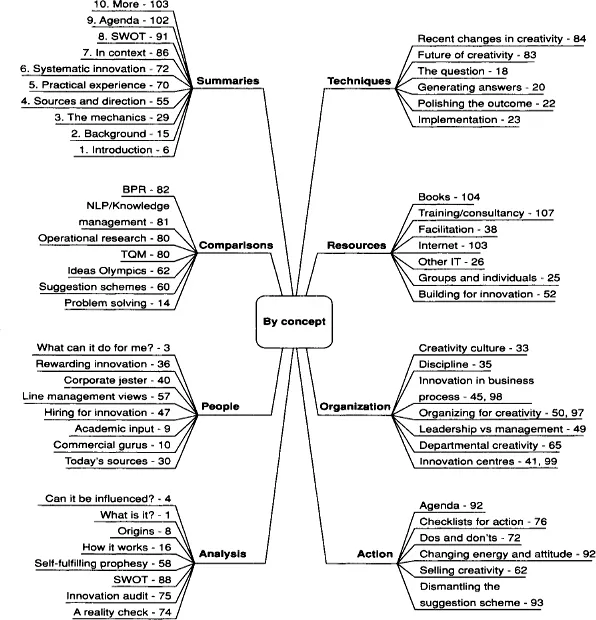
Figure 1.1 Content of book by concept
Content by chapter
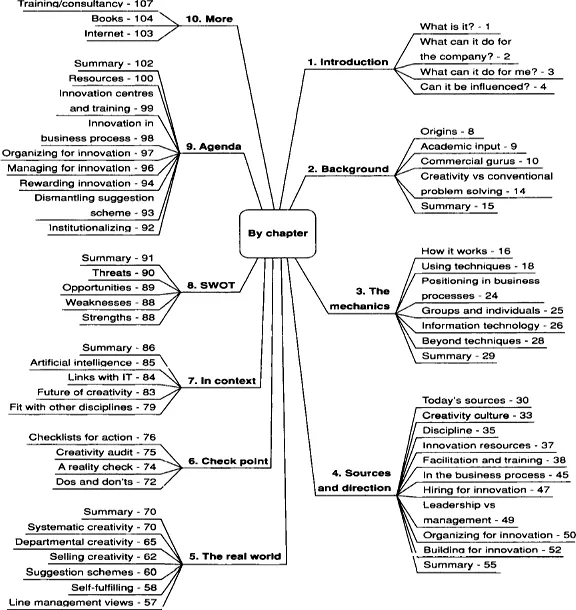
Figure 1.2 Content of book by chapter
Chapter 2
Innovation
emerges
emerges
This chapter looks at the origins of creativity in a general sense, and the specifics of business creativity. It considers how the work of the pioneers was given a commercial workover by gurus like Edward de Bono and Roger von Oech. It examines the differences that establish creativity as a separate discipline from traditional problem-solving.
The birth of creativity
‘Looking at the brain’s structure of axons and neurons, one can imagine that new ideas are combinations of existing ones.’ Chon Bok – developer of the Axon Idea Processor
Where did creativity come from? This is a bit like asking how long is a piece of string. As long as there have been people, there have been creative people and there has been creativity. Equally, that creativity has been applied both to what could loosely be described as art and what might be thought of as ‘practical’ creativity – the forerunner of business creativity – innovation with a specific, beneficial end in mind, rather than creativity for its own sake.
At any time in history there have been creative people around. Whether we consider Archimedes’ leap of imagination in the bath, the elegant solutions to the combination of space and weight that marked the medieval stonemason’s craft, Leonardo da Vinci’s eclectic skills or the vast outpouring of Victorian ingenuity, creativity has been a common thread. Until the 1900s, though, creativity has been very much thought of as a gift. An inherent ability, rather than something that could be taught or improved on. As with so many other things, the legacy of the twentieth century has been to put the assumptions of the past into a different perspective.
The academics arrive
‘If at first the idea is not absurd, then there is no hope for it.’ Albert Einstein
Throughout the twentieth century, scientists and philosophers struggled with the nature of thought and mind. But the breakthrough as far as business creativity was concerned was the work of Alex Osborn. Osborn took creativity away from the theoreticians and moved it into applied science. Osborn’s central tenet was that at any one time we have a very limited view of what we actually know. As we go through life we accumulate a vast amount of experience and influence, hardly any of which is consciously available to u...
Table of contents
- Front Cover
- Half Title
- Dedication
- Title Page
- Copyright
- Contents
- Preface
- 1 Innovation in brief
- 2 Innovation emerges
- 3 The mechanics of innovation
- 4 The innovation powerhouses
- 5 Swamps and alligators
- 6 A moment’s pause
- 7 Innovation in context
- 8 Innovation SWOT
- 9 Innovation agenda
- 10 Finding out more
- Index
Trusted by 375,005 students
Access to over 1.5 million titles for a fair monthly price.
Study more efficiently using our study tools.
Frequently asked questions
Yes, you can cancel anytime from the Subscription tab in your account settings on the Perlego website. Your subscription will stay active until the end of your current billing period. Learn how to cancel your subscription
No, books cannot be downloaded as external files, such as PDFs, for use outside of Perlego. However, you can download books within the Perlego app for offline reading on mobile or tablet. Learn how to download books offline
Perlego offers two plans: Essential and Complete
- Essential is ideal for learners and professionals who enjoy exploring a wide range of subjects. Access the Essential Library with 800,000+ trusted titles and best-sellers across business, personal growth, and the humanities. Includes unlimited reading time and Standard Read Aloud voice.
- Complete: Perfect for advanced learners and researchers needing full, unrestricted access. Unlock 1.5M+ books across hundreds of subjects, including academic and specialized titles. The Complete Plan also includes advanced features like Premium Read Aloud and Research Assistant.
We are an online textbook subscription service, where you can get access to an entire online library for less than the price of a single book per month. With over 1.5 million books across 990+ topics, we’ve got you covered! Learn about our mission
Look out for the read-aloud symbol on your next book to see if you can listen to it. The read-aloud tool reads text aloud for you, highlighting the text as it is being read. You can pause it, speed it up and slow it down. Learn more about Read Aloud
Yes! You can use the Perlego app on both iOS and Android devices to read anytime, anywhere — even offline. Perfect for commutes or when you’re on the go.
Please note we cannot support devices running on iOS 13 and Android 7 or earlier. Learn more about using the app
Please note we cannot support devices running on iOS 13 and Android 7 or earlier. Learn more about using the app
Yes, you can access Creativity and Innovation for Managers by Brian Clegg in PDF and/or ePUB format, as well as other popular books in Business & Business General. We have over 1.5 million books available in our catalogue for you to explore.