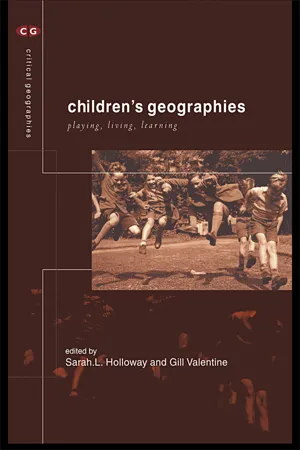
Children's Geographies is an overview of a rapidly expanding area of cutting edge research. Drawing on original research and extensive case studies in Europe, North and South America, Africa and Asia, the book analyses children's experiences of playing, living and learning.
The diverse case studies range from an historical analysis of gender relationss in nineteenth century North American playgrounds through to children's experiences of after school care in contemporary Britain, to street cultures amongst homeless children in Indonesia at the end of the twentieth century. Threaded through this empirical diversity, is a common engagement with current debates about the nature of childhood.
The individual chapters draw on contemporary sociological understandings of children's competence as social actors. In so doing they not only illustrate the importance of such an approach to our understandings of children's geographies, they also contribute to current debates about spatiality in the social studies of childhood.
eBook - ePub
Children's Geographies
Playing, Living, Learning
- 304 pages
- English
- ePUB (mobile friendly)
- Available on iOS & Android
eBook - ePub
Children's Geographies
Playing, Living, Learning
About this book
1
CHILDREN's GEOGRAPHIES AND THE NEW SOCIAL STUDIES OF CHILDHOOD
Sarah L.Holloway and Gill Valentine
Introduction
Children's Geographies presents an overview of a rapidly expanding area of research. Drawing on original research in Europe, North and South America, Africa and Asia, this volume provides an analysis of children's experiences of playing, living and learning. The case studies are diverse, ranging from an historical analysis of gender relations in nineteenth-century North American playgrounds, through children's experiences of after-school care in contemporary Britain, to street cultures amongst homeless children in Indonesia at the end of the twentieth century. Threaded through this empirical diversity is a common engagement with current debates about the nature of childhood. The individual chapters draw on contemporary sociological understandings of children's competence as social actors. In so doing they not only illustrate the importance of such an approach to our understandings of children's geographies, they also contribute to debates about spatiality in the new social studies of childhood. In this chapter we introduce the academic contexts from which the individual studies stem and provide an outline of the rest of the book. The next section discusses the social construction of childhood and the changing approach to the study of children within the social sciences. The subsequent section illustrates the importance of geographical work on children, highlighting the difference that place makes, the importance of the different sites of everyday life and the spatial imagery in ideologies of childhood. We end by providing an outline of the rest of the book, which is divided into three sections—playing, living and learning.
Children and childhood
The invention of childhood
Debates about identity and difference have been a dominant focus of interest in the social sciences during the 1980s and 1990s. A common trend in these rather disparate sets of writings (for example, Hall 1992; Rutherford 1990; Weeks 1985; Young 1990) has been to dispute essentialist assumptions about identity and instead uncover the ways in which our fractured identities are socially constructed. Children and the concept of childhood have a rather interesting relation to these debates. Like many social identities, child appears at first sight to be a biologically defined category, marked in this case by chronological age. Children, it is commonly assumed, are those subjects who have yet to reach biological and social maturity—quite simply they are younger than adults, and have yet to develop the full range of competencies adults possess. On the one hand, this less-than- adult status means that childhood is a time when children are to be developed, stretched and educated into their future adult roles, most clearly through the institution of schooling, but also through the family and wider social and civic life. In the most general sense, then, childhood is understood to be a time of socialisation where children learn what it is to be fully human adult beings. On the other hand, as less-than-adults, children in the West are assumed to have the right to a childhood of innocence and freedom from the responsibilities of the adult world. Thus responsible adults have a duty to protect children from dangerous knowledges and people, and in normal circumstances children are not expected to contribute economically to their households or the care of others.
This marking of children as adults’ ‘other’ is challenged by academics who illustrate that the current understanding of children in the North as being less developed, less able and less competent than adults (Waksler 1991) is historically specific. Most well known is the work of Ariès (1962) who traced the emergence of childhood through an analysis of cultural artefacts (see also Cunningham 1991; Hendrick 1990; Stainton-Rogers and Stainton-Rogers 1992; Steedman 1990). Though drawing mainly on French culture, his analysis is conventionally supposed to be generalisable to the rest of the Western world (Jenks 1996). Ariès (1962) argues that the ancient world's understandings of childhood had been forgotten in medieval civilisation, and that in the Middle Ages young people were regarded as miniature adults, rather than conceptually different from adults. ‘Children’ were thus not present in medieval icons, and only began to be represented in later centuries as ideas about childhood began to develop. In the sixteenth century children began to emerge as playthings for adults from privileged backgrounds. This marked the beginning of the process through which children came to be understood as separate and distinct types of beings, and with the Enlightenment these more modern conceptions of childhood began to dominate. Jenks (1996:65) argues that it was in this period that children ‘escaped into difference’ as the category of the child came to be viewed as inherently different from that of the adult.
Jenks (1996) identifies two ways of thinking and talking about this distinctive category of the child that emerge from the historical and cross-cultural literature, which he names as Dionysian and Apollonian views of childhood. Dionysian understandings of childhood were the first to emerge and in this view, children are conceived of as little devils, as inherently naughty, unruly, unsocialised beings. The strong links between such ideas and Christian doctrine are evident in Schnucker's (1990) analysis of late sixteenth-and early seventeenth-century Puritan childrearing advice. The nineteenth-century Evangelical movement in Britain promoted similar attitudes to childrearing, as evidenced in this extract of a letter from Susanna Wesley to her son John:
the parent who studies to subdue (self-will) in his children, works together with God in the saving of a soul: the parent who indulges it does the devil's work; makes religion impracticable, salvation unattainable; and does all that in him lies to damn his child, soul and body, for ever!… This, therefore, I cannot but earnestly repeat,—Break their wills betimes; begin this great work before they can run alone, before they can speak plain, or perhaps speak at all. Whatever pains it cost, conquer their stubbornness; break the will, if you would not damn the child. I conjure you not to neglect, not to delay this! Therefore (1) Let a child, from a year old, be taught to fear the rod and to cry softly. In order to do this, (2) Let him have nothing he cries for; absolutely nothing, great or small; else you undo your own work. (3) At all events, from that age, make him do as he is bid, if you whip him ten times running to effect it. Let none persuade you it is cruelty to do this; it is cruelty not to do it. Break his will now, and his soul will live, and he will probably bless you to all eternity.
(Wesley 1872, quoted in Newson and Newson, 1974:56)
This concentration on defeating the ‘devil within’ needs to be understood in the context of very high infant mortality rates (see Walvin 1982 for examples). Given the widespread belief in Heaven and Hell, preparing a child for death was as important as preparing them for life: a disciplined child might fail physically but would be sure of eternal salvation (Newson and Newson 1974; Richardson 1993).
Apollonian views of childhood emerged later than Dionysian ones, and were formalised in the mid-eighteenth-century works of Rousseau, who celebrated children's natural virtues and talents which adults could develop by gentle coaxing:
If the philosophy of the Enlightenment brought to eighteenth century Europe a new confidence in the possibility of human happiness, special credit must go to Rousseau for calling attention to the needs of children. For the first time in history, he made a large group of people believe that childhood was worth the attention of intelligent adults, encouraging an interest in the process of growing up rather than just the product. Education of children was part of the interest in progress which was so predominant in the intellectual trends of the time
(Robertson 1976:407, quoted in Jenks 1996:65)
In this view, children are represented as little ‘angels’, who are born good and innocent of adult ways. These ideas underlie much of the growth since the late nineteenth century in concern for the education and welfare of children, which is evidenced in the provision or regulation of much childcare, education, and interventionist welfare services. That Apollonian ‘angels’ emerged after Dionysian ‘little devils’ should not, however, be taken to mean that the former has now replaced the latter: both apparently contradictory understandings of the child continue to be mobilised in contemporary Western societies (as we discuss later), and neither should be considered unproblematic (Jenks 1996).
In both Apollonian and Dionysian constructions of childhood, children's (‘good’ or ‘bad’) behaviour is assumed to be a natural part of what it is to be a child, natural tendencies which must be shaped or curbed by adults. Both conceptions are thus essentialist, seeing ‘childish’ behaviour as stemming from biological impulses. In illustrating the historical specificity of contemporary understandings of childhood in the North, the authors discussed earlier show that the child, far from being a biological category, is a socially constructed identity. Not only is the category of the child a recent invention, but the qualities supposed to be natural in children have changed over time (and, as we discuss later, space). The category child—like woman, ‘white’, or disabled— is thus shown to be a social construction which, to follow Connell’ s (1987:78) arguments about gender, is ‘radically unnatural’, being inscripted on the body through a lengthy historical process. Only in ‘modern’ times has physical immaturity been socially dealt with through the historical process we call childhood (cf. Connell 1987:79). Unlike most other social identities, childhood is something which all adult beings have experienced rather than a difference which forever separates people. Perhaps this is why children, as adults’ ‘other’, are not feared and loathed (cf. Rose 1993 on masculinity and femininity) but openly valued, with childhood being celebrated for those of an appropriate age. Interestingly, though this conception of childhood is recent, its precise demarcation remains problematic. Official definitions of where one ends and the other begins vary even within individual countries, and these are contested by different groups of children and adults (see Hendrick 1990; James 1986; Sommerville 1982; Stainton-Rogers and Stainton-Rogers 1992; Steedman 1995). It is to the studies of the experience of childhood that we now turn.
The new social studies of childhood
One ‘academic’ consequence of the construction of the child as less than adult, and childhood as a phase of socialisation, is that research on children has been less valued than that on other topics, and children have in the past been far from visible even in research which concerns their everyday experiences. Ambert (1986), for example, identified a near absence of children in North American sociological research, and argued that this reflected the continuing influence of founding theorists whose preoccupations were shaped by the patriarchal values of the societies in which they lived (and hence paid little attention to children), and the system of rewards within the discipline which favours research on the ‘big issues’ such as class, bureaucracies, or the political system. Even in those branches of the discipline where children might be expected to feature, for example the sociology of the family or education, they were in the past strangely missing (Brannen and O’Brien 1995; James, Jenks and Prout 1998). Here, children tended to be seen as human becomings rather than human beings, who through the process of socialisation were to be shaped into fully human adult beings. As children in this view were regarded as incompetent and incomplete, as ‘adults in the making rather than children in the state of being’ (Brannen and O’Brien 1995:70), it was the forces of socialisation—the family, the school—which received attention rather than children themselves.
Recognition that childhood is a socially constructed phenomenon, however, has been accompanied by a challenge to ‘traditional’ approaches to the study of children with their emphasis on the socialisation of children through various stages of development (Oakley 1994). Researchers in what are now called the new social studies of childhood provide a two-pronged challenge to the relative absence of children from the sociological research agenda. First, their insistence that childhood is a social construction which varies with time and place and as it articulates with other social differences (Prout and James 1990), forms the basis of a research agenda which places an analysis of the social construction of different childhoods at centre stage. If childhood is a social rather than a biological phenomenon—which varies between social groups, societies and historical periods—its construction, contestation and consequences are worthy of academic attention. Second, the new social studies of childhood claim an epistemological break from previous sociological work, in that they study children as social actors, as beings in their own right rather than as pre-adult becomings (Brannen and O’Brien 1996; James et al. 1998; Qvortrup et al. 1994; Waksler 1991). Rather than accepting contemporary constructions of children in the North as less able and competent than adults, these researchers insist that children are active beings whose agency is important in the creation of their own life-worlds:
Children are and must be seen as active in the construction and determination of their own social lives, the lives of those around them and of societies in which they live. Children are not just the passive subjects of social structures and processes
(Prout and James 1990:8)
Children's competence as social actors is a key theme in the new social studies of childhood. The aim, however, is not to celebrate children's creativity and resourcefulness to the detriment of an analysis of wider social structures. Recognition of children's agency does not necessarily lead to a rejection of an appreciation of the ways in which their lives are shaped by forces beyond the control of individual children. As James and Prout argue:
A more satisfactory theoretical perspective would be one that could account for childhood as a structural feature of society in the moment of its impinging upon children's experiences in daily life and the reshaping of the institution of childhood by children through their day to day activities. In essence, it would address both structure and agency in the same movement.
(James and Prout 1995:81)
Nor, as we suggested earlier, does a recognition of children's agency result in a universalisation of the category ‘child’. Though children are defined in relation to adults, other diff...
Table of contents
- Cover Page
- Title Page
- Copyright Page
- Critical Geographies
- Plates
- Maps
- Tables
- Notes on contributors
- Acknowledgements
- 1: Children's geographies and the new social studies of childhood
- Part 1: Playing
- Part 2: Living
- Part 3: Learning
Trusted by 375,005 students
Access to over 1.5 million titles for a fair monthly price.
Study more efficiently using our study tools.
Frequently asked questions
Yes, you can cancel anytime from the Subscription tab in your account settings on the Perlego website. Your subscription will stay active until the end of your current billing period. Learn how to cancel your subscription
No, books cannot be downloaded as external files, such as PDFs, for use outside of Perlego. However, you can download books within the Perlego app for offline reading on mobile or tablet. Learn how to download books offline
Perlego offers two plans: Essential and Complete
- Essential is ideal for learners and professionals who enjoy exploring a wide range of subjects. Access the Essential Library with 800,000+ trusted titles and best-sellers across business, personal growth, and the humanities. Includes unlimited reading time and Standard Read Aloud voice.
- Complete: Perfect for advanced learners and researchers needing full, unrestricted access. Unlock 1.5M+ books across hundreds of subjects, including academic and specialized titles. The Complete Plan also includes advanced features like Premium Read Aloud and Research Assistant.
We are an online textbook subscription service, where you can get access to an entire online library for less than the price of a single book per month. With over 1.5 million books across 990+ topics, we’ve got you covered! Learn about our mission
Look out for the read-aloud symbol on your next book to see if you can listen to it. The read-aloud tool reads text aloud for you, highlighting the text as it is being read. You can pause it, speed it up and slow it down. Learn more about Read Aloud
Yes! You can use the Perlego app on both iOS and Android devices to read anytime, anywhere — even offline. Perfect for commutes or when you’re on the go.
Please note we cannot support devices running on iOS 13 and Android 7 or earlier. Learn more about using the app
Please note we cannot support devices running on iOS 13 and Android 7 or earlier. Learn more about using the app
Yes, you can access Children's Geographies by Sarah L. Holloway, Gill Valentine, Sarah L. Holloway,Gill Valentine in PDF and/or ePUB format, as well as other popular books in Social Sciences & Geography. We have over 1.5 million books available in our catalogue for you to explore.