- 256 pages
- English
- ePUB (mobile friendly)
- Available on iOS & Android
eBook - ePub
About this book
Owen Bishop's First Course starts with the basics of electricity and component types, introducing students to practical work almost straight away. No prior knowledge of electronics is required. The approach is student-centred with self-test features to check understanding, including numerous activities suitable for practicals, homework and other assignments. Multiple choice questions are incorporated throughout the text in order to aid student learning. Key facts, formulae and definitions are highlighted to aid revision, and theory is backed up by numerous examples within the book. Each chapter ends with a set of problems that includes exam-style questions, for which numerical answers are provided at the end of the book. This text is ideal for a wide range of introductory courses in electronics, technology, physics and engineering. The coverage has been carefully matched to the latest UK syllabuses including GCSE Electronics, GCSE Design & Technology, Engineering GCSE and Edexcel's BTEC First in Engineering, resulting in a text that meets the needs of students on all Level 2 electronics units and courses. Owen Bishop's talent for introducing the world of electronics has long been a proven fact with his textbooks, professional introductions and popular circuit construction guides being chosen by thousands of students, lecturers and electronics enthusiasts.
Information
Part 1
Electricity
Topic 1
Electrons
Put some small pieces of kitchen foil on the workbench. You can use small pieces of cork, instead. Rub a plastic pen with a dry woollen cloth. Rub hard for ten or twenty seconds. Hold the pen a few millimetres above the pieces of foil. They jump up and stick to the pen. Some of them may jump up and down again several times.
Figure 1.1
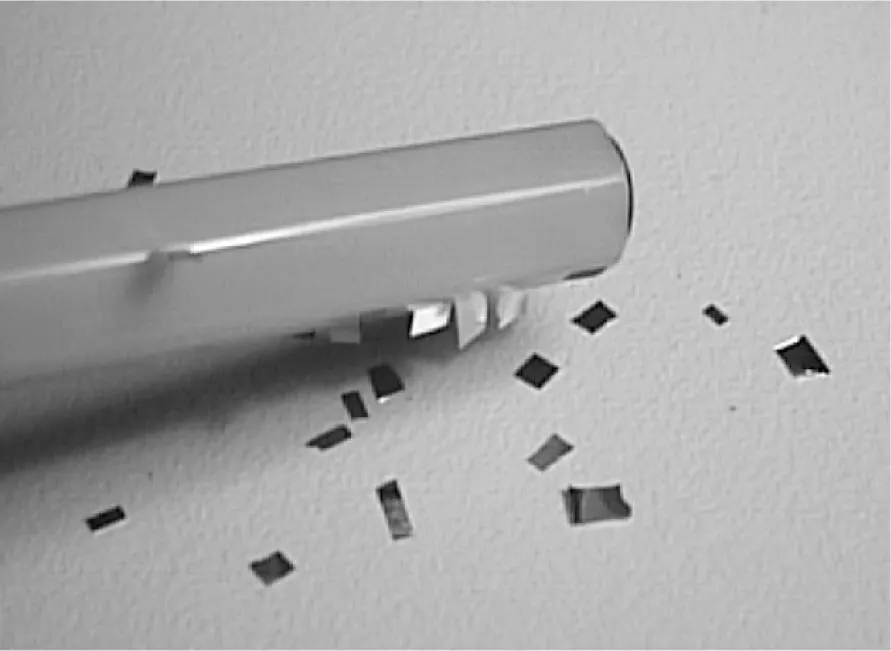
Figure 1.2
The reason that the pieces jump is that they are attracted by electrons on the pen. Rubbing the cloth on the pen has made electrons from the cloth transfer to the pen. We say that the pen is charged with electrons. It has an electric charge.
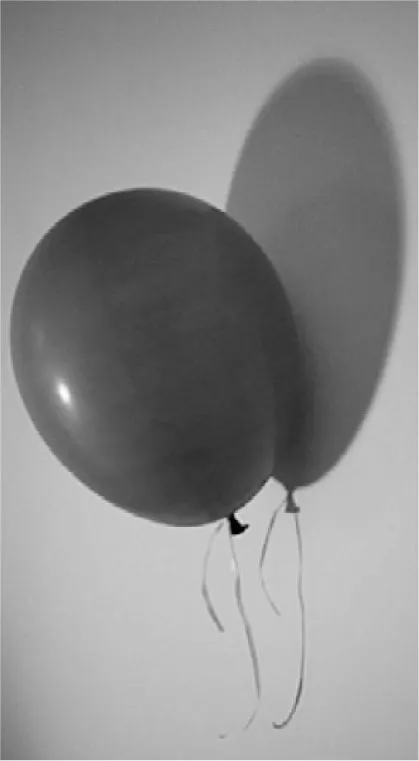
Some other things can be charged by rubbing. Rub a balloon with a cloth (or against your clothes). Then place it in contact with the wall of the room. It does not fall down to the floor but stays where you put it, on the wall. The electric charge has produced an electric force that holds the balloon against the wall.
Figure 1.3
Things to do
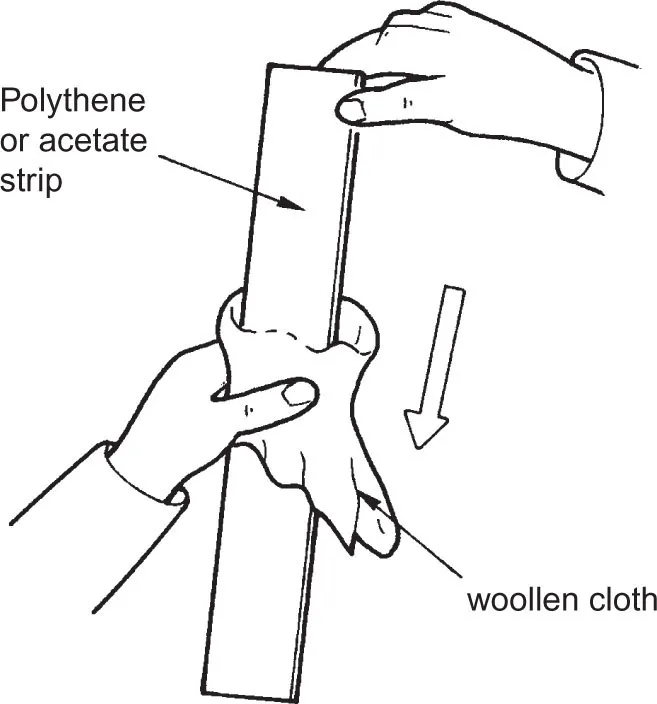
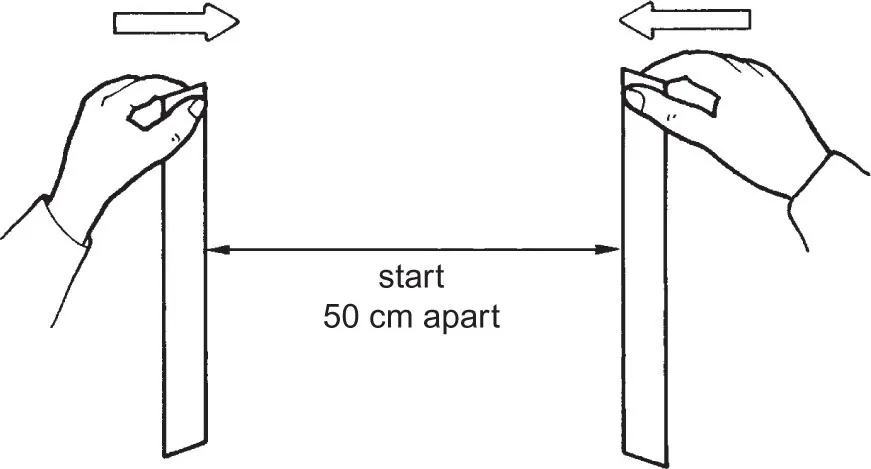
You need two strips of polythene, about 30 cm by 2 cm, and a soft dry cloth. Put the strips on the workbench and rub them briskly with the cloth. Pick up the strips by one end, one in each hand. Hold them about 50 cm apart. Then slowly move them together.
Repeat this, using one strip of polythene and one strip of acetate sheet. What do the strips do now?
Figure 1.4
Self Test
What do you expect will happen if you try to bring two charged acetate strips together?
KINDS OF CHARGE
You have found that:
• Two charged polythene strips repel each other. They try to stay apart.
• A polythene strip and an acetate strip attract each other. They try to come together.
It seems that the charge on acetate is different from that on polythene, so:
There are two kinds of charge
Two charged polythene strips repel each other, so:
Like charges repel
Two differently charged strips attract each other, so:
Unlike charges attract
Self Test
Pieces of foil jump up to a charged plastic pen. Then some of them jump down again. Why does this happen?
POSITIVE AND NEGATIVE CHARGE
The two kinds of charge are called positive charge and negative charge. These names do not mean that positive charge has something that negative charge does not have. They just mean that the charges are of opposite kinds.
Rubbing a polythene strip with a cloth transfers some of the electrons from the atoms in the cloth on to the strip. Electrons have negative charge, so the strip becomes negatively charged. Also, the atoms of the cloth have now lost some electrons. This makes the cloth positively charged.
Rubbing an acetate strip with a cloth does the opposite. It removes electrons from the strip, leaving it positively charged. The cloth gains electrons and becomes negatively charged.
USING ENERGY
Positive and negative charges always attract each other. They try to come together. When you rub the cloth on the plastic, you separate the negative charge from the positive. It takes energy to pull them apart when they are trying to come together. This energy comes from the muscles of your arm.
ELECTRONS
Electrons are too small to see, even with a powerful microscope.
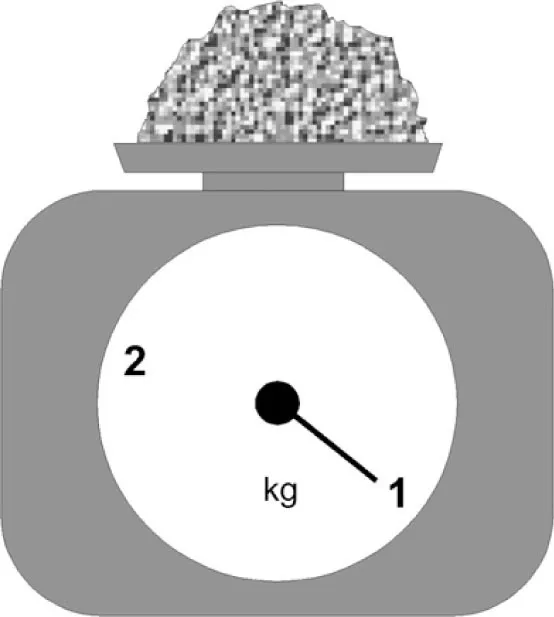
Electrons are too light to weigh. You need 1 000 000 000 000 000 000 000 000 000 000 electrons to weigh 1 kg (an amazing fact that you do not need to remember).
Figure 1.5
The most important fact about electrons is that they carry negative electric charge. The charge on a single electron is extremely small. But, if you have enough of them (as on the pen or the charged polythene), you can show the force that their charge causes. There are lots more things that we can do with electrons, as you will find out as you work through the book.
Self Test
Why is it impossible to have a pile of electrons, like that shown in the drawing?
ELECTRONS AND ATOMS
Matter is made up of molecules of many different kinds. Molecules are made up of one or more atoms. Atoms are made up of electrons (negatively charged), protons (positively charged) and neutrons (uncharged).
The simplest possible atom consists of one electron and one proton. The proton is at the centre of the atom and the electron is circling around it, in orbit.
Figure 1.6

With one unit of negative charge on the electron and one unit of opposite but equal charge on the proton, the atom as a whole is uncharged.
The electron is circling at high speed around the proton, like a planet orbiting the Sun. There must be a force to keep it in orbit. In the case of a planet the force is gravity, the attraction between the masses of the Sun and the planet. In the case of the electron the force is the electrical attraction between oppositely charged bodies. The experiments on pages 3–4 demonstrated this.
OTHER KINDS OF ATOM
There are more than a hundred different elements in nature, including hydrogen, helium, copper, zinc, iron, mercury and oxygen, to name only a few.
Each element has its own distinctive structure, the atoms being made up of fixed numbers of electrons and protons.
In spite of these differences, all elements have the same basic plan. There is a central part, called the nucleus, where most of the mass of the atom is conc...
Table of contents
- Cover
- Halftitle
- Title
- Copyright
- Contents
- Introduction
- PART 1. Electricity
- PART 2. Electronic Components
- PART 3. Electronic Systems
- PART 4. Electronic Systems in Action
- Supplements
- Acknowledgements
- Index
Trusted by 375,005 students
Access to over 1.5 million titles for a fair monthly price.
Study more efficiently using our study tools.
Frequently asked questions
Yes, you can cancel anytime from the Subscription tab in your account settings on the Perlego website. Your subscription will stay active until the end of your current billing period. Learn how to cancel your subscription
No, books cannot be downloaded as external files, such as PDFs, for use outside of Perlego. However, you can download books within the Perlego app for offline reading on mobile or tablet. Learn how to download books offline
Perlego offers two plans: Essential and Complete
- Essential is ideal for learners and professionals who enjoy exploring a wide range of subjects. Access the Essential Library with 800,000+ trusted titles and best-sellers across business, personal growth, and the humanities. Includes unlimited reading time and Standard Read Aloud voice.
- Complete: Perfect for advanced learners and researchers needing full, unrestricted access. Unlock 1.5M+ books across hundreds of subjects, including academic and specialized titles. The Complete Plan also includes advanced features like Premium Read Aloud and Research Assistant.
We are an online textbook subscription service, where you can get access to an entire online library for less than the price of a single book per month. With over 1.5 million books across 990+ topics, we’ve got you covered! Learn about our mission
Look out for the read-aloud symbol on your next book to see if you can listen to it. The read-aloud tool reads text aloud for you, highlighting the text as it is being read. You can pause it, speed it up and slow it down. Learn more about Read Aloud
Yes! You can use the Perlego app on both iOS and Android devices to read anytime, anywhere — even offline. Perfect for commutes or when you’re on the go.
Please note we cannot support devices running on iOS 13 and Android 7 or earlier. Learn more about using the app
Please note we cannot support devices running on iOS 13 and Android 7 or earlier. Learn more about using the app
Yes, you can access Electronics by Owen Bishop in PDF and/or ePUB format, as well as other popular books in Technology & Engineering & Civil Engineering. We have over 1.5 million books available in our catalogue for you to explore.