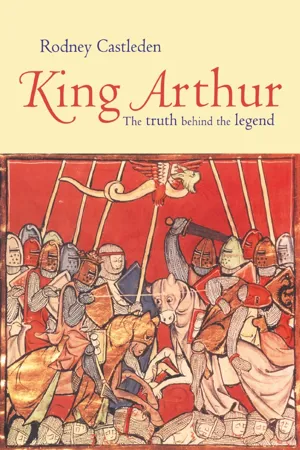
King Arthur is often written off as a medieval fantasy, the dream of those yearning for an age of strong, just rulers and a contented kingdom. Those who accept his existence at all generally discard the stories that surround him. This exciting new investigation argues not only that Arthur did exist, as a Dark Age chieftain, but that many of the romantic tales - of Merlin, Camelot and Excalibur - are rooted in truth.
In his quest for the real King Arthur, Rodney Castleden uses up-to-date archaeological and documentary evidence to recreate the history and society of Dark Age Britain and its kings. He revives the possibility that Tintagel was an Arthurian legend, and proposes a radical new theory - that Arthur escaped alive from his final battle. A location is even suggested for perhaps the greatest mystery, the whereabouts of Arthur's grave.
King Arthur: The Truth Behind the Legend offers a more complete picture of Arthur's Britain and his place in it than ever before. The book's bold approach and compelling arguments will be welcomed by all readers with an interest in Arthuriana.
- 280 pages
- English
- ePUB (mobile friendly)
- Available on iOS & Android
eBook - ePub
About this book
CHAPTER ONE
‘WHO THIS ARTHUR WAS’
For over a thousand years, the story of Arthur’s life and death has been the principal myth of the island of Britain. The circumstances of his rise to power from obscure origins, the saga of his career as a king and war-leader of the Celts against the Saxons, the establishment of a long and secure peace, the disintegration of his court, the descent into civil war and finally his death as a result of treachery on the field of battle—these elements have been retold and rewoven continually in new ways to carry new messages for new ages, until they are sometimes transformed virtually beyond recognition. The recycling continues from Geoffrey of Monmouth in the twelfth century through Malory in the fifteenth and Tennyson in the nineteenth, to John Arden, Monty Python and John Boorman’s Excalibur film in the twentieth century. Each century, each sub-culture, recreates its own Arthur, sometimes further from, sometimes closer to, the collection of folk stories told in the middle ages.
The Arthurian saga is nevertheless much more than a hotchpotch of tales made up by medieval minstrels, and it is essential to try to separate the Arthur of the romances—the Arthur of Geoffrey, Malory and the medieval troubadours—from the historical Arthur—the dark age warrior on whom all the rest of the super-structure was built.
We need to strip away the later anachronisms, the ornaments and grace-notes, the bits of medieval infilling, if we are to reconstruct the biography of the historical Arthur. This requires enormous care. The material that appears in the medieval stories though not in the sixth- or seventh-century documents might at first sight look like a later invention, yet we cannot ignore it as some may derive from oral traditions maintained in Cornwall, Wales or Brittany, or even written accounts copied in the intervening centuries and later lost. Some scholars have taken everything out, argued everything away, leaving just two brief mentions in the Easter Annals:1
516: Battle of Badon, in which Arthur carried the cross of our lord Jesus Christ on his shoulders for three days and three nights, and the British were victors.
537: Strife of Camlann, in which Arthur and Medraut perished [or fell].
These two listings are the bottom line, our irreducible minimum. Within these few words we have the nearest thing to proof of Arthur’s existence and prominence in the early sixth century: we also have evidence of his celebrity as a warrior and war-leader. They nevertheless do not mention his kingship as such, and some have argued on the strength of this that Arthur cannot have been a king, but that, as we shall see, is going too far. The Ages of Reason and Science have thrown up many attacks on Arthur’s historical reality, attacks that have been understandable reactions to the excesses of medieval credulity. The addition of magical elements—Merlin, the Grail stories, the sword in the stone, the Lady of the Lake—was the last straw. The magic goaded rational historians into rejecting Arthur altogether as a historical figure, and even led some to treat him as a re-processed ancient Celtic deity.2
But evidence does exist to show that Arthur was a real person, and the purpose of this book is to explore that evidence and see how the historical Arthur fitted into the realities of the sixth century. Archaeology is very unlikely ever to be able to prove or disprove his existence, simply because it follows different paths, but it can supply the social, economic, cultural and political setting for the living people of his day. Once we see Arthur as real flesh, bone and blood, his contemporaries as real people with whom he had real personal, social and political relationships, and sixth-century Britain as a real landscape with its own geography, its own towns and villages, fields and farms, its own ports, strongholds, networks of roads and trade routes, its own multiplicity of kingdoms—then we shall see the dynamics of dark age society at work. We shall see how Arthur’s career was created by the troubled and changing times in which he lived; we shall see how the careers of other military leaders were shaped in rather similar ways. Arthur was, as we shall see, very much a child of his time.
Traditions, whether local or regional, are notoriously difficult to evaluate. Some are no more than old wives’ tales invented to explain a peculiar landform or an uncomprehended megalith, tales that have been accorded a certain dignity through repetition and familiarity. But other traditions have turned out to be true. The story of Troy, as told in Homer, was for a long time thought to be pure poetic fiction; then the work of Frank Calvert and Heinrich Schliemann proved that Troy had really existed. At a more local level, there was a Cornish tradition that a ninth-century church lay buried at Perranzabuloe; sands shifted by a storm in 1835 revealed that a tiny ancient church had indeed been buried there. Another, more fanciful, West Country story held that druids once dispensed wine out of a gold cup at the Cheesewring; in 1837, a bronze age gold beaker was found inside the Rillaton Barrow just 400m away.3 Quite how the knowledge was acquired, retained and transmitted in that instance must be a matter for speculation, but the local lore turned out to contain some truth.
There were other war-leaders besides Arthur. He had his forerunners in the fifth century, and there were others after him in the sixth and seventh centuries who also made defiant and heroic stands against the westward advance of the Saxons. There were warleaders among the Saxons too, and the names of several have come down to us in the Anglo-Saxon Chronicle. Yet there was something particular, something special, about Arthur that caused his memory to be cherished and honoured far above that of any other warrior. What was it that made Arthur so special?
The once and future king
One distinctive feature of the Celtic culture was that, though victory was earnestly sought and fulsomely praised, it was the great defeats that were remembered longest and most yearningly. Something of this survives in modern Britain, which is after all still part-Celtic. When we hear of the heroic bravery witnessed at Dunkirk we have to remind ourselves that what is being described is a massive British retreat in the face of enemy attack, not a victory at all. Yet Dunkirk has acquired the flavour of something that was in some mysterious way greater than victory. Long, long before, the British dwelt nostalgically on Arthur’s great defeat, gloated over the hero’s death at Camlann. As Leslie Rouse has said, ‘It was the hero of the losing side, king Arthur, who imposed himself on the imagination.’ It is not uncommon for conquerors to succumb to the spirit of the conquered. Jung commented on what he called the indianization of immigrants of various racial origins arriving in the New World; American college initiation ceremonies derive from Indian rites of passage, while the white leaders of American religious sects have a tendency to turn into Indian shamans. In a similar way, the Roman Empire succumbed to a mystery religion originating among an obscure and oppressed subject people.4 It is perhaps not so out of the ordinary for the English to have adopted Arthur. In the centuries that followed his death, Arthur became a symbol representing the glory of Britain as it once was, and might yet have been had it not been destroyed by the Saxon invader.
The idea of Arthur then became a seminal influence in the evolving idea of British nationhood. In the dark ages and early middle ages, the Celts saw in Arthur the lost leader who had given them the sweetness of victory and peace, if only for four decades or so. He became the perfect symbol of a kingdom and a culture lost when they were disinherited by the Saxons. Vain hope that kingdom and culture might one day be restored was embodied in a strange belief that Arthur had somehow escaped death at Camlann, never really died at all, but lay sleeping in a cave or under a hill waiting for the day when he would wake and drive the enemy, whoever it might be, from Britain’s shores. Arthur was now more than a king: he was a god.
The image of this dark age warrior-king hung over the aristocracy of the middle ages like a faded, tattered, war-torn battle standard hanging in a royal chapel, redolent of past greatness and signifying exemplary virtues that could never be matched by the living. Medieval kings of England sought to be worthy of his memory, to identify themselves subliminally with Arthur, by both image and lineage, but it was an anachronistic Arthur they tried to imitate, a figure substantially re-written and taking the stage as a thinly disguised medieval king. They were imitating an ideal king who in his turn was imitating them. The idea of Arthur became a force in medieval British politics. Henry II wanted to prove that Arthur was dead in order to remove any hopes the Celts may have entertained that he would rise again to do battle against the Plantagenets. There are conflicting views about it, but it was probably for this reason that in 1190 Henry II arranged for Arthur’s coffin to be ‘discovered’ at Glastonbury and exhumed. We know that when Henry II visited Dyfed in 1179 and met the bard who told him where Arthur’s grave was, he was also told of the tradition that Arthur would ride once more.5 If Arthur’s bones had been found, there was little chance of Arthur riding into battle again.
The story virtually repeated itself 100 years later, when Edward I was subduing the Welsh. To make it clear that Arthur would not be returning to help them, in 1278 the king went to Glastonbury and had the bones removed from their casket and put on public display, with the ostensible motive of reburying them in a place of great honour right in the centre of the abbey church. In 1283 Edward I was presented at Aberconwy with a collection of relics that included the regalia of the ancient British kings; amongst this was a crown alleged to be Arthur’s, by which Edward was plainly signalling in typical medieval language his succession to Arthur’s throne. In case anybody missed the point, the English chroniclers decoded it: ‘and so the glory of the Welsh, though against their will, was transferred to the English’.6 Edward III went a step further in identifying himself as Arthur’s successor when he contemplated re-establishing the Round Table as an order of chivalry. In the end, in 1348, he founded instead the Order of the Garter in imitation of Arthur’s order of Round Table knights.
Arthur had come to be seen as the model for kingship. But for accidents of destiny, two royal princes named Arthur might have become kings of England: one was forestalled by murder (by King John), the other, Henry VIII’s elder brother, by fatal illness. Arthur’s virtues were without limit. He was a renowned warrior and a just leader, a sponsor of youth and defender of the Celtic realm, he was a righter of wrongs, an enforcer of the law and the ultimate authority in time of danger. He was, in short, the best and greatest of kings, and it was natural that, right through to the time of Victoria and Albert, he was seen as the ultimate model for the British monarchy.
The idea of Arthur has not just fired the imagination of kings and princes, but of ordinary people too. In 1220, an abbot used Arthur as a desperate measure to get his monks’ attention. ‘Seeing that many were asleep [in the Chapter House], some even snoring, he cried out: Hark, brethren! I will tell you of something new and great. There was a mighty king whose name was Arthur!’ This electrified everyone in the room. ‘Had they not come to a sad pass, when they would not stay awake to hear of holy things but were agog at the mention of Arthur?’
That power to excite is still there. In 1113 men knocked each other about in Bodmin, drawing blood in their disagreement as to whether Arthur was dead or not. Now, they don’t, but the interest is still strong. Part of that interest lies in Arthur’s association with mystery and magic. In the legend, magic was used by Merlin to enable Uther to father Arthur on Ygraine in Tintagel Castle. There was mystery surrounding his death too. The Welsh tradition poses ‘a grave for Arthur’ as one of the great puzzles; there was the myth of his ‘sleep’ and eventual return. Malory famously described him as rex quondam rexque futurus, ‘the once and future king’. The fifteenth-century poet Lydgate described him as ‘a king y-crowned in Fairye’.7 There was the Holy Grail saga, probably added on relatively late, but which gave Arthur’s kingdom and reign a special yearning spirituality that appealed to the medieval mind.
It may well be Arthur’s strange position midway between king and demi-god, between Christianity and paganism, between history and myth, that appeals to so many people now. How far these Merlinesque elements were part of the dark age reality we shall later explore, but one thing is certainly true, and it is that the myth, magic and mystery elements have become an integral part of the Arthurian myth. The brief bright gleam from Excalibur sent glancing across one-and-a-half millennia of British history still influences the way we think about Britain as a land, and Britain as a nation.
Doubts about Arthur’s existence
It was very largely because Arthur’s name was later surrounded by so much mystique, and because it became so richly symbolic, that many historians refused to believe he ever existed. The magical conception, the strange manner of his accession, the mysterious disappearance after Camlann: all made it look as if Arthur was a fictitious character, a figment of the medieval minstrels’ imagination. The settings of some of the stories—the Dolorous Tower, the Red City—strongly suggest a fictional world, a world of rich romantic fantasy, a world not to believe in.
Attempts have been made, most notably and most successfully by John Morris, to strip away the magical and fanciful elements that look like later accretions and reconstruct the reality of dark age Britain. This is perhaps the best way to begin: to look at the documentary evidence for the period AD 450–550, the century in which Arthur must have lived (if he lived at all), and build an historian’s eye view of events. We need at least temporarily to forget the glinting twilights and special effects of Boorman’s wonderful Excalibur and see the dark age setting as a period of real history. As such, it becomes a legitimate field of academic study and falls subject to the normal discipline of an historian’s scrutiny. The documents will be reviewed in Chapter 2, to see how far they prove, support or corroborate the existence of a king called Arthur. Then, in Chapter 3, the archaeological evidence from a range of British sites will be considered, some of it independently corroborating the documentary evidence, some adding entirely new detail and fleshing out the picture. From these two strands, historical and archaeological, the setting for Arthur’s alleged career should emerge.
We can, using recognized, conventional academic procedures, test whether Arthur existed. We may be able to go further and assemble elements of his biography. Who and what was he? What did he really achieve? Where did he operate? Did Camelot and the knights exist too?
Arthur began to re-emerge from the misty land of legend in the late eighteenth century, with the writings of Sharon Turner. Joseph Ritson’s 1825 Life of King Arthur, completed in about 1803 but not published until twenty-two years after his death, was in some ways the seminal work. While maintaining a rigorous scepticism about the reliability of the sources in detail, Ritson could see that it was ‘manifest from authentick history’ that Arthur was a real person who had been a brave warrior and probably a dark age chieftain or sub-king. In the 1930s, R.G.Collingwood saw him as holding the late Roman military office of Comes Britanniarum, Count of the Britons, employing cavalry to defeat Saxon foot-soldiers. The cavalry idea has outlived the rest of Collingwood’s theory, much of which relied perhaps too heavily on the assumptions that the list of battles in Nennius is genuine and that their names are traceable to identifiable locations. The sites that could be identified are widely scattered, therefore Arthur must have been very mobile. While Kenneth Jackson rejected much of Collingwood’s theory, he too looked for likely locations for the battles in Nennius’ list, confirming a wide geographical distribution. Jackson thought Arthur was probably, though not certainly, real. If he existed, Arthur was a ‘supreme British commander of genius’ active mainly in southern Britain.8
Reports on Glastonbury and South Cadbury Castle lent support to the idea of Arthur as a real historical figure,9 a line of thought that culminated in John Morris’s important 1973 work, The Age of Arthur, which confirmed Arthur’s royal—indeed imperial—status. Since this high water mark, the tide of belief in Arthur has begun to ebb away again. In history as in politics, there is a periodic pendulum swing, first one way, in favour of the historical Arthur, and then the inevitable other, against him. The post-1973 anti-Arthur writers include D.N.Dumville (1977) and Peter Salway (1981). David Dumville crushingly criticized the use of Welsh sources as historical evidence, and the scholarly pursuit of the historical Arthur seemed to come once more to a halt, with Leslie Alcock retreating into agnosticism and Philip Rahtz waving Arthur aside as ‘this non-subject’.10 Nick Higham is even more dismissive:
As an historical figure [Arthur] should be laid to rest once more as an unwarranted and retrospective intrusion on the fifth century. Not only did Arthur himself not exist but the age which led to his invention was no less fictional.11
Perhaps the most unrelenting opponent of the historical Arthur is Oliver Padel.12 His arguments and assertions will be considered at appropriate points during this book. It may usefully be said here that the powerful overall effect of his 1994 article relies heavily on the accumulation of sceptical though poorly founded remarks. He says, for example, of the reference to Arthur in the sixth-century poem The Gododdin that the line might have been added in the ninth century; there is no reason to suppose that it was, and we would not normally resort to this method of argument in studies of later centuries (or earlier, for that matter). For a second example we may take Padel’s citation of a tenth-century poem The Prophecy of Britain, which does not mention Arthur. Clearly this will not suffice as proof that Arthur never lived. Today’s newspaper may omit to mention the Queen, but it would be a rash reader who inferred from this that the United Kingdom had become a republic.
Padel’s approach to Arthur—presupposing that all references to him must be unhistorical, late, anachronistic intrusions...
Table of contents
- Cover Page
- Title Page
- Copyright Page
- Figures
- Plates
- Preface and Acknowledgements
- Chapter One: ‘Who this Arthur was’
- Chapter Two: The Documents
- Chapter Three: The Archaeology
- Chapter Four: Arthur’s Britain
- Chapter Five: Arthur
- Chapter Six
- Chapter Seven: The Death of Arthur
- Appendix A: The Kings of Powys
- Appendix B: The Kings of Demetia
- Appendix C: The Arthnou Stone from Tintagel
- Notes
- Bibliography
Trusted by 375,005 students
Access to over 1.5 million titles for a fair monthly price.
Study more efficiently using our study tools.
Frequently asked questions
Yes, you can cancel anytime from the Subscription tab in your account settings on the Perlego website. Your subscription will stay active until the end of your current billing period. Learn how to cancel your subscription
No, books cannot be downloaded as external files, such as PDFs, for use outside of Perlego. However, you can download books within the Perlego app for offline reading on mobile or tablet. Learn how to download books offline
Perlego offers two plans: Essential and Complete
- Essential is ideal for learners and professionals who enjoy exploring a wide range of subjects. Access the Essential Library with 800,000+ trusted titles and best-sellers across business, personal growth, and the humanities. Includes unlimited reading time and Standard Read Aloud voice.
- Complete: Perfect for advanced learners and researchers needing full, unrestricted access. Unlock 1.5M+ books across hundreds of subjects, including academic and specialized titles. The Complete Plan also includes advanced features like Premium Read Aloud and Research Assistant.
We are an online textbook subscription service, where you can get access to an entire online library for less than the price of a single book per month. With over 1.5 million books across 990+ topics, we’ve got you covered! Learn about our mission
Look out for the read-aloud symbol on your next book to see if you can listen to it. The read-aloud tool reads text aloud for you, highlighting the text as it is being read. You can pause it, speed it up and slow it down. Learn more about Read Aloud
Yes! You can use the Perlego app on both iOS and Android devices to read anytime, anywhere — even offline. Perfect for commutes or when you’re on the go.
Please note we cannot support devices running on iOS 13 and Android 7 or earlier. Learn more about using the app
Please note we cannot support devices running on iOS 13 and Android 7 or earlier. Learn more about using the app
Yes, you can access King Arthur by Rodney Castleden in PDF and/or ePUB format, as well as other popular books in History & British History. We have over 1.5 million books available in our catalogue for you to explore.