- 200 pages
- English
- ePUB (mobile friendly)
- Available on iOS & Android
eBook - ePub
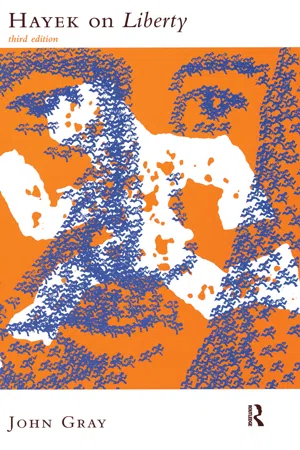
Hayek on Liberty
About this book
Not available since the 1980s, this up-dated edition by the leading political philosopher, John Gray, outlines his new position on Hayek. In a substantial new chapter, Gray assesses how far the historical development of the last ten years can be deployed in a critique of Hayek's thought. His reassessment is not only a provoking study of a classical philosopher. It is also a timely contribution to the debate over the future of conservatism, as Gray argues that Hayekian liberalism - 'the most well-articulated political theory of the new right' - is flawed.
Information
1
Hayek’s System of Ideas: Its Origins and Scope
The Unity of Hayek’s System of Ideas and its Philosophical Character
As part of the reawakening of public and scholarly interest in the intellectual tradition of classical liberalism, Hayek’s writings in a range of academic disciplines have been recalled from a period of neglect during which it seemed to many that they had been consigned to oblivion. It is not an exaggeration to say that the re-emergence of classical liberalism and the rediscovery of Hayek’s writings are complementary aspects of a single current of opinion. For, while Hayek’s writings address and illuminate some of the most formidable issues of the age, and answer to many comtemporary anxieties, they do so within the frame of thought constructed by the great classical liberals. Hayek’s work is in the tradition of classical liberalism, not simply because his concerns are in many areas those of Locke and Burke, Adam Smith and Kant, but also because, like the theorists of liberalism’s Golden Age in the eighteenth century, Hayek seeks to raise up a system of ideas, a structure of principles with the aid of which we can understand social and political life and subject it to reasoned criticism. No-one who knows Hayek’s work can doubt that his attempt to restate liberal principles in a form appropriate to the circumstances and temper of the twentieth century has yielded a body of insights wholly comparable in profundity and power with those of his forebears in the classical liberal tradition. In Hayek’s work, the chief values of classical liberalism—the dignity of the human individual and the moral primacy of his freedom, the virtues of free markets and the necessity for limited government under the rule of law—are defended within an intellectual framework of uncompromising modernity. There can be no doubt that Hayek’s reformulation of classical liberalism succeeds in building on the intellectual foundations inherited from the liberal period a body of thought as powerful as any that can be found within the classical liberal writers and far more resistant to criticism than was classical liberalism itself.
Even Hayek’s most convinced critics would hesitate to deny these achievements of his work. At the same time, even among his friends and disciples, the sense of Hayek’s work as composing a system of ideas is often missing. The reasons for this widespread failure to grasp the systematic character of Hayek’s thought may seem obvious. His writings cross several major disciplines—theoretical economics, jurisprudence, philosophy, psychology and intellectual history among them—and they span over half a century. Again, though there has been some interest in recent years among philosophers and cultural historians in the milieu of thought of the last decades of Hapsburg Vienna, most economists and social theorists remain deeply ignorant of that milieu, and accordingly can have little understanding of the context of thought in which Hayek’s outlook was nurtured. It seems to me, though, that the general failure of comprehension in regard to the character of Hayek’s work as a system of ideas has other sources, distinct from the two I have just mentioned and having to do rather with the inherent structure of Hayek’s outlook itself.
The chief aim of this study is to exhibit Hayek’s contributions to the various disciplines of inquiry in which he has worked as constituting a system in virtue of their being informed and governed throughout by a distinctive philosophical outlook. Even Hayek’s achievements in economic theory can be shown on the interpretation I advance to trade upon and put to work genuine and powerful insights in philosophy which Hayek achieved very early in his intellectual career. My interpretation has the novel aspect that it treats Hayek as a philosopher sans phrase, whose contributions to the social sciences (like those of J.S.Mill) express a natural application of his philosophical outlook. The comparison with Mill is here a close one, despite their many deep differences, in that in Hayek’s case as in Mill’s, his contributions to economics were preceded by an effort to establish a new position in the theory of knowledge in the most general sense. This has been concealed in Hayek’s case because his profound and neglected study in epistemology and philosophical psychology, The Sensory Order, was published only in 1952, after Hayek’s principal contributions to economics, whereas Mill’s System of Logic (1843) is a temporal as well as a methodological forerunner of his Principles of Political Economy (1848). Though it was published only in the fifties, The Sensory Order was first sketched as a student paper by Hayek in 1920, and its argument was substantially complete by the early twenties. A careful investigation of its argument is indispensable to any adequate understanding of Hayek’s work, not only because it remains his most extended explicit statement in general philosophy, but also because it reveals most clearly the intellectual influences at work in Hayek’s writings. Most crucially, however, the view of knowledge it defends can be shown to be presupposed by many of the positions Hayek has adopted in economic theory and in social philosophy. The elusiveness and subtlety of Hayek’s writings, on which many commentators have remarked, is in great part explained by their general failure to perceive the relevance of his work in the philosophies of knowledge and mind to the stands he has taken up in economic and social theory. This failure is regrettable and surprising: regrettable, in that it has reinforced the neglect which Hayek’s work has suffered in contemporary intellectual life, and surprising in that his writings in the social sciences are studded with references to his more explicitly philosophical works, and, above all, to The Sensory Order.
Hayek’s philosophical outlook is an extremely distinctive version of post-Kantian critical philosophy in which a number of more contemporary influences—the philosophies of Mach, Popper, Wittgenstein and Polanyi, most notably—have been synthesized into a coherent system. It would be a mistake, at the same time, to see Hayek’s thought as essentially eclectic, a weaving together over decades of strands of reflection garnered from other writers, since all the evidence suggests that his conception of the mind and of the limits to our knowledge has been with him from the start, acquiring refinement and expansion in the course of his intellectual development but remaining unaltered in its most fundamental respects. The structure of his conception, and its persistence throughout the many influences under which he has temporarily come, has misled many of Hayek’s interpreters into periodizing his intellectual career into distinct phases—a Misesian phase, perhaps, in which he supposedly embraced the philosophical outlook of his colleague in economics, L.von Mises, followed by a Popperian one which emerged from his meeting and friendship with Sir Karl Popper—but it is easy to show that such interpretations are wide of the mark. Hayek’s thought retains the character of a coherent system rather than an eclectic construction, even if in the end it harbours conflicts which demand a revision of some of its elements.
Hayek’s General Philosophy: The Kantian Heritage
The entirety of Hayek’s work—and, above all, his work in epistemology, psychology, ethics, and the theory of law—is informed by a distinctively Kantian approach. In its most fundamental aspect, Hayek’s thought is Kantian in its denial of our capacity to know things as they are or the world as it is. It is in his denial that we can know things as they are, and in his insistence that the order we find in our experiences, including even our sensory experiences, is the product of the creative activity of our minds rather than a reality given to us by the world, that Hayek’s Kantianism consists. It follows from this sceptical Kantian standpoint that the task of philosophy cannot be that of uncovering the necessary characters of things. The keynote of critical philosophy, after all, is the impossibility of our attaining any external or transcendental standpoint on human thought from which we could develop a conception of the world that is wholly uncontaminated by human experiences or interests. We find in Kant’s own writings—above all the Critique of Pure Reason (1781)—a case against the possibility of speculative metaphysics which Hayek himself has always taken to be devastating and conclusive. It is a fundamental conviction of Hayek’s, and one that he has in common with all those who stand in the tradition of post-Kantian critical philosophy, that we cannot so step out of our human point of view as to attain a presuppositionless perspective on the world as a whole and as it is in itself. The traditional aspiration of western philosophy—to develop a speculative metaphysics in terms of which human thought may be justified and reformed—must accordingly be abandoned. The task of philosophy, for Hayek as for Kant, is not the construction of any metaphysical system, but the investigation of the limits of reason. It is a reflexive rather than a constructive inquiry, since all criticism—in ethics as much as in science—must in the end be immanent criticism. In philosophy as in life, Hayek avers, we must take much for granted, or else we will never get started.
Hayek’s uncompromisingly sceptical Kantianism is strongly evidenced in The Sensory Order. There Hayek disavows any concern as to ‘how things really are in the world’, affirming that ‘… a question like “what is X?” has meaning only within a given order, and…within this limit it must always refer to the relation of one particular event to other events belonging to the same order.’1 Above all, the distinction between appearance and reality, which Hayek sees as best avoided in scientific discourse,2 is not to be identified with the distinction between the mental or sensory order and the physical or material order. The aim of scientific investigation is not, then, for Hayek, the discovery behind the veil of appearance of the natures or essences of things in themselves, for, with Kant and against Aristotelian essentialism, he stigmatizes the notion of essence or absolute reality as useless or harmful in science and in philosophy. The aim of science can only be the development of a system of categories or principles, in the end organized wholly deductively, which is adequate to the experience it seeks to order.3
Hayek is a Kantian, then, in disavowing in science or in philosophy any Aristotelian method of seeking the essences or natures of things. We cannot know how things are in the world, but only how our mind itself organizes the jumble of its experiences. He is Kantian, again, in repudiating the belief, common to empiricists and positivists such as David Hume and Ernst Mach, that there is available to us a ground of elementary sensory impressions, untainted by conceptual thought, which can serve as the foundation for the house of human knowledge. Against this empiricist dogma, Hayek is emphatic that everything in the sensory order is abstract, conceptual and theory-laden in character: ‘It will be the central thesis of the theory to be outlined that it is not merely a part but the whole of sensory qualities which is…an “interpretation” based on the experience of the individual or the race. The conception of an original pure core of sensation which is merely modified by experience is an entirely unnecessary fiction.’4 Again, he tells us that ‘the elimination of the hypothetical “pure” or “primary” core of sensation, supposed not to be due to earlier experience, but either to involve some direct communication of properties of the external objects, or to constitute irreducible mental atoms or elements, disposes of various philosophical puzzles which arise from the lack of meaning of these hypotheses.’5 The map or model we form of the world, in Hayek’s view, is in no important respect grounded in a basis of sheer sense-data, themselves supposed to be incorrigible. Rather, the picture we form of the world emerges straight from our interaction with the world, and it is always abstract in selecting some among the infinite aspects which the world contains, most of which we are bound to pass by as without interest to us.
Hayek’s Kantianism, so prominent in his theory of knowledge, is no less pronounced in his jurisprudence and in his political philosophy. It is neglect of the influence on his social theory of Kant’s account of the law that has misled some of Hayek’s interpreters into construing him as a theorist of rights in the tradition of John Locke (a tradition whose most distinguished contemporary spokesman is found in Robert Nozick). In fact Hayek’s view of law and justice is altogether Kantian in that it relinquishes any reference to natural law—which forms the necessary matrix for any account of natural rights—and treats moral rights, not as themselves framing absolute constraints of justice on the content of law, but rather as implications of the nature of law itself when certain fundamental features of the human circumstance are taken into account. As I shall try to make clear in a later chapter, Hayek’s theory of justice is not rights-based, but procedural: we discover the demands of justice by applying to the permanent conditions of human life a Kantian test of universalizability. This is to say that, if a rule or maxim is to be acceptable as just, its application must be endorsed by rational agents across all relevantly similar cases. Hayek’s view of justice is little understood, in part because it has often been assumed that the contrast between a patterned account of justice such as that of John Rawls (himself a theorist in a Kantian tradition) and the entitlement-based theory of Robert Nozick in which moral rights figure as fundamental constraints on all other values, is a contrast which exhausts all plausible accounts. Hayek’s view of justice would in fact have been better understood, if we had followed his own explicit guidance, and seen it as a synthesis of Kant’s requirement of universalizability in practical reasoning with David Hume’s account of the content and basis of the rules of justice. One of the most intriguing features of Hayek’s political philosophy is its attempt to mark out a tertium quid between the views of justice of Hume and Kant. His theory of knowledge may similarly be interpreted as aiming at a reconciliation of the apparently opposed insights of Popper and Wittgenstein. In all of his writings, however, the distinctively Kantian flavour is evident in his strategy of working with postulates or regulative ideas, epistemological and normative, which are as metaphysically neutral, and as uncommitted to specific conceptions of the good life, as he can reasonably make them. It is this minimalist or even formalist strategy of argument that most pervasively expresses Hayek’s Kantian heritage.
Four Influences on Hayek’s Sceptical Kantianism: Mach, Popper, Wittgenstein and Polanyi
Hayek’s theory of knowledge is Kantian, we have seen, in affirming that the order we find in the world is given to it by the organizing structure of our own mind and in claiming that even sensory experiences are suffused with the ordering concepts of the human mind. His view of the mind, then, is Kantian in that it accords a very great measure of creative power to the mind, which is neither a receptacle for the passive absorption of fugitive sensations, nor yet a mirror in which the world’s necessities are reflected.
There are a number of influences on Hayek, however, which give his Kantianism a profoundly distinctive and original aspect. The first of these influences is the work of Ernst Mach (1836–1916), the positivist philosopher whose ideas dominated much of Austro-German intellectual life in the decades of Hayek’s youth. Hayek’s debts to Mach are not so much in the theory of knowledge, as in the attitude both take to certain traditional metaphysical questions. I have observed already that Hayek dissented radically from the Humean and Machian belief that human knowledge could be reconstructed on the basis of elementary sensory impressions, and throughout his writings Hayek has always repudiated as incoherent or unworkable the reductionist projects of phenomenalism in the theory of perception and behaviourism in the philosophy of mind. In these areas of philosophy, then, Hayek’s work has been strongly antipathetic to distinctively positivistic ambitions for a unified science. At the same time, while never endorsing the dogma of the Vienna Circle that metaphysical utterances are literally nonsensical, Hayek has often voiced the view that many traditional metaphysical questions express ‘phantom-problems’.
In both The Sensory Order and later in The Constitution of Liberty, Hayek affirms that the age-old controversy about the freedom of will embodies such a phantom-problem.6 Hayek’s ‘compatibilist’ standpoint in respect of freedom of the will—his belief that the causal determination of human actions is fully compatible with ascribing responsibility to human agents for what they do—is analogous with his stance on the mind—body question. In both controversies Hayek is concerned to deny any ultimate dualism in metaphysics or ontology, while at the same time insisting that a dualism in our practical thought and in scientific method is unavoidable for us. Thus he says of the relations of the mental and physical domains that ‘While our theory leads us to deny any ultimate dualism of the forces governing the realms of the mind and that of the physical world respectively, it forces us at the same time to recognize that for practical purposes we shall always have to adopt a dualistic view.’7 And Hayek concludes his study of the foundations of theoretical psychology in The Sensory Order with the claim that ‘to us mind must remain forever a realm of its own, which we can know only through directly experiencing it, but which we shall never be able to fully explain or to “reduce” to something else.’8
Hayek’s thought has a Machian positivist aspect, then, not in the theories of mind or perception, but in its attitu...
Table of contents
- Cover
- Half Title
- Title Page
- Copyright
- Contents
- Note to the Third Edition
- Preface to the First Edition and Acknowledgements
- 1. Hayek’s System of Ideas: Its Origins and Scope
- 2. The Idea of a Spontaneous Social Order
- 3. The Law of Liberty
- 4. Economic Theory and Public Policy
- 5. Some Contrasts and Comparisons
- 6. Assessment and Criticism
- Postscript: Hayek and the dissolution of classical liberalism
- Biographical Note on Hayek
- Bibliographical Note on Recent Studies of Hayek
- Notes
- Index
Trusted by 375,005 students
Access to over 1.5 million titles for a fair monthly price.
Study more efficiently using our study tools.
Frequently asked questions
Yes, you can cancel anytime from the Subscription tab in your account settings on the Perlego website. Your subscription will stay active until the end of your current billing period. Learn how to cancel your subscription
No, books cannot be downloaded as external files, such as PDFs, for use outside of Perlego. However, you can download books within the Perlego app for offline reading on mobile or tablet. Learn how to download books offline
Perlego offers two plans: Essential and Complete
- Essential is ideal for learners and professionals who enjoy exploring a wide range of subjects. Access the Essential Library with 800,000+ trusted titles and best-sellers across business, personal growth, and the humanities. Includes unlimited reading time and Standard Read Aloud voice.
- Complete: Perfect for advanced learners and researchers needing full, unrestricted access. Unlock 1.5M+ books across hundreds of subjects, including academic and specialized titles. The Complete Plan also includes advanced features like Premium Read Aloud and Research Assistant.
We are an online textbook subscription service, where you can get access to an entire online library for less than the price of a single book per month. With over 1.5 million books across 990+ topics, we’ve got you covered! Learn about our mission
Look out for the read-aloud symbol on your next book to see if you can listen to it. The read-aloud tool reads text aloud for you, highlighting the text as it is being read. You can pause it, speed it up and slow it down. Learn more about Read Aloud
Yes! You can use the Perlego app on both iOS and Android devices to read anytime, anywhere — even offline. Perfect for commutes or when you’re on the go.
Please note we cannot support devices running on iOS 13 and Android 7 or earlier. Learn more about using the app
Please note we cannot support devices running on iOS 13 and Android 7 or earlier. Learn more about using the app
Yes, you can access Hayek on Liberty by John Gray in PDF and/or ePUB format, as well as other popular books in Politics & International Relations & Political Philosophy. We have over 1.5 million books available in our catalogue for you to explore.