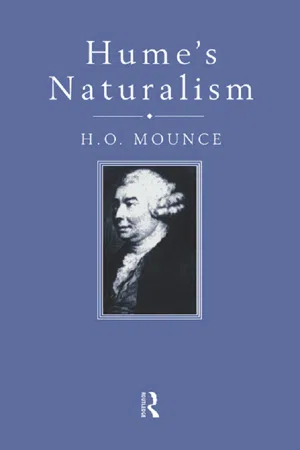
Hume's Naturalism provides a clear and concise guide to the debates over whether Hume's empiricism or his 'naturalism' in the tradition of the Scottish 'Common Sense' school of philosophy gained his upper hand. This debate is central to any understanding of Hume's thought. H.O. Mounce presents a beautifully clear guide to Hume's most important works, The Treatise on Human Nature and Dialogues Concerning Natural Religion. Accessible to anyone coming to Hume for the first time, Hume's Naturalism affords a much needed overview of the key concepts of empiricism, causation, scepticism, reason and morality that are essential to any understanding of Hume's philosophy.
- 160 pages
- English
- ePUB (mobile friendly)
- Available on iOS & Android
eBook - ePub
Hume's Naturalism
About this book
Information
1
Introduction
The Scholarly Background
The importance of naturalism in understanding Hume’s philosophy was first emphasized by Kemp Smith. Kemp Smith’s work has been available for more than fifty years1 but it has not had the influence one might have anticipated. Amongst specialists on Hume, it has certainly had an influence. But amongst philosophers in general, at least until very recently, it has been largely ignored. It is still very common, for example, to find references to ‘Humean Causation’. This is the view that causation is identical with regularity or constant conjunction. The implication is that Hume held this view. It is not uncommon to find people who assume that Hume denied the existence of causation altogether. Kemp Smith spent some time in demolishing both those views. My own interpretation of Hume differs from Kemp Smith’s but it is greatly indebted to him and it will be useful therefore to consider, first, what interpretation he advanced, and second, why it has not been widely influential.
The interpretation of Hume most commonly accepted in the nineteenth century was advanced by Thomas Reid and, later, by T.H.Green.2 In his Inquiry, Reid argued with great power and clarity that the empiricism of the eighteenth century rested on what he termed the theory of ideas. Roughly speaking, this is the view that our knowledge of objects is derived from the ideas or images which they impress on our minds. It is these ideas or images which are the immediate objects of perception, not the objects in an independent world which they represent. Reid argued that this view led inevitably to scepticism, for unless we already have knowledge of an independent world how can we know that it is represented by our images or ideas? He argued, further, that the whole view rested on a fallacy. The ideas or images, to which the empiricists refer, are really the sensory experience involved in perceiving an object. This sensory experience is that whereby we perceive; it is not what we perceive. The empiricists confuse the two. Thus the sensory experience involved in perceiving a tree, that whereby it is perceived, is identified with the object of perception, what is perceived. In effect, the object of perception becomes our own sensory experience, which comes between ourselves and the tree.
The scepticism implicit in this view is not apparent in every empiricist. But that is because not every empiricist is consistent. It is here that we may appreciate the virtue of Hume. Unlike earlier empiricists, he follows the implications of the empiricist view and makes explicit the scepticism it contains. In his philosophy, we are deprived of our certainty not simply in an independent world but even in the reality of the self. The only reality are the ideas or impressions themselves.
For Reid, then, the virtue of Hume lies in his making explicit the scepticism inherent in empiricism, thereby, though unwittingly, reducing it to absurdity. But Reid was concerned not simply to expose the fallacies of empiricism; he wished also to replace it with a quite different philosophy. This was the naturalism which is found already in Shaftesbury but which was developed most clearly by philosophers in the Scottish school, such as Hutcheson, Turnbull, Kames, Reid himself and, later, William Hamilton. The essence of Scottish naturalism is that our knowledge has its source not in our experience or reasoning but in our relations to a world which transcends both our knowledge and ourselves. The power of this view may be illustrated by referring once more to empiricism. The empiricist view is that our knowledge has its source in sense experience. Thus our belief counts as knowledge only if we can justify it. We justify a belief by stepping outside it and comparing it with what we observe in the world. This view overlooks a point of some importance. The power of comparing a belief with the world itself presupposes beliefs about the world. We cannot step outside all our beliefs. This means that we cannot justify our knowledge as a whole, though we may justify one belief by reference to others. ‘Belief’ said William Hamilton ‘is the primary condition of reason, not reason the ultimate ground of belief’.3 The Scottish naturalists clearly anticipated views which were later developed by Kant. Thus our ideas or beliefs cannot simply be the product of sense experience since without ideas or beliefs our sense experience is blind. The point may be illustrated by reference to our belief in an independent world. On the empiricist view, this belief is justified by an inference from sense experience. But sense experience, being subjective, can give us no idea of an independent world. If we have no idea of such a world, how can we infer it? The inference from sense experience is plausible only if we already have knowledge of such a world. But if we already have such knowledge, it is unnecessary to make the inference. We could never have known an independent world were it not given to us in natural belief. For it is the condition of all our knowledge. It is naturalism in this sense which Reid opposes to the empiricism, as he sees it, of Hume’s philosophy.
Now one of the main objects of Kemp Smith’s study is to show that Reid’s interpretation of Hume is mistaken. He argues that Hume was already aware of the scepticism inherent in empiricism and that the aim of his philosophy was not to advance but rather to counteract that scepticism, on the basis of views which in many respects were similar to Reid’s own. As evidence forthis, Kemp Smith argues that the Treatise is misleading in its arrangement, so that to appreciate the flow of its argument one needs, as it were, to read it backwards. In the first book, we are presented with views in epistemology which are empiricist in their tendency; in the last, with views on morals which are plainly influenced by the naturalism of Hutcheson. Kemp Smith argues that the views in the first book are merely provisional; it is the views in the last which are fundamental to the Treatise as a whole. Thus Hutcheson had argued that morality arises not through reasoning but on the basis of feelings given to us by nature. In morals, reason is the slave of the passions. The originality of the Treatise is that Hume takes this view and applies it quite generally, so that reason is everywhere subordinate to feeling, not simply in morals but even in matters of fact. In all our knowledge, we depend ultimately on natural attitude or belief. What the Treatise presents, in short, is not empiricism but a thoroughgoing naturalism. To appreciate the force of Hume’s view we may compare it with a view of man which had become common during the enlightenment. The leading thinkers of the enlightenment accepted the Greek definition of man as a rational animal; in other words, they assumed that man is moved primarily by reason, the feelings being subordinate, serving to help or hinder reason in its operation. Hume exactly reverses this view.4 Reason is always subordinate in its operation to feeling or beliefs, which have their origin in our nature and are not themselves derived from reason. The implication of this view is the opposite of sceptical. The essence of scepticism is that it seeks through reason to undermine our fundamental beliefs. Hume’s point is that reason is cogent only when it is subordinate to our fundamental beliefs. Consequently it cannot undermine them. Thus in discussing our belief in an independent world his aim is not to undermine that belief. His point is precisely that reason cannot undermine a belief which is implanted in us by nature. The belief in an independent world, being prior to reason, is impervious to it.
Thus the sceptic still continues to reason and believe even tho’ he asserts, that he cannot defend his reason by reason…. Nature has not left this to his choice, and has doubtless esteemed it an affair of too great importance to be trusted to our uncertain reasonings and speculations. We may well ask, What causes induce us to believe in the existence of body? but ‘tis in vain to ask Whether there be body or not? That is a point, which we must take for granted in all our reasonings.5
At the heart of Hume’s philosophy in the Treatise is his analysis of causality. Kemp Smith supports his interpretation of Hume by a brilliant account of this analysis. It must be taken in two stages. In the first, Hume takes an instance of the causal process, for example, one ball’s moving another, and seeks to detect the features essential to it. He immediately detects two suchfeatures, contiguity and succession. The first ball is in contact with the second (contiguity); the movement of the second follows upon contact with the first (succession). But these features, though necessary to our idea of causality, are not sufficient. A mere succession does not in itself strike us as causal. Hume detects a third feature, constant conjunction. When the process is repeated, the same thing occurs. It is clear, however, that constant conjunction can reveal no feature that is not already known. For it is a mere repetition of the process already detected. That concludes the first stage of the analysis. It is essential to note, first, that Hume has confined himself throughout to what can be detected in the causal process simply by observation or sense experience and, second, that the conclusion is entirely negative. Our knowledge of causality cannot be derived simply from sense experience. In short, the conclusion is the opposite of empiricist. Observation of the external world cannot in itself reveal what is essential to causality. In particular, it cannot reveal what is most essential, namely, its necessity. What convinces us that a process is causal is not a mere succession in the events; rather it is the feeling that when the first event occurs the second is bound to follow. We feel the events always occur that way. The question is how we can detect what will always occur, simply by observing what occurs here and now. The answer is that we cannot.
Hume now moves to the second stage of his analysis. Having considered and found unsatisfactory what we observe in the external process, he next considers what occurs in our minds when we observe that process. What appears in sense experience is insufficient; we must now consider what we may contribute to what appears. Here we have the essentials, it may be noted, of Kant’s Copernican revolution.6 To elucidate our knowledge, it is insufficient to consider what appears in the world; we must consider how the mind takes what appears to it. Thus, on Hume’s analysis, there is a tendency, instinctive or natural to the mind, to trust repeated occurrence. Having experienced one event repeatedly follow another, we feel on observing the first that the second is bound to follow. Our idea of causality is based on this feeling, which is habitual or instinctive to the mind. What appears in sense experience as constant conjunction is turned by the mind into the form of causality. But the workings of the mind are instinctive or natural. They are not based on any rational insight into the objective nature of the causal process. On a matter of this importance, nature has not trusted to our fallible reasonings and speculations. Thus our reasoning about matters of fact can proceed only when the mind already takes the world in the form of causality, only when it is already adjusted to the causal process. The adjustment itself is prior to reason. It follows that our understanding of the world is based on relations which arise from the workings of nature, not from those of our own understanding.
This takes us to the heart of Hume’s philosophy. The aim of the Treatise is to draw the limits of human reason, thereby providing the cure both for scepticism and for speculative metaphysics. The speculative metaphysician, assuming an unlimited power in human reason, seeks through its exercise todiscover the ultimate nature of the universe. But he soon encounters problems, baffling in their nature, which he solves by an exercise rather of his imagination than of his reason. Consequently, what we find in speculative metaphysics is a proliferation of systems, each having as much or as little authority as any of the others. Philosophical scepticism arises as a recoil from this situation. Finding himself perplexed by insoluble problems, the philosopher takes refuge in universal doubt. The cure for both these tendencies is a proper understanding of the nature, and therefore of the limits, of human reason. Reason is cogent only when it derives its power from our natural beliefs, the ultimate causes of which are entirely unknown. Scepticism is dissipated when it is understood that reason, being relative to those beliefs, cannot undermine them. Speculative metaphysics is dissipated when it is understood that reason is inevitably limited by the beliefs to which it is relative. In this respect, the analysis of causality is exemplary. In causality we have a process which enters at every moment into all our affairs. But we have no insight into the nature of the process. It carries us in all our reasonings, but we do not know what carries us. For nature has equipped us to respond to causality, not to understand it. The moral is obvious.
While we cannot give a satisfactory reason why we believe, after a thousand experiments, that a stone will fall or fire burn, can we ever satisfy ourselves concerning any determination which we may form with regard to the origin of worlds and the situation of nature from and to eternity?7
The conclusion of a sound philosophy, therefore, is that we should confine our reasonings to where they may be fruitful, to those aspects of human and physical nature which we are given to understand.
Imperfections
Through a redistribution of emphases, Kemp Smith has turned Hume from an empiricist into a Scottish naturalist. His study belongs amongst those great works of scholarship, through which our understanding of a subject is not simply increased but rather transformed. Why then has his work not been more widely influential? There are various factors. Some of them belong to the circumstances of the time. His work appeared in 1941, when the philosophical world was preoccupied with logical positivism.8 Kemp Smith belonged to an older generation and was associated with idealism, a philosophy commonly thought to be discredited. The logical positivists had an allegiance to empiricism, of which their philosophy was a development, and they took Hume as one of their champions. The minority who opposed empiricism took Hume at this estimate and were more concerned to criticize than to understand him. Moreover, Kemp Smith’s contrast betweenempiricism and naturalism did not appear to the philosopher of the time as a contrast. The naturalism of the Scottish school was not understood. The only naturalism available was the scientific naturalism of the logical positivists, which was a development of empiricism. At the time, there was no apparent contrast.
But these are factors which belong to the circumstances of the time. The more important factors, for our purpose, are those which arise from certain imperfections in Kemp Smith’s own work. There are two such imperfections, and each must be considered in some detail. The first concerns the consistency of Hume’s naturalism. As we have seen, Kemp Smith recognizes that the opening sections of the Treatise are empiricist in their tendency. He argues, however, that these views are merely provisional and that they are properly understood only when they are supplemented by the views which occur later. The trouble is that empiricism and naturalism, of the Scottish type, are not simply different but incompatible, so that it is difficult to see how one can arrive at the latter simply by supplementing the former. For the Scottish naturalist, the mind is to be understood in its relations to a world which transcends it. For the eighteenth-century empiricist, the world is to be understood through its reflections in the mind. For the naturalist, the relations between mind and world are intentional or teleological. For the empiricist, the world impresses itself on the mind in a manner which is quasi-mechanical. For the naturalist, the mind reveals its capacities precisely in our dealings with an independent world. For the empiricist, the mind is characterized by what is private or subjective. The naturalist has no problem about the existence of the independent world, since the existence of such a world provides the setting for his whole philosophy. The empiricist, having characterized the mind, has great difficulty in showing how it can know an independent world.
It is impossible to combine those views in a coherent philosophy. If there is a philosophy which contains both, we must reject some of its aspects in favour of others. Now Kemp Smith’s tendency is to take Hume’s philosophy as a whole. Either he is an empiricist, as Reid supposes, or he is a naturalist, as Kemp Smith supposes himself. But one of the most striking features of the Treatise, the source perhaps of its enduring appeal, is that it vividly expresses the processes of philosophical perplexity, the condition in which the mind is torn between incompatible views. This is most vividly expressed in the section where Hume himself falls into the scepticism from which at the beginning of the section he had promised to deliver us.
I begun this subject with premising, that we ought to have an implicit faith in our senses, and that this wou’d be the conclusion, I shou’d draw from the whole of my reasoning. But to be ingenuous, I feel myself at present of a quite contrary sentiment, and am more inclin’d to repose no faith at all in my senses, or rather imagination, than to place in it such an implicit confidence.9
Overall clarity or coherence is not the most evident feature of Hume’s philos ophy.10 In this, he is greatly inferior to Thomas Reid. Reid’s philosophy is based on a systematic criticism of the philosophical assumptions common to his age and, in particular, of the empiricist scheme which Hume adopts at the beginning of the Treatise. Hume himself seems never to have considered such a criticism. The scheme was commonly accepted by the philosophers of the age and he took it as established. It allows hi...
Table of contents
- Cover
- Half Title
- Title Page
- Copyright
- Dedication
- CONTENTS
- Preface
- 1. Introduction: The Scholarly Background
- 2. Aims and Methods in the Treatise
- 3. Empiricist Assumptions
- 4. Causation
- 5. Scepticism
- 6. The passions
- 7. Reason and Morality
- 8. Reason and Theology
- 9. Conclusion
- Notes
- Bibliography
- Index
Trusted by 375,005 students
Access to over 1.5 million titles for a fair monthly price.
Study more efficiently using our study tools.
Frequently asked questions
Yes, you can cancel anytime from the Subscription tab in your account settings on the Perlego website. Your subscription will stay active until the end of your current billing period. Learn how to cancel your subscription
No, books cannot be downloaded as external files, such as PDFs, for use outside of Perlego. However, you can download books within the Perlego app for offline reading on mobile or tablet. Learn how to download books offline
Perlego offers two plans: Essential and Complete
- Essential is ideal for learners and professionals who enjoy exploring a wide range of subjects. Access the Essential Library with 800,000+ trusted titles and best-sellers across business, personal growth, and the humanities. Includes unlimited reading time and Standard Read Aloud voice.
- Complete: Perfect for advanced learners and researchers needing full, unrestricted access. Unlock 1.5M+ books across hundreds of subjects, including academic and specialized titles. The Complete Plan also includes advanced features like Premium Read Aloud and Research Assistant.
We are an online textbook subscription service, where you can get access to an entire online library for less than the price of a single book per month. With over 1.5 million books across 990+ topics, we’ve got you covered! Learn about our mission
Look out for the read-aloud symbol on your next book to see if you can listen to it. The read-aloud tool reads text aloud for you, highlighting the text as it is being read. You can pause it, speed it up and slow it down. Learn more about Read Aloud
Yes! You can use the Perlego app on both iOS and Android devices to read anytime, anywhere — even offline. Perfect for commutes or when you’re on the go.
Please note we cannot support devices running on iOS 13 and Android 7 or earlier. Learn more about using the app
Please note we cannot support devices running on iOS 13 and Android 7 or earlier. Learn more about using the app
Yes, you can access Hume's Naturalism by Howard Mounce,H.O Mounce in PDF and/or ePUB format, as well as other popular books in Philosophy & Empiricism in Philosophy. We have over 1.5 million books available in our catalogue for you to explore.