- 496 pages
- English
- ePUB (mobile friendly)
- Available on iOS & Android
eBook - ePub
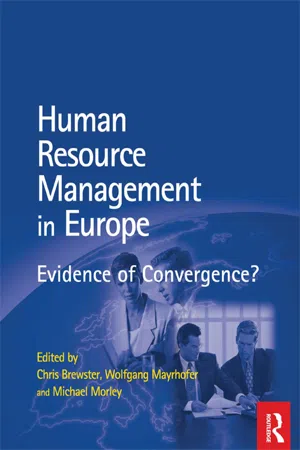
HRM in Europe
About this book
The increasing number of cross-border alliances and mergers both within Europe and between Europe and other parts of the world have made it imperative for students of management to have a thorough understanding of the European context for human resource management (HRM). This book enables managers and students to become "fluent" in the many various environments, approaches and practices that exist across Europe for managing human resources.
The text employs comprehensive comparable representative data collected longitudinally during the last decade and it also draws directly on the expertise of leading HRM scholars. Entirely fresh analyses of HRM in Europe, based on new and hitherto unpublished data are presented and this analysis is critically important for students, researchers and also for practitioners.
The book is divided into three parts: concepts and theoretical issues , trends in relation to these issues and comparisons between individual countries, and summaries and conclusions on the issue of convergence and divergence.
Part 1
1
Human Resource Management:
A Universal Concept?*
LEARNING OBJECTIVES
By the end of this chapter readers should be able to:
- Outline the origins of human resource management (HRM) in the US and some of the implications of that origin.
- Explain the concepts of universal and contextual HRM.
- Distinguish between hard and soft variants of HRM.
- Outline the differences between the convergence and divergence theories of HRM and the different models that have been mooted.
- Understand aspects of the European context for HRM.
- Understand the structure of the remainder of the book and how the book can be most effectively used.
INTRODUCTION
How are, and how should, people be managed? This is one of the most fundamental questions in the field of business management. After all, effective people management is an important, if not the most important, determinant of organisational success and it has been argued that it is one of the factors which distinguish the high-performing organisation. However, there is much complexity facing those responsible for people management. This complexity transcends both the strategic and the operational and includes key questions such as: What vision do we have for people management in the organisation? At what level should the specialist human resource (HR) function operate? How does HR contribute to organisational performance? How do we recruit, select, develop and reward for best fit? These issues and all their consequences for the organisation are the substance of “human resource management” (HRM) which may be interpreted in specific or general terms, referring to the professional specialist role performed by the HR manager or more generally to any individual who has responsibility for people management issues. Whatever the scope of our focus, management theorists have long argued that if one could develop people management systems that could be proved to be effective, they could be applied universally. In other words there is a belief that there is “a right way” of managing people that can be implemented by management consultants throughout the world.
This chapter traces briefly the origins of HRM and explores some of the basic questions about the universality of HRM. It also examines the context for HRM in Europe as a prelude to exploring the rest of the book.
HRM:THE US ORIGINS OF THE FIELD
Scientific management
In the early part of the 1900s, Taylor came to the conclusion that American industry was woefully inefficient because of the absence of any systematic approach to management. He observed the lack of a clear structure of command, resulting in confusion in the assignment of tasks combined with a general lack of skills in the workforce. Based on his work at the Bethlehem Steel Company (1900–1911), Taylor encouraged employers to adopt a more systematic approach to job design, employment and payment systems (Taylor, 1947). His experience at Bethlehem led him to develop four main principles of management which became the cornerstones of his subsequent work, namely: the development of a true science of work, the scientific selection and development of workers, the co-operation of management and workers in studying the science of work, and the division of work between management and the workforce. Described as “scientific management”, it was designed to enhance the efficient use of manpower. The task of management was to divide the work process into discrete tasks and, on the basis of time and motion studies, to analyse each task in terms of its skill and time requirements. The individuals being managed were to be assigned tasks and given the training required for the effective and efficient performance of those tasks and provided with a physical environment designed to maximise performance. Teamwork, or any form of co-worker consultation, was regarded by Taylor as unnecessary and even undesirable. Problems encountered by employees in the course of performing their tasks were to be immediately reported to supervisors who functioned as “troubleshooters”. The supervisors were also responsible for measuring individual task performance. Task performance over and above a prescribed level would trigger individual bonus payments.
It is difficult to gauge precisely the impact of scientific management but it would appear that derivatives of it continued to exert a powerful influence on American managers well into the 1980s – until the rise of HRM, in fact. From a HR perspective, the spread of scientific management placed greater weight on the careful selection and systematic training of employees. Associated with this trend was increased attention to job design, working conditions and payment systems. However, beyond the promotion of efficiency, scientific management has also been seen as the source of many of the problems associated with industrial work, such as high levels of labour turnover and absenteeism, and low levels of employee motivation. Indeed, the emergence and growth of alternative schools of thought can be traced to criticisms of or reactions to scientific management and to suggestions that improvements in organisational effectiveness could be achieved through greater attention to worker needs and, particularly, by providing workers with more challenging jobs and an improved work environment.
For our purposes here, HRM can trace its genesis to three major reactions to scientific management. The first of these surfaced as early as the late 1920s, forming the basis of what is popularly referred to as the human relations or behavioural perspective. The second was human capital theory and the third reaction centred on a consultancy text In Search of Excellence. Let us briefly examine each in turn.
The human relations perspective
In contrast to scientific management, the human relations movement focused on the human side of management and sought to provide insights into how social and psychological factors could be important in understanding and influencing workplace performance. Elton Mayo, a Harvard professor and a keen disciple of scientific management, along with his colleague, Fritz Roethlisberger, was called upon by the giant utility company General Electric (GE) to investigate the causes of chronic low productivity at its Hawthorne works. Commonly known as the Hawthorne Studies, and chronicled by Roethlisberger and Dickson (1939) in Management and the Worker, these investigations were to prove hugely significant in the evolution of management thought (Tiernan et al., 2001). Mayo assumed that the root problem lay in the physical context and that it needed fine-tuning. He divided the workers into two groups, an experimental and a control group. After explaining his general intentions to the experimental group in an amiable and respectful manner, he began systematically to improve their lighting, noting its effect on productivity. The resultant productivity improvement, combined with the corresponding lack of change in the control group, appeared to confirm the validity of scientific management. However, Mayo's decision to provide further verification by, after informing the experimental group, decreasing the strength of the lighting caused him to question the scientific management paradigm. This was because instead of the productivity of the experimental group declining, as had been confidently expected, it continued to rise.
Mayo concluded that what was happening was more complex than had been understood hitherto. Two effects in particular seemed to him significant. First, the fact that they were the subject of attention was a new experience for most of these workers. Previously, they had more or less been treated as living machines. Employees enjoyed the attention that was paid to them and worked more effectively as a result. Second, despite the intentions of the management at GE, employees had formed informal groups that exerted a powerful independent influence on individuals’ performance. Mayo surmised that individuals have needs over and above the purely material, i.e. they have social needs, or a need to belong. Not only had scientific management failed to take these needs into account, it had attempted to suppress them. Moreover, it had also failed to recognise that groups that are consulted and informed can generate a commitment that can be harnessed to the aims of the firm.
It is reasonable to say, however, that America's managers largely ignored Mayo's conclusions. They continued to be wedded to the tenets of scientific management. In later years the human relations perspective enjoyed a revival, not least in works by Maslow (1943) and McGregor (1960). Maslow emphasised needs over and above the purely materialistic, arguing that work must be designed in such a way that it provides opportunities for interest and personal growth. This was seen to be important on the basis of the existence of a series of needs ranging from instinctive needs for sustenance and security to higher-order needs such as self-esteem needs and the need for self-actualisation. Lower-order or fundamental needs, according to this theory, must be satisfied before higher-order needs can be activated and dealt with.
McGregor (1960) in his seminal contribution The Human Side of Enterprise focused on managerial assumptions about workers and the implications for managerial behaviour. He attacked the underlying assumptions of many American managers, which he referred to as “Theory X”. Core assumptions were, according to McGregor, that employees would never seek, let alone exercise, responsibility and were to be treated accordingly. McGregor argued that such assumptions were self-defeating and should be replaced by an assumption (Theory Y) that employees, given the right conditions, were more than willing to play a responsible role. However, although the ideas of this new wave of human relations theorists enjoyed some measure of academic influence, their impact on the hearts and minds of American managers was limited.
Human capital theory
During the 1970s economists began to turn their attention to the significance of HRs for productivity. Economic theory had traditionally regarded labour as a cost rather than an asset. Human capital theory challenged this view by pointing to the rapid post-war recovery of countries like Japan and Germany. Despite having had much of their physical capital stock destroyed during World War II, these countries recovered much more quickly than had been predicted by economists. Schultz (1971) argued that this could only be ascribed to the quality of these countries’ human capital. Moreover, it became apparent in international comparisons that these two countries were, when one controlled for the effects of traditional assets such as technology and hours worked, out-performing their competitors. It was argued that such differences stemmed first and foremost from the quality of the human capital at these countries’ disposal. Human capital economists dubbed the source of these differences “the black box” of economics because of the difficulties involved in assigning values to human capital. Indeed, even today these difficulties have not been overcome although efforts are still being made to do so, not least by leading consultancy firms in conjunction with valuing the assets of enterprises (Johanson and Larsen, 2000). In particular there is some conceptual confusion as to what constitutes human capital. The term “human capital” can be construed as an umbrella term encompassing competencies, values, attitudes, capabilities, information, knowledge and organisational processes that can be utilised to generate wealth. However, as Garrick and Clegg (2000) suggest, human capital capacities are only of value when integrated with financial objectives.
Given the imprecision of the concept of human capital it has, so far, shared the same fate as that of the human relations movement, namely to be consigned to an academic existence whose impact on managerial thinking was marginal.
In search of excellence
It was not until the early 1980s that the scientific management approach to management was seriously questioned by US management practitioners. In the light of chronic economic difficulties in the US, especially in comparison with the success of Japan, they experienced a severe crisis of confidence. Some 10 years after the human capital critique, it became received wisdom that Japanese firms were not only out-competing their American counterparts in terms of price but, more importantly, they were also surpassing them in terms of quality. This crisis of confidence finally opened the door to alternative approaches to management, many of which drew heavily on the ideas contained in the human relations perspective and human capital theory. One of the most influential responses to this threat came from two McKinsey consultants, Peters and Waterman, who attempted to discover the sources of excellence in those American firms that remained globally competitive. In their examination of these highly successful organisations, they unearthed eight cultural values (see box) that were viewed as significant.
Their findings suggested that in order to achieve quality, the structures of scientific management were consider...
Table of contents
- Front Cover
- Half Title
- Cranfield Network on International HRM
- Title Page
- Copyright
- Contents
- Preface
- Acknowledgements
- List of contributors
- Part 1
- Part 2
- Part 3
- Appendix 1 International survey methodology: experiences from the Cranfield network Olga Tregaskis, Caroline Mahoney and Sarah Atterbury
- Appendix 2 Cranet questionnaire
- Bibliography
- Index
Trusted by 375,005 students
Access to over 1.5 million titles for a fair monthly price.
Study more efficiently using our study tools.
Frequently asked questions
Yes, you can cancel anytime from the Subscription tab in your account settings on the Perlego website. Your subscription will stay active until the end of your current billing period. Learn how to cancel your subscription
No, books cannot be downloaded as external files, such as PDFs, for use outside of Perlego. However, you can download books within the Perlego app for offline reading on mobile or tablet. Learn how to download books offline
Perlego offers two plans: Essential and Complete
- Essential is ideal for learners and professionals who enjoy exploring a wide range of subjects. Access the Essential Library with 800,000+ trusted titles and best-sellers across business, personal growth, and the humanities. Includes unlimited reading time and Standard Read Aloud voice.
- Complete: Perfect for advanced learners and researchers needing full, unrestricted access. Unlock 1.5M+ books across hundreds of subjects, including academic and specialized titles. The Complete Plan also includes advanced features like Premium Read Aloud and Research Assistant.
We are an online textbook subscription service, where you can get access to an entire online library for less than the price of a single book per month. With over 1.5 million books across 990+ topics, we’ve got you covered! Learn about our mission
Look out for the read-aloud symbol on your next book to see if you can listen to it. The read-aloud tool reads text aloud for you, highlighting the text as it is being read. You can pause it, speed it up and slow it down. Learn more about Read Aloud
Yes! You can use the Perlego app on both iOS and Android devices to read anytime, anywhere — even offline. Perfect for commutes or when you’re on the go.
Please note we cannot support devices running on iOS 13 and Android 7 or earlier. Learn more about using the app
Please note we cannot support devices running on iOS 13 and Android 7 or earlier. Learn more about using the app
Yes, you can access HRM in Europe by Wolfgang Mayrhofer,Chris Brewster,Michael Morley in PDF and/or ePUB format, as well as other popular books in Business & Business General. We have over 1.5 million books available in our catalogue for you to explore.