eBook - ePub
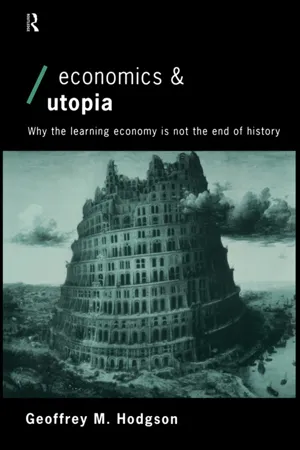
Economics and Utopia
Why the Learning Economy is Not the End of History
- 368 pages
- English
- ePUB (mobile friendly)
- Available on iOS & Android
eBook - ePub
About this book
Since the fall of the Berlin Wall we have been told that no alternative to Western capitalism is possible or desirable. This book challenges this view with two arguments. First, the above premise ignores the enormous variety within capitalism itself. Second, there are enormous forces of transformation within contemporary capitalisms, associated with moves towards a more knowledge-intensive economy. These forces challenge the traditional bases of contract and employment, and could lead to a quite different socio-economic system. Without proposing a static blueprint, this book explores this possible scenario.
Information
1: INTRODUCTION
History is that impossible thing: the attempt to give an account, with incomplete knowledge, of actions themselves undertaken with incomplete knowledge. So that it teaches us no short-cuts to Salvation, no recipe for a New World, only the dogged and patient art of making do. … Yes, yes, the past gets in the way; it trips us up, bogs us down; it complicates, makes difficult. But to ignore this is folly, because, above all, what history teaches us is to avoid illusion and make believe, to lay aside dreams, moonshine, cure-alls, wonder-workings, pie-in-the-sky – to be realistic.
Graham Swift, Waterland (1983)
The road to utopia is devious. I set out equipped with political philosophy and a liking for literary utopias, and arrived with the conviction that utopianism is a distinctive form of social science.
Barbara Goodwin, Social Science and Utopia (1978)
The ideological polarisation between socialism and communism, on the one hand, and capitalism, on the other, has dominated the twentieth century. Today, however, the People’s Republic of China remains the only major power still claiming attachment to a communist ideology, and even there private property and markets are now extensive and well established. The world is no longer so starkly polarised as it was from 1917 to 1989. Ideas of wholesale central planning and public ownership have become widely unpopular. Despite the fact that the Eastern Bloc may have been remote from the socialist ideal the events of 1989 and after have been associated with a further decline in faith in a socialist future. All forms of socialism and social-democracy have suffered, despite the numerous socialist critics of Joseph Stalin or Mao Zedong, and the many who have long proposed more liberal moderate or democratic versions of socialism. Their voices have hardly survived the disintegration of the Eastern Bloc.
Nowhere is this more clearly illustrated than in Sweden, where the Social-Democrats suffered a collapse of will and belief once the ideological guyrope of the Soviet Union gave way. This is despite their long tradition of proclaiming a third road – one divergent from both individualistic capitalism and Soviet-style ‘socialism’. Since 1945, Sweden had been widely proclaimed as the pioneer of a humane and radical version of social-democracy. But by 1989 even the advocates of a relatively egalitarian and democratic variety of capitalism were enduring a crisis of vision and purpose. As Ralf Dahrendorf (1990, p. 71) has remarked: ‘communism has collapsed: social democracy is exhausted’.
Nevertheless, the loss of confidence within social-democracy began earlier than the collapse in the East. In much of Europe and elsewhere, social-democracy has been in retreat since before 1989. The leaderships of many social democratic parties have abandoned many of their traditional goals. The British Labour government of 1974–79 rejected its own radical economic programme as early as 1975 and embraced monetarism by 1976. In 1981 the Socialist Party was elected to govern France, committed to Keynesian, reflationary, macroeconomic policies and an agenda of social and economic reform. Within a short time, these policies were largely abandoned, and the French government inaugurated a programme of privatisation of publicly owned corporations. All major socialist and social democratic parties have long lost their faith in their former core idea of public ownership. Proponents of capitalism have long set the terms of debate. The dramatic events of 1989 consolidated and reinforced a trend which was already well under way in several major European countries.
Strikingly, what has emerged out of the recent developments is the view that this is ‘the end of history’. Francis Fukuyama (1992, p. xiii) argued that liberal democracy marks the ‘end point of mankind’s ideological evolution’ and the ‘final form of human government’. Liberal democracy ‘remains the only coherent political aspiration that spans different regions and cultures around the globe’. Even before Fukuyama’s fashionable treatise, it was widely held that liberal–democratic capitalism is the normal or ideal state of affairs: once established and refined, it cannot be surpassed. What Fukuyama and his followers neglected, however, was that ‘liberal democracy’ is not a singular prospect. Itself it contains infinite possibilities and potential transformations. The ‘end of history’ phrase denies this.
It has also been proclaimed that there is no alternative to liberal democratic capitalism: something close to the politico-economic system in the United States is seen to be the ideal. As The Economist announced on 26 December 1992: ‘The collapse of communism brought universal agreement that there was no serious alternative to free-market capitalism as the way to organise economic life.’ This suggests an even more restricted set of options.
According to all these pronouncements, the protracted convolutions and sufferings of the years from 1917 to 1989 in the countries of the East amounted to little else but a long detour from the ideal or normal condition. It has thus been argued that neither the Eastern Bloc, nor the socialist movement as a whole, were ever on the road to a superior or even durable alternative future.
In such terms the ‘communist experiment’ in the East could be viewed in retrospect as an historical oddity. Consider an example of a much earlier deviation from the perceived mainstream of history. Established against the odds by the dedication of an army of crusaders, the Kingdom of Jerusalem survived as a substantial Christian state against hostile Saracens for nine decades (1099–1189). This almost forgotten Kingdom is now regarded as an atypical deviation from an otherwise unbroken millennium of Islamic power in the Middle East.
Similarly, a group of dedicated Bolsheviks secured power in Russia in 1917. They and their successors held out in their Communist enclave against the repeated and varied military and economic incursions of capitalism for 74 years. Just as the Kingdom of Jerusalem appears in retrospect as an awkward deviation from the course of history, so too the Soviet Union has begun to be treated as an unnatural aberration. The bifurcated, bipolar world of much of the twentieth century was displaced in the 1990s by a singular vision of capitalist ascendancy. Along the lines of a science fiction novel,1 it was as if history had previously made an extraordinary leap to an alternative universe at the time of the First World War, only to return again to the ‘normalcy’ of Western capitalism in the last decade of the century.
History itself seemed to oblige with dramatic endorsements of this view. Soon after the collapse in the East, civil war erupted in the former Yugoslavia, with vicious ethnic hatred that was tragically redolent of the earlier Balkan War of 1912–13. Furthermore, Europe as a whole experienced outbreaks of anti-Semitism and ethnic nationalism, again reminiscent of an earlier era. In the early 1990s Europe seemingly returned to the ‘normalcy’ of the years prior to 1917.
It was likewise with the balances of international power. Germany, the rising European nation of the 1871–1914 years, was repeatedly defeated and humiliated from 1918 to 1945. The country was divided from 1945 to 1989, but Western Germany gained relative and absolute economic strength. With reunification in 1989, Germany seemed to announce that it had fully rejoined with its own destiny, exhibited by the rising overall tendency of its political power. The earlier – seemingly aberrant – failures and losses had been overcome.
It is thus tempting to see the present world as a natural, inevitable and even permanent outcome, to which all past deviations have at last returned. From this point of view the end of both history and of utopia is declared. Tempting as it is, this perspective is untenable. It is fallacious not simply because it ignores the pace and consequences of technological and economic change. It also fails to recognise the manifest diversity of existing capitalist development, and the way in which each socio-economic formation is moulded unavoidably by its own history. This book elaborates these critiques.
SOME REMARKS ON UTOPIA
However, at least in conventional terms, no utopian scheme or blueprint is outlined in this work. The aim in this area is more modest: to review utopian thinking by way of a few key exponents and to raise the possibility of a more developed utopian discourse. This does not mean that the author is indifferent between varied proposals for an improved society. On the contrary, it is insisted here that critical engagement with, and evaluation of, such proposals are both desirable and ultimately unavoidable. Furthermore, this work attempts to identify some of the intellectual tools required for such an engagement.
Humankind has been inspired by the idea of a perfect society since ancient times, and especially since the sixteenth-century Utopia of Thomas More.2 Often such utopias have been socialistic or communistic in character, involving collectivist ideals and shared property. However, as Cosimo Quarta (1996, p. 154) rightly insists: ‘it must be understood that utopia is a much older and complex phenomenon than socialism’. Even today, as noted below, there are other, quite different, utopian proposals. Recognising that we are not confined to one set of possible scenarios, there is much to be said for an ongoing dialogue on such ‘idealistic’ and ‘utopian’ themes, removing many of the negative and pejorative associations of these words. But we must also learn from the errors and horrors of utopianism in the past.
As Zigmunt Bauman (1976, p. 10) has remarked, there is an essential ambiguity in the word ‘utopia’. One relates to its Graeco-Latin origin, as contrived by More: ‘a place which does not exist’. The other commonplace meaning is ‘a place to be desired’. These two meanings are not mutually exclusive. In this book we are concerned with the intersection of the two. ‘Utopia’ is here taken to mean a socio-economic reality that is both non-existent and alleged by some to be desirable.
A third connotation of the word ‘utopian’ is one of implausibility or unattainability. If adopted, this meaning would exclude any feasible alternative future, and is thus too restrictive. A useful distinction can be made between possible and impossible utopias, and there is no good reason to assume that the former category is empty. It is important not to confuse possibility with actuality. Contrary to those who are cynical about the possibility of change, or who have an excessive faith in the efficiency or virtues of the present, actual circumstances are a small subset of all possible circumstances. Non-existence is a question of fact, but such facts do not imply that non-existing and alternative systems are unfeasible. The pejorative use of the word ‘utopian’, as implausible or impossible, is rejected here.
The word ‘utopia’ fosters a likelihood of change, and points to an unfulfilled future that differs from the present. In general, a utopia is a description of a desired world to come: whether or not such prognostications are feasible and whether or not such a desire is shared by others.
Karl Marx and Frederick Engels were highly critical of what they called ‘utopian socialism’. Marx (1976a, p. 99) wrote disdainfully of those ‘writing recipes … for the cook-shops of the future’. Although sympathetic to the goals of the utopian socialists, these radicals were criticised by Marx and Engels for failing to root their ideal in an analysis of the real forces in capitalist society that could lead to their realisation. The term ‘utopian socialist’ was used by Marx and Engels to deprecate and dismiss proposals for a socialist future that were not based on a ‘scientific’ identification and analysis of the economic forces and political movements that could lead to their own realisation (Schumpeter, 1954, p. 206).
However, Marx and Engels took many presuppositions of the utopian socialists for granted, including the rational transparency and feasibility of socialism itself. As a result, ‘Marx and Engels thus left an ambiguous legacy in which vigorous attacks on utopianism accompanied utopian speculation’ (Geoghegan, 1987, p. 34). Even Marx’s analysis of capitalism is entwined with presuppositions concerning the nature of economic processes that pointed to a utopian future. Overall, the analysis is capped by the thesis that capitalism engenders its own negation and itself prepares the preconditions for the transition to communism. Marxism, in the words of Bernard Chavance (1985, p. 255), is a ‘utopia which is presented under the guise of an anti-utopia’.
Utopian thinking is typically associated with socialism and communism. However, the contrasting politico-economic schemes of pro-market libertarians can equally be described as utopian. Karl Polanyi (1944, p. 3) referred to the free-market ideal of many in the nineteenth century as ‘a stark utopia’. Robert Boguslaw (1965, p. 136–42) cited similarly ‘the utopia of laissez faire’. The utopia of the free market has had prominent exponents in both the nineteenth and twentieth centuries. For example, Krishan Kumar (1987, p. 49) noted that ‘the utopian element in “free trade” was especially clear in the writings and pronouncements of John Bright and Richard Cobden’. Vincent Geoghegan (1987, p. 3) pointed out that ‘Thatcherite conservatism is a glaring example of right-wing utopianism, with its summoning up of the supposed glories of Victorian Britain.’
Friedrich Hayek, the Nobel Laureate and intellectual champion of free-market individualism, was candid about his own utopian agenda. He also wrote: ‘it is probably no exaggeration to say that economics developed mainly as the outcome of the investigation and refutation of successive Utopian proposals’ (Hayek, 1933, p. 123). This same forceful idea reappears many years later:
Utopia, like ideology, is a bad word today; and it is true that most utopias aim at radically redesigning society and suffer from internal contradictions which make their realization impossible. But an ideal picture of a society which may not be wholly achievable, or a guiding conception of the overall order to be aimed at, is nevertheless not only the indispensable precondition of any rational policy, but also the chief contribution that science can make to the solution of the problems of practical policy.
(Hayek, 1982, vol. 1, p. 65)
Indeed, Hayek’s own utopian vision pervades his writings and it is much more considered and detailed than that of Marx. Unlike Marx, Hayek (1960) devoted a whole book to an exposition of his own utopian thinking. Whatever their virtues or failings, free market utopias have to be considered alongside socialism or communism. Subsequent chapters of the present work scrutinise utopias of both the socialist and free-market variety.
To some, market ultra-liberalism is ‘realistic’, while collectivism is the unreal scheme of dreamers. This is often a manifestation of ideological bias, based on the presumption that pure free-market economies are more feasible than those based purely on collective property. It is argued in subsequent chapters and elsewhere (Hodgson, 1984, 1988) that neither ‘pure’ extreme is feasible and that all economies necessarily involve a plurality of forms of property and systemic regulation.
Furthermore, ‘the market’ itself is not a pure and unambiguous entity. This fact is typically ignored by both critics and supporters of market systems. All markets are institutions and many types of market institution are possible. Be it of either distaste or admiration, ‘the market’ is not a singular object. Unless this is properly understood, that widely-used term ‘the market’ is potentially misleading. The singular term ‘the market’ has always to be used with qualification and caution.3
Likewise, the deceptive worldly rhetoric of ‘market forces’ invokes a physical metaphor, wrongly suggesting that all markets are subject to the same universal – as if mechanical – laws. On the contrary, not only do markets vary from time to time and place to place, but each market is set in a particular, and potentially variable, cultural context. This creates a wide variety of possible, internal market rules, routines and outcomes.
Furthermore, the notion of a singular and unfettered market system is mistaken. All markets involve rules and norms and are never fully ‘free’. Likewise, no market is entirely ‘chaotic’ or ‘anarchic’; all markets involve institutional structures. Both advocates and opponents of markets have to specify which type of market they advocate or oppose. The market is not a singular extreme, unambiguously representing one end of a utopian spectrum.
Leaving aside the precise features of any desired utopia – and without confining the notion of utopia to the socialist and communist proposals – the abandonment of any debate about socio-economic goals is both undesirable and impossible. The lack of such an ongoing dialogue creates a void in higher values and aspirations. In the modern, commercial epoch, such a vacuum is likely to be filled instead by a base individualistic ethic of monetary and material gain. The attempt to abandon all utopian thinking unwittingly opens the door to the hedonistic utopia of the selfish, disregarding, enjoyment of material wealth. Arguably, such materialism and individualism are more symptoms of social and moral decay than engines of economic growth.
The events of 1989–91 should not mark the end of utopian discourse. The absence of utopia is not a state to be desired. As Oscar Wilde argued a century ago in his essay ‘The Soul of Man Under Socialism’:
A map of the world that does not include Utopia is not worth even glancing at, for it leaves out the one country at which Humanity is always landing. And when Humanity lands there, it looks out, and, seeing a better country, sets sail. Progress is the realisation of Utopias.
(Wilde, 1963, p. 924)
Accordingly, as Bauman (1976, p. 13) noted: ‘Utopias revitalise the present. … The presence of a utopia, the ability to think of alternative solutions to the festering problems of the present, may be seen therefore as a necessary condition of historical change.’
To repeat: utopian thinking in some form is both desirable and unavoidable. But an important caveat is necessary. Utopianism itself has a deserved bad name because millions have died and suffered as the direct consequence of ruthless political movements led by idealists who were convinced that extreme measures were necessary to bring humanity to their version of the promised land. Wilde himself became a victim of an embittered ‘utopian’ pursuing the goal of an exclusively heterosexual society. As a result, four years after Wilde had published the above words he was in gaol. He died shortly afterwards.
Simply consider those describing themselves as followers of Marxism– Leninism. Their actions may not have been in accord with the word or spirit of Marx or of Lenin, but that is beyond the immediate point. The fact is that the name and alleged inspiration of Marxism–Leninism carry an appalling legacy. Perhaps as many as 100 million people have died since 1917 in assassinations, purges and famines, carried out in the name of that ideology: Stalin, Mao, Pol Pot. Stalin himself is now believed to be directly or indirectly responsible for the deaths of about 30 million people.4 Mao does not escape significant culpability: it is estimated that in the famines following Mao’s ‘Great Leap Forward’ in 1958–60 there were also around 30 million deaths.5 A significant proportion of humankind in the twentieth century has been sacrificed on the altars of utopia.
This negative legacy cannot be ignored. Utopian discussion is desirable, but only if the horrendous mistakes of the past can be avoided. A new and more cautious way of thinking about utopia is required. What is suggested here is the beginnings of what could be described as ‘meta-utopian’ discourse: the comparative theoretical examination of utopias and anti-utopias, rather than another detailed prescription of a Utopian blueprint. We may be able to articulate some general ideas and principles to guide and evaluate utopian thinking, unconfined to the values and constraints of a single utopia.6
In contrast, some have argued that all forms of utopianism should be entirely rejected: the discourse on and about utopias should be ended. It is suggested here, howe...
Table of contents
- COVER PAGE
- ECONOMICS AS SOCIAL THEORY
- TITLE PAGE
- COPYRIGHT PAGE
- ILLUSTRATIONS
- PREFACE
- 1: INTRODUCTION
- PART I: VISIONS AND ILLUSIONS
- PART II: THE BLINDNESS OF EXISTING THEORY
- PART III: BACK TO THE FUTURE
- NOTES
- BIBLIOGRAPHY
Trusted by 375,005 students
Access to over 1.5 million titles for a fair monthly price.
Study more efficiently using our study tools.
Frequently asked questions
Yes, you can cancel anytime from the Subscription tab in your account settings on the Perlego website. Your subscription will stay active until the end of your current billing period. Learn how to cancel your subscription
No, books cannot be downloaded as external files, such as PDFs, for use outside of Perlego. However, you can download books within the Perlego app for offline reading on mobile or tablet. Learn how to download books offline
Perlego offers two plans: Essential and Complete
- Essential is ideal for learners and professionals who enjoy exploring a wide range of subjects. Access the Essential Library with 800,000+ trusted titles and best-sellers across business, personal growth, and the humanities. Includes unlimited reading time and Standard Read Aloud voice.
- Complete: Perfect for advanced learners and researchers needing full, unrestricted access. Unlock 1.5M+ books across hundreds of subjects, including academic and specialized titles. The Complete Plan also includes advanced features like Premium Read Aloud and Research Assistant.
We are an online textbook subscription service, where you can get access to an entire online library for less than the price of a single book per month. With over 1.5 million books across 990+ topics, we’ve got you covered! Learn about our mission
Look out for the read-aloud symbol on your next book to see if you can listen to it. The read-aloud tool reads text aloud for you, highlighting the text as it is being read. You can pause it, speed it up and slow it down. Learn more about Read Aloud
Yes! You can use the Perlego app on both iOS and Android devices to read anytime, anywhere — even offline. Perfect for commutes or when you’re on the go.
Please note we cannot support devices running on iOS 13 and Android 7 or earlier. Learn more about using the app
Please note we cannot support devices running on iOS 13 and Android 7 or earlier. Learn more about using the app
Yes, you can access Economics and Utopia by Geoffrey M Hodgson in PDF and/or ePUB format, as well as other popular books in Volkswirtschaftslehre & Wirtschaftstheorie. We have over 1.5 million books available in our catalogue for you to explore.