Overview
Emotional intelligence (EI) has been taught for a very long time: ‘Since the beginning of civilization, parents and teachers have been helping children to better understand and control their emotions and those of others’ (Cherniss 2004: 319). Emotional intelligence helps to predict success in social situations because it reflects how a person applies knowledge to the immediate situation. Hence, if one wants to measure EI, one should measure the degree of common sense. Bar-On (1997) defined emotional intelligence as: ‘an array of personal, emotional, and social competencies and skills that influence one's ability to succeed in coping with environmental demands and pressures’. EI is therefore an important factor in determining one's ability to succeed in life and directly influence one's general psychological well-being in terms of overall emotional health. This construct implies that people have different abilities to perceive, understand and manage emotions.
Judging by the many websites which offer to teach emotional intelligence, the topic is seen as being vital to human development. Given the emphasis placed on emotional intelligence together with research indicating that emotional development starts from birth, there is an urgent need to examine not only emotional development in general but also the development of one aspect of emotional development, namely the growth of emotional intelligence in the context of child development.
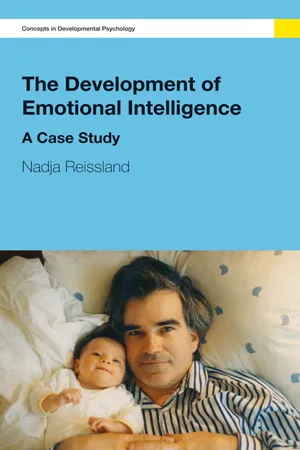
This book addresses some of the questions on the first steps taken in helping a baby becoming a person able to apply emotional intelligence in the day-to-day context. With this book, the reader will get an insight into how emotions are socialized in context and how emotional intelligence might grow in the context of a father's interactions with his daughter. Additionally, the role of a father, which has been less extensively studied (e.g. Pruett 1998) than the role of the mother in development generally and in emotional development particularly, will be discussed.
This book brings together two different types of inquiry: an academic overview of the topic of emotional intelligence in various contexts and a case study of one baby's development. The academic overview and the case study are reported in two parts of the book. The first part concerns emotional intelligence in terms of theories and published research mostly in refereed journals and to a lesser extent in books written by experts. The second part is about one child's journey on the road to becoming emotionally intelligent, reported through the eyes of her father. This part of the book is based on transcripts of tape-recordings, in which the father recounts his daughter's behaviour. The audiotapes are recorded by the father while he engages with his daughter, for example, while changing her nappy, dressing her, feeding her and playing with her from the time the baby is 1 month old to the time when she has reached 4 years of age and her father is dying of cancer. Given that all records are audiotapes, the baby's development is mainly reflected through the voice of her father and to a lesser extent through her vocalizations, with no direct observation of the child's behaviours.
Background to the Study of Emotional Intelligence
Research on the topic of emotional intelligence relates to questions of how people perceive, control and evaluate emotions. However, there is still extensive discussion on definitions of emotional intelligence, whether it is a valid concept and how it relates to cognition and social performance (Mayer et al. 2008). Various definitions of EI and the question of whether or not the EI construct is helpful in understanding development are topics addressed in Chapter 1. One aspect of EI that people at least in western society seem to agree on is that emotional development is essential for healthy psychological functioning. In order to show emotions in appropriate contexts, which is part of emotionally intelligent functioning, children need to be able to ‘read’ the emotions of others both in terms of being able to identify facial expressions and labelling emotions as well as listening to the pitch of voice in which the emotion is expressed. These developments will be discussed in more detail in Chapter 2. A number of studies have shown that healthy psychological functioning which is facilitated by emotional intelligence as well as psychological dysfunction, are closely related to health in general. For example, negative emotions lower the immune system of a person and lead to an increased risk of disease. In relation to children it has been linked to specific areas of functioning such as school performance. The topic of health will be discussed in Chapter 6.
EI in the Context of Emotional Development
In spite of the interest in the topic of emotional intelligence, the question of how an infant becomes an emotionally competent adult is still not clear. Although we do know that the influence of parents, as socialization agents, is crucial to infant development of emotion understanding and expression (Saarni 1999), the process of development needs still to be clarified. It is agreed that communication about emotions and social-emotional development begins at birth (Cohen 2003). A child's learning about emotions has been studied in the context of parental socialization of children's emotions. For example, Gottman and Declaire (1997) describe how a 2 year old's temper tantrum for her toy zebra is channelled into sleep by her father's empathetic understanding of her frustration. This topic in relation to the growth of emotional intelligence is explored in Chapter 3, where the language of emotional intelligence is discussed.
Novel Approach to Studying the Development of EI
The novel approach of this book is that, rather than analysing the child's behaviour directly, the father is used as a mirror in which we can observe the child's behaviour. Hence, I analyse language used by the father in order to identify how changes in adult language relate to the child's growing understanding of that language. It is the father's interpretations of his daughter's understanding which are used in this context. One might argue that the child does not understand anything at this early age. However, one might also argue that ‘understanding’ entails changes in behaviour based on pitch variations in speech and this is the level of understanding which I refer to in this book. Although clearly a 9-month-old baby does not have the vocabulary to understand her father's sophisticated speech, still the baby reacts to what the father says and this reaction is reflected in her father's comments on those reactions. Emotion words have been analysed extensively; less is known about the words which we use to describe emotions evoked by the melody of language. Words spoken with different intonation will evoke different understanding of those words such that asking a child to come and look can be said in a loving way or with surprise or anger for example. A young baby, who does not understand the vocabulary, will still understand the meaning of an utterance. Research has shown that in fact adults will disregard the actual words spoken at times. For example, responding to a greeting with ‘I am well’ will be interpreted as truthful or just polite depending on the intonation of the response. This leads to the surprising finding that babies, not knowing any words, and adults, knowing that the same word can have different meanings, rely more on the melody of language to derive meaning than 5 year olds, who are starting to become proficient in language, and who rely on the spoken words to understand the meaning of these words.
Emotional Discourse and EI
Emotional discourse is an important aspect of emotional development in general and the development of emotional intelligence in particular. According to Zeidner et al. (2003), early language-dependent skill learning is governed by reinforcement and modelling processes. In simplified terms, reinforcement helps the child to learn what is good or bad by getting praised or scolded. Modelling desirable behaviours means the child can imitate actions observed and behave accordingly. Subsequent insightful learning is influenced by emotional discourse with parents and others. Even though emotions are seen to be important their function in development has been neglected: ‘Although emotion is considered to be a corner stone of human experience many current theoretical models and the research bodies they have generated have not adequately considered the role of emotion in development and psychopathology’ (Southam-Gerow and Kendall 2002: 189–190). The latest interest in emotion has been fuelled by the concepts, among others, of emotional intelligence, emotional competence and emotional education in a variety of educational, scientific, medical and legislative domains (e.g. Buck 1993; Goleman 1995; Greenberg et al. 1995; Salovey and Sluyter 1997).
Emotion Socialization and EI
Emotion socialization occurs both through direct instruction and contingent responding as well as modelling and social referencing. A parent might tell the baby not to throw food from the high chair, or might smile when trying to elicit a smile from a baby or instruct the baby to say ‘thank you’ when receiving a gift. Infants often glance at their mother or father when they are uncertain of the situation and want to know whether it is, for example, safe to touch an unfamiliar toy. How to understand other people's emotions is related to an empathetic ability which allows people to ‘feel’ what other people might be feeling. This topic is discussed in Chapter 5 as well as in the case study. It has long been acknowledged that the melody of language teaches the baby about how to interpret daily events. For example, a mother will express her surprise in a higher pitch when the baby does not show surprise during play than when the baby has learned that the situation is surprising (Reissland et al. 2002). Mothers will talk in a higher pitch when they interact with their baby in a play situation than in an ordinary situation (Reissland and Snow 1996) and they will express information with varying pitch depending on whether they teach their infant about positive or negative events in the environment (e.g. Fernald 1992). One important part of the socialization of emotional functioning concerns the ability to regulate emotions, which is the topic of Chapter 4.
The Case Study
In spite of the fact that there is interest in emotional development in general and emotional intelligence in particular, very little research has been carried out concerning the beginnings of emotion as it develops into intelligent emotional functioning in a social context. This is the topic of the second part of this book. What does it mean for a child to become emotionally intelligent? How does a baby learn about emotions in the context of parent–child interaction from birth to 2 years of age? In order to examine this question the social context of first use of emotion words by the father and the development and change over a two-year period are examined from both the baby's and the parent's point of view. The data are based on daily tape-recorded ‘conversations’ between a baby daughter and her father. This case study shows clearly via the observations recorded by the father how over a two-year period a child learns to express and understand emotions in social interaction. This capacity to reason with emotion will be examined in four areas: to perceive emotion, to integrate it, to understand it and to manage it.
The Importance of the Father and EI
The importance of a father's influence on his child's emotional development should not be underestimated. In a study on fathers’ influence on their children's cognitive and emotional development in toddlers, Cabrera et al. (2007) argued that what was termed a father's ‘supportiveness’ was positively associated with children's emotional regulation at 2 years of age and in pre-school. In contrast, fathers who were deemed to be intrusive had a negative effect on their infants’ emotional development. Intrusiveness was negatively related to emotional functioning in terms of the ability to regulate their emotions when the child had reached 2 years of age.
The idea that different cultures manage emotions differently has been demonstrated eloquently in a book by Daniel Everett (2008), which discusses the Pirahã people, who seem to live in the present and who could be conceived of in western culture as heartless or cruel, but who according to Everett have just a different world view which serves them well in their society and their environment. Emotional intelligence is tactical, in that it relates to immediate demands of a situation, while cognitive intelligence is strategic, in that it relates to long term goals or abilities to plan for the future. In that sense the Pirahã, who according to Everett (2008) live more or less exclusively in the present with little regard for past or future, should show a high degree of emotional intelligence.
EI in Infancy
Although the concept of emotional intelligence has been extensively used in the context of adult education, helping to train high-level executives, emotional development begins from birth. However, there is a gap, in terms of the age at which emotional intelligence has been tested. Most research is concerned with adults, although the most recent addition to the EI inventory tests children as young as 7 years of age. Still, apart from Saarni (1999), very few studies have linked emotional competence to children below the age of 7 years and to my knowledge no one has looked comprehensively at the foundations of emotional intelligence from birth. This is reflected in some of the definitions of emotional intelligence, such as Mayer et al. (2008: 527), who state that: ‘Emotional Inte...