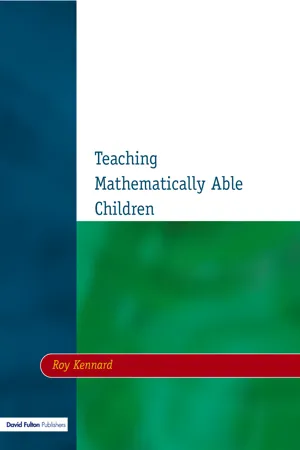
This work aims to help primary and secondary teachers to recognize and teach mathematically able pupils. Roy Kennard reviews the characteristics of the very able pupils and shows how these characteristics are reflected in the National Curriculum for Mathematics. He goes on to show how: mathematically able children can be challenged through problem solving and interactive discussion; and the use of in-depth case studies and other examples of pupils' work makes it possible for teachers to see the consequences of the approaches discussed.
This text also considers whole school organizational and leadership approaches and should be useful to school management teams or "gifted and talented coordinators." This revised and updated second edition should be of interest to teachers, advisers, lecturers and students with an interest in securing effective provision for mathematically able pupils.
- 96 pages
- English
- ePUB (mobile friendly)
- Available on iOS & Android
eBook - ePub
Teaching Mathematically Able Children
About this book
Information
Chapter 1
Perspectives on the characteristic mathematical abilities of able children
Mathematics as an activity
A starting point for the exploration of mathematical ability is the consideration of the nature of mathematics itself. The content of the school mathematics curriculum is recognisable to most people. In this sense we know what mathematics looks like. We recognise the facts, skills and conceptual structures that make up number, algebra, geometry and statistics. Facts are generally regarded as items of knowledge that must be remembered, while skills are seen as procedures that improve with practice. Both are embedded in a richly interconnecting network or conceptual structure (Cockcroft 1982). Typically, it is this content that is assessed through the traditional forms of testing and examining, and for many people this content is the mathematics. While this view of mathematics is popular it is also restrictive. In terms of throwing light on the nature of mathematical ability it is not very helpful.
A sound complementary case can be made for seeing mathematics as something more than pure content. The key point here is that mathematics may be viewed as an activity or as a set of interrelated processes. From this standpoint the content of mathematics is the outcome of this activity. The nature of this activity is readily revealed through reflection on the processes involved in creating mathematics at a personal level. That is to say, if the mathematical task is essentially one of problem solving or enquiry then stepping back from the mathematics itself and reflecting on the strategies involved will illuminate the nature of mathematical thinking. The key processes revealed by working in this way appear to be: searching for and recognising pattern; specialising; conjecturing; representing, including the use of symbols and diagrams; generalising; verifying; and proving (Bell et al. 1979; Mason 1985; Pirie 1987). If the processes referred to here are essential to making mathematics, can they also be regarded as abilities?
Two further questions arise at this point. First, is the picture complete yet? Has the full range of abilities been articulated? Secondly, do mathematically able children show such abilities to a greater degree than their relatively less able peers? If so, will a complete picture of the nature of mathematical ability help teachers in ordinary classrooms to identify mathematically able children?
The work of Krutetskii
Recent studies and sources of debate about provision for mathematically able children have all drawn on the work of V. A. Krutetskii (1976). This was a major study lasting 12 years that set out to describe the characteristics of 'mathematically gifted pupils as they solve various problems' (p. 78). His aim was to identify aspects of mathematical ability 'in which differences between pupils capable of learning mathematics and pupils less capable would be the most striking' (p. 84). Typically it is Krutetskii's conclusions that are referred to rather than the way he constructed his model of mathematical ability. He reveals that this was done by making certain assumptions, through initial probing experiments and observations of gifted primary school children and by reflecting on the essence of mathematical thinking. Table 1.1 summarises Krutetskii's model in these terms.
In developing his theory of logical-mathematical intelligence Gardner (1993) also sought to characterise mathematical ability by examining the essence of mathematics and the work of eminent mathematicians. His conclusions closely resemble many of the characteristics above, most notably: sensing the direction of a problem; sustaining long chains of reasoning; using mathematical notation;

specialising or breaking down a problem into simpler but related parts; abstracting general features from mathematical material; and remembering general arguments based on mathematical reasoning.
Krutetskii then devised a series of tests in which the abilities hypothesised reflected a view of problem solving corresponding to the three stages of interpreting, processing and retaining information. Analysis of the results of these tests confirmed the hypothetical model. He also found that capable pupils typically searched for the simplest or most economical solution and saw this as a consequence of the ability to think flexibly. Gifted pupils also exhibit a 'mathematical cast of mind', which enables them to view the world mathematically. This takes the form of a tendency to think in visual—spatial terms, logical—analytical terms or both. The abilities for visualising mathematical forms and for spatial concepts are not integral to Krutetskii's structure of mathematical abilities; he regards them only as indicators of a particular type of mind. In this context other researchers have found that pupils with a tendency to visualise mathematical material are under-represented in groups of high mathematical achievers (Presmeg 1986). Krutetskii also omits speed of thought, computational ability and a memory for numbers, symbols and formulae from his model. They might be useful but they do not characterise only the most capable pupils. With regard to memory, Krutetskii is clear that able pupils are characterised by a capacity to remember generalised approaches and patterns of reasoning rather than a capacity for the pure recall of specific information.
The structure developed by Krutetskii is a consequence of the responses of able and relatively less able children to his test items. His model seems to confirm the process abilities mentioned above, although not always in quite the same terms. The process of proving, for example, clearly relates to his component about the ability to reason logically. The process of generalising maps onto Krutetskii's category of the same name, but Krutetskii goes further with references to generalised approaches to problem solving. The processes of searching for pattern through the exploration of special cases leading to conjectures about possible relationships seems to correspond to his point about generalising from the study of examples. Symbolising or the use of symbols is a feature of mathematical activity and appears as an element of Krutetskii's model. Other research by Osborn (1983) suggests that mathematically able children are recognisable by their ability to manipulate symbolic representations of abstract quantities.
There does seem to be a case, however, for making these process abilities explicit and not subsuming them into Krutetskii's categories. Specialising, for example, is the generating of examples for further study, and is best carried out systematically to reveal patterns. International research supports the view that mathematically gifted pupils have the ability to work systematically (Span and Overtoom-Corsmit 1986). Mason describes conjecturing as the 'recognising of a burgeoning generalisation' (1985: 82) and it may be seen as the process of articulating possible relationships, and is thus associated with the supporting processes of checking and verifying. This area of overlap between Krutetskii's abilities and the notion of process abilities occurs because of attempts to describe the essence of mathematical thinking. The structure put forward by Krutetskii is, however, wider than the notion of process abilities arrived at by reflecting on mathematics as an activity.
Age
Krutetskii also considers the development of mathematical abilities with respect to age. The model of mathematical abilities referred to in Table 1.1 seems to be associated with able children of secondary school age. In the primary years, however, children as young as 8 years old may show embryonic forms of these components of mathematical ability Krutetskii observed that with appropriate teaching children's embryonic forms develop noticeably between the ages of 8 and 10. In seeking to describe the characteristic abilities of able children in the primary years he excluded exceptionally gifted children and did not attempt to 'strictly' relate specific characteristics to specific ages. His analysis focused on the characteristic abilities of generalising, perceiving the formal structure of a problem, curtailment of thinking, flexibility of thinking, striving for elegant solutions and mathematical memory.
The ability to generalise emerges earlier than other components of mathematical ability. Initially this takes the form of a child being able to recognise an instance of a general rule. Krutetskii observed that children exhibited the ability to work from particular cases towards an unknown general rule only from about the age of 11. The ability to generalise is closely associated with the ability to perceive formally the essence of mathematical material. Children as young as 8 years old can focus on the relationships between quantities without being held by the nature of the concrete objects involved. Less able pupils see only the objects, and not the relationships between them.
Curtailment of reasoning only appears in a rudimentary form in the primary years. Difficult problems are solved step by step. Some curtailment was noticed in the thinking of capable 9- and 10-year-olds, especially where there was familiarity with the problem type. Flexibility of thinking in terms of searching for alternative ways of solving problems was not observed in the thinking of 8-year-olds. The only exception to this was when researchers intervened, and in these instances children aged 8-10 did show signs of flexibility. Older children with a capability for mathematics demonstrate flexibility when they independently make fresh approaches to mathematical material and show that they are not limited by previous methods.
The tendency to search for the simplest or most economical solution to a problem is not a characteristic of able children in the primary years. Only from the age of about 11 onwards do able children exhibit this particular ability. Krutetskii also reports that for the primary years he did not observe a tendency for children to remember generalised approaches and patterns of reasoning. Children in these years tend to remember generalised results and the specifics of a mathematical situation. During the primary years children tend to remember both the 'general and the particular, the relevant and the irrelevant, the necessary and the unnecessary' (Krutetskii 1976: 339). Older children will tend to remember generalised approaches in such a way that if a result is forgotten it can be reconstructed.
For views on the characteristics of children in the infant years Straker (1983) reports the observations of teachers. Mathematical ability manifests itself in:
A liking for numbers including use of them in stories and rhymes; an ability to argue, question and reason using logical connectives: if, then, so, because, either, or . . .; pattern-making revealing balance or symmetry; precision in positioning toys, e.g. cars set out in ordered rows, dolls arranged in order of size; use of sophisticated criteria for sorting and classification; pleasure in jigsaws and other constructional toys.
(1983:17)
It is important to note that some of the above points do not entirely correspond to Krutetskii's model. Characteristics associated with 'liking' and 'pleasure' are of a qualitatively different kind to the features of ability so far discussed. While able children may show these traits they cannot be thought of as abilities. Sorting and classifying, however, may be seen as activities linked to generalising. They promote discrimination between objects in order to make general classifications.
Further teacher observations are reported by Straker, although the age group is unspecified, and once again these are a mixture of attitudes, character traits and abilities. Extracting only the references to ability in these teacher observations gives a picture of mathematical ability that emphasises flexibility and mathematical justification. Flexibility is described in terms of looking for alternative approaches and searching for the simplest solution. Mathematical justification is referred to in terms of reasoning from evidence. Able children are also described as frequently inquisitive in a mathematical way about the world in which they live; in Krutetskii's terms they exhibit a 'mathematical cast of mind'.
Recent guidance from the NNS, targeted at primary school teachers, says of mathematically able pupils that:
They typically:
- grasp new material quickly;
- arc prepared to approach problems from different directions and persist in finding solutions;
- generalise patterns and relationships;
- use mathematical symbols confidently;
- develop concise logical arguments.
(DfEE 2000b: 4)
Other guidance emanating from the National Literacy and Numeracy Strategies offers a similar model but adds that:
Pupils who are able in mathematics:
- develop logical arguments, often taking valid shortcuts;
- may not be exceptional in carrying out calculations, but may see calculations as detail and less important than the problem as a whole.
(DfEE 2000c: 2)
The NNS guidance does not distinguish between different year groups in the primary age phase. In this regard it seems to be suggesting that when pupils display the characteristics mentioned they may be regarded as more able in mathematics irrespective of their age. The NNS guidance clearly overlaps with Krutetskii's profile of abilities but, in a similar way to Straker's analysis, it also incorporates traits such as 'persistence'. It concurs with Krutetskii in that it does not see computational ability as an indicator of high mathematical ability but departs from his model for children under the age of 11 by including speed of thought, logical argument and the confident use of mathematical symbols. It must be remembered, however, that Krutetskii restricted his age-related study and that he avoi...
Table of contents
- Cover
- Title
- Copyright
- Contents
- Dedication
- Preface to second edition
- Acknowledgements
- Introduction
- 1 Perspectives on the characteristic mathematical abilities of able children
- 2 Mathematically able children and the National Curriculum
- 3 Pupils' self-perceptions
- 4 Teaching approaches that challenge mathematically able pupils
- 5 Organisational approaches for challenging mathematically able pupils
- 6 Case study 1: Working with able Year 9 pupils
- 7 Case study 2: Industry links
- 8 Case study 3: Working with able Year 6 pupils
- 9 A note on mathematical achievement and gender
- 10 Conclusion
- 11 A note on resources
- References
Trusted by 375,005 students
Access to over 1.5 million titles for a fair monthly price.
Study more efficiently using our study tools.
Frequently asked questions
Yes, you can cancel anytime from the Subscription tab in your account settings on the Perlego website. Your subscription will stay active until the end of your current billing period. Learn how to cancel your subscription
No, books cannot be downloaded as external files, such as PDFs, for use outside of Perlego. However, you can download books within the Perlego app for offline reading on mobile or tablet. Learn how to download books offline
Perlego offers two plans: Essential and Complete
- Essential is ideal for learners and professionals who enjoy exploring a wide range of subjects. Access the Essential Library with 800,000+ trusted titles and best-sellers across business, personal growth, and the humanities. Includes unlimited reading time and Standard Read Aloud voice.
- Complete: Perfect for advanced learners and researchers needing full, unrestricted access. Unlock 1.5M+ books across hundreds of subjects, including academic and specialized titles. The Complete Plan also includes advanced features like Premium Read Aloud and Research Assistant.
We are an online textbook subscription service, where you can get access to an entire online library for less than the price of a single book per month. With over 1.5 million books across 990+ topics, we’ve got you covered! Learn about our mission
Look out for the read-aloud symbol on your next book to see if you can listen to it. The read-aloud tool reads text aloud for you, highlighting the text as it is being read. You can pause it, speed it up and slow it down. Learn more about Read Aloud
Yes! You can use the Perlego app on both iOS and Android devices to read anytime, anywhere — even offline. Perfect for commutes or when you’re on the go.
Please note we cannot support devices running on iOS 13 and Android 7 or earlier. Learn more about using the app
Please note we cannot support devices running on iOS 13 and Android 7 or earlier. Learn more about using the app
Yes, you can access Teaching Mathematically Able Children by Roy Kennard in PDF and/or ePUB format, as well as other popular books in Education & Education General. We have over 1.5 million books available in our catalogue for you to explore.