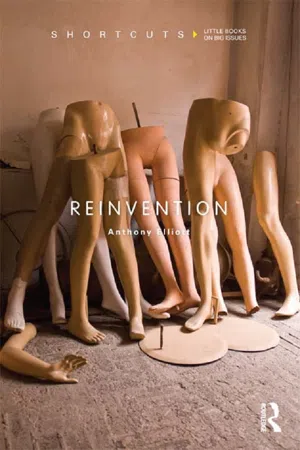
Ours is the era of 'reinvention'. From psychotherapy to life coaching, from self-help manuals to cosmetic surgery, and from corporate rebranding to urban redesign: the art of reinvention is inextricably interwoven with the lure of the next frontier, the breakthrough to the next boundary – especially boundaries of the self.
In this insightful and provocative book, Anthony Elliott examines 'reinvention' as a key buzzword of our times. Through a wide-ranging and impassioned assessment, Elliott reviews the new global forms of reinvention – from reinvention gurus to business reinvention, from personal makeovers to corporate rebrandings. In doing so, he undertakes a serious if often amusing consideration of contemporary reinvention practices, including super-fast weight loss diets, celebrity makeovers, body augmentations, speed dating, online relationship therapies, organizational restructurings, business downsizings, and many more.
This absorbing book is an ideal introduction to the topic of reinvention for students and general readers alike. Reinvention offers a provocative and radical reflection on an issue (sometimes treated as trivial in the public sphere) that is increasingly politically urgent in terms of its personal, social and environmental consequences.
Our culture of reinvention is perhaps nowhere more evident than at the level of the body, which consumer society presents as a key site for enhancements, transformations and remouldings. From patented crèmes to diet pills to breast implants, ours is the age of body reshaping, recontouring, upgrading and updating. Reality television programmes, such as 10 Years Younger, Extreme Makeover and Cosmetic Surgery Live, advance this cultural preoccupation with changes to the body. Magazines and tabloid newspapers relentlessly track possible cosmetic and surgical enhancements to celebrity bodies. Billboards worldwide advertise digitally enhanced, photoshopped images of slender, sleek and stylized bodies. To be sure, the body has become the personalized space of self-reinvention par excellence.
This preoccupation with refashioning and reinvention – the era in which “drastic plastic” reigns supreme – was momentarily brought into stark confrontation with itself in 2011, when news spread across the globe of a mother injecting her eight-year-old daughter with Botox. The mother, a beautician based in the UK, was reportedly using Botox and other fillers on her daughter's face – injecting her forehead, lips and around the eyes – in order to improve the girl's chances of winning a child beauty pageant. The child, according to the mother's account, would one day become a star as a result of these cosmetic measures. Media reports also noted that the child underwent a “virgin wax monthly”, so as to prevent any possible development of pubic hairs prior to the child reaching puberty. Indeed, the mother discussed in interview the possibility of her daughter undertaking in the near future procedures such as eyebrow waxing, as well as top-end surgical procedures including breast implants.
This media story, perhaps hardly surprisingly given the child's age, generated strong disbelief in some, horror in others, and moral outrage in many. Part of the cultural shock over this little girl's regular injections of Botox, arguably, concerned an uncomfortable societal awareness of the pervasiveness of a disturbed relationship with bodies – to such a degree that disaffection now infiltrates attitudes towards children's bodies too. Yet in addition to such awareness, there might also have been some appreciation – and related fear? – of the infinite plasticity of the body. Today, regularly and routinely, advertising and media inform that the human body can now be reinvented however one chooses. Bodies are open to improvement, remoulding, resculpting, enhancement and transformation. There are, literally, no limits to body reinvention. You are the architect of your own body – its shape, contours and appearance – and so it is you, in our culture of intensive new individualism, that will be judged favourably on looking good – or not!
In this chapter, I shall examine some key features of contemporary transformations to bodies in our time of intensive reinvention. The chapter introduces two areas of current bodily transformation and reinvention: the first section examines the cosmetics industry; the second section reviews cosmetic surgical culture and the makeover industries. Throughout I shall consider the rich variety of bodily transformation practices from the standpoint of reinvention society.
The skin game
In 2011, supermodel Kate Moss appeared on billboards and in glossy magazines worldwide advertising cosmetics and perfume for Christian Dior. The marketing campaign was “Dior Addict”, in which – with Brigitte Bardot inspired cat-eyes and pouting lips – Moss gazed directly at the camera/viewer, gripping a lipstick designed to cast her as an ever-so-famous addict. In one stroke, Moss managed to combine sex appeal and addiction, mixing glamour with vulnerability in stylized proportion. The “Dior Addict” marketing campaign captures well the extent to which addiction now functions as a kind of “cultural shorthand” for fashionable reinvention. From cosmetic maintenance to diet fads to plastic surgery, we can see an addiction to “body redesign” turned into profit.
Consumer culture, according to the late French sociologist Jean Baudrillard, multiplies and accelerates the compulsive excesses of body reshaping. Baudrillard's notion of a “hyperreal world” – of contemporary women and men obsessed with the hyper-slim, the hyper-fit and the hyper-sexual – is one of addiction incarnate. Consumerism and addiction, on this viewpoint, sit together cheek by jowl. In contemporary societies of reinvention, consumer culture is rendered sublime, charged as it is with reconciling the complex contradictions of desire and disappointment, emotion and emptiness. If there is something intoxicating about consumerism it is not only because it trades in extravagant expectations, but because it deceives as well as seduces. Simultaneously holding out the promise of scintillating style and yet frustrating fulfilment at every turn, consumerism inhabits a terrain of lethal ecstasy – each repeated frustration of desire helping to unleash, in turn, new desires or fresh appetites. Consumer culture thus seduces, enthrals, overwhelms and, ultimately, traumatizes.
If consumer culture in contemporary society diagnoses the human body as flawed, the cosmetics industry is on hand with purported solutions of repair. Successful cosmetics companies, in offering quick-fix solutions to signs of bodily ageing, build upon a deep cultural anxiety that bodies require ongoing work in order to measure up to contemporary standards of health, beauty and sex appeal. From patented crèmes to celebrity-endorsed lotions, the cosmetics industry brands beauty as a personal project of self-realization and self-reconstruction, as something that with ongoing effort – cash, care and discipline – can be achieved. From this angle, the advertising and promotion of cosmetic products – lipstick, mascara, blusher colours – underscores the various sites of the body that demand ongoing “beauty work”. Indeed, sociologist Celia Lury has argued that today we witness a sharp proliferation of areas of the body to which the cosmetics industries offer beauty products and solutions. Lips, eyelashes, finger nails, skin, cheeks, shoulders, elbows, armpits, legs and feet: these and other body-parts, as represented in advertising from the cosmetics and style industries, require continual attention, work, repair and renewal.
Against a global media backdrop of unprecedented visual scrutiny of bodies and commercial imagery of sex, the widespread cultural anxiety that body-parts require ongoing, routine and vigilant work or attention is raised to the second power. “Maintaining one's body” has become a central preoccupation of contemporary women and men, and there are two key ways in which the cosmetics industry promotes this urge to self-maintenance, self-enhancement and self-remaking. The first is through reference in advertising and promotions to the “threats” of ageing, and its associated connections with bodily decay. As a result of the intricate connections between beauty, youth and sex appeal, so some cultural analysts have argued, people (and especially women) are put on “high alert” to detect any signs of ageing and related “bodily faults”. Here the youth aesthetic – which directly ties age to sexual beauty – is pivotal to the selling of cosmetics.
The second way in which the cosmetics industry underscores the cultural dynamics of reinvention is through positioning consumers as recipients of the latest scientific breakthroughs and developments in beauty. In this way, the emotional and aesthetic work of bodily reinvention is framed in terms of keeping appearances up-to-date with recognized scientific knowledge. In this connection, advertising focused on beauty creams offering non-invasive alternatives to cosmetic surgery has played an important part in redefining bodily reinvention. Consider, for example, the marketing of skincare products by Rodial, a company that has been spectacularly successful through its representation of the scientific efficacy of high-tech, fast-acting products that result in body recontouring without surgery. Rodial offer consumers hungry to purchase a desirable body a range of options – from “Arm Sculpt” (a product containing “Lipocare” and which promises to “banish bingo wings”) to “Boob Job” (which offers an increase of up to half a cup size after 56 days) to “Tummy Tuck” (which can reduce “the abdominal area by up to 2cm in 8 weeks”). Such purported fixes are lifted straight from the cosmetic menus of plastic surgery, a cross-referencing designed to entice consumers. A triumph of hype over substance? There are many who think so, to such an extent that consumer complaints about Rodial led to an investigation by the UK's Advertising Standards Agency in 2011. Even so, the buying of such expensive beauty creams that promise instant transformation remains vast.
In many ways, the cosmetics industry is increasingly dependent for its revenue upon the latest techno-scientific developments in the field of cosmetic plastic surgery. The increasing intrusion of the claims of cosmetic plastic surgery into the marketing of cosmetics is part and parcel of the commercial logics to influence women and men to spend cash on body-maintenance and body-transformation. Again, consider some of the following advertising claims (selected somewhat randomly from fashion magazines) for skin-care products:
“Surgery can wait! You laugh, you frown, your brow furrows … your skin contracts and wrinkles deepen. Our solution? Wrinkle De-Crease.”
“Pump it up 40%: Up to 40% Plumper Lips Collagen Effect.”
“Try the latest advances in non-surgical facelift treatment.”
“My Lips Are In Perfect Shape: My Lips Look Fabulously Full and Perfectly Contoured.”
“As good as surgery: airbrushed perfection in an instant.”
From the ideological standpoint of such advertising language, it is clear that we live today in a world in which beauty is increasingly intricately interwoven with the aesthetics of cosmetic surgery. From this angle, women (and increasingly men) are rendered “desirable” only to the extent that the project of anti-ageing and its marketing-related strategies of reinvention are adopted and followed. Consumer society requires a salutary stiffening of the resolve of individuals: to knuckle down and reverse all signs of ageing, to identify and destroy indications of mortality. In globalized consumer society, these strategies may be many and varied, but they increasingly draw inspiration from and reference cosmetic surgery. This now provides a convenient transition to a more detailed examination of the rise of cosmetic surgery and makeover culture.
Drastic plastic
As an indication that the reinvention impulse of consumer culture goes all the way down – into the very contours of the body – one need only consider the phenomenal rise of cosmetic surgery and related makeover industries. Whilst not as large as either the cosmetics or diet industries, cosmetic surgical culture is both truly global and booming. The total worldwide market for cosmetic surgery and its associated invasive technologies was valued at
35 billion in sales for 2010. If cosmetic surgery represents big business in the twenty-first century, this is partly because of its remarkable proliferation of offerings and diversification in services. Not that long ago cosmetic surgery was essentially synonymous with facelifts (rhytidectomy) or nose jobs (rhinoplasty), and was largely the preserve of the rich and famous. Today cosmetic surgery has also come to mean Botox, breast implants, liposuction, tummy tucks, penile enlargements and thigh and buttock lifts. Moreover there has been a noticeable democratization of cosmetic medicine, with a wholesale shift in the availability of such services to the mass market, often financed on credit cards and personal loans. Hence cosmetic surgical culture is the arrival of an age in which consumers are willing to go into debt to finance their desires for flatter stomachs, bigger breasts and younger looking faces.
What does this tell us about the world we live in? Some critics view the spread of cosmetic surgical culture as symptomatic of the lures of narcissism, of a culture held in thrall to the superficialities of appearance. Cosmetic surgical culture, however, rejects the charge that it is superficial. Nowadays, or at least many advocates of makeover culture argue, appearance and identity are increasingly interwoven; the design of appearance becomes a “project of identity”. Yet even if this is so, it is informative if one compares – drawing from figures released by the International Society of Aesthetic Plastic Surgeons – the different kinds of bodily reinvention purchased through cosmetic surgery around the globe. Throughout North America and the UK, breast implants and liposuction are the most popular surgical procedures. (In the US, the American Society for Aesthetic Plastic Surgery estimated that there were 318,123 breast augmentations performed in 2010. In the UK, the British Association of Aesthetic Plastic Surgeons estimated that 9,418 underwent breast augmentations in 2010.) Yet this is not the case in countries such as Japan, China or India, where instead rhinoplasty (nose augmentation) and blepharoplasty (modification of the eyelid) are more common.
The UK's love affair with cosmetic surgical culture has been reflected throughout the early 2000s in the routine doubling of patient numbers requesting surgical procedures (see Elliott 2008). Yet if cosmetic surgical culture brooks large in the UK, its hold is even more dramatic throughout Europe in general. Time magazine ran a feature, “Europe's Extraordinary Makeover”, which documented unprecedented numbers of individuals demanding elective cosmetic surgery during the early 2000s. Countries such as France, Germany, Spain and Turkey all outstripped Britain in their consumption of the culture of nip and tuck. Interestingly, it is among the younger generation that we find the most passionate embracement of surgical culture.
Cheaper and more widely available than ever before, cosmetic surgery has fast become a lifestyle choice. For good or ill, celebrity culture has been central in this connection, with its novel blending of Botox and bling transforming various aspects of today's cultural landscape. What is under continual review here is the reinvented body. Magazines such as Who Weekly and People, as well as television programmes such as E News and Entertainment Tonight, document the surgical enhancements and cosmetic transformations of celebrities. Makeover TV programmes likewise cast the body as a site of transformation and reinvention. Programmes such as American network ABC's Extreme Makeover and the UK Channel 4’s Ten Years Younger, which deployed cosmetic procedures to “redesign” women, as well as various cable offerings including Cosmetic Surgery Live, The Swan and MTV's I Want a Famous Face, show in microscopic detail bodies as pumped, plucked, pummelled, suctioned, stitched, shrunk and surgically augmented. Advanced plastic surgery, high-tech cosmetic enhancements to the body, cosmetic dentistry and novel exercise and diet regimes are routinely used in such programmes to artificially enhance beauty, to resculpt the body and to restructure the self.
If celebrity-inspired cosmetic surgery is a dominant symbol of contemporary culture, this is because it runs all the way down into routine social practices – such that the human body is today increasingly cast as infinitely plastic and pliable. Plasticity is of course good news to mainstream commercial life, and there are few more profitable areas of contemporary consumer culture than where the makeover industries intersect with shopping. The consumer industry and consumer markets undertake continual cross-referencing of products, labels, brands and services to the cosmetic resculpting and reconstructing of the body. The whole commercial language of cosmetic surgical culture is relentlessly focused on episodic change, the purchase of one-off transactions. Cosmetic procedures – from Botox and collagen fillers to liposuction and breast augmentation – are increasingly reduced to a purchase mentality. There's now an emergent generation of consumers who might be called the Plastic Generation, who treat cosmetic surgery as on a par with shopping: consumed fast and with immediate results. Jennifer Hayashi Danns's Stripped, an autobiographical account of the culture of lap-dancing clubs, underscores the “instant gratification” connected to the purchase of breast implants. The incessant talk of breast implants in the lap-dancing industry, according to Danns, means that women feel they are purchasing the equivalent of a new car or designer handbag when deciding to go under the surgeon's knife. This is a trend which now percolates throughout the wider culture, especially with breast implants rendered normative through online pornography and reality TV shows.
The reinvention message peddled by cosmetic surgery and the makeover industries is arguably especially ironic. The marketing spin from various makeover industries is that there is nothing to stop you reinventing yourself however you choose. If there are advantages in being able to re-sculpt your body according to your own self-design, however, there are also restrictions. Perhaps most significantly, surgical enhancements of the body are largely fashioned with the short-term in mind. They are, literally, until “the next procedure”. Any patient or client returning from a cosmetic procedure performed by a top surgeon in, say, Harley Street London or Beverley Hills is today likely to do so with more than mere bandages and wounds. For many cosmetic surgical institutes now dispatch their patients home with a magazine, catalogue or sometimes DVD – in which is outlined other cosmetic procedures by which one can keep one's surgically enhanced body up-to-scratch. Even so, surgical culture combines brilliant technology with dramatic self-fashioning, medical advances with a narcissistic understanding of the self as a work of art. The current cultural fascination with cosmetic surgery represents the struggle of fantasy against reality, the pyrrhic victory of society over biology.
The explosion in cosmetic surgery currently unfolding holds a mirror to the social logics of reinvention unleashed by globalization, with its blurring of fact and fantasy, culture and biology. Certainly there was a moment in the early 2000s when it looked as though cosmetic surgery and its related makeover culture was about to establish a new orthodoxy as regards beauty and body norms. For a period, a brash new sensibility over-determined by cosmetic surgical culture – and increasingly evident throughout fashion, film, pop music, cosmetics and the like – ruled. But that period has today been brought low, and largely as a result of the excesses of the cosmetic surgical and makeover industries themselves. In 2011, for example, a media scandal erupted concerning ruptures in breast implants made by a French company, Poly Implant Prosthesis (PIP). It emerged that the PIP implants were not made with medical-grade silicone (as required by European law), but rather industrial-grade silicon, which is used for example in the manufacture of mattresses. The scandal linked the faulty implants with cancer, as it emerged that more than 30,000 women in France had undergone breast implants with industrial silicone. Various public protests unfolded across Europe, and health agencies in France, Germany, the Czech Republic and elsewhere recommended the immediate removal of faulty implants.
In the meantime, as with the bulk of global media scandals, talk of health risks and medical dangers flourished as regards cosmetic surgery. Anti-ageing injections and related facial fillers were linked in 2012 with serious health complications, infections and deformities. Fears about the safety of various non-surgical cosmetic procedures intensified, as did public debate regarding the regulation of unqualified cosmetic practitioners. Such media scandals have also drawn attention to the long-term emotional consequences of the so-called “instant gratifications” of cosmetic surgical culture, as scars and deformities are in turn linked ...
Table of contents
Front Cover
REINVENTION
SHORTCUTS
Dedication
Title Page
Copyright
CONTENTS
Foreword
Acknowledgments
Introduction: The rise of reinvention
1 The reinvention of bodies
2 The reinvention of persons
3 The reinvention of careers
4 The reinvention of corporations
5 Networks of reinvention
6 The reinvention of places
Conclusion: The reign of reinvention
Further reading
References
Index
Trusted by 375,005 students
Access to over 1.5 million titles for a fair monthly price.
Study more efficiently using our study tools.
Frequently asked questions
Yes, you can cancel anytime from the Subscription tab in your account settings on the Perlego website. Your subscription will stay active until the end of your current billing period. Learn how to cancel your subscription
No, books cannot be downloaded as external files, such as PDFs, for use outside of Perlego. However, you can download books within the Perlego app for offline reading on mobile or tablet. Learn how to download books offline
Perlego offers two plans: Essential and Complete
Essential is ideal for learners and professionals who enjoy exploring a wide range of subjects. Access the Essential Library with 800,000+ trusted titles and best-sellers across business, personal growth, and the humanities. Includes unlimited reading time and Standard Read Aloud voice.
Complete: Perfect for advanced learners and researchers needing full, unrestricted access. Unlock 1.5M+ books across hundreds of subjects, including academic and specialized titles. The Complete Plan also includes advanced features like Premium Read Aloud and Research Assistant.
Both plans are available with monthly, semester, or annual billing cycles.
We are an online textbook subscription service, where you can get access to an entire online library for less than the price of a single book per month. With over 1.5 million books across 990+ topics, we’ve got you covered! Learn about our mission
Look out for the read-aloud symbol on your next book to see if you can listen to it. The read-aloud tool reads text aloud for you, highlighting the text as it is being read. You can pause it, speed it up and slow it down. Learn more about Read Aloud
Yes! You can use the Perlego app on both iOS and Android devices to read anytime, anywhere — even offline. Perfect for commutes or when you’re on the go. Please note we cannot support devices running on iOS 13 and Android 7 or earlier. Learn more about using the app
Yes, you can access Reinvention by Anthony Elliott in PDF and/or ePUB format, as well as other popular books in Scienze sociali & Cultura popolare. We have over 1.5 million books available in our catalogue for you to explore.