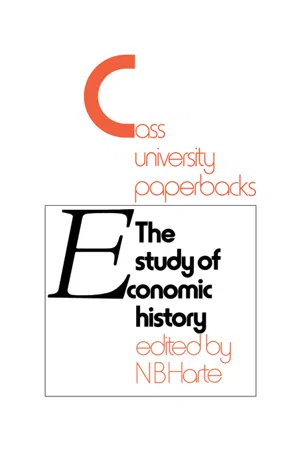
- 385 pages
- English
- ePUB (mobile friendly)
- Available on iOS & Android
eBook - ePub
1
ON THE STUDY OF ECONOMIC HISTORY
(Harvard, 1893)
This inaugural lecture was delivered at Harvard University on the 4th January 1893.
ON THE STUDY OF ECONOMIC HISTORY
THE teacher in England or America who seeks to explain his attitude towards economic science does so at the present time under peculiarly favourable conditions. There reigns just now a spirit of tolerance and mutual charity among political economists such as has not always been found within their circle. It is not that we have returned to the confident dogmatism and unanimity of the last generation,—of the period which extended from the publication of John Stuart Mill’s treatise to the sounding of the first note of revolt in Cliffe Leslie’s essays. It is rather that, though there are still marked divergencies, the followers of one method no longer maintain that it is the only method of scientific investigation; that, on the other hand, the believers in induction now recognize more fully the value of deduction; that the most abstract sometimes refer to facts and the most concrete occasionally make use of abstraction; and, what is far more important, that they are inclined, whatever their own turn of thought may be, to let others alone who walk not with them, or even to cheer them on their way in the benevolent hope that they may arrive at something worth the getting. It has now become almost a commonplace even with economists of the older school that students may usefully be led to work in different ways, owing to ‘varieties of mind, of temper, of training, and of opportunities.’1 In England an association has at last been founded which includes among its members most of those writers and teachers who are seriously interested in economics, and a journal has been established which welcomes contributions from every side with admirable impartiality. In America an association, which has for some years been doing excellent work, but which has hitherto been a little one-sided in its membership, has just widened its borders, and brought in even those against whose teachings it was once its business to protest. The controversies which break the monotony of life for our German colleagues have now but a faint echo among English-speaking economists; the personal anatgonisms which separate French schools are altogether absent; and to most of us the recent exchange of hostilities between two distinguished English economists has seemed almost an anachronism. It is, therefore, with something of trepidation that I venture upon what may possibly look like a renewal of old controversies. Yet it is encouraging to think that, even if one had something very ‘extreme’ to say, one might now count upon being heard with patience and urbanity.
It would be idle to deny that the hopes which were entertained by the younger men of the ‘historical’ or ‘inductive’ school in Germany some twenty years ago, and by Cliffe Leslie and more recently by Dr. Ingram among English writers, have not hitherto been realized. They looked for a complete and rapid transformation of economic science; and it needs only a glance at the most widely used textbooks of to-day to see that no such complete transformation has taken place. Of this disappointment a partial explanation may be found in the fact that the historical economists were still so far under the spell of the old discipline as to continue to conceive of economics under the forms made familiar by the manuals. They still had before their eyes the customary rubrics of Production, Distribution, and Exchange; they still handled the sacred terms Value, Supply, Demand, Capital, Rent, and the rest,—terms which, to use Oliver Wendell Holmes’s phrase, were just as much in need of depolarization as the terms of theology; they still looked forward to framing ‘laws’ similar in character, however different in content, to the ‘laws’ in possession of the field. Aiming, as they unconsciously did, at the construction of a body of general propositions dealing with just the same relations between individuals as the older school had given its attention to, it was natural that they should fall back on the use of that deductive method which is certainly of service for the analysis of modern competitive conditions, although they had begun by unnecessarily rejecting it. And thus the ‘methodological’ arguments of the orthodox may seem to have gained an easy victory.
I shall attempt to show later that this is not an adequate version of the matter; that during this period the historical movement has been slowly pushing its way towards it own true field of work. Even in its relation to current economic teaching, it has performed a work of vital importance. It has been no mere aberration, passing away and leaving no trace; nor is it quite a complete account of it to say that it has contributed useful elements which have been incorporated in the body of economic science. It has done more than this: it has changed the whole mental attitude of economists towards their own teaching. The acceptance of the two great principles,—which are but different forms of the same idea,—that economic conclusions are relative to given conditions, and that they possess only hypothetical validity, is at last a part of the mental habit of economists. The same is true of the conviction that economic considerations are not the only ones of which we must take account in judging of social phenomena, and that economic forces are not the only forces which move men. It need hardly be said that all this was recognized in word long ago; but it may be left to the verdict of those who are conversant with the literature of the last generation whether these convictions were really underlying and fruitful parts of daily thought, as they are now tending to be. The remark, indeed, is not out of place in passing that, although this salutary conversion may be discerned among professional economists, it has hardly taken place so completely as one could wish with the educated public, and that historical zealots may still do good service in insisting on these well-worn platitudes.
The altered mental attitude of the theoretic economists themselves towards their own doctrine is so much the most important result, from the point of view of current teaching, of the historical movement that it dwarfs its other effects in the same direction. But these other effects are well worth looking at; and they are evident enough, if we turn over the two most important of modern treatises, the Principles of Professor Marshall and the Lehrbuch of Professor Wagner. Professor Marshall so clearly realizes that the understanding of modern conditions is assisted by a consideration of their genesis that he introduces his work by two chapters on ‘The Growth of Free Industry and Enterprise,’ and by another chapter on ‘The Growth of Economic Science.’ So, again, his discussion of Population is preceded by a history of the doctrine, and a history of population itself in England. His treatment of Industrial Organization consists largely of historical reflections. The theory of Distribution is introduced by a sketch of its history, and the doctrine of Rent is considered in relation to early forms of land tenure. With Professor Wagner the influence of historical thought is even more marked. As every one is aware who has had occasion to consult the recent volumes of his Finanzwissenschaft, his accumulation of historical material has grown so fast that it is threatening to become unwieldy. A more convincing evidence of his familiarity with historical modes of thought is presented in many parts of his treatment of general theory; e.g., in his acceptance of the position that ‘capital,’ as it is now understood, is an ‘historical,’ and not an eternally necessary ‘category.’ He even attempts to formulate an historical law,—a law of the course of economic evolution,—and that in a matter which touches modern problems very closely; to wit, his ‘law of the increasing extension of public and state activity.’ That Wagner should to-day be regarded, and should regard himself, as a champion of abstraction and deduction as against the ‘extreme Historismus,’ though just enough in the main, has in it something of the irony of circumstances. It reminds one of the observation of John Stuart Mill that the great advantage from the presence of extremists is that any course short of the extreme gains the charm of ‘moderation.’
It need hardly be said with regard to the examples just given that, suggestive as such historical reflections and generalizations may be, they are not to be regarded as necessarily either accurate or desirable methods of using historical material. They illustrate, however,—and that is all I wish to show,—the influence, to a large extent the unrealized influence, of the Zeitgeist even over writers who wish to carry on the old traditions.
In the wider issue of the comparative merits of induction and deduction, it may be observed that conservative economists themselves no longer employ the sweeping language in favour of deduction which characterized their predecessors. They have discovered, like M. Jourdain with his prose, that in one very important field, that of Production, they have been inductive all along without knowing it.2 It is further allowed by recognized authorities that ‘within the province of descriptive and classificatory economics there is unlimited scope for valuable economic work.’3 And, accordingly, we see a series of useful studies in modern industrial life,—studies largely historical,—appearing under the highest economic patronage.4 Even the pages of the Harvard Quarterly Journal of Economics,—the peculiar home of theory,—furnish articles on the history of the tariff or of the currency; though it must be allowed that even the severest theorists have sometimes coquetted with facts when they approached these particular topics. It is true that we are cautioned that ‘the knowledge of particular facts, which is thus afforded, does not in itself constitute the end and aim of economic science.’5 But we will not be distressed by this if only the work of inquiry will go on. It marks the awakening,—or the reawakening,—in American and English economics of a sacred passion for the observation of real life, of which it has too long been devoid.
I have, however, already remarked that, while thus affecting the character of the teaching of economic theory, the historical movement has pursued its way, and is now settling down into a channel of its own. This is none other than the actual investigation of economic history itself. This may, perhaps, be a somewhat surprising remark. It may be asked, ‘What, then, have the economists of that school been doing hitherto?’ It will, however, I think be found that the creators of the school were rather men who had been touched by the historical thought around them, and inspired by its ideas, than original investigators. This was not to their discredit: it was the result of the situation. But to-day the leaders of the school are throwing themselves into detailed research, and are feeling their way towards independent historical construction. We have only to look at the publications of Professor Schmoller, of Berlin, and of the body of fellow-workers he has gathered around him, or at the large programme of inquiry into agrarian history which Professor Knapp, of Strasburg, and his circle have put before themselves,6 to discover how strong is the current in this direction. And with this serious engagement in historical inquiry has come a clearer perception of the nature of the generalizations towards which that inquiry must work. It is seen that these will not be mere corrections or amplifications of current economic doctrines: they will rather be conclusions as to the character and sequence of the stages in economic development. The point of view is here no longer that of a bargain between individuals in given social conditions, but of the life and movement of whole industries and classes, of the creation and modification of social mechanism, of the parallel progress and inter-action of economic phenomena and economic thought. The studies of the school are no longer individualist and psychological, but collectivist and institutional. To help out my meaning by two hackneyed but convenient phrases, the ‘laws’ of which they think are ‘dynamic’ rather than ‘static’; and they aim at presenting the ‘philosophy’ of economic history. And, thus, their interest in any one period is not that they may compare it with the present or any other period, but because every period may furnish them with points from which they may determine the curve of economic evolution.
It has been inevitable that, with such an ideal before him, the leader of this newer historical school, Gustav Schmoller, should sometimes have spoken slightingly of the attempt to continue the old work of deductive argumentation: it was inevitable that the theorists he has in mind should retort with language of equal confidence in the superior merits of their own methods. It is often hard for a man to recognize that he pursues a particular line of thought chiefly because his own mental gifts lie in that direction. It is very natural that he should feel that the task towards which he is himself drawn is the most urgent and beneficent of all tasks. But when Professor Schmoller, instead of being submissive to the lessons read to him, remarks that it is useless to expect progress from ‘the further distillation of the already-a-hundred-times-distilled abstractions of the old dogmatism,’7 and declares very plainly that those who attempt the process lack a wide philosophical training,8 he uses language, which, as Matthew Arnold said on a somewhat similar occasion, has certainly ‘too much vivacity,’ and is sure to create soreness. And when Professor Menger retorts by inventing for the labors of his opponent the pleasing terms ‘miniature-painting’,9 ‘micrography.’10 and specialissima about some gilds or other,’11 he can hardly be acquitted of a certain acerbity.
It is surely time to cry a truce to controversy. Let it be acknowledged that for a long time to come there are likely to be many honest and hard-working and intelligent men who will be interested in economic theory: let it be acknowledged, likewise, that there are likely to be a number,—small, indeed, in America and England, but still noticeable,—who also are honest and hard-working and not altogether unintelligent, who will be interested in economic history. Let us try for the next twenty years to leave one another severely alone, and see what will come of it. If we have time, let us read one another’s books. Perhaps we shall be converted: perhaps we shall only get a suggestion here and there; but, if we cannot agree, let us be silent. We shall, at any rate, gain some little additional time for our own inquiries; and meanwhile the general progress of human thought may quietly bring a solution. And yet I would hardly be supposed to imply that the controversy of the last few years has been a waste of words. A good deal of fighting was necessary before the right of the historical economist to a fair field was recognized in England and America. I should not be surprised to hear that in Germany some few years ago there was the opposite evil,—a too complete exclusion of economic theorists from places of academic influence. But now that an armistice can be signed on honourable terms, it were well to do so. Harvard must receive the credit of having been the first among universities to realize the altered situation. It has been the first to see the wisdom of having both attitudes—the theoretical and the historical—represented in a great institution of learning. Its action is the more commendable because it has been determined upon at the instigation of teachers already in possession of the territory, whose own intellectual sympathies are chiefly on the side of theory. They have shown a confidence in free inquiry, and an understanding of the true nature of a university, which are still rare.
But such a truce ought not certainly to prevent any of us from frankly expressing his own private opinions to any student who cares to ask for them. And the opportunity to make one’s own position plain upon assuming new duties in a new sphere is so rare that it may fairly be brought within the same exception. It must be remembered that I...
Table of contents
- Cover
- Halftitle
- Title
- Copyright
- Contents
- Preface
- Introduction : The Making of Economic History
- 1 On the Study of Economic History (Harvard, 1893)
- 2 The Position and Prospects of The Study of Economic History (Oxford, 1908)
- 3 The Aims of Economic History (Edinburgh, 1908)
- 4 The Study of Economic History (Cambridge, 1929)
- 5 The Study of Economic History (Oxford, 1932)
- 6 The Study of Economic History (L.S.E., 1932)
- 7 On Medieval History as a Social Study (L.S.E., 1933)
- 8 The Historical Method in Social Science (Cambridge, 1939)
- 9 Economic history at Oxford (Oxford, 1946)
- 10 The Relation of Economic History to Economic Theory (L.S.E., 1946)
- 11 The Sixteenth and Seventeenth Centuries: The Dark Ages in English Economic History? (L.S.E., 1956)
- 12 The Study of Modern Economic History (Bristol, 1958)
- 13 Progress and the Individual in Economic History (Edinburgh, 1959) 219
- 14 The Place of Economic History in Historical Studies (Nottingham, 1960)
- 15 Time and Place (Leeds, 1960)
- 16 The Historian’s Profession (Strathclyde, 1963)
- 17 Economic History—A Science of Society? (Sheffield, 1964)
- 18 History and the Social Sciences (Leicester, 1965)
- 19 Economic Growth: The Economic and Social Historian’s Dilemma (Nottingham, 1966)
- 20 Economic History as a Social Science (Swansea, 1967)
- 21 Living with the Neighbours: The Role of Economic History (Oxfovd, 1970)
- Index
Trusted by 375,005 students
Access to over 1.5 million titles for a fair monthly price.
Study more efficiently using our study tools.
Frequently asked questions
Yes, you can cancel anytime from the Subscription tab in your account settings on the Perlego website. Your subscription will stay active until the end of your current billing period. Learn how to cancel your subscription
No, books cannot be downloaded as external files, such as PDFs, for use outside of Perlego. However, you can download books within the Perlego app for offline reading on mobile or tablet. Learn how to download books offline
Perlego offers two plans: Essential and Complete
- Essential is ideal for learners and professionals who enjoy exploring a wide range of subjects. Access the Essential Library with 800,000+ trusted titles and best-sellers across business, personal growth, and the humanities. Includes unlimited reading time and Standard Read Aloud voice.
- Complete: Perfect for advanced learners and researchers needing full, unrestricted access. Unlock 1.5M+ books across hundreds of subjects, including academic and specialized titles. The Complete Plan also includes advanced features like Premium Read Aloud and Research Assistant.
We are an online textbook subscription service, where you can get access to an entire online library for less than the price of a single book per month. With over 1.5 million books across 990+ topics, we’ve got you covered! Learn about our mission
Look out for the read-aloud symbol on your next book to see if you can listen to it. The read-aloud tool reads text aloud for you, highlighting the text as it is being read. You can pause it, speed it up and slow it down. Learn more about Read Aloud
Yes! You can use the Perlego app on both iOS and Android devices to read anytime, anywhere — even offline. Perfect for commutes or when you’re on the go.
Please note we cannot support devices running on iOS 13 and Android 7 or earlier. Learn more about using the app
Please note we cannot support devices running on iOS 13 and Android 7 or earlier. Learn more about using the app
Yes, you can access Study of Economic History by N.B. Harte in PDF and/or ePUB format, as well as other popular books in History & Economic History. We have over 1.5 million books available in our catalogue for you to explore.