- 112 pages
- English
- ePUB (mobile friendly)
- Available on iOS & Android
eBook - ePub
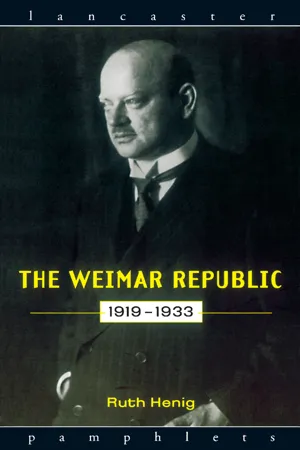
The Weimar Republic 1919-1933
About this book
This book represents a much-needed reappraisal of Germany between the wars, examining the political, social and economic aims of the new republic, their failure and how they led to Nazism and eventually the Second World War. The author includes:
* an examination of the legacy of the First World War and the Treaty of Versailles
* discussion of the early years of crisis culminating in the Ruhr Invasion and the Dawes Settlement
* assessment of the leadership of Stresemann and Bruning
* exploration of the circumstances leading to the rise of Hitler
* an outline of the historiography of the Weimar Republic.
1
The birth of Weimar
A dynamic but deeply divided society
The unification of Germany ushered in a period of unprecedented economic and industrial expansion. On the eve of the First World War, the German Empire was Europe’s most dynamic and rapidly growing industrial power. Coal production had increased since 1871 by 800 per cent, and the output of 277 million tons in 1914 almost rivalled the British volume of output, far eclipsing France’s 40 million tons and Russia’s 36 million. More electricity was generated than in Britain, Italy and France combined. In steel production, German furnaces turned out two-thirds of the European total, a greater output than the combined totals of Britain, France and Russia. German electrical and chemical industries led the world in their inventiveness and in the quality of their products.
Accompanying this massive economic growth was an equally impressive increase in population from 41 million in 1871 to almost 65 million in 1910, a rise of 50 per cent. By the eve of the First World War, around 60 per cent of this population lived in towns or cities as compared to just over one-third in 1871 and were seeking employment in industry and in handicrafts rather than in agriculture. By the end of the war, Germany’s urban-based population was in percentage terms the second largest in the world, behind the United States of America. Such profound economic and population distribution changes could not fail to have the most far-reaching social, political and economic consequences.
The political facade of a united German Empire after 1871 concealed deep-seated regional divisions. The new constitution was based on a federation of twenty-five states, dominated by Prussia, which occupied three-fifths of the new territorial unit and contained three-fifths of its population. But smaller states clung tenaciously to their considerable financial and legal powers and to their distinctive local identities. Before 1914, there were no fewer than four German armies – those of Prussia, Bavaria, Württemberg and Saxony which were united only under the supreme command of the German Emperor. It was not until the First World War that one national army emerged, and only in the new constitution of 1919 that a single Reich army was firmly established under the supreme command of the President.
There were deep religious and ethnic divisions in the new empire. While the majority of the population embraced Protestantism, there were strong Catholic concentrations in the west and south of Germany, and from the outset the Catholic community operated politically through its own Catholic Centre Party. The Polish communities in the east and the Danish population in northern Germany also developed their own political and social organisations, and the French population of Alsace and Lorraine remained until 1918 totally unreconciled to rule from Berlin, a sentiment shared to a surprising degree by the indisputably German inhabitants of Bavaria and of Hanover.
Opposing political interest groups, shaped to a large extent by social and economic factors, also emerged strongly in the German Empire after 1870. The stronghold of conservative movements was to be found in the East Elbian provinces of Prussia, based on the large landed estates and their allied rural networks dominated by the old-established and well-connected Junker families. These powerful traditional agricultural elites were determined to maintain their dominant political position in the new Germany, but found themselves under increasing attack from more liberal forces representing the growing professional and commercial classes in the new empire. The pace of economic development which Germany experienced in the decades after 1870 greatly strengthened the liberal camp as against their conservative rivals, but it also introduced a dynamic new contender for political power, the Social Democratic Party representing the growing army of workers being recruited to workshops and to factories. As the population of Germany rocketed, the proportion of the German electorate voting for mainstream conservative and liberal parties declined from 60 per cent in the later 1880s to only 38 per cent in 1912. The Social Democratic Party, who gained a third of the votes cast in the 1912 election, had emerged as Germany’s largest political party. In its commitment to sweeping, indeed revolutionary, economic and political change, it threatened the entire political and economic structure of Wilhelmine Germany, a structure the conservative elites were determined to retain intact.
Rapid social and economic change and modernisation compounded the growing political tensions. The agrarian sector increasingly lagged behind its dynamic industrial and commercial counterparts. As Junker estates struggled to meet the growing challenge of cheap food and grain imports, their political leaders became more determined than ever to uphold their political and social power, and to make no concessions to liberal or socialist forces. The growing middle class found itself torn in many different directions, some industrialists and professional groups wishing to make common cause with the agrarian social elites, some opting to continue to support the National Liberal Party or, on religious grounds, the Catholic Centre Party, and yet others wishing to move in a more progressive direction and offer some concessions to the working class. Political choice was to a considerable extent influenced by location – whether an individual lived in a large city, smaller community or in a rural area – and by occupation, whether in a dynamic, rapidly-growing sector of the economy or in a more traditional job. Yet by 1914 a substantial and growing proportion of the middle class felt itself to be increasingly on the defensive against hostile economic and social forces.
The huge growth in working-class power was perceived to be the greatest political and economic challenge facing the German Empire by the turn of the century, and many historians have cited it as one of the main spurs driving German leaders to contemplate involvement in war in 1914 in a desperate bid to uphold their supremacy. Yet the working class was itself divided by religion and by region, and the great mass of the rank and file was in fact more concerned to pursue immediate trade-union demands than to endorse revolutionary Marxist principles. Furthermore they were as susceptible to nationalist propaganda as were their social superiors and for the most part regarded themselves as German workers, or as natives of Bavaria or Schleswig, rather than as workers of the world.
Thus the regional, religious and social divides which had been such a pronounced feature of the German Empire in 1871 had by 1914 been overlaid by new economic and political divisions. On the eve of the First World War, Germany was a society in transition. Agriculture was giving way to industry, artisans’ guilds to mass manufacture in factories, family businesses to commercial conglomerates and corporations. People were moving to towns and to cities, and in consequence their economic status was often at variance with their position in society, sometimes for the better, and sometimes not. Yet Germany remained in many ways a very traditional and hierarchical society, in which the occupational status of the head of the family defined and confirmed the position of all family members. As Thomas Childers has pointed out, ‘family background in Germany was officially measured by fathers occupation, not income. In a society where profession was listed in telephone directories along with family name, occupational status loomed very large indeed.’
Political and social change could not be kept at bay indefinitely. Sooner or later, working-class demands were bound to challenge the power of the predominantly landed ruling elites in Germany. At the same time, new economic elites were emerging, whose growing commercial wealth posed a different set of challenges to the agrarian elites. The failure to resolve these struggles for political and economic supremacy in the years before 1914 left a dangerous political legacy which had the potential to destabilise any subsequent regime. Furthermore, at the very time when a new political structure was urgently demanded, Germany faced defeat, and had experienced a lengthy and economically ruinous war, which left behind its own set of grave economic, political and social problems on top of the existing ones. It was not an auspicious start for the introduction of democracy.
The impact of the First World War
The German Chancellor, Bethmann-Hollweg, had worked hard in the weeks after the Sarajevo murders to persuade the German people that Germany had no choice but to fight a defensive war against the encircling Entente Powers, and particularly against reactionary, expansionist Russia.
The German population enthusiastically endorsed the government’s decision to declare war, and on 4 August, 1914, the representatives of the workers sitting in the Reichstag under the banner of the SPD voted in favour of war credits.
This display of patriotism by the SPD Reichstag deputies had a number of fateful consequences. Committed Marxist members of the party were opposed from the outset to involvement in what they saw as a capitalist war against fellow workers in neighbouring countries. As the war dragged on, those who were ideologically opposed to it were able to gain considerable support for their views, and in 1917 they broke away from the main body of the SPD to form the Independent Social Democratic Party, or USPD. The divisions between the USPD and the SPD grew steadily wider as the war came to an end and added to the political and economic tensions which erupted across the country in the autumn of 1918.
At the beginning of the war, however, unity and patriotism characterised the mood of the country. The Kaiser was gratified that he saw only Germans, not parties; the socialists, whom he had dismissed as ‘unpatriotic fellows’ before the war, now appeared to be supporting it as enthusiastically as the rest of the population. This brief outburst of national solidarity and purpose remained strong in peoples memories. Though it quickly gave way to stoic endurance and later to increasing social and economic unrest, the myth burned brightly of a Volksgemeinschaft, or people’s community, bound together in pursuit of a clear set of national objectives. It was reinforced by the experience of soldiers in the trenches, drawn into close comradeship by the hardships and dangers they faced day after day. Throughout the 1920s, the image of a united German people selflessly pursuing a common destiny in war, on the battlefields and in the factories and workshops at home, was repeatedly contrasted with the allegedly shabby political compromises and self-seeking deals of Weimar politicians. It was a contrast that some extreme nationalists, and in particular the former First World War corporal, Adolf Hitler, exploited particularly effectively.
The scale and duration of the war quickly exceeded all expectations. The failure of the SchliefFen plan to defeat the French army within the first few weeks of combat led to stalemate on the western front, and to fighting on two widely separated battle fronts, in northern France and Belgium, and in Poland and western Russia. This was the military nightmare the German General Staff had sought so desperately to avoid. As the war dragged on, 13 million men in total were called up to serve in the German army, or nearly 20 per cent of Germany’s 1914 population. Inevitably, there were large numbers of casualties, around 2 million killed and nearly 5 million wounded. Life in the trenches or on the eastern front took its toll; even those who escaped serious injury suffered gas attacks, or severe bouts of frostbite. By 1918, the great German army was beginning to experience significant problems of recruitment and morale. Hundreds of thousands of soldiers tried to buy their way out of combat, or to disappear from view while home on leave.
Throughout the 1920s, the new regime struggled to support the millions of men who could no longer work because of their war injuries, the 600,000 war widows and around 1.2 million children orphaned during the war. These people and their families believed passionately that the sacrifices made during the war should be acknowledged and to some degree recompensed. But in the economic climate of postwar Germany, this was asking for more than governments could afford without heavy tax increases. The economic consequence of the First World War was to impoverish Germany: in 1919, real national income was only two thirds of what it had been in 1913, and industrial production had shrunk to two-fifths.
To pay for the war, German leaders resorted to heavy borrowing in the confident expectation that victory would enable them to pass on their debts to their defeated enemies. The immediate effect was to trigger off massive inflation. In 1915, prices in Germany rose in one single year by more than they had over the previous forty-five years. By the end of 1918, the German mark had lost about three-quarters of its 1913 value. As price rises and in particular the costs of housing, fuel and food outstripped wage increases, unrest spread, particularly in the urban areas. By the end of the war, with real earnings having declined by between a quarter and a half in value, up to a third of the inhabitants of many major cities were surviving only by means of family support payments from the government, and the food shortages experienced particularly during the winter of 1917–18 drove millions to the edge of starvation.
But the misery was not seen to be equally shared. While millions suffered, a few were still able to afford ostentatiously luxurious holidays at fashionable spas or in elegant Baltic seaside resorts. It was said that ‘everything is still available in any amounts at a high price’ .By the end of the war, according to Kocka, the Visible luxury of a few contrasted sharply with the increasing hardship of the masses’.There were other causes of social resentment. The importance of heavy industrial production to a successful war effort enabled union leaders to protect the wages and conditions of their members to a certain extent.Those on fixed incomes, however, who derived their living from rents, investment income or pensions saw an alarming erosion in their wealth by the end of the war.
The Russian revolutions of 1917 sent strong shock waves through the industrial centres of Germany They fanned the flames of worker unrest and contributed to a total of over 550 strikes by the end of the year. In January 1918, more than a million workers were on strike across the country; the response of the military authorities who were now running the war was to redouble efforts to win an outright victory. To Colonel Bauer, one of Ludendorff’s principal assistants, the choice was clear: victory would bring ‘a long and secure peace, with firm, purposeful government at home’. A compromise or negotiated peace, on the other hand, would force Germany ‘to drop militarily and politically out of the concert of great powers, decline into economic misery and drift towards a Bolshevik regime …’.
But with the United States now in the war, victory proved to be beyond Germany’s capabilities. Instead of driving on to a glorious triumph, in the course of the summer of 1918 Germany’s military leaders Hindenburg and Ludendorff found themselves facing a humiliating defeat. As Germany’s allies Bulgaria and Austria-Hungary collapsed, her military options narrowed dramatically. She could fight on to the bitter end, risking invasion and significant territorial losses, or she could sue for the best peace terms available.
Faced with this stark choice, the German military commanders made two crucial decisions which had fateful consequences for their political successors. They decided that the most palatable peace settlement was likely to be gained from American President Woodrow Wilsons Fourteen Points speech of January 1918 which contained proposals which they had previously condemned as a front for ‘imperialistic conquest in the guise of peace’ and as serving the interests of ‘Anglo-Saxon world hegemony’. And secondly they concluded that a civilian-based government would have more chance of securing a relatively lenient peace than a military one. Accordingly, the Reichstag leaders of those parties which had supported a peace resolution in July 1917 were suddenly transformed in late September 1918 from national traitors to responsible ministers, commanded by the desperate military authorities to take over the reins of government under the chancellorship of Prince Max of Baden and to sue for peace on the basis of Wilson’s Fourteen Points.
Though the German army had been on the retreat since the late spring of 1918, it was still surviving in reasonable order, and had not yet been forced back into Germany. In handing over responsibility to the political parties at this crucial point in time, Ludendorff proved himself to be far more politically astute than the politicians. He adroitly shifted the blame for defeat onto their shoulders. As he explained to his military staff: ‘I have advised His Majesty to bring those groups into the government whom we have in the main to thank for the fact that matters have reached this pass… . Let them now conclude the peace that has to be negotiated. Let them eat the broth they have prepared for us.’ Thus the highest military authorities in Germany were already accusing the liberal, centre and left-wing party leaders of causing defeat by their demand for a negotiated peace in 1917 and by their refusal to give the army all-out support. It was not long before nationalist groups throughout Germany were elaborating on this ‘stab in the back’ administered by pacifists and socialists to the valiant army in the field, and asserting that defeat could have been averted, even victory secured, had it not been for the mood of defeatism and the sparks of revolution deliberately fanned by traitors at home.
The German revolution of 1918–19
The six months from October 1918 to March 1919 witnessed turbulent revolutionary activity across Germany, fierce struggles between socialists and nationalists and moves to establish a new constitutional state. This period is referred to as the ‘German revolution’, but in fact there were three different revolutionary processes in train, each with its own aims and agenda.
There were first of all those seeking far-reaching constitutional changes, initially seeking to reform the monarchy and make it more accountable to Parliament, but then, after the abdication of the Kaiser, in early November 1918, pressing for the setting up of a Constitutional Assembly to pave the way for a democratic republic. These were the aims of the Reichstag leaders entrusted with the task of negotiating a peace with President Wilson, broadly supported by the Catholic Centre, Progressive Liberal and Social Democratic parties.
However, the reluctance of the Kaiser to accept any changes, and an ill-judged attempt by the admiralty to order a last-ditch naval challenge by the High Seas Fleet to the British navy triggered off a second more radical revolutionary process. It seemed to the sailors at Kiel and to the war-weary workers and their families across the country that the authorities were intent on prolonging the war; as the peace negotiations dragged on, there was a mutiny at the big Kiel naval base, which led to the setting up of a sailors’ council. Within days, in the first week of November, similar councils appeared at Wilhelmshaven, in Hamburg and Colog...
Table of contents
- Cover
- Half Title
- Title Page
- Copyright Page
- Table of Contents
- Foreword
- Preface
- Chronology
- 1 The birth of Weimar
- 2 The struggle for survival, 1919–23
- 3 Consolidation and confrontation
- 4 The collapse of Weimar
- 5 Weimar in retrospect
- Further reading
Trusted by 375,005 students
Access to over 1.5 million titles for a fair monthly price.
Study more efficiently using our study tools.
Frequently asked questions
Yes, you can cancel anytime from the Subscription tab in your account settings on the Perlego website. Your subscription will stay active until the end of your current billing period. Learn how to cancel your subscription
No, books cannot be downloaded as external files, such as PDFs, for use outside of Perlego. However, you can download books within the Perlego app for offline reading on mobile or tablet. Learn how to download books offline
Perlego offers two plans: Essential and Complete
- Essential is ideal for learners and professionals who enjoy exploring a wide range of subjects. Access the Essential Library with 800,000+ trusted titles and best-sellers across business, personal growth, and the humanities. Includes unlimited reading time and Standard Read Aloud voice.
- Complete: Perfect for advanced learners and researchers needing full, unrestricted access. Unlock 1.5M+ books across hundreds of subjects, including academic and specialized titles. The Complete Plan also includes advanced features like Premium Read Aloud and Research Assistant.
We are an online textbook subscription service, where you can get access to an entire online library for less than the price of a single book per month. With over 1.5 million books across 990+ topics, we’ve got you covered! Learn about our mission
Look out for the read-aloud symbol on your next book to see if you can listen to it. The read-aloud tool reads text aloud for you, highlighting the text as it is being read. You can pause it, speed it up and slow it down. Learn more about Read Aloud
Yes! You can use the Perlego app on both iOS and Android devices to read anytime, anywhere — even offline. Perfect for commutes or when you’re on the go.
Please note we cannot support devices running on iOS 13 and Android 7 or earlier. Learn more about using the app
Please note we cannot support devices running on iOS 13 and Android 7 or earlier. Learn more about using the app
Yes, you can access The Weimar Republic 1919-1933 by Ruth Henig in PDF and/or ePUB format, as well as other popular books in History & 20th Century History. We have over 1.5 million books available in our catalogue for you to explore.