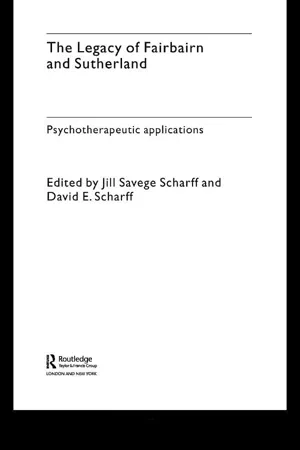
The Legacy of Fairbairn and Sutherland provides the first comprehensive review of W.R.D. Fairbairn and John Sutherland's theories on psycho-social development. It reviews Fairbairn and Sutherland's ideas, traces the philosophical roots of their thinking, explores their legacy, and demonstrates their relevance to contemporary practice. International contributors set these psychoanalytic theories in their philosophical and cultural context. They discuss the growing acceptance of Fairbairn and Sutherland's work in Europe and the Americas. They discuss the theories' impact on current thinking in subjects such as sexuality, hysteria, autonomy and repression. They re-examine the theories in the light of current clinical experience, illuminate them with reference to contemporary psychoanalytic theories and illustrate them with examples from work with children, adults, groups and families.
This book presents an original fusion of the ideas of two of the most noteworthy figures in recent psychoanalysis. It will prove fascinating reading for all practicing and training psychotherapists and psychoanalysts.
eBook - ePub
The Legacy of Fairbairn and Sutherland
Psychotherapeutic Applications
- 312 pages
- English
- ePUB (mobile friendly)
- Available on iOS & Android
eBook - ePub
The Legacy of Fairbairn and Sutherland
Psychotherapeutic Applications
About this book
Information
Part I
Fairbairn
Introduction to Part I
David E. Scharff
Fairbairn has been at the center of my interest since the beginning of my career. As a young psychiatric resident in Boston, I was being immersed in ego psychology, but I managed to find colleagues to introduce me to object relations theory. That interest was cemented on meeting Jill, who was working with Jock Sutherland at the time, and later on meeting members of the Fairbairn family, Cosmo, Annabel, and especially Ellinor with whom I have worked closely on editing some of Fairbairn’s uncollected work over the last ten years.
Part I begins with my overview of Fairbairn’s contributions to psychoanalytic theory and practice. Kirkwood and Birtles follow with scholarly papers placing Fairbairn in the philosophical context. Vermorel and Rehberger describe the impact that Fairbairn has had in France and Germany. Hensel demonstrates how he applies Fairbairn’s views to understanding sexual dysfunction and perversion treated in individual psychoanalysis. The editors complement that chapter with a discussion of the role of satisfactory, rejecting and exciting objects in sexuality as they are revealed in analytic couple and sex therapy. Two German women authors revisit the topics of hysteria and dissociation. American child therapists match their clinical illustrations to Fairbairn’s paper on child assault and to motivational systems theory respectively. The Argentinians use Fairbairn’s endopsychic structure as the basis for a new systematization of psychopathology. A German and a French author discuss the analyst as an accepted or refuted object, real and in the transference. Part I concludes with an American paper on the tie to the bad object in couple relationships and a Swedish riff on Fairbairn’s theories of art as objects of art themselves.
Chapter 1
The development of
Fairbairn’s theory
David E. Scharff
Fairbairn was a devoted psychoanalyst, original in his thinking, yet diligent in his study of Freud. He was interested in Freudian theory from early in his career, as we can see from the lecture notes he prepared for a psychology discussion class on “The Ego and the Id” at the University of Edinburgh (1928 in Birtles & Scharff 1994). The seeds of change are already there in his notes on his points for criticism, including the problem of how the superego could be repressed and at the same time be an agent of repression, a topic he explored in two papers, now printed together (1929a). In his thesis submitted for the MD degree in 1929 (1929b) he explored the relationship between the defenses of repression and dissociation in an original and scholarly way that is the forerunner of his thinking on the theory of the personality introduced 15 years later. Of particular interest is his study of Freud’s libido theory (1930), in which he noted the difference between appetitive and reactive tendencies, a precursor to his idea of aggression as a reactive tendency (an aggressive reaction to frustration) as opposed to Freud’s idea of aggression as a drive that was inbuilt from the beginning and not at all dependent on the reaction of the environment (1939a).
Very early on, Fairbairn saw the role of affects as having to do with giving meaning to relationships, and being determined by the relationship between the self and the environment. This was a different slant on affect than Freud’s. Fairbairn’s clinical papers were always couched in terms of object relations – beginning more than a decade in advance of the time that he actually formulated his object relations theory (1927). During the 1930s he wrote a number of interesting papers that he did not later see as having been central to his eventual contribution, but they were very substantial in themselves. For instance, his paper on child abuse (1935) and sexual assault (1939b), from the standpoint of both victim and perpetrator, are in advance of their time, and clinically useful today (see Chapter 15). Through the years, Fairbairn applied psychoanalysis to child development, education, general psychology, dentistry, and social issues.
The last major papers before object relations theory to come on to his screen were on the psychology of art, in one of which his point is that art is “making something for fun” (1938a: 384) and in the other, he speaks of the work of art as a restored object (1938b). As best I can understand it, Fairbairn’s (1938a) aim in describing art as fun is to fit in with Freud’s idea of the pleasure principle, but at the same time he includes Melanie Klein’s idea about restitution, and draws heavily on her ideas of esthetics. Fairbairn (1938b) talks about the genesis of art as “the found object,” which on the one hand connects emotionally with the object relations of the artist especially, and on the other hand elicits an aesthetic response from the beholder, with whose unconscious object relations it resonates. He has an idea of the artistic object itself being located at a transitional point between creator and perceiver (see Chapter 18).
Fairbairn’s model of development
Then, we come to a great period of about five years of productivity, from 1940 to 1944, during which four seminal papers show Fairbairn’s ideas moving steadily towards his final theory of object relations.
In the first paper on schizoid factors in the personality (1940), Fairbairn makes the hypothesis that the splitting of the object leads to splitting of the ego – a totally new idea in analytic thinking. He gives one of his really fine clinical descriptions characterizing the schizoid personality by its secret withdrawal from the world of external objects, overevaluation of the internal world, and fear that its love (not its hate as Klein thought) will destroy or damage the object. He was the first to identify the affect of the schizoid problem as one of futility connected to the hopelessness of ever being able to reach or remain connected to the object, Fairbairn concludes that schizoid people are unable to love or be loved for themselves. Splitting of the self to various degrees is found not only in pathology: Splitting is universal.
The second of these four central papers revises the psychopathology of psychosis and neurosis (1941). Fairbairn begins by restating the centrality of splitting, and goes on to give, for the first time, a fundamental revision of Freudian analysis. He asserts that libido is object seeking, not pleasure seeking as Freud thought, and that what is central to the developing infant and the person going through life is the need for relationships, not the need for gratification. This paper is unique in that he brings on line issues that he does not talk much about thereafter, although they remain important on their own. He conceptualizes growth as the movement from infantile dependence to mature dependence, rather than towards the development of a genital personality.
Fairbairn breaks up development into the stages of early oral development, represented by an attitude of taking in, sucking, and rejecting, and a later oral phase of biting alternating with sucking. The early oral phase is the pre-ambivalent stage, in which the object is a part object, the breast of the mother. Here he shows a marked influence of Klein’s language of part objects. The late oral phase then is the one where ambivalence becomes possible. This corresponds to Klein’s depressive position in which sucking and biting alternate. At this stage, the object is the mother who has the breast, not the breast itself. The whole mother gets treated at times as part object, but it is the whole mother who is the object.
Fairbairn then moves to a discussion of what he calls a transitional process. (When Winnicott (1951) later borrowed the term transitional and gave it a very different set of meanings, he still included the idea of the transition from the earliest aspects of dependence to later aspects.) In this transition, there is a dichotomy of the object. The object is split into good and bad, and is treated in unconscious fantasy as if it is inside or outside the self, or it may be regarded simply as internal contents. Mature dependence is the attitude of giving, in which accepted and rejected objects are both exteriorized. The outside world is recognized as having an independent life: It is not simply a function of a person’s internal life. The person accepts the other as being a whole person with genitals who is capable of genital aspects of relationships. He writes: “The real point about the mature individual is not that the libidinal attitude is essentially genital, but that the genital relationship is essentially libidinal” (p. 32). This is quite different from Freud’s view that the object is genitalized by the Oedipal child’s sexual curiosity and desire. Fairbairn’s insight asks us to rethink Freud’s notion of sexual zones as being at the center of development. Fairbairn says that anality is not a stage of sexual development, but a frequent conversion phenomenon. He writes: “It is not a case of the individual being preoccupied with disposal at this stage because he is anal, but of his being anal because he is preoccupied at this stage with the disposal of contents” (p. 43). Body areas lend themselves to the expression of internal ways of handling relationships because they have similarity to the child’s way of handling relationships at a given stage.
Fairbairn identifies four techniques of relating to the object during the transition from infantile to mature dependence. These are not developmentally sequenced: they are not linear syndromes, or phenomena. They are alternative ways of handling internal object relations, depending on whether the object is thought of as inside or outside the self. For instance, in the obsessional character or syndrome, the good, accepted object and the rejected object are both felt to be internal. The obsessional personality controls good and bad objects inside the self, and tries to order the world in accordance with this internal situation. In the paranoid syndrome or character, the good, accepted object is inside and the bad is outside, and so the person avoids the badness of the outside world that is felt as being aimed at the self. In the hysterical personality, the good object is outside and the bad object is inside, and so the person feels like a bad person who is constantly trying to reach the elusive good object which is out there. In the phobic person, both good objects and bad objects are outside the self and so aspects of the environment feel unsafe and must be avoided, because there is no security inside the self, but at the same time the person wants to find the good that is out there in the dangerous world by locating it in a person or place and clinging to it for safety.
The return of the repressed object
In the third paper on the repression and return of bad objects (1943a), Fairbairn manages a much tighter formulation. This paper is famous for its description of moral issues in dynamic form, and for his description of the repression and return of bad objects. The term “bad” used in reference to internal objects means that the objects are felt as libidinally bad: It is not that they are actually bad. The badness of objects is not, in the first instance, a moral issue, although it leads to the development of aspects of morality. The child takes in what is too painful to bear, does not accept the object because it feels bad, splits it off from the good part of the object, and represses the unaccepted, bad part in the individual unconscious. The fate of the repressed bad objects, however, is to return from the inside, but, through the frequently used defense of projection, the person feels as if they are coming back from the outside.
In this paper Fairbairn develops his famous idea of conditional badness as opposed to unconditional badness. This unique contribution is especially relevant now as therapists are called upon more and more to deal with forms of abuse. Abused children prefer to see themselves as bad, and their parental persecutors as good, because if the parent is acknowledged to be bad, then the child lives in a universe where there is no hope; but if the persecutor is good and the child is bad, then the child can try to reform, and be good so that there is hope of improvement. The situation is one of conditional badness, meaning that the child meets the conditions of being bad and deserving a bad situation. If the child were to recognize that the parent is bad regardless of the child’s behavior, then the child’s attempts to be good and create a good response would not change the situation at all, and there would be no hope of anything better. In that case, the badness is said to be unconditional: In effect the child says, “If I can’t be good, then I’ll make evil my good,” expressing attachment to a bad object that is libidinized.
Fairbairn illustrates this point with reference to Freud’s (1923) story of a destitute artist who, when he fell into a melancholic state on the death of his father, made a pact with the Devil as a father substitute. Sutherland, who was the one to recognize the relevance of Freud’s case for Fairbairn’s point that the attraction to evil reflects the attachment to the bad object, advised Fairbairn that he “would find it a good story” (Sutherland 1989: 121). Fairbairn certainly found the story useful to support his line of thinking, and also noted that the man in the story was relieved of his demoniacal possession only when he invoked the aid of a good object. Fairbairn uses Freud’s example to prove his point that it is the libidinal tie to the bad object that resists analysis, and that giving up that attachment to the bad object cannot happen until the analyst becomes installed as a good object.
Fairbairn’s model of psychic structure
In the fourth paper, on endopsychic structure, Fairbairn’s formulation of the organization of the personality now comes into view. Here is Fairbairn’s own diagram given in that paper (1944: 105; see Figure 1.1). Fairbairn’s ideas come together in, and are illustrated by, the dream of a patient, which displays the five parts of the ego that he identified that year. Incidentally, he uses the term ego throughout, keeping intact his lineage from Freud, even though early in his writing he had coined the term “the organized self.” But when Guntrip said later that he believed that Fairbairn really did mean the self, Fairbairn agreed. (In my way of thinking, I tend to use the term ego when I’m talking about mechanisms of psychic organization, and to use the term self when talking about the person’s internal experience...
Table of contents
- Cover Page
- Half Title page
- Title Page
- Copyright Page
- Dedication
- Contents
- List of Contributors
- Acknowledgements
- Part I Fairbairn Introduction to Part I
- Part II Sutherland and Fairbairn
- Index
Trusted by 375,005 students
Access to over 1.5 million titles for a fair monthly price.
Study more efficiently using our study tools.
Frequently asked questions
Yes, you can cancel anytime from the Subscription tab in your account settings on the Perlego website. Your subscription will stay active until the end of your current billing period. Learn how to cancel your subscription
No, books cannot be downloaded as external files, such as PDFs, for use outside of Perlego. However, you can download books within the Perlego app for offline reading on mobile or tablet. Learn how to download books offline
Perlego offers two plans: Essential and Complete
- Essential is ideal for learners and professionals who enjoy exploring a wide range of subjects. Access the Essential Library with 800,000+ trusted titles and best-sellers across business, personal growth, and the humanities. Includes unlimited reading time and Standard Read Aloud voice.
- Complete: Perfect for advanced learners and researchers needing full, unrestricted access. Unlock 1.5M+ books across hundreds of subjects, including academic and specialized titles. The Complete Plan also includes advanced features like Premium Read Aloud and Research Assistant.
We are an online textbook subscription service, where you can get access to an entire online library for less than the price of a single book per month. With over 1.5 million books across 990+ topics, we’ve got you covered! Learn about our mission
Look out for the read-aloud symbol on your next book to see if you can listen to it. The read-aloud tool reads text aloud for you, highlighting the text as it is being read. You can pause it, speed it up and slow it down. Learn more about Read Aloud
Yes! You can use the Perlego app on both iOS and Android devices to read anytime, anywhere — even offline. Perfect for commutes or when you’re on the go.
Please note we cannot support devices running on iOS 13 and Android 7 or earlier. Learn more about using the app
Please note we cannot support devices running on iOS 13 and Android 7 or earlier. Learn more about using the app
Yes, you can access The Legacy of Fairbairn and Sutherland by Jill Savege Scharff, David E. Scharff, Jill Savege Scharff,David E. Scharff in PDF and/or ePUB format, as well as other popular books in Psychology & Applied Psychology. We have over 1.5 million books available in our catalogue for you to explore.