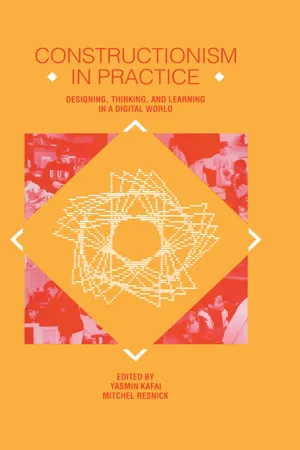
The digital revolution necessitates, but also makes possible, radical changes in how and what we learn. This book describes a set of innovative educational research projects at the MIT Media Laboratory, illustrating how new computational technologies can transform our conceptions of learning, education, and knowledge. The book draws on real-world education experiments conducted in formal and informal contexts: from inner-city schools and university labs to neighborhoods and after-school clubhouses. The papers in this book are divided in four interrelated sections as follows:
* Perspectives in Constructionism further develops the intellectual underpinnings of constructionist theory. This section looks closely at the role of perspective-taking in learning and discusses how both cognitive and affective processes play a central role in building connections between old and new knowledge.
* Learning through Design analyzes the relationship between designing and learning, and discusses ways that design activities can provide personally meaningful contexts for learning. This section investigates how and why children can learn through the processes of constructing artifacts such as games, textile patterns, robots and interactive devices.
* Learning in Communities focuses on the social aspects of constructionist learning, recognizing that how people learn is deeply influenced by the communities and cultures with which they interact. It examines the nature of learning in classroom, inner-city, and virtual communities.
* Learning about Systems examines how students make sense of biological, technological, and mathematical systems. This section explores the conceptual and epistemological barriers to learning about feedback, self-organization, and probability, and it discusses new technological tools and activities that can help people develop new ways of thinking about these phenomena.
eBook - ePub
Constructionism in Practice
Designing, Thinking, and Learning in A Digital World
- 360 pages
- English
- ePUB (mobile friendly)
- Available on iOS & Android
eBook - ePub
Constructionism in Practice
Designing, Thinking, and Learning in A Digital World
About this book
Information
PART I
PERSPECTIVES IN CONSTRUCTIONISM
1
A Word for Learning
Why is there no word in English for the art of learning? Webster says that the word pedagogy means the art of teaching. What is missing is the parallel word for learning. In schools of education, courses on the art of teaching are often listed simply as “methods.” Everyone understands that the methods of importance in education are those of teaching—these courses supply what is thought to be needed to become a skilled teacher. But what about methods of learning? What courses are offered for those who want to become skilled learners?
The same imbalance can be found in words for the theories behind these two arts. “Theory of Instruction” and “Instructional Design” are among many ways of designating an academic area of study and research in support of the art of teaching. There are no similar designations for academic areas in support of the art of learning. Understandably: The need for such names has not been felt because there is so little to which they would apply. Pedagogy, the art of teaching, under its various names, has been adopted by the academic world as a respectable and important field. The art of learning is an academic orphan.
One should not be misled by the fact that libraries of academic departments of psychology often have a section marked “learning theory.” The older books under this heading deal with the activity that is sometimes caricatured by the image of a white-coated scientist watching a rat run through a maze; newer volumes are more likely to base their theories on the performance of computer programs than on the behavior of animals. I do not mean to denigrate such books—I am myself the co-author of one and proud of it—but only to observe that they are not about the art of learning. They do not, for instance, offer advice to the rat (or the computer) about how to learn, although they have much to say to the psychologist about how to train a rat. Sometimes they are taken as a basis for training children, but I have not been able to find in them any useful advice about how to improve my own learning.
The unequal treatment by our language of the arts of learning and of teaching is visible in grammar as well as in vocabulary. Think, for example, of parsing the sentence, “The teacher teaches a child.” Teacher is the active subject of the sentence; child is the passive object. The teacher does something to the learner. This grammatical form bears the stamp of school’s hierarchical ideology in representing teaching as the active process. The teacher is in control and is therefore the one who needs skill; the learner simply has to obey instructions. This asymmetry is so deeply rooted that even the advocates of “active” or “constructivist” education find it hard to escape. There are many books and courses on the art of constructivist teaching, that talk about the art of setting up situations in which the learner will “construct knowledge”; but I do not know of any books on what I would assume to be the more difficult art of actually constructing the knowledge. The how-to-do-it literature in the constructivist subculture is almost as strongly biased to the teacher side as it is in the instructionist subculture.
A first step toward remedying these deficiencies is to give the missing area of study a name so that we can talk about it. Besides, it is only respectful to do this: Any culture that shows proper respect to the art of learning would have a name for it. In Mindstorms I proposed a word that did not catch on, but since I believe that there is more cultural readiness for such a word today, I shall try again—always bearing in mind that my principal goal is less to advocate this particular word than to emphasize the need for one. If the culture is really ripe for such a word, many people will throw in their own words (perhaps simply by quietly using them), and eventually one will take root in the soil of the language. Linnaeus, the father of botanical terminology, could decide to call a familiar white flower Bellis perennis, but the common language calls it a daisy, ignoring the Latin name just as it ignores the botanist’s insistence that a daisy is an “inflorescence” and not a flower at all. A person can propose; “the culture” or “the language” disposes.
In any case, to illustrate the gap in our language and my proposal for filling it, consider the following sentence: “When I learned French I acquired ____________ knowledge about the language, ____________ knowledge about the people, and ___________ knowledge about learning.” Linguistic and cultural would fill in the first two blanks with no problems, but the reader will be hard put to think up a word to fill in the third blank. My candidate is mathetic, and I thereby make restitution for a semantic theft perpetrated by my professional ancestors, who stole the word mathematics from a family of Greek words related to learning. Mathmatikos meant “disposed to learn”; mathema was “a lesson,” and manthanein was the verb “to learn.” Mathematicians were so convinced that theirs was the only true learning that they felt justified in appropriating the word, and succeeded so well that the dominant connotation of the stem math- is now that stuff about numbers they teach in school. One of the few traces of the original sense of the root retained by current English is “polymath.” This is not a person who knows many kinds of mathematics, but one who has learned broadly. Following my proposal, I would use the noun mathetics for a course on the art of learning, as in: “Mathetics (by whatever name it will come to be known) is even more important than mathematics as an area of study for children.”
A comparison with another Greek term borrowed for talking about mental process will clarify the intended meaning of “mathetics” and perhaps support its “sound” and “feel.” Heuristics—from the same stem as Archimedes’ cry “Eureka!”—means the art of intellectual discovery. In recent times it has been applied specifically to discovering solutions of problems. Thus mathetics is to learning what heuristics is to problem solving.
Although the idea of heuristics is old—it goes back at least to Descartes and, if one stretches it a little, to the Greeks—its influence on contemporary educational thinking is mainly due to mathematician George Polya, who is best known through his book, How to Solve It. His theme runs parallel to my complaint that school gives more importance to knowledge about numbers and grammar than to knowledge about learning, except that in place of the word learning, Polya says “principles of solving problems.” I would echo this wholeheartedly: In school, children are taught more about numbers and grammar than about thinking. In an early paper that supported and extended Polya’s ideas, I even formulated this as a challenging paradox:
It is usually considered good practice to give people instruction in their occupational activities. Now, the occupational activities of children are learning, thinking, playing, and the like. Yet, we tell them nothing about those things. Instead, we tell them about numbers, grammar, and the French Revolution; somehow hoping that from this disorder the really important things will emerge all by themselves. And they sometimes do. But the alienation-dropout-drug complex is certainly not less frequent.… The paradox remains: why don’t we teach them to think, to learn, to play? (Papert, 1971, chap. 2, p. 1)
Traditional education sees intelligence as inherent in the human mind and therefore in no need of being learned. This would mean that it is proper for school to teach facts, ideas, and values on the assumption that human beings (of any age) are endowed by nature with the ability to use them. Polya’s challenge started with the simple observation that students’ ability to solve problems improved when he instructed them to follow such simple rules as, “Before doing anything else, spend a little time trying to think of other problems that are similar to the one in hand.” He went on to develop a collection of other heuristic rules in the same spirit, some of which, like this one, apply to all kinds of problems and some to specific areas of knowledge, among which Polya himself paid the most attention to mathematics.
Another typical example of Polya’s type of rule adapts the principle of “divide and conquer.” Students often fail to solve a problem because they insist on trying to solve the whole problem all at once; in many cases they would have an easier time of it if they were to recognize that parts of the problem can be solved separately and later be put together to deal with the whole. Thus the Wright Brothers had the intention from the beginning of building a powered airplane that could take off from a field, but had they tried to build such a thing for their first experiments, they would very likely have come to the same gory end as many of their predecessors. Instead, they solved the problem of wing design by inventing and building a wind tunnel in which they tested wing sections. Then they built a glider that would take off from a track lined up with the wind in a place where winds were ideal. Independently of all this they also worked on an engine. In this way they gradually conquered all the problems.
Polya wished to introduce into education a more explicit treatment of the principles of what is often called “problem solving.” In the same way, I want to introduce a more explicit treatment of the principles of learning. But thinking about heuristics helps to explain the idea of mathetics in another way as well. By offering my own unorthodox explanation of why heuristic principles help students, I shall try to bring out a contrast between heuristics and mathetics.
I believe that problem solving uses processes far more subtle than those captured in Polya’s rules. This is not to say that the rules are not valuable as aids to solving problems, but I do think that their most important role is less direct and much simpler than their literal meaning. Attempting to apply heuristic rules checks students in the rush to get done with a problem and get on with the next. It has them spend more time with the problem, and my mathetic point is simply that spending relaxed time with a problem leads to getting to know it, and through this, to improving one’s ability to deal with other problems like it. It is not using the rule that solves the problem; it is thinking about the problem that fosters learning. So does talking about the problems or showing them to someone else. What is mathetic here is the shift of focus from thinking about whether the rules themselves are effective in the immediate application to looking for multiple explanations of how working with the rules can contribute in the longer run to learning. To make the point in a possibly exaggerated form, I suggest that any kind of “playing with problems” will enhance the abilities that lie behind their solution.
This interpretation of why heuristic methods work highlights several mathetically important themes, each of which points to a way in which school impedes learning and to some good advice about how to do it better.
To begin with, the theme of “taking time,” just mentioned in connection with Polya, is well illustrated by a passage from a book whose name has more than once raised eyebrows when I quoted it in academic circles: the best-selling, The Road Less Traveled, by psychiatrist M. Scott Peck (1980). I read the book in the first place for the same reason that I have made alliances with LEGO and Nintendo, which has also caused some academically pure and politically correct eyebrows to rise at the idea of having any connection with people who make money. Anyone who can draw as many people into situations related to learning as Peck, LEGO, or Nintendo knows something that educators who have trouble holding the attention of 30 children for 40 minutes should want to learn.
Here is what Peck (1980) had to say about taking time:
At the age of thirty-seven I learned how to fix things. Prior to that time almost all my attempts to make minor plumbing repairs, mend toys or assemble boxed furniture according to the accompanying hieroglyphical instruction sheet ended in confusion, failure and frustration. Despite having managed to make it through medical school and support a family as a more or less successful executive and psychiatrist, I considered myself to be a mechanical idiot. I was convinced I was deficient in some gene, or by curse of nature lacking some mystical quality responsible for mechanical ability. Then one day at the end of my thirty-seventh year, while taking a spring Sunday walk, I happened upon a neighbor in the process of repairing a lawn mower. After greeting him I remarked, “Boy, I sure admire you. I’ve never been able to fix those kind of things or do anything like that.” My neighbor, without a moment’s hesitation, shot back, “That’s because you don’t take the time.” I resumed my walk, somehow disquieted by the gurulike simplicity, spontaneity and definitiveness of his response. “You don’t suppose he could be right, do you?” I asked myself. Somehow it registered, and the next time the opportunity presented itself to make a minor repair I was able to remind myself to take my time. The parking brake was stuck on a patient’s car, and she knew that there was something one could do under the dashboard to release it, but she didn’t know what. I lay down on the floor below the front seat of her car. Then I took the time to make myself comfortable. Once I was comfortable, I then took the time to look at the situation. I looked for several minutes. At first all I saw was a confusing jumble of wires and tubes and rods, whose meaning I did not know. But gradually, in no hurry, I was able to focus my sight on the brake apparatus and trace its course. And then it became clear to me that there was a little latch preventing the brake from being released. I slowly studied this latch until it became clear to me that if I were to push it upward with the tip of my finger it would move easily and would release the brake. And so I did this. One single motion, one ounce of pressure from a fingertip, and the problem was solved. I was a master mechanic!
Actually, I don’t begin to have the knowledge or the time to gain that knowledge to be able to fix most mechanical failures, given the fact that I choose to concentrate my time on nonmechanical matters. So I still usually go running to the nearest repairman. But I now know that this is a choice I make, and I am not cursed or genetically defective or otherwise incapacitated or impotent. And I know that I and anyone else who is not mentally defective can solve any problem if we are willing to take the time. (pp. 27–28)
Give yourself time is an absurdly obvious principle that falls equally under heuristics and mathetics. Yet school flagrantly contravenes it by its ways of chopping time: “Get out your books … do 10 problems at the end of chapter 18 … DONG … there’s the bell, close the books.” Imagine a business executive, or a brain surgeon, or a scientist who had to work to such a fragmented schedule.
This story speaks as poignantly about a second theme—talking—as about time. Peck does not say this explicitly, but one can guess that he would have had the epiphany about taking his time at an earlier age than 37 had he talked more often to more people about his and their experiences with mechanical problems. A central tenet of mathetics is that good discussion promotes learning, and one of its central research goals is to elucidate the kinds of...
Table of contents
- Cover Page
- Half Title page
- Title Page
- Copyright Page
- Dedication
- Contents
- List of Contributors
- Introduction
- Part I: Perspectives in Constructionism
- Part II: Learning Through Design
- Part III: Learning in Communities
- Part IV: Learning about Systems
- Author Index
- Subject Index
Trusted by 375,005 students
Access to over 1.5 million titles for a fair monthly price.
Study more efficiently using our study tools.
Frequently asked questions
Yes, you can cancel anytime from the Subscription tab in your account settings on the Perlego website. Your subscription will stay active until the end of your current billing period. Learn how to cancel your subscription
No, books cannot be downloaded as external files, such as PDFs, for use outside of Perlego. However, you can download books within the Perlego app for offline reading on mobile or tablet. Learn how to download books offline
Perlego offers two plans: Essential and Complete
- Essential is ideal for learners and professionals who enjoy exploring a wide range of subjects. Access the Essential Library with 800,000+ trusted titles and best-sellers across business, personal growth, and the humanities. Includes unlimited reading time and Standard Read Aloud voice.
- Complete: Perfect for advanced learners and researchers needing full, unrestricted access. Unlock 1.5M+ books across hundreds of subjects, including academic and specialized titles. The Complete Plan also includes advanced features like Premium Read Aloud and Research Assistant.
We are an online textbook subscription service, where you can get access to an entire online library for less than the price of a single book per month. With over 1.5 million books across 990+ topics, we’ve got you covered! Learn about our mission
Look out for the read-aloud symbol on your next book to see if you can listen to it. The read-aloud tool reads text aloud for you, highlighting the text as it is being read. You can pause it, speed it up and slow it down. Learn more about Read Aloud
Yes! You can use the Perlego app on both iOS and Android devices to read anytime, anywhere — even offline. Perfect for commutes or when you’re on the go.
Please note we cannot support devices running on iOS 13 and Android 7 or earlier. Learn more about using the app
Please note we cannot support devices running on iOS 13 and Android 7 or earlier. Learn more about using the app
Yes, you can access Constructionism in Practice by Yasmin B. Kafai, Mitchel Resnick, Yasmin B. Kafai,Mitchel Resnick in PDF and/or ePUB format, as well as other popular books in Education & Education General. We have over 1.5 million books available in our catalogue for you to explore.