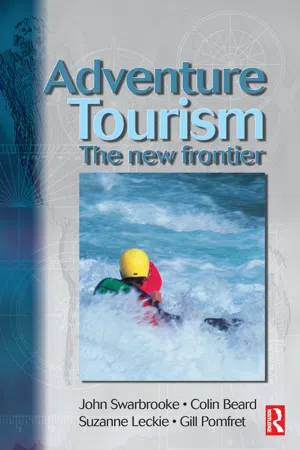
Looking at the past, present and future of adventure tourism, Adventure Tourism: the new frontier examines the product, the adventure tourist profile, and issues such as supply, geography and sustainability. International case studies are used to illustrate these issues, including: Gorilla watching holidays,Trekking on Mount Everest, Diving holidays, and Outward Bound packages.
Analysis of the development and nature of adventure tourism accompanies these studies, ensuring that the title is useful both for undergraduate and postgraduate students of tourism and for professionals involved in managing adventure tourism enterprises.
There is also a companion website with additional cases, which can be found at www.bh/com/companions/0750651865.
- 368 pages
- English
- ePUB (mobile friendly)
- Available on iOS & Android
eBook - ePub
Adventure Tourism
About this book
Part B The demand side
DOI: 10.4324/9780080469812-4
3 The adventure tourist
DOI: 10.4324/9780080469812-5
Introduction
Adventure tourism is an increasingly widespread phenomenon in the new millennium, and appeals to an expanding proportion of the population who are seeking self-fulfilment and excitement through participating in physically and mentally stimulating activities, travelling to remote destinations or engaging in ‘adrenaline-rush’ experiences as part of their tourist experience. Patterns of consumer behaviour in tourism are in a constant state of flux, and as the ‘new tourist’ (Poon, 1993) emerges as a more experienced traveller, demanding unique and enticing holiday experiences, adventure tourism has begun to carve a niche market for itself.
Tourism organizations have facilitated the growth of adventure holidays through promoting and selling a vast array of organized adventure experiences to a diverse range of markets as novel and exclusive experiences, from whale watching to white-water rafting, bungee jumping to self-discovery holidays. Moreover, the independent travel market has triggered a growth in adventure tourism, with an increasing number of people tailor-making their own adventures to suit individual tastes and needs. Round the world travel (RTW), a form of independent adventure travel, has recently expanded in popularity amongst all age groups. Although some people follow the well-trodden RTW network of destinations in Asia and Australasia, meeting up with other fellow travellers en route, others visit more remote destinations – Siberia and Mongolia, for example. These are places where the tourism industry is not well established and other independent travellers are few and far between. Travelling to such countries, many kinds of adventure can be experienced – as the following extract from the book Lonely Planet Unpacked illustrates:
Travelling independently can sometimes be tricky. The sacred mountain of Shiliin Bogd Uul is apparently closed to the disputed, undefined and unfenced Chinese border. After we spent several glorious hours exploring the mountain, our jeep was suddenly followed by a Mongolian army jeep, and then stopped by a machine-gun wielding soldier. He leaned into the driver's window, confiscated the keys and asked our reasons for being near the border. We obviously didn’t say what he wanted to hear, so he forced us to detour to the military barracks and then questioned us for five hours. I was firstly accused of being a Chinese smuggler, and then, because I don’t even remotely look Chinese, of being a Russian spy. The Mongolian soldier had never heard of Australia, and failed to comprehend my guide who constantly explained that I was ‘from a lonely planet’.(Greenaway, 1999:21, cited in Wheeler, 1999).
This quotation sums up the experience of just one typology of adventure tourist who is seeking out an original and exciting holiday, with an opportunity to engage in self-discovery and cultural exchange, in a faraway place. A plethora of other ‘adventurers’ also exist whose motives, behaviour and experiences will differ from the example quoted above.
These different (yet sometimes overlapping) categories reflect the broad nature of the adventure tourism phenomenon and the many links it has with other forms of tourism. Some of these links will be explored from the adventure consumer's perspective throughout this chapter.
Although adventure tourism clearly overlaps with other tourism types, adventurers have a number of distinguishing attributes that set them apart from other tourist markets. They generally take risks and thrive from mental or physical challenge, they seek out novel and stimulating experiences, and they sometimes engage in adventure for personal development or reasons of self-esteem.
Before introducing the key topics covered within this chapter, it is important to point out that the subject of consumer behaviour in adventure tourism is not particularly well developed in terms of research. Indeed, there is a dearth of information on the characteristics of adventure tourists and their motives. This is due to the relatively recent recognition of adventure tourism as a unique market in its own right, coupled with the current evolution of this concept within academic circles. Most of the work carried out to date – based on the broad theme of ‘adventure consumers’ – originates from the fields of psychology and recreation. Many parallels can be drawn between these two subject areas and tourism, in relation to the consumer of adventure tourism. Without a doubt, psychology and recreation-based investigations have shaped the direction of research into the behavioural components of adventure tourists. Hence, in this chapter we have attempted to apply some of this work to the behaviour of adventure tourists.
The main themes of this chapter are as follows:
- The changing patterns of consumer trends, and how newly evolving trends have instigated interest in adventure travel
- The influence of consumer lifestyles and age groups on participation in adventure tourism
- The behaviour of adventure tourists, including the following sections:
- ‘Soft’ and ‘hard’ adventurers, their distinctive characteristics and behaviours
- Tourist motivation, including key concepts that are relevant to adventure tourist motivation
- Diverse motivational factors that influence people's decision to participate in adventure tourism, with particular emphasis on the role of risk as a primary motive
- The characteristics and motives of other types of tourist that participate in similar forms of tourism to adventure tourism (i.e. ecotourism, wildlife tourism and expeditions).
Changing consumer trends
Over the last two decades, society has witnessed a number of changes in consumer behaviour. A move towards healthier lifestyles, a heightened sensitivity to green issues and a more quality-conscious consumer are just a few of the transformations taking place in contemporary society. Such changes are reflected in people's holiday-taking behaviour – for example, more people are taking activity holidays.
With regard to the British population, Mintel (1999) reports that between 1994 and 1999 the demand for domestic activity holidays grew by 5 per cent whilst the number of people participating in this type of holiday abroad increased by a dramatic 36 per cent. These statistics are a sure indicator of the rising popularity of activity-based holidays, and this growth can be attributed to lifestyle changes.
Another recently evolved trend concerns the role of leisure in people's lives. Undoubtedly leisure has become an increasingly important part of our daily existence, and has positively impacted on the demand for tourism in many different ways. Adventure tourism is no exception here. One line of thought, in relation to the growth of this form of tourism, is that modern-day living and work life lack clear meaning. This encourages people to search for meaning and fulfilment throug...
Table of contents
- Cover Page
- Half Title Page
- Dedication
- Title Page
- Copyright Page
- Table Of Contents
- Acknowledgements
- Table of Contents
- Preface
- Part A: Setting the context
- Part B: The demand side
- Part C: The supply side
- Part D: The management of adventure tourism
- Part E: Key sectors of adventure tourism
- Part F: The future of adventure tourism
- Part G: Case studies
- Bibliography
- Index
Trusted by 375,005 students
Access to over 1.5 million titles for a fair monthly price.
Study more efficiently using our study tools.
Frequently asked questions
Yes, you can cancel anytime from the Subscription tab in your account settings on the Perlego website. Your subscription will stay active until the end of your current billing period. Learn how to cancel your subscription
No, books cannot be downloaded as external files, such as PDFs, for use outside of Perlego. However, you can download books within the Perlego app for offline reading on mobile or tablet. Learn how to download books offline
Perlego offers two plans: Essential and Complete
- Essential is ideal for learners and professionals who enjoy exploring a wide range of subjects. Access the Essential Library with 800,000+ trusted titles and best-sellers across business, personal growth, and the humanities. Includes unlimited reading time and Standard Read Aloud voice.
- Complete: Perfect for advanced learners and researchers needing full, unrestricted access. Unlock 1.5M+ books across hundreds of subjects, including academic and specialized titles. The Complete Plan also includes advanced features like Premium Read Aloud and Research Assistant.
We are an online textbook subscription service, where you can get access to an entire online library for less than the price of a single book per month. With over 1.5 million books across 990+ topics, we’ve got you covered! Learn about our mission
Look out for the read-aloud symbol on your next book to see if you can listen to it. The read-aloud tool reads text aloud for you, highlighting the text as it is being read. You can pause it, speed it up and slow it down. Learn more about Read Aloud
Yes! You can use the Perlego app on both iOS and Android devices to read anytime, anywhere — even offline. Perfect for commutes or when you’re on the go.
Please note we cannot support devices running on iOS 13 and Android 7 or earlier. Learn more about using the app
Please note we cannot support devices running on iOS 13 and Android 7 or earlier. Learn more about using the app
Yes, you can access Adventure Tourism by Colin Beard,John Swarbrooke,Suzanne Leckie,Gill Pomfret in PDF and/or ePUB format, as well as other popular books in Business & Hospitality, Travel & Tourism Industry. We have over 1.5 million books available in our catalogue for you to explore.