eBook - ePub
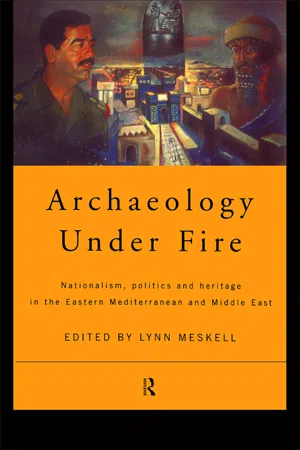
Archaeology Under Fire
Nationalism, Politics and Heritage in the Eastern Mediterranean and Middle East
- 264 pages
- English
- ePUB (mobile friendly)
- Available on iOS & Android
eBook - ePub
Archaeology Under Fire
Nationalism, Politics and Heritage in the Eastern Mediterranean and Middle East
About this book
The Middle East and Eastern Mediterranean are some of the most politically charged regions in which archaeology is implicated. Historically, they played a formative role in the birth of archaeology as a discipline. Archaeology Under Fire addresses archaeology's role in current political issues, including the ethnic cleansing in the Balkans, the division of Cyprus, and the continued destruction of Beirut. The contributors consider the positive role of the past as a means of reconciliation, whether it be in Turkey, Israel, and the Gulf. They advocate a responsible global archaeology, and an awareness of contemporary issues can only enhance this aim.
Information
Chapter 1
Archaeology, politics and the cultural heritage of Cyprus
A.Bernard Knapp and Sophia Antoniadou
Introduction
Across the spectrum of contemporary archaeology, few would deny that political realities impact powerfully and often negatively on both archaeological practice and archaeological interpretation. We hear more and more of archaeology’s role in the construction and legitimisation of cultural or ethnic identity, and of the destruction, sale and obliteration of archaeological pasts from their modern cultural contexts. Such ‘cultural cleansing’ is nourished by the consequences of war, nationalistic fervour, inter-ethnic conflict, and the illicit and universally condemned trade in antiquities. In these situations, political neutrality is unachievable and can no longer be condoned by archaeologists (Pollock 1992: 301–4).
Nor can archaeology deny its overtly political role in informing us about our human past, disrupting long-held myths and prejudices, and impacting our current social constructions within the global village. The current literature is awash with articles treating ethnicity, cultural identity, politics and nationalism in archaeology (for example, Atkinson et al. 1996; Díaz-Andreu and Champion 1995; Graves-Brown et al 1996; Jones 1997a; Kohl and Fawcett 1995a; Schmidt and Patterson 1995; Trigger 1984; Whitelam 1996). Archaeologists tend to adopt current social concerns such as these, make them their own, and relate them— consciously or unconsciously—to the historic as well as the prehistoric past (Wilk 1985). However, it is not enough simply to be aware of the atrocities committed during the last decade as a result of ethnic or nationalistic turmoil throughout the world: we must also realise that archaeological information in these regions has been accessed, used and abused for unintended purposes by diverse special interest groups (Preucel 1995: 161).
Images and symbols from the past play conspicuous and powerful roles in the political present. Archaeological finds may become banners for newly-created ethnic groups or nations (see Brown 1994, chapter 3). Mythical and historical evidence for ancient migrations may be cited to justify ethnic cleansing or to legitimise present-day territorial expansion. Renfrew (1994: 156) maintains that ‘the perversion of ethnicity is the curse of our century.’ As a direct result of national funding practices or even of individual archaeologists’ personal interests, disproportionate emphasis is given to certain sites (for example, Great Zimbabwe) or classes of data (for example, Islamic pottery in Iron Age east Africa) that are seen to be politically useful. Such overt political bias in archaeological research and interpretation is neither new nor unusual: what has changed is the willingness of archaeologists to recognise such realities. By its nature archaeology has always had an obvious political dimension, and nationalism—like ethnic or cultural identity—makes manifest the character of archaeology as a social, historical and political enterprise (Silberman 1995: 249; see Hodder, chapter 6).
Despite a long-standing archaeological tradition and the potential global impact implicit in any study of the Middle East, most studies of archaeology and ethnicity or nationalism have steered clear of the region’s volatile states (cf. Elon 1994; Jones 1997b; Silberman 1987, 1989). Meskell in the introduction to this book maintains that this reality is linked inextricably to the construction of our field, which views archaeologies in the region as conservative and theoretically challenged (similarly Knapp 1996: 141–2); in this respect, world archaeology simply has shortchanged itself. However, in order to treat the politics of archaeology in this region, it is necessary to consider deeper currents in the unfolding of the modern world system—the spread of capitalism, and the eventual but inevitable reaction of postcolonial cultures.
Such a statement implies that we exist in a state of ‘postcoloniality’, but in fact the present is entirely bound up in colonial formations. Postcolonial means more than just beyond colonialism: it is also concerned with implementing sociopolitical action to resist and replace dominant imperial structures (Jacobs 1996: 161). Whereas people, cultures and nations may actively resist and deny colonialist tendencies and colonial constructs (Thomas 1994: 58–60), the past is always being reworked nostalgically and adapted creatively to the present. When contemporary European states began their economic and imperial expansion over the globe during the seventeendi to eighteenth centuries, empirical dogma began to replace religious beliefs, and the proponents of classical or biblical archaeology found themselves forced to counter historical doubts cast on the validity of scripture by Darwinian evolutionary theory and by European evolutionary archaeology (Silberman 1995: 255). The discovery and excavation of sites in ancient western Asia and the eastern Mediterranean positioned ‘Western’ scholars as the legitimate cultural (and imperial) heirs of a rich archaeological past (see Özdogan, chapter 5; Bahrani, Chapter 8 and Hassan, Chapter 11). Residual formations of colonialism like this are still very powerful in the eastern Mediterranean and the Middle East, despite postcolonial ‘resistance’; moreover, the (formerly) colonised still engage in complicity, conciliation and even disregard for colonialism. It is mainly those who harbour nostalgic feelings for imperialism that see the formerly colonised as actively resisting the former ‘core’ (Jacobs 1996: 14–15). As long as assumptions of superiority and the right of force are galvanised in the rhetoric of contemporary research, part of what Said (1978: 12, 94–5) called the ‘Orientalist discourse’, constructions of the past will devalue indigenous cultures and histories, and propagate the dominant, Euro-American presentations of the past constantly repeated by the major figures in the field (Whitelam 1996).
The situation on the eastern Mediterranean island of Cyprus also involves a somewhat different, cultural translation of a far more distant colonial past (cf. van Dommelen 1997: 306). Silberman (1995: 259), for example, states:
For a nation like the Republic of Cyprus, with its obvious political attachment to images of Greek antiquity, the extensive excavation and presentation of classical cities like Paphos, Kition, and Ammathus [sic] are clearly linked to a modern, national self-consciousness.
But what of those places that do not become part of the official heritage, or are denied a role in that heritage because they are inaccessible (i.e., in occupied territory)? Such sites take on powerful political roles and set the stage for struggles over cultural identity and political power. Heritage, then, imbues certain places with symbolic values and beliefs, and transforms them into a space where cultural identity is defined or contested, and where the social order is reproduced or challenged (Jacobs 1996: 35). Increasingly, heritage culture represents a strategy of response to global forces, centred on the preservation radier than the reinterpretation of identities; the imperative is to salvage ‘placed identities for placeless times’ (Robins 1991: 41). Heritage involves a dynamic process where multiple pasts compete to become sanctified. The politics of archaeology on Cyprus are both multiple and ambiguous: dividing lines are sharply drawn on the land itself, and contrasting arguments and ideologies are precisely defined. Yet both sides, for entirely different reasons, follow political or economic agendas that affect the preservation of Cyprus’ cultural heritage (see also Özdogan, chapter 5).
The 1974 Turkish invasion and subsequent occupation of the northern part of the island precipitated a blatantly ideological, cultural cleansing of the Greek Cypriote past; it also set in motion a train of events which continues to impact negatively on the practice and potential of archaeology on the island. The list of antiquities that have gone missing or been destroyed since 1974 continues to grow. Archaeologists no longer have any legal status to study or conduct any kind of research in the occupied northern part of the island. The status of Turkish Cypriote archaeologists in this regard can be debated, of course, but they have nonetheless a moral duty to control and protect the cultural heritage in the face of its large-scale destruction and looting. Whatever the situation may have been prior to 1974, the prevailing culture history of Cyprus has become quite biased, based as it is on excavations and surveys that have been limited for the past twenty three years to the southern sixty three per cent of the island. Since 1974, in other words, the cultural, archaeological, environmental and ideological conditions that prevail in the north have been inaccessible to most practising field archaeologists, to virtually all people who study Cypriot archaeology and to all Greek Cypriotes.1
In the attempt to treat all these diverse and volatile issues, this chapter presents first a general discussion of politics in archaeology, followed by a more focused treatment of imperialism, postcolonialism, globalism and the cultural identity of Cyprus. Two factors are then considered that have impacted the politics of archaeology within contemporary Cyprus. First, we outline the political and religious background to events that resulted in the Turkish invasion of Cyprus in 1974, and examine the pattern of destruction and desecration in the northern part of the island, citing data from public records. Second, we consider from a cultural and political perspective the negative impact of such developments on the practice and interpretation of archaeology in Cyprus today. We conclude with an overview of the politics of postcolonial place, and argue that Cypriot archaeologists will have to frame their own political agenda as contemporary political realities beyond their control shape and re-shape the cultural heritage of Cyprus.
The politics of archaeology
Shanks and Tilley (1987a, 1987b, 1989) have argued that only political goals are viable in archaeological research; archaeological discussion and interpretation thus should aim to disempower political and intellectual élites by affirming the validity of diverse explanations of the past (Trigger 1995: 263; cf. Holtorf et al. 1996). Other archaeologists who speak from gender, Third World, or rural perspectives maintain that archaeologists like Shanks and Tilley are élitist in their own right, and have done nothing to advance the position of the real archaeological underclasses (e.g., Andah 1995; Ferguson 1992; Handsman 1991; Spector 1993; Wylie 1991, 1993; Zimmerman 199S). Trigger (1995: 263– 4) points out that archaeological data have been adopted to promote bigotry, violence and destruction just as much as they have been used to promote social justice. When archaeological enterprise is used to justify unpredictable or unacceptable political ends, archaeologists have to move beyond polemic, and attempt to redress the social or moral imbalance.
The way archaeologists interpret the past is conditioned by what they individually and collectively believe they know about the past, and by the techniques available for recovering, analysing and interpreting archaeological evidence (Trigger 1995: 265–6). Archaeologies influenced by nationalism are neither all bad nor all good, and the intricate relations between nationalistic archaeologies and political practice stem from the nature, tradition and relevance of archaeology to the political process (Trigger 1995: 270). For their part, archaeologists must recognise that their personal attitudes towards politics or nationalism are likely to stem from what they perceive to be in their own self-interest. Whatever such personal views or biases may be, there can be no justification for deliberately distorting the archaeological record, or for misinterpreting it with political ends in mind (Kohl and Fawcett 1995b: 9).
At one end of the spectrum, archaeological data have been misinterpreted for nationalistic or political purposes, and human history has been deliberately reconstructed. At the opposite end, nationalistic archaeology has generated questions about ethnicity or local cultural configurations that most processual and culture histor ical archaeologists would have eschewed. Viewed optimistically, then, the practice of a political archaeology can help to resist and overcome colonial and imperial residues. As Meskell emphasizes in the introduction to this book, postprocessual or interpretive archaeologies foreground social and political contexts; they work at the local level and are concerned with issues of meaning, symbolism, ethical and political responsibilities, and cultural or even individual identities. Postmodernist approaches to the study of the past (Knapp 1996; Preucel 1995) now extol the proliferation of competing narratives. Indeed, it is only within a theoretical milieu which encourages diverse viewpoints that archaeology can develop its social conscience and political stance. Ethnic cleansing and cultural fragmentation are not simply academic matters; they are human reactions that involve the creation of new polities, the assertion of re-worked cultural identities, the disempowerment of social groups and the destruction of past histories. Given such realities, the intrinsic power of the past challenges archaeology’s engagement in the present and raises compelling questions about archaeological practice on a local level and archaeological responsibilities on ...
Table of contents
- Cover Page
- Title Page
- Copyright Page
- Illustrations
- Contributors
- Introduction Archaeology matters
- Chapter 1: Archaeology, politics and the cultural heritage of Cyprus
- Chapter 2: The past is ours
- Chapter 3: Contests of heritage and the politics of preservation in the Former Yugoslav Republic of Macedonia
- Chapter 4: Bulgarian archaeology
- Chapter 5: Ideology and archaeology in Turkey
- Chapter 6: The past as passion and play
- Chapter 7: Beirut’s memorycide
- Chapter 8: Conjuring Mesopotamia
- Chapter 9: Whose game is it anyway?
- Chapter 10: The Gulf Arab states and their archaeology
- Chapter 11: Memorabilia
- Chapter 12: Ancient Egypt in America
Trusted by 375,005 students
Access to over 1.5 million titles for a fair monthly price.
Study more efficiently using our study tools.
Frequently asked questions
Yes, you can cancel anytime from the Subscription tab in your account settings on the Perlego website. Your subscription will stay active until the end of your current billing period. Learn how to cancel your subscription
No, books cannot be downloaded as external files, such as PDFs, for use outside of Perlego. However, you can download books within the Perlego app for offline reading on mobile or tablet. Learn how to download books offline
Perlego offers two plans: Essential and Complete
- Essential is ideal for learners and professionals who enjoy exploring a wide range of subjects. Access the Essential Library with 800,000+ trusted titles and best-sellers across business, personal growth, and the humanities. Includes unlimited reading time and Standard Read Aloud voice.
- Complete: Perfect for advanced learners and researchers needing full, unrestricted access. Unlock 1.5M+ books across hundreds of subjects, including academic and specialized titles. The Complete Plan also includes advanced features like Premium Read Aloud and Research Assistant.
We are an online textbook subscription service, where you can get access to an entire online library for less than the price of a single book per month. With over 1.5 million books across 990+ topics, we’ve got you covered! Learn about our mission
Look out for the read-aloud symbol on your next book to see if you can listen to it. The read-aloud tool reads text aloud for you, highlighting the text as it is being read. You can pause it, speed it up and slow it down. Learn more about Read Aloud
Yes! You can use the Perlego app on both iOS and Android devices to read anytime, anywhere — even offline. Perfect for commutes or when you’re on the go.
Please note we cannot support devices running on iOS 13 and Android 7 or earlier. Learn more about using the app
Please note we cannot support devices running on iOS 13 and Android 7 or earlier. Learn more about using the app
Yes, you can access Archaeology Under Fire by Lynn Meskell in PDF and/or ePUB format, as well as other popular books in Social Sciences & Middle Eastern History. We have over 1.5 million books available in our catalogue for you to explore.