![]()
Part 1
Linking models to data for development
![]()
1 An introduction to empirical development economics
1.1 The objective of the book
This is a book about quantitative methods which aims to enable you to carry out empirical work in development economics. It is not a book of econometric theory or data description, although both are key elements of the toolbox you need to be able to carry out empirical work. We are concerned with the measurement of economic relationships using techniques of estimation and the methods of the classical theory of statistical inference. The economic relationships we analyse come from economic theory. Our objective in this book is to draw on models from economic theory that allow us to test propositions of central interest in development economics. Theories can be developed without concern for the statistical problems associated with drawing inference from the data: econometrics seek to bridge the gap between economic theory and the data-based representation of the economic systems or relationships of interest.
We typically use econometric methods for three related purposes: policy analysis, testing theory and forecasting. We begin by giving some examples of the questions and issues that can arise for each of these possible uses of quantitative methods in economics.
Examples of policy analysis:
• Does a training programme work?
• How much does investing in education/health/social networks increase productivity and/or wages?
• What effect does raising the minimum wage have on unemployment?
• Is a high rate of inflation costly?
These issues are all clearly matters of policy interest. There is also a direct link from a policy instrument to a desired outcome. We want to know how we can go about investigating whether a particular policy instrument will have the desired impact on the outcome.
Examples of theory for testing:
• The Harris–Todaro model predicts that high wage sectors in poor countries will have high unemployment to generate equilibrium across sectors.
• Endogenous growth theory predicts that the growth rate (growth rate – not the level of income) will be a function of the level of investment in human capital.
• Risk is particularly important in agricultural markets, which dominate the livelihoods of the poor in developing countries. If households cannot adequately insure, market outcomes will be inefficient and limit the ability of the poor to invest.
These three examples have in common that they are predictions from models which are widely used in development economics. In this book you will meet these models (and many others). The objective of this part of the book is to show you how such models are tested. For each of those predictions you can ask: does the data support the theory?
If the answer is yes then that is good news for the theory. If the answer is no that is not necessarily bad news for the theory. There may be a problem with your data or there may be a problem with how you have used the data. If there are not then you need to think about what theory, better than the one you have, can explain the data.
Examples of forecasting questions:
• What will be the level of commodity prices for copper over the next 20 years?
• How much will poverty increase in a country subject to a large shock to the terms of trade?
• How educated will the population of India be at the end of the next ten years?
The key element of forecasting is that it requires time-series data. By definition you are asking about how the future will evolve. You can only assess forecasts by comparing the outcomes with the predictions.
The common dimension across all these uses for quantitative methods is a model. We cannot do policy analysis, test theory or forecast unless we have a model which tells us how the variables we are interested in are related to the variables we think determine them. You can think of econometrics as combining three elements: economic theory, data and statistical theory. These three elements are used to develop models that are ‘good’ explanations for policy analysis, testing theory or forecasting. What is ‘good’ about a model is a complex question to which we will return throughout the book.
In economics generally, and in development economics in particular, models are freely available and data is much scarcer. You will find many models which have not been tested and some models which are regarded as rather obviously true but which, when tested, turn out to be inconsistent with the data. One example we use in the first part of the book is the Harris–Todaro model of what determines equilibrium in labour markets in poor countries.
1.2 Models and data: the Harris–Todaro model
The key prediction of the Harris–Todaro model of labour markets is very simple. Wages in urban areas exceed those in rural areas by substantial amounts. Why do people not move? Well, they do, and in doing so they create urban unemployment which acts to equilibrate the market by ensuring that the expected wage in the urban area is equal to the wage in the rural sector.
The following exposition is taken from Fields (1975: 167–8). Let Wa and Wu denote agricultural and urban wage rates, respectively, Eu the number of urban jobs, and Lu the urban labour force. The expected urban income is
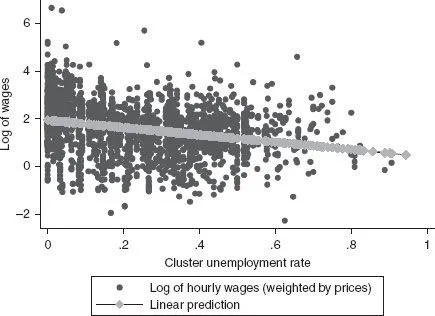
Figure 1.1 A wage curve for South Africa (1993)
Source: SALDRU data
Expected rural income
E(
Wa) is simply
Wa. The amount of rural–urban migration
is a function of the urban–rural expected wage differential,
the rural–urban equilibrium condition is E(Wu) = E(Wa)
and the equilibrium employment rate is
We see that this model has some very simple and intuitive predictions. As the urban wage rises relative to the rural, the employment rate must fall – and, by implication, the unemployment rate must rise. So, if this model is correc...