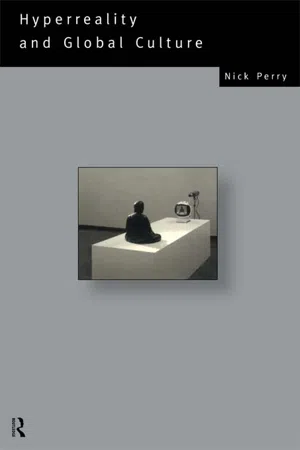
This book explores a world where the boundaries between reality and representation have become blurred, a world where LA Law is used to train lawyers.
Drawing on examples from around the globe, Nick Perry presents a fascinating and entertaining analysis of both familiar objects and situations as well as the more unusual and absurd. Meals served in British pubs, motor-cycle gangs in downtown Tokyo, Australian movies, are just some examples used by the author in his engaging exploration of modern sense of the 'unreal'.
Hyperrealities also engages with well known theorists of contemporary culture, from Baudrillard and Umberto Eco to Jameson and Sartre.
- 208 pages
- English
- ePUB (mobile friendly)
- Available on iOS & Android
eBook - ePub
Hyperreality and Global Culture
About this book
Information
1
ANTIPODEAN CAMP
An essay by Walter Benjamin contains the most famous allegory on the experience of modernity which the archive of critical theory has to offer. Benjamin conceived of a Paul Klee drawing entitled Angelus Novus as having portrayed ‘the angel of history’, in that:
His face is turned towards the past. Where we perceive a chain of events, he sees one single catastrophe which keeps piling ruin upon ruin and hurls it in front of his feet. The angel would like to stay, awaken the dead and make whole what has been smashed. But a storm is blowing from Paradise; it has got caught in his wings with such violence that the angel can no longer close them. The storm irresistibly propels him into the future to which his back is turned, while the pile of debris before him grows skyward. This storm is what we call progress.
(Benjamin 1968:257–8)
Theodor Adorno (1977:194–5) was subsequently to interpret this same drawing as ‘the angel of the machine…whose enigmatic eyes force the onlooker to try to decide whether he is announcing the culmination of disaster or salvation hidden within it’. A further transmutation of Benjamin’s inter-war image of the ruins of modernity occurs in Wim Wenders’ 1988 film Wings of Desire in which the angel confronts the bleak cityscape of a divided post-war Berlin and its inhabitants. Wings of Desire was completed just before the Berlin Wall was itself reduced to ruins, and in Richard Wolin’s (1994:lii) intellectual biography of Benjamin, the film is interpreted as an inordinately dispirited and characteristically postmodern borrowing, one which has the effect of excising that utopian sensibility that Wolin sees as infusing Benjamin’s work (as expressed, for example, in the notion of Paradise as the source of the storm). What Wenders’, Adorno’s and Benjamin’s permutations on this allegory have in common is a pervasive melancholy, a melancholy that reaches across the historical distance and contextual distinctions between their texts. That allegory’s mythic associations are, however, now so subdued, if not lost, as to edge them all, but Wenders in particular, towards an unsought ‘campiness’ (this tendency is aided and abetted in Wings of Desire by the presence of Peter Falk as a ‘Columbo’-like figure). The result is that the foregrounding of artifice fails to function as a Brechtian-style provocation or incentive by which to forge a connection with that lived reality external to the text. Rather the effect is of a sliding in the very processes of signification which works as if to tacitly confirm the instability of that conception of meaning and representation on which such a connection is premised.
In Peter Sloterdijk’s (1988) attempt to formulate what has been called a postmodernism of resistance, the allegorizing is altogether less angelic and ethereal and altogether more embodied and down-to-earth. His Critique of Cynical Reason derives from Diogenes and is exemplified not only by the Greek philosopher’s famous injunction to the young Alexander of Macedonia to ‘stop blocking his sunlight’, but also by his indifference to the prevailing dress codes and by his act of public masturbation in the Athenian marketplace. This invests the traditionally derisive epithet, ‘wanker’, with a somewhat novel set of associations, whilst yet cryptically affirming that wry reflection from Martin Crowley’s stage play The Boys in the Band that, ‘the great thing about masturbation is that you don’t have to look your best’ (1970:12).
Yet both Andreas Huyssen and Jürgen Habermas hint at continuities between Benjamin’s imagery and Sloterdijk’s text. Huyssen (1988:ix) prefaces his foreword to the book with a quote from Brecht, ‘Reduced to his smallest dimension, the thinker survived the storm’. And the English translation of the book carries an observation from Habermas’ review of the German edition which suggests that Sloterdijk, ‘gleans from the pile of rubble a piece of truth. He calls this truth the cynical impulse’. Sloterdijk’s search for the ‘lost cheekiness’ of Diogenes and the Greek cynics, prompts him to see that,
In intellectual trash, in the cynical show, in the hysterical uprising and in the crazy parade, the suffocating armor around the well-behaved wild ego loosens up: Rocky Horror Picture Show, the hot-cold hissing death drive of the hunger for oneself.
(Sloterdijk 1988:128)
Althzough Sloterdijk is on to something here, by viewing the appeal of such practices through the filter of a high modernist lens he can find only the apocalyptic, the nihilistic and that antipathy to meaning and form which such an avant-gardist perspective valorizes. What is missing is both a recognition of, and responsiveness to, what Dana Polan identifies as ‘a fundamental weirdness in contemporary mass culture’ (1986:182, italics in original) and, more specifically, an awareness of that playfulness (that is not quite affection) which accompanies such thoroughly stylized subversions of, and sardonic distancing from, hitherto dominant forms. This is only another way of saying that The Rocky Horror Picture Show was written by a New Zealander (Richard O’Brien) although it is not to say that it could only have been written by a New Zealander. But it is perhaps only in New Zealand, or just possibly Australia, that a conservative former Prime Minister (Sir Robert Muldoon) would prove willing, eager even, to take time out from advertising gardening products in order to act as the master of ceremonies for a stage version of The Rocky Horror Picture Show. In doing so he was no doubt aware that, in Auckland as elsewhere, a suburban cinema had for several years regularly screened the film version on Saturday nights. And that the film’s loyal audiences were prone to signal their thoroughly institutionalized familiarity with the screenplay by replicating the actors’ modes of attire and emulating the action as it unfolded on the screen.
The Rocky Horror Picture Show, the matter of fact willingness of an ex-Prime Minister to act as its MC (Master of Ceremonies) and to subsequently appear, complete with the appropriate cloak and make-up, as Count Robula, (the host for the horror movie on late-night television) are all instances of ‘antipodean camp’. Are these utterly marginal differences or central signs of the times? Politics/business as usual or institutional cross-dressing? The same familiar fetishisms or is something rather strange afoot? Another recent New Zealand Prime Minister did it somewhat differently than his conservative predecessor—and did it whilst in office. For example, as the head of a Labour Government, David Lange warmly welcomed Mickey Mouse to his primeministerial suite (see Figure 1.1). Faced with the cooling of official diplomatic relations with America as a result of his government’s ban on nuclear ship visits, he was photographed in an anti-nuclear ‘Nukebuster’ tee-shirt whose design was inspired by the then topical ‘Ghostbusters’ motif. In an appearance on breakfast-time American television he observed that, ‘I’ve been four times to Disneyland, but never to the White House’ going on to (accurately) point out that invitations to the latter location had none the less been extended ‘to all sorts of hoods’.
Although both Muldoon and Lange could thus be seen to be ‘camping it up’, in the sense of both consciously fabricating their performances and being concerned to convey that consciousness to the putative audience, it is none the less misleading to read their respective versions of the practice of camp as purely artifice, as empty of meaning (cf. Sontag 1966). The style is the meaning, so that although at one level they are presented as performances without weight, or at best as light entertainment (cf. Dyer 1992:135–47), they were also explicable as movements in orbit around contrasting centres of gravity. As such, their self-mocking patterns of self-protection served to do more than signal their differing personal vanities. They also, albeit more or less incidentally, insinuated competing conceptions of what politics is for. And they showed how such conceptions might be represented within, but against, the forms and conventions of a journalistic realism that was understood as inadequate to the task of their dramatization. If a cartoonist might have been prompted to caricature Muldoon as Richard the Third playing Lear, then perhaps the corresponding image in Lange’s case was of Hamlet playing Falstaff. Their performances were, however, not so much symptomatic of the principle that anything goes but rather that an ‘anything’ can be made into a ‘something’ through the style of presentation, in that the response which the style calls up is potentially a means of identification and a political resource. In this respect their conduct might appear somewhat analogous to those public performances by Ronald Reagan which had prompted Travers (1993:131) to cite Weinstein’s (1988:175–6) suggestion that ‘The unity of the Reagan mind is not ideational, but is constituted by the impulse to feel good about himself…and it is this passion that unites him to the public at large’.

Figure 1.1 (Former) New Zealand Prime Minister David Lange and friend
What was scandalizing about Reagan, however, and what tended to reduce his critics to oscillating between condescension and bafflement, was that he not only seemed unaware of his own banality but also indifferent to its policy consequences. By contrast, Muldoon and Lange’s performances were altogether more knowing— if altogether less consequential. They offered ways of making something out of marginality through representations which otherwise serve to confirm and reinforce it. Thus whereas Muldoon parodied through appearance that very power and conception of self which he had been so reluctant to relinquish, Lange signalled his particular understanding of the limits of the very power for which he had struggled by parodying it as appearance.
Is this sufficient to account for the bleak edge to the style’s surface whimsy, the difficulty of determining whether its practitioners be categorized as affirmatively comic or resignedly ironic, the sense that caught up within these practices is a pathos which is so resolutely resistant to the tragic as to almost invoke it? In offering to share its open secret of triumphant failure, such antipodean camp is constitutively oxymoronic. Compromised if made explicit, yet determined to signal its affirmative hostility to the world’s indifference, it shows what it must not tell. These principles might be said to have been merged and made consciously aesthetic in ‘A rock and a hard pla(i)ce’ (see Figure 1.2), a ceramic artifact through which the potter Peter Lange indicates that he is both his own man and New Zealand’s, as well as being David’s brother. The whimsy is primary—no matter whether one considers the pottery or the politicians—but there is also something that is both locally grounded and rather fishy about their explicitly authentic fakery. Not quite the brothers grim(m) meet Dracula, but a coded foray into uncharted territory none the less. Uncharted, in that they seem to waver between parodying, and participating in, received critical assumptions about New Zealand culture. For it has long been something of a critical cliché to point to a darkness and profound unease at work in New Zealand’s films and novels, something as yet unnamed that is seen as linked to the cultural dominance of evasiveness and guilt about the nation’s history. What isn’t clear is whether the style is explicable as a populist influenced mockery of such a gloomy (high) cultural orthodoxy or whether, rather like Roland Barthes’ (1973:15–25) account of wrestling it represents its transposition and continuation within a more explicitly popular idiom.
Read one way, this would seem to return us to that which Sloterdijk detects, and responds to, in The Rocky Horror Picture Show. But inasmuch as the Australians offer their own permutation on antipodean camp, a version which seems no less suffused with the cynical impulse, but yet is free of any such affinities with either Gothic foreboding or Germanic melancholy, then it becomes difficult to determine whether such associations are fortuitous or elective. This is despite the not entirely whimsical suggestion by New Zealand’s best-known historian (Keith Sinclair) that the New Zealand population consisted of the ‘South Pacific’s three million Prussians’.

Figure 1.2 A rock and a hard pla(i)ce—pottery by Peter Lange
The differences between Australia and New Zealand matter greatly on each side of the Tasman. For those north of the Equator, however, they may be more difficult to detect. For example, if in 1988 Wenders had chosen to film Brisbane’s river rather than Berlin’s Wall, then the imagery he might have captured would have been no less startling, but startlingly different. For at the official opening of the Brisbane Expo 1988, the Queen of England had sailed up one side of the Brisbane river in her Royal Barge, whilst a submarine of the Australian Navy, painted bright pink and complete with a perspex deck and more than thirty dancing girls, had sailed down the other. Meanwhile, the contingent of local wharfies who had earlier bared their buttocks as the Royal Barge had sailed past, returned to their more traditional watersiding pursuits.
To read the parable of Alexander and Diogenes into the Royal Barge/wharfies incident is plausible enough. It also bears comparison with the aphorism by which James Scott introduces his Domination and the Arts of Resistance (1990). Scott anticipates his critique of hegemony as a concept by citing an Ethiopian proverb, ‘When the great lord passes by, the wise peasant bows deeply and silently farts’. The Australian wharfies share this critical impulse, but proved to be a great deal more theatrical and irreverent in its expression, not least because it can be read as not just a symbolic challenge to a traditional authority but as a symbolic confirmation of the traditional ordering of gender relations.1
That submarine and its female entourage shrug off any such clear-cut definition however. Even by the standards of what Guy Debord (1994) has called the society of the spectacle, there is something strangely equivocal and indeterminate about it, a kind of phallic androgyny. Whether in terms of the anthropological puzzle of how such a phenomenon was possible, or in terms of the metaphorical possibilities which it creates, it succeeded in making all else at Expo seem positively circumspect. The authentically fibreglass New Zealand sheep and the authentically Australian living statues were pedestrian by comparison. One wonders what the Chaplin of The Great Dictator would have made of such a combination of militarism and entertainment, such a blending of state power and mockery of disciplined authority, formal ceremony and happy-happy-joy-joy, cheerleader and jeerleader, Count Robula and Nukebuster, oppression and seduction, death and desire. It is the antinomies which pile skyward here, yet in each of these couplets the first terms are so ambiguously shored up by the second as to insinuate the instability of their authority. In George Orwell’s (1950) classic essay on ‘Shooting an Elephant’, he had pointed up the effectively precarious hold of a presumptively stable system of colonial control, and, more generally, issued a reminder to the powerful of what they are up against. ‘Decorating a submarine’ would seem to offer an inflection on such a theme, but an inflection which wavers between the securely colonial and the eclectically postmodern, a masquerade of/on the patriarchal.
Yet one of the many ways in which the differences between Australia and New Zealand do matter is that although Brisbane might signify ‘Australia’ on one side of the Tasman, on the other it is more likely to mean ‘Queensland’. In 1988 Queensland may not have been the only Australian state in which farmers drove station wagons bearing the bumper slogan ‘Eat Beef, Ya Bastards’, but in 1988 it was none the less that state in which such an exhortation seemed more menacingly redneck than assertively funny. Likewise if the 1988 Expo had been held not in Brisbane but in Melbourne or Canberra, then that submarine would have been altogether less likely to have graced either the former city’s Yarra river or the latter’s Lake Burley Griffin. Nevertheless the closing ceremony at the Atlanta Olympics in 1996 made it clear to a global audience that the Brisbane episode had been no flash in the pan but rather a glimpse of Australia’s own precious metal, destined for authentic coin of the realm status. No elephants were shot, but some marsupials were blown up. For in anticipation of the Sydney 2000 Olympics, the officially sanctioned image of Australia which was flashed around the world from the Atlanta stadium was of over-inflated, synthetic blue kangaroos perched precariously on bicycles.
This is a second order version of kitsch, one in which the cultural cringe (i.e. the nominal repudiation, but tacit genuflection to European canons of taste) although it is still at work, shows signs of being not so much transcended as assimilated into the realm of cultural history. ‘Australian’ is, in part, still signified by the invocation of that once fresh pattern of mockery and condescension towards cultural pretension which are the stock in trade of a now thoroughly globalized Dame Edna Everage and a now thoroughly Anglified Clive James. This is, however, interwoven with a reflexively informed exaggeration of its own banality, and it is throu...
Table of contents
- Front Cover
- HYPERREALITY AND GLOBAL CULTURE
- Half Title
- Title Page
- Copyright
- Dedication
- Contents
- List of Illustrations
- Acknowledgments
- Introduction: From original/copy to original copy
- 1 Antipodean camp
- 2 Am I rite? Or am I write? Or am I right Reading The Singing Detective
- 3 Post-pictures and Ec(h)o effects
- 4 On first buying into Munich’s BMW 325iA
- 5 The emporium of signs
- 6 Indecent exposures: Theorizing whistleblowing
- 7 Dead men and new shoes
- 8 Travelling theory/nomadic theorizing
- Notes
- Bibiliography
- Index
Trusted by 375,005 students
Access to over 1.5 million titles for a fair monthly price.
Study more efficiently using our study tools.
Frequently asked questions
Yes, you can cancel anytime from the Subscription tab in your account settings on the Perlego website. Your subscription will stay active until the end of your current billing period. Learn how to cancel your subscription
No, books cannot be downloaded as external files, such as PDFs, for use outside of Perlego. However, you can download books within the Perlego app for offline reading on mobile or tablet. Learn how to download books offline
Perlego offers two plans: Essential and Complete
- Essential is ideal for learners and professionals who enjoy exploring a wide range of subjects. Access the Essential Library with 800,000+ trusted titles and best-sellers across business, personal growth, and the humanities. Includes unlimited reading time and Standard Read Aloud voice.
- Complete: Perfect for advanced learners and researchers needing full, unrestricted access. Unlock 1.5M+ books across hundreds of subjects, including academic and specialized titles. The Complete Plan also includes advanced features like Premium Read Aloud and Research Assistant.
We are an online textbook subscription service, where you can get access to an entire online library for less than the price of a single book per month. With over 1.5 million books across 990+ topics, we’ve got you covered! Learn about our mission
Look out for the read-aloud symbol on your next book to see if you can listen to it. The read-aloud tool reads text aloud for you, highlighting the text as it is being read. You can pause it, speed it up and slow it down. Learn more about Read Aloud
Yes! You can use the Perlego app on both iOS and Android devices to read anytime, anywhere — even offline. Perfect for commutes or when you’re on the go.
Please note we cannot support devices running on iOS 13 and Android 7 or earlier. Learn more about using the app
Please note we cannot support devices running on iOS 13 and Android 7 or earlier. Learn more about using the app
Yes, you can access Hyperreality and Global Culture by Nicholas Perry in PDF and/or ePUB format, as well as other popular books in Social Sciences & Media Studies. We have over 1.5 million books available in our catalogue for you to explore.