This handbook consists of 19 chapters that critically review mainstream hospitality marketing research topics and set directions for future research efforts. Internationally recognized leading researchers provide thorough reviews and discussions, reviewing hospitality marketing research by topic, as well as illustrating how theories and concepts can be applied in the hospitality industry.
The depth and coverage of each topic is unprecedented. A must-read for hospitality researchers and educators, students and industry practitioners.
Much of the hospitality and tourism marketing literature implies that the sector represents one more facet of the service industry. Indeed principles adapted from manufacturing and product marketing are applied to redefine marketing issues through the prism of product, place, price and promotion, by adding people, processes and place in service contexts (Parasuraman et al., 1991; Palmer, 2001). In this framework, marketing strategies and tactics in hospitality and tourism are principally concerned with adjusting each of these elements to provide a competitive offer to customers (Kotler, 2003). The same concepts apply, therefore, to marketing to hotel and restaurant customers, as those apply to marketing to laundry or financial service customers (Lovelock, 1999).
This chapter argues that these techniques fail to recognize the potentially unique relationship between guests and hosts. That is not to say that the more conventional and rational approaches do not have a place, but there is a need to recognize that hospitality and tourism experiences have important emotional dimensions that traditional marketing approaches tend to underplay. By understanding the hospitality-based transaction between guests and hosts, marketeers and commercial operators can deliver customers experiences through which to build customer loyalty and a robust business better able to withstand competitor pressure. The guest and host relationship has a long tradition, pre-dating modern hospitality and tourism businesses by thousands of years and universally evident across all societies. The study of this relationship and the mutual obligations imposed on both guests and hosts, together with the study of hospitableness, suggests that commercial practice has much to gain from traditional understanding of hospitality. The chapter briefly outlines some of the issues related to hospitality and hospitableness and discusses the implications for commercial practice. For the purposes of this discussion, I use the term hospitality to refer to transaction between host and guest, together with cultural and religious obligations associated with the two roles. Hospitableness, on the other hand, is exclusively concerned with host behavior and the personal qualities used to ensure the well-being and comfort of guests.
More than a service encounter?
The emergence of the word ‘hospitality’ to describe hotel and catering activities in English-speaking countries is worthy of research in its own right, but beyond the scope of this chapter. The implied intention was to present in a more favorable light, the commercial bar, hotel, and restaurant businesses through reference back to traditions, both cultural and domestic, of host's concern for the well-being of guests. Hospitality creates an impression of hosting and hospitableness, which prioritizes guest experiences. Hospitality also suggests a commitment to meeting guests’ needs as the key focus in these essentially commercial operations and a nobility of purpose beyond the more venal commercial relationship implied in the hotel, the bar, or the restaurant. Hospitality implies a selfless commitment to the meeting of the emotional needs of guests whereas bars, hotels and restaurants imply commercial relationships where service comes at a price, and only if profitable (in principle).
The re-branding of bars, hotels and restaurants, and other catering activities as hospitality may not have been a totally cynical step and one that just ‘sounded right’. Reference to the implied meaning does open up some interesting avenues of enquiry that may ultimately refocus commercial activities. Certainly recent academic developments, stimulated initially by In Search of Hospitality: theoretical perspectives and debates (Lashley and Morrison, 2000), have taken up some of the issues that the word hospitality implies, as a way of better informing the study of hospitality for those destined to manage hospitality business operations. Some commentators suggest that two alternative schools of thought have emerged (Litteljohn, 1990; Jones, 2004; Lashley, 2004). ‘Hospitality studies’ refers to the study of hospitality as a social phenomenon with traditions stretching across cultures and historical time periods. An array of social scientists provides insights into the study of hospitality. The following are some examples of authors who have written about hospitality from specific social science perspectives: anthropology (Andrews, 2000; Selwyn, 2000; Cole, 2006), social history (Walton, 2000; Lomine, 2005), philosophy (Derrida, 2002; Telfer, 1996, 2000), social geography (Bell, 2006; Wharton, 2006), and sociology (Ritzer, 1993, 2006; Warde and Martens, 2001). Each helps to establish a broader understanding of hospitality as a human activity with long and widespread antecedents. In fact, Derrida says, ‘Not only is there a culture of hospitality, but there is no culture that is not also a culture of hospitality. All cultures compete in this regard and present themselves as more hospitable than the others. Hospitality – this is culture itself’ (2002:361).
The second school of thought can be said to be concerned with hospitality management and the management of hospitality business operations. This is the traditional perspective to be found across the international hospitality industry and in the educational provision for careers as managers in the sector. Here the concerns are primarily with an array of applied business management disciplines in accounting, marketing, human resources management, operations management, legal principles, etc. That said, the traditional study of hospitality management practice might involve social science inputs through disciplines in economics, psychology, and organizational behavior, for example.
In fact, the supposed dichotomy between the ‘studies’ and ‘management’ schools is a false one (Jones, 2004; Lashley, 2004). Sound management education and practice needs to be based on a firm grounding of critical and analytical insights from the social sciences. Hence study of hospitality is key to studies for hospitality management (Lashley, 2004; Lashley et al., 2006a; Lashley et al., 2006b). In this context, an understanding of hospitality as a human relationship involving people in host and guest roles is essential to better inform the marketing of hospitality and tourism operations. Through a better understanding of the provision of hospitality and acts of hospitableness, commercial organizations are better able to recognize the emotional experiences involved and ensure that management practice focuses on their production.
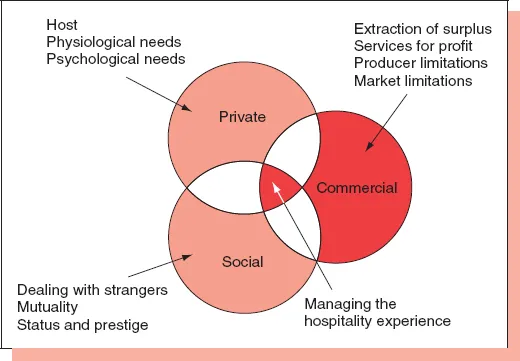
Lashley (2000) initially proposed that a three-domain model helped to set the context of hospitality using an admittedly crude Venn diagram, not only to distinguish between cultural/social, private/domestic, and commercial domains but also to show how they potentially overlap and influence each other. This is reproduced as Figure 1.1.
Whilst it was recognized that the Venn diagram was unsophisticated, it did allow a discussion of the three domains to take place, and the following paragraphs will highlight some of the emerging issues that have implications for the marketing of hospitality and tourism. Figure 1.2, which will be introduced later, suggests a model for the organization of business activities founded on the primacy of host and guest transactions as a means of building guest loyalty.
Figure 1.1 The three domains of hospitality (Source: Lashley (2000)).
The social/cultural domain
Destination marketing often makes reference explicitly and implicitly to the hospitality and welcome given to visitors. Failte Ireland's (2005) tourism marketing research shows that nine out of every ten overseas visitors to Ireland claim Irish friendliness and hospitality as the primary reasons for visiting the country. The Jamaican smile and welcome, and the world-famous ‘Southern hospitality’ in the USA are also examples of the claims about the welcome strangers will receive in different cultures, which are employed in the marketing of particular destinations. The quotation from Derrida given above suggests that these are claims made by all cultures and are indications of the human decency with which a society seeks to define itself. The problem is that both Derrida and tourism marketeers tend to downplay the extent to which these obligations to be hospitable vary between cultures, and over time.
Selwyn (2000) reminds us that a dominant culture-related definition of hospitality across societies is that it involves ‘converting strangers into friends’ (p. 19) and provides examples spanning continents, religions, and cultures. In Western settings, O'Gorman (2006) refers to an array of both Greco–Roman and Judeo–Christian texts extolling the religious obligations on both hosts and guests. O‘Gorman says (p. 23)
Hospitality includes food, drink and accommodation and also is concerned with the approach to be adopted e.g. welcoming, respectful and genuine. Hospitality is offered and the extent or limitation of it is based on the needs and the purpose of the guests/strangers. Alliances are initially developed through hospitality between friends, households and states, and are strengthened through continuing mutual hospitality. Hospitality once granted between individuals, households and states is also granted to descendants and through extended friendships.
Apart from the general obligation to offer succor and support to travelers, strangers, and the poor, reciprocity is also an important consideration of the hospitality relationship; in other words, the host may one day be the guest. Reciprocity was an important feature of tourism in Augustinian Rome (Lomine, 2005). Families built up networks of mutual relationships through offering and receiving hospitality, and toured between the various network members.
Heal's (1990) work on hospitality in the early modern England suggests that there were strong cultural obligations to offer hospitality to strangers, travelers, and the homeless. In particular, the host was required, as a moral and sacred obligation, to offer protection and safety to the guest, as well as shelter and nourishment. Heal argues that five underlying principles have governed English hospitality during the period. These are:
1. the relationship between host and guest is a ‘natural’ one (i.e., it is grounded in the nature of social life);
2. an intrinsic part of being a host is having regard for the ‘sacred nature’ of the guest (which refers, broadly, to the honor and status which a guest may bring to the host);
3. hospitality is noble;
4. ‘altruistic giving’ is an established and expected part of English social life; and
5. the social relationships and exchanges that hospitality engenders are at least as important as those formed in the market place (p. 22).
The obligations clearly extend back through human history and, until recently, in ‘modern societies’ carried strong moral sanctions for those who failed either to offer hospitality as a host or to behave appropriately as a guest. In the latter case, guests overstaying their welcome was a significant concern. Sherringham and Daruwalla (2006) remind us of an old Italian saying, which roughly translates as, ‘Guests are like fish, after three days they stink’. Selwyn's account of the three varieties of coffee offered free to travelers to the city of Sarajevo showed a deteriorating quality of coffee being offered, depending on the length of the visitor's stay. ‘If he has still not departed for the town having taken some cups of this second variety, the guest is served a third type which is known as sikterusa, which means “fuck off coffee” ’ (Selwyn, 2000, p. 33).
As further confirmation of these strong obligations in recent history, it is interesting to note that Shakespeare makes references to hospitality and inappropriate host and guest behaviors many times in his plays. Typically, he uses transgression of the laws of hospitality as a way on increasing the villainy of the character and action. Whilst twenty-first century audiences may well need to have the significance explained to them, it is likely that contemporary Jacobean audiences well understood that the murder of Duncan whilst he was a guest in Macbeth's house further intensified the outrage of the crime. Just in case, however, Shakespeare has Lady Macbeth feign horror on the discovery of the murder by saying, ‘What in our house?’ In other words, reminding the audience that the King has been murdered whilst the Macbeths should have been protecting him. In King Lear, when Buckingham is about to have his eyes removed by Lear's sons-in-law whilst he is entertaining them in his home, he says, ‘But you are my guests’. In both cases, Shakespeare uses the contemporary audience's understanding of the obligations of hospitality for dramatic effect, to distance the perpetrators from normal, moral, and decent society. Clearly, current cultural and religious pronouncements rarely consider these obligations to offer protection and hospitality to guests, though Selwyn (2000) traces sermons by religious leaders stretching into the nineteenth century where the virtues of extending hospitality are extolled. Even in the 1930s, in the United States, the Catholic Workers’ movement advocated re-engaging with medieval ideas of hospitality as a way of providing support for unemployed and poverty-stricken people (Selwyn, 2000). The key point here is that the obligations to be hospitable to strangers and to the poor has changed in industrial societies, though there is no reason why they ...
Table of contents
Cover Page
Half Title Page
Title Page
Copyright Page
Contents
Preface
List of Contributors
Part One Hospitality Marketing Concepts
Part Two Hospitality Marketing Functions and Strategies
Part Three Hospitality Consumer Behavior
Part Four Destination Marketing
Part Five Special Topics
Index
Trusted by 375,005 students
Access to over 1.5 million titles for a fair monthly price.
Study more efficiently using our study tools.
Frequently asked questions
Yes, you can cancel anytime from the Subscription tab in your account settings on the Perlego website. Your subscription will stay active until the end of your current billing period. Learn how to cancel your subscription
No, books cannot be downloaded as external files, such as PDFs, for use outside of Perlego. However, you can download books within the Perlego app for offline reading on mobile or tablet. Learn how to download books offline
Perlego offers two plans: Essential and Complete
Essential is ideal for learners and professionals who enjoy exploring a wide range of subjects. Access the Essential Library with 800,000+ trusted titles and best-sellers across business, personal growth, and the humanities. Includes unlimited reading time and Standard Read Aloud voice.
Complete: Perfect for advanced learners and researchers needing full, unrestricted access. Unlock 1.5M+ books across hundreds of subjects, including academic and specialized titles. The Complete Plan also includes advanced features like Premium Read Aloud and Research Assistant.
Both plans are available with monthly, semester, or annual billing cycles.
We are an online textbook subscription service, where you can get access to an entire online library for less than the price of a single book per month. With over 1.5 million books across 990+ topics, we’ve got you covered! Learn about our mission
Look out for the read-aloud symbol on your next book to see if you can listen to it. The read-aloud tool reads text aloud for you, highlighting the text as it is being read. You can pause it, speed it up and slow it down. Learn more about Read Aloud
Yes! You can use the Perlego app on both iOS and Android devices to read anytime, anywhere — even offline. Perfect for commutes or when you’re on the go. Please note we cannot support devices running on iOS 13 and Android 7 or earlier. Learn more about using the app
Yes, you can access Handbook of Hospitality Marketing Management by Haemoon Oh in PDF and/or ePUB format, as well as other popular books in Business & Hospitality, Travel & Tourism Industry. We have over 1.5 million books available in our catalogue for you to explore.