eBook - ePub
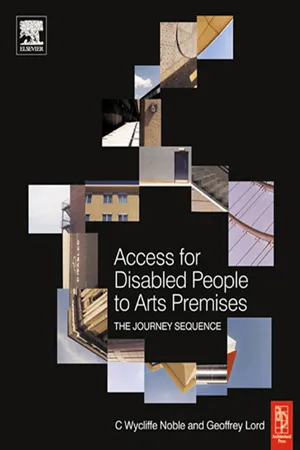
Access for Disabled People to Arts Premises: The Journey Sequence
- 192 pages
- English
- ePUB (mobile friendly)
- Available on iOS & Android
eBook - ePub
Access for Disabled People to Arts Premises: The Journey Sequence
About this book
Illustrating actual building design solutions that have been created to improve accessibility for disabled patrons and performers, the 'Journey Sequence' outlines the best examples of design innovation produced in response to new and upcoming legislation.
A knowledge of how to design for the disabled can be crucial in winning contracts and having designs accepted. This book shows how the practical implications have already been successfully approached.
Covering the whole sequence from parking, to entry, and including details of facilities for the visually and hearing impaired users, advice is given on the methods designers should use in assessing the requirements of disabled people. This is not a publication giving theoretical prescription but rather an illustrated record of achievements in buildings of all sizes where proper access to the disabled has been created. It includes 14 case studies and examples that illustrate the diverse ways that accessibility has been incorporated into arts buildings throughout the UK. This includes Cinemas, Theatres, Concert Halls, Opera Houses, Museums and Libraries. The author team highlights specific design details that are particularly unique, to stimulate the reader and show that creating better accessibility for the disabled both demands and creates innovative design.
Information
Table of contents
- Cover Page
- Half-title Page
- Dedication Page
- Title Page
- Copyright Page
- Table Of Contents
- Joint authors
- Foreword by The Earl of Snowdon GCVO
- Preface
- Introduction
- Acknowledgements
- 1 Development of the Journey Sequence
- 2 Venue descriptions
- 3 Examples of good practice
- 4 Communication techniques for sensory or cognitively impaired audiences
- 5 The International Symbol of Access (ISA)
- 6 Legislation and standards
- 7 Appendices
- Bibliography
- Contacts for each venue
- Index
Trusted by 375,005 students
Access to over 1.5 million titles for a fair monthly price.
Study more efficiently using our study tools.
Frequently asked questions
Yes, you can cancel anytime from the Subscription tab in your account settings on the Perlego website. Your subscription will stay active until the end of your current billing period. Learn how to cancel your subscription
No, books cannot be downloaded as external files, such as PDFs, for use outside of Perlego. However, you can download books within the Perlego app for offline reading on mobile or tablet. Learn how to download books offline
Perlego offers two plans: Essential and Complete
- Essential is ideal for learners and professionals who enjoy exploring a wide range of subjects. Access the Essential Library with 800,000+ trusted titles and best-sellers across business, personal growth, and the humanities. Includes unlimited reading time and Standard Read Aloud voice.
- Complete: Perfect for advanced learners and researchers needing full, unrestricted access. Unlock 1.5M+ books across hundreds of subjects, including academic and specialized titles. The Complete Plan also includes advanced features like Premium Read Aloud and Research Assistant.
We are an online textbook subscription service, where you can get access to an entire online library for less than the price of a single book per month. With over 1.5 million books across 990+ topics, we’ve got you covered! Learn about our mission
Look out for the read-aloud symbol on your next book to see if you can listen to it. The read-aloud tool reads text aloud for you, highlighting the text as it is being read. You can pause it, speed it up and slow it down. Learn more about Read Aloud
Yes! You can use the Perlego app on both iOS and Android devices to read anytime, anywhere — even offline. Perfect for commutes or when you’re on the go.
Please note we cannot support devices running on iOS 13 and Android 7 or earlier. Learn more about using the app
Please note we cannot support devices running on iOS 13 and Android 7 or earlier. Learn more about using the app
Yes, you can access Access for Disabled People to Arts Premises: The Journey Sequence by Geoffrey Lord,C Wycliffe Noble in PDF and/or ePUB format, as well as other popular books in Architecture & Architecture General. We have over 1.5 million books available in our catalogue for you to explore.