eBook - ePub
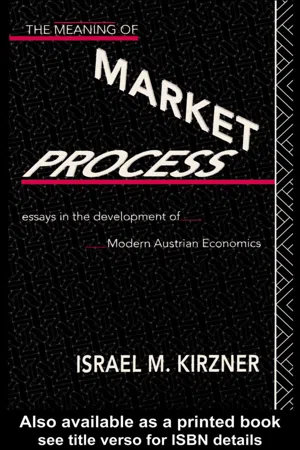
The Meaning of the Market Process
Essays in the Development of Modern Austrian Economics
- 264 pages
- English
- ePUB (mobile friendly)
- Available on iOS & Android
eBook - ePub
The Meaning of the Market Process
Essays in the Development of Modern Austrian Economics
About this book
Israel Kirzner is the foremost proponent of the modern Austrian theory of the market process. This book offers substantive insights in support of this theory and a new historical interpretation of how the ideas of modern Austrians emerged.
Information
Part I
The market process approach
Chapter 1
Market process theory: in defence of the Austrian middle ground
The chapters in this book have all, in one way or another, to do with the Austrian view of the market as a systematic process of mutual discovery by market participants. An overview of this Austrian understanding of the market, and of the task of economic theorizing in explicating this process, is provided in Chapter 2. The present introductory chapter has the purposes of reaffirming the thesis that this Austrian approach occupies the middle ground between two more ‘extreme’ positions in contemporary economic thinking, and of defending the viability of this middle ground against some recent criticisms raised by proponents of a radical subjectivism. Identification of the Austrian approach with the middle ground is not merely a matter of doctrinal classification; it will turn out that this identification (and especially a defence of this position against current criticisms) can contribute significantly to an appreciation of what market process theory can offer towards economic understanding. It is because of this contribution that this chapter can perhaps usefully serve to introduce the present volume. I shall call the thesis that the market process approach occupies the middle ground the Garrison thesis. 1
THE GARRISON THESIS
In a comment on a paper contributed by Professor Loasby to a conference volume a number of years ago, Roger Garrison first introduced the important insight that Austrian economics occupies a position intermediate between two more extreme perspectives in contemporary economics (Garrison 1982). On the one hand we have the mainstream neoclassical perspective, based on the assumption that equilibrium positions are strongly relevant to explanations of real world markets. On the other hand we have the perspective of those (including post-Keynesians) who are profoundly sceptical concerning both the meaningfulness and the real world relevance of the equilibrium models of mainstream theory. It turns out, Professor Garrison showed us, that on a number of important issues the Austrians differ from both of the (divergent) positions taken by these approaches. Let us take notice of two of these issues; they will be particularly useful for our subsequent discussions.
Knowledge ad market co-ordination
Mainstream economics, Garrison pointed out, has gravitated to one polar position on knowledge. ‘Perfect knowledge — or perfect knowledge camouflaged beneath an assortment of frequency distributions — has been the primary domain of standard theory for several decades now’ (Garrison 1982: 132). (We may add that, in multiperiod models of general equilibrium incorporating intertemporal exchange, this perfect knowledge assumption has been extended, in principle, to knowledge of all future time.) Much of the criticism, from post-Keynesians, Shackle and others, of mainstream economics has taken its point of departure to be the radical uncertainty which shrouds the future. This uncertainty is seen as so impenetrable as to render absurdly irrelevant all those neoclassical theories built up from individual optimizing decisions, assumed to be made between well-defined alternative future possibilities. As Shackle (1972: 465) put it, the ‘gaps of knowledge’ which arise from an uncertain future ‘stultify rationality’ (see also pp. 229f.). Knowledge is not, of course, completely absent but, the critics would maintain, there is no way, within a theory of markets, that existing ‘open-ended’ (Shackle 1972: 230) ignorance can be systematically eliminated. (Search is no solution because the ‘worth of new knowledge cannot begin to be assessed until we have it. By then it is too late to decide how much to spend on breaching the walls to encourage its arrival’ (pp. 272f.)). Thus the brute circumstance of ignorance concerning the future actions of other people makes it impossible for markets to induce consistency among individual decisions (Lachmann 1986a: 56f.).
It is here that the Austrian theory of market process takes a position concerning knowledge and possible market equilibration which avoids both these extremes. On the one hand the perfect knowledge assumption makes it pointless to ask how the market process can induce co-ordination among decisions; such co-ordination is already implied in the perfect knowledge assumption. On the other hand the assumption of invincible ignorance places the possibility of a systematic market process of systematic co-ordination entirely beyond reach.
For Austrians, however, mutual knowledge is indeed full of gaps at any given time, yet the market process is understood to provide a systemic set of forces, set in motion by entrepreneurial alertness, which tend to reduce the extent of mutual ignorance. Knowledge is not perfect; but neither is ignorance necessarily invincible. Equilibrium is indeed never attained, yet the market does exhibit powerful tendencies towards it. Market co-ordination is not to be smuggled into economics by assumption; but neither is it to be peremptorily ruled out simply by referring to the uncertainty of the future.
Volatility of data and the viability of economic science
Mainstream economics, Garrison further pointed out, often appears to occupy a polar position which recognizes no variability in the underlying data at all. At this extreme, ‘preferences, resource availabilities, and technology, do not change at all. Here, apart from the path dependency issue, the equilibrating tendency is not in doubt. This pole of the spectrum has been the popular stomping ground for neoclassical theorists …’ (Garrison 1982: 133). On the other hand there is the possible extreme position which sees economic data as being ‘more volatile than we care to imagine. In these circumstances we can predict not only that the question of an equilibrating tendency would be answered in the negative, but also that economic science … would itself be nonexistent’ (p. 133). Between these two perceptions of the changing world is that which has nourished the Austrian tradition (and, surely, informed the thinking of most economists). This perception is that the world is indeed constantly changing in unpredictable ways. People die, babies are born, tastes change spontaneously. Resource availabilities change over time; technological knowledge may evolve autonomously. But, it would be insisted, the rapidity and unpredictability of these changes is not, in general, so extreme as to frustrate the emergence of powerful and pervasive economic regularities. It is because these changes are frequent enough to ensure perennial disequilibrium that we need to understand the nature of equilibrating forces. It is because of the possibility, at least, of a benign limit to the volatility of these changes that these equilibrating forces do, at least sometimes, manifest themselves as unmistakable economic regularities. The scope of and possibility for a relevant economic science depends, as Garrison noted, on recognizing not only the variability of economic data but also the extent to which the co-ordinating properties of markets may be able to make themselves felt in spite of this variability.
ENTREPRENEURSHIP AND THE AUSTRIAN MIDDLE GROUND
In apaper several years ago (Kirzner 1985a: ch. 1 and fn. 9), which explicitly drew its inspiration from the Garrison thesis, the present writer applied the thesis to locating an Austrian view of the entrepreneur within the spectrum of relevant viewpoints to be found within the profession. Two opposing ‘extreme’ views concerning entrepreneurship were identified.
One view of the entrepreneur sees him as responding frictionlessly, and with full co-ordination, to market conditions, with pure profit the corresponding reward which these market conditions require and make possible. An excellent example of this view is that provided by T.W. Schultz (1975), for whom the entrepreneur is seen as responsively and smoothly providing a needed service to the market, that of reallocating resources under conditions of disequilibrium. Because this service is valuable there is a demand curve for it. And, because the ability to deal with disequilibria is scarce, there is a supply curve with respect to this service. Thus the entrepreneurial service of dealing with disequilibria commands a market price, as implied by the intersection of the relevant supply and demand curves. It is clear that this Schultzian view sees the market as, in the relevant sense, always fully coordinated: the market is always generating the correct volume of services needed to correct incorrect decisions. This extreme view, it must seem, has managed to squeeze entrepreneurship — even though it is defined as the ability of dealing with disequilibrium — back into the neoclassical equilibrium box.
The second ‘extreme’ view of the entrepreneur sees his activity in an almost precisely opposite way. This view is best exemplifiedby the perspective developed in the profound and prolific work of G.L.S. Shackle. For Shackle entrepreneurship simply cannot be fitted into the framework of equilibrium theory made up of strictly rational decisions (Shackle 1972:92, 134). More seriously, for Shackle the human choice, in all its manifestations, involves (in exactly the same way as entrepreneurship itself does) an ‘originative and imaginative art’ (p. 364), in no sense an automatic response to given circumstances. Thus, for Shackle, recognition of the ubiquity of the entrepreneurial element carries with it extremely damaging implications for the entire body of neoclassical theory. So, far from being able to assimilate a problematic entrepreneurship to an equilibrium theory of unchallenged validity, Shackle finds insoluble problems with equilibrium theory precisely because of its total incompatibility with the entrepreneurial element in human choice.
Between these two extreme views, one seeing entrepreneurship as consistent with equilibrium economics, the second seeing entrepreneurship as utterly destroying the relevance of equilibrium economics, this writer proposed to locate a third (‘Austrian’) view of entrepreneurship. This third view, developed from Misesian insights by the writer in several earlier works, finds entrepreneurship incompatible with the equilibrium state, but compatible with, and indeed essential for, the notion of the equilibration process.
Pursuing this third view, it was argued, can enable us to salvage elements of important validity from each of the more extreme views. We can, with Shackle, retain our appreciation for the ‘originative’ (i.e. the entrepreneurial) aspect of human choice. Yet we need not surrender the insight concerning the co-ordinative role of the entrepreneur which was emphasized by Schultz. The third view of the entrepreneur, that recognizing the propensity of the entrepreneur alertly to discover failures in existing patterns of co-ordination among market decisions, permits us to see how systematic (‘equilibrating’) market tendencies can be traced back to creative, originative, entrepreneurial alertness.
THE DOUBLE-EXPOSURE OF THE MIDDLE GROUND
It is in the nature of a centrist position to provoke criticism from each of the polar perspectives which it has eschewed. Such centrist positions must then be defended from two quite different sides. Two quite different types of attack may have to be rebutted, calling for simultaneous arguments pointing, it might at first sight appear, in almost diametrically opposed directions. This has indeed been the situation in which Austrian economics has, quite naturally, found itself.
Austrian economists must defend themselves against mainstream neoclassical economists unhappy with the vagueness, the indeterminateness and the imprecision which they see as inseparable from an approach prepared to recognize perennial disequilibrium. At the same time Austrians are placed on the defensive by critics of mainstream neoclassical economics, who are unhappy with the postulation, by the Austrians, of possibly powerful equilibrating tendencies.
Until recently Austrians found it necessary to devote much of their attention to defending themselves against mainstream neoclassical critical concerns. This was rather to be expected. It was, after all, their divergence from that mainstream that was the most obvious feature of the Austrian position. Recently, however, the centrist position of the Austrians has drawn criticism from a different direction, a criticism rooted not in mainstream equilibrium convictions but in the most uncompromising rejection of those convictions. This line of radical subjectivist criticism has assailed the Austrian middle ground position not for its recognition of open-ended uncertainty, of the creativity of individual choice, of the pervasiveness of disequilibrium market conditions, but for what the subjectivist critics have seen as the incompleteness ofthat recognition.
In particular, this line of criticism has challenged the very possibility of a middle ground position in the arena occupied by mainstream neoclassical theorists and their most radical opponents. If we are prepared to reject the set of constricting assumptions which characterize the equilibrium models of mainstream theory, consistency requires, this line of criticism insists, that we accept the utter irrelevance of these models for economic understanding. If Austrians reject an economics which in effect recognizes only the equilibrium state, they must reject, as well, the notion of equilibration altogether. There can be no half-way house. The middle ground which Austrians seek to occupy does not enjoy the strengths of the two polar positions from which they seek to escape. It suffers, rather, from the inconsistencies arising from the attempt to have the best of two utterly irreconcilable worlds.
The purpose of this chapter is to reaffirm the viability of the Austrian middle ground by addressing, in particular, the line of subjectivist criticism offered by those insisting upon the most complete rejection of the neoclassical paradigm. Such a defence of the Austrian middle ground assumes a special significance in the light of the historical attitude of the Austrian tradition towards the social function of the market.
MARKET CO-ORDINATION AND THE AUSTRIAN TRADITION
The early theoretical contributions of the Austrian economists brought them into sharp conflict with the historicism of the German School. At issue was the validity and relevance of a body of theory proclaiming the existence of important economic regularities. The postulation of economic regularities has implied, throughout the history of economics, certain consequences for the evaluation of the market economy. In the absence of such recognized regularities, a market economy may be perceived as a social system the apparent inadequacies of which invite deliberate corrective measures on the part of a benevolent state. A pattern of income distribution which seems offensive to an intuitive sense of justice can be corrected by appropriate redistributive policies. Market prices which appear, to the eyes of the policy makers or their constituents, to be too high or too low can be corrected by appropriate legislation. It was always the objections raised by the economic theorists which seemed to challenge the effectiveness of such proposed social policies. The existence of economic regularities implied severe limits to the corrective powers of the state. In fact, in the light of these regularities, the apparent inadequacies of the market often turn out to be not inadequacies at all, but unavoidable costs necessary for social co-ordination. Price controls, far from improving conditions for the consumer or for the farmer or whomever, are shown by economic theory to generate disastrous man-made shortages or gluts. Redistributive taxation policies are shown to generate undesired and undesirable disincentive or incentive effects.2 The tendency of economic theory to suggest a more sensitive appreciation for the social-efficiency properties of a market system has been so powerful and pervasive over the history of economics as to make economic theory the obvious obstacle to (and enemy of) would-be radical economic reformers (Stigler 1959: 522–32; Zweig 1970: 25). The early Austrian theorists indeed came, not surprisingly, to be identified with a generally classical liberal policy stance (see for example Streissler 1988: 192–204; see also this volume, Chapter 5).
For Carl Menger and his followers the market economy tends to allocate resources and assign incomes according to the valuations of consumers. As Menger (1981: 173) put it, ‘the price of a good is a consequence of its value to economizing men, and the magnitude of its price is always determined by the magnitude of its value’. Those who object to market outcomes simply do not appreciate the faithfulness and consistency with which markets transmit valuations. ‘It may well appear deplorable to a lover of mankind that possession of capital or a piece of land often provides the owner a higher income for a given period of time than the income received by a laborer for the most strenuous activity during the same period. Yet the cause of this is not immoral, but simply that the satisfaction of more important human needs depends upon the services of the given amount of capital or piece of land than upon the services of the laborer’ (p. 174). Clearly all this results from a theoretical perspective which sees consumer valuations as being quite faithfully translated into market decisions concerning resource allocation and resource prices.
What we wish, indeed, to emphasize is not so much the conservatism, or classical li...
Table of contents
- Cover
- Half Title
- Foundations of the market economy series
- Full Title
- Copyright
- Dedication
- Contents
- Preface
- Acknowledgements
- Part I The market process approach
- Part II The emergence of the Austrian view
- Part III Some new explorations in the Austrian approach
- Part IV Some related issues emerging from the Austrian approach
- Notes
- References
- Index
Trusted by 375,005 students
Access to over 1.5 million titles for a fair monthly price.
Study more efficiently using our study tools.
Frequently asked questions
Yes, you can cancel anytime from the Subscription tab in your account settings on the Perlego website. Your subscription will stay active until the end of your current billing period. Learn how to cancel your subscription
No, books cannot be downloaded as external files, such as PDFs, for use outside of Perlego. However, you can download books within the Perlego app for offline reading on mobile or tablet. Learn how to download books offline
Perlego offers two plans: Essential and Complete
- Essential is ideal for learners and professionals who enjoy exploring a wide range of subjects. Access the Essential Library with 800,000+ trusted titles and best-sellers across business, personal growth, and the humanities. Includes unlimited reading time and Standard Read Aloud voice.
- Complete: Perfect for advanced learners and researchers needing full, unrestricted access. Unlock 1.5M+ books across hundreds of subjects, including academic and specialized titles. The Complete Plan also includes advanced features like Premium Read Aloud and Research Assistant.
We are an online textbook subscription service, where you can get access to an entire online library for less than the price of a single book per month. With over 1.5 million books across 990+ topics, we’ve got you covered! Learn about our mission
Look out for the read-aloud symbol on your next book to see if you can listen to it. The read-aloud tool reads text aloud for you, highlighting the text as it is being read. You can pause it, speed it up and slow it down. Learn more about Read Aloud
Yes! You can use the Perlego app on both iOS and Android devices to read anytime, anywhere — even offline. Perfect for commutes or when you’re on the go.
Please note we cannot support devices running on iOS 13 and Android 7 or earlier. Learn more about using the app
Please note we cannot support devices running on iOS 13 and Android 7 or earlier. Learn more about using the app
Yes, you can access The Meaning of the Market Process by Israel M Kirzner in PDF and/or ePUB format, as well as other popular books in Economia & Business generale. We have over 1.5 million books available in our catalogue for you to explore.