- 200 pages
- English
- ePUB (mobile friendly)
- Available on iOS & Android
eBook - ePub
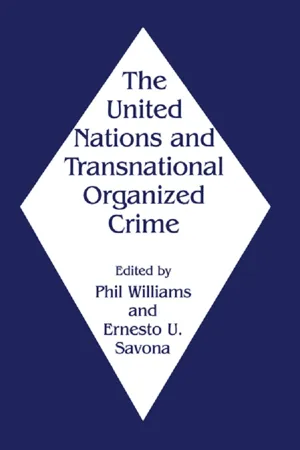
The United Nations and Transnational Organized Crime
About this book
Transnational organized crime poses a serious threat to the international community. This volume, the product of a UN conference, discusses the dangers of transnational organized crime and identifies forms of regional, national and international co-operation for its prevention and control, including intelligence networks, preventive strategies, extradition treaties, criminalizing participation in criminal organizations and the elaboration of an international convention. The reduction and subsequent containment of transnational organized crime require governments not only to recognize the seriousness of the challenge, but also to allocate resources commensurate with this challenge. The authors warn that should the international community fail to do this, the prospects for democratic government and the rule of law will be gloomy.
Problems and Dangers Posed by Organized Transnational Crime in the Various Regions of the World
Introduction
During the last few years, the international community has experienced an increasing number of political upheavals, geopolitical changes and technological restructuring, which have led countries to confront a diversity of challenges. No doubt, organized transnational crime, a new dimension of more 'traditional' forms of organized crime, has emerged as one of the most alarming of these challenges. Organized transnational crime, with the capacity to expand its activities and to target the security and the economies of countries, in particular developing ones and those in transition, represents one of the major threats that governments have to deal with in order to ensure their stability, the safety of their people, the preservation of the whole fabric of society and the viability and further development of their economies.
Responding adequately to the social, political, and economic problems posed by organized crime requires a clear understanding of their roots, their nature and the probability of success of particular kinds of countervailing efforts. Policy made without such an understanding is both fundamentally flawed and doomed to failure. Without insight there can be no solutions. Accordingly, it is necessary to analyse comprehensively the threat posed by transnational criminal organizations. A threat assessment of this kind has to focus on the steps to be taken to reduce the opportunities available to criminal organizations, to disrupt their operations and indict and punish their operatives, and to limit and if possible remove their profits. Furthermore, any society that aspires to a broad knowledge of organized crime must not underestimate the capabilities of the adversary if it wishes to comprehend and thoroughly evaluate that adversary's strengths and weaknesses.
The status of knowledge about organized crime allows key issues to be identified through which all of its features may be investigated. First of all, although there is no single monolithic criminal organization, it is clear that the problem is a global one and that no state or region is immune. Investigations have revealed that the various organizations have different structures, varying criminal emphases and distinct modi operandi but, at the same time, there are increasing linkages and cooperative enterprises among these groups. It is critically important, therefore, that governments and the public should be made aware of the threat posed by organized crime groups that cross national borders with speed, ease, and a complete disregard for national laws and regulations. Transnational organized crime has developed in ways that pose a serious challenge for governments and needs to be dealt with as a matter of urgency. The longer the problem is left untreated, the more entrenched and pervasive these groups will become, and the more difficult will it be to disrupt their activities, incarcerate their members and dismantle their organizational structures.
Second, it would be a grave mistake to underestimate the capabilities of these organizations. Traditionally, organized crime has been seen largely as a law and order problem rather than as something that can threaten the viability of societies, the independence of governments, the integrity of financial institutions, and the functioning of democracy. The fact that a particular problem has always been conceptualized and understood within certain parameters does not prevent it from taking on new forms that pose a novel and much more formidable challenge. Organized crime has undergone a transformation of this kind and can no longer be understood as simply a local or national phenomenon. The difficulty is that many policy makers tend to focus only on the local or domestic scene and have been slow to recognize the increasingly transnational nature of the problems they are examining. This has happened, for instance, in countries where the rejection of the 'alien conspiracy model' of organized crime has led to a preoccupation with local, regional and national aspects rather than the international dimensions of the problem.1
Third, organized crime groups can vary considerably. While each group has to be understood on its own terms with its own strengths and weaknesses, and not thought of as fitting into a single model, the study of the problem and the elaboration of policies and strategies should always take into account common characteristics and, more importantly, the links between groups in their operations across borders. A failure to consider these issues may lead to generic countermeasures being drawn up for the use of national and international law enforcement agencies, whereas countermeasures in fact need to be tailored carefully to specific organizational characteristics, to the political, economic and cultural contexts within which groups operate, and to the nature and extent of their operations.
A last preliminary remark concerns the reach of transnational organized crime. It is essential to recognize that, in dealing with transnational criminal organizations, criminals must ultimately be sought out in their home base, even though their activities may be geographically very widespread, rather than focusing on specific regions when the real problem is not region specific. This is not to ignore the potential for regional countermeasures as one form of international cooperation to deal with the threat. Regional initiatives provide an important link in a panoply of countermeasures that ideally should encompass local, national, regional, and global levels.
The identification and evaluation of policy responses by the international community need to be based on knowledge. An understanding of the opposition and its activities, aims and modus operandi remains crucial to any effort to maintain the rule of law and to promote justice, democracy and peace.
Key Concepts
Organized crime
The term 'organized crime' has long been a source of controversy and contention, probably because of differences in the ways of approaching various features of the problem. A broad consensus has nevertheless emerged on several conditions that have to be met before the term may be considered applicable.
Participants in criminal organizations are considered to be persons associated for the purpose of engaging in criminal activity on a more or less sustained basis. They usually engage in enterprise crime, namely the provision of illicit goods and services, or of licit goods that have been acquired through illicit means, such as theft or fraud. Organized crime 'represents in virtually every instance an extension of a legitimate market spectrum into areas normally proscribed. Their separate strengths derive from the same fundamental considerations that govern entrepreneurship in the legitimate market place: a necessity to maintain and extend one's share of the market'.2
The activities of organized crime groups require a significant degree of cooperation and organization to provide the illicit goods and services. Like any business, the business of crime requires entrepreneurial skill, considerable specialization, and a capacity for coordination, and this in addition to using violence and corruption to facilitate the conduct of activities. Corruption can range from payoffs to law enforcement officials to the infiltration or co-option of political authorities. Although it has been suggested that, in some instances of organized crime, the use of violence and corruption is not as widespread as it is presumed to be, in other cases it is very much in evidence.3 Furthermore, both violence and corruption are tactics that organized crime groups tend to resort to for self-protection, the settlement of disputes and the facilitation of illicit business activities.
Experts are also concerned, however, with more controversial issues, such as the size, structure and cohesion of criminal organizations. At one end of the spectrum are those who see organized crime in terms of large hierarchical organizations that are structured rather like traditional corporations. At the other end are those who contend that 'for the most part, organized crime groups tend to be loosely structured, flexible, and highly adaptable. In fact... the real power and effectiveness of organized crime is found in these amorphous qualities. Rather than resembling a formal corporate structure, organized crime more closely resembles a social exchange network in the community'.4 Moreover, it is argued, these groups tend to be relatively small in size, fluid in nature and characterized by considerable opportunism.5 Rather than being seen in terms of dichotomies between small or large organizations and formal structures or informal networks, however, these dimensions can be best understood in terms of a continuum from small to large and from fluid network organizations to bureaucratic structures. In addition, it is important to consider the elements of continuity and evolution that characterize organized criminal groups. Moreover, some groups may combine elements of the formal hierarchical structure at certain levels, with a more amorphous fluid network at the lower levels.
Size and degree of formal structure provide two dimensions along which groups can be identified and compared, as a preliminary to identifying their strengths and vulnerability and devising appropriate countermeasures by governmental and law enforcement agencies.
A third important variation concerns the scope of criminal activities. Some groups are highly specialized and focus upon one kind of activity, such as prostitution or drugs; others engage in a broader range of criminal activities, such as credit card fraud and various financial 'seams'.
The discussion of organized crime has thus far concentrated on the traditional aspects of the subject. There has been, however, a major transformation, whereby what had traditionally been a domestic, local or national problem, was transformed into a major regional and global problem, with pervasive and far-reaching consequences not only for individual states but also for the international community of states.
Transnational criminal organizations
The term 'transnational' is generally used to refer to the movement of information, money, physical objects, people, or other tangible or intangible items across state boundaries, when at least one of the actors involved in this movement is non-governmental.6 Terrorist groups are similar in nature to many corporations. Criminal organizations are also increasingly engaged in activities that tend to cross national borders.
Virtually any tangible item involved in transnational transactions is likely to have a significant economic dimension, in that it can be treated as a commodity or service to which monetary value can be attached.7 Since the crime industry is about the criminal exploitation of business opportunities and is dominated by supply organizations, it is no surprise to see organizations springing up that transport illicit commodities across national jurisdictions.8
The globalization of trade and of consumer demand for leisure products made it natural for criminal organizations to move from national activity to transnational operations. Of course, not all those involved in organized crime operate at this level, but there are inextricable connections between the local and the global, and the transnational dimension of crime has taken on unprecedented importance. Furthermore, it is likely that organized crime groups that are still predominantly national in scope will increasingly operate across borders in the future, in order to exploit market opportunities in other states.
The provision of illicit goods and services has never been completely inhibited by national boundaries. Indeed, 'smuggling has often been called the world's second oldest profession'.9 The scale of smuggling activity, however, has grown well beyond efforts to avoid tariffs or taxes on licit products, and to a growing extent involves trafficking in illicit products.
Criminals and criminal organizations have increasingly engaged in cross-border activity, both in response to market opportunities and as a means of reducing their vulnerability to law enforcement efforts. Uneven criminal justice and law enforcement capabilities mean that the degree of risk varies considerably according to the location of the organization. Consequently, criminal organizations tend to have a home base in areas where the risks are low and engage in providing illicit goods and services to markets where the profits are very high.
By acting transnationally, criminal organizations are able to obtain access to lucrative markets and to find points of vulnerability that they can infiltrate, while still operating from areas where they are relatively immune to law enforcement efforts. They also channel the proceeds from illicit activities through the global financial system, often using tax havens and relatively unregulated banking centres as major points of access.
These activities have become sufficiently important to suggest the emergence of what have been termed 'transnational criminal organizations', that is, organized crime groups that have a home base in one state but operate in one or more host states where there are favourable market opportunities.10 These organizations have become major players in global economic activity and are the key players in illicit industries, such as drug production and trafficking, that are global in scope and yield profits higher than the gross national products of some developing and developed states.
They bear many similarities to transnational corporations and, like transnational corporations, they vary considerably in structure, strength, size, geographical range and the scope or diversity of their operations. Some are global in reach and organized hierarchically; others are more limited in the scope of their operations and more fluid in structure. Their common feature is that they engage in unregulated forms of enterprise, involving illicit products and services, the illicit smuggling of licit products, the theft of licit products, or all three kinds of activity.
In trying to understand these organizations, a useful starting point is to view them as a blend of the corporate and the criminal and, for the purposes of analysis and, in certain respects only, as a mirror of transnational corporations. Like transnational corporations, their major concern is the pursuit of profit, and in this pursuit they engage in far-flung economic activities that readily cross national borders. Moreover, both transnational criminal organizations and transnational corporations share a desire to maximize their freedom of action and to minimize the effects of both national and international control over their activities. While this is a useful starting point, however, transnational criminal organizations differ from transnational corporations in several important respects.
First of all, transnational corporations may use economic incentives and sometimes act ruthlessly in order to achieve their economic objectives; but, when licit corporations break the law, it is the exception rather than the rule. With transnational criminal organizations, in contrast, law-breaking is the norm and a key element of their very identity. Although these organizations may inves...
Table of contents
- Cover
- Title
- Copyright
- Contents
- Introduction
- Problems and Dangers Posed by Organized Transnational Crime in the Various Regions of the World
- National Legislation and its Adequacy to Deal with the Various Forms of Organized Transnational Crime: Appropriate Guidelines for Legislative and Other Measures to be Taken at the National Level
- Most Effective Forms of International Cooperation for the Prevention and Control of Organized Transnational Crime at the Investigative, Prosecutorial and Judicial Levels
- Appropriate Modalities and Guidelines for the Prevention and Control of Organized Transnational Crime at the Regional and International Levels
- The Feasibility of Elaborating International Instruments, including Conventions, against Organized Transnational Crime
- Conclusions and Recommendations of the International Conference on Preventing and Controlling Money Laundering and the Use of the Proceeds of Crime: A Global Approach
- Report of the Secretary-General: Implementation of General Assembly Resolution 49/150 on the Naples Political Declaration and Global Action Plan against Organized Transnational Crime
Trusted by 375,005 students
Access to over 1.5 million titles for a fair monthly price.
Study more efficiently using our study tools.
Frequently asked questions
Yes, you can cancel anytime from the Subscription tab in your account settings on the Perlego website. Your subscription will stay active until the end of your current billing period. Learn how to cancel your subscription
No, books cannot be downloaded as external files, such as PDFs, for use outside of Perlego. However, you can download books within the Perlego app for offline reading on mobile or tablet. Learn how to download books offline
Perlego offers two plans: Essential and Complete
- Essential is ideal for learners and professionals who enjoy exploring a wide range of subjects. Access the Essential Library with 800,000+ trusted titles and best-sellers across business, personal growth, and the humanities. Includes unlimited reading time and Standard Read Aloud voice.
- Complete: Perfect for advanced learners and researchers needing full, unrestricted access. Unlock 1.5M+ books across hundreds of subjects, including academic and specialized titles. The Complete Plan also includes advanced features like Premium Read Aloud and Research Assistant.
We are an online textbook subscription service, where you can get access to an entire online library for less than the price of a single book per month. With over 1.5 million books across 990+ topics, we’ve got you covered! Learn about our mission
Look out for the read-aloud symbol on your next book to see if you can listen to it. The read-aloud tool reads text aloud for you, highlighting the text as it is being read. You can pause it, speed it up and slow it down. Learn more about Read Aloud
Yes! You can use the Perlego app on both iOS and Android devices to read anytime, anywhere — even offline. Perfect for commutes or when you’re on the go.
Please note we cannot support devices running on iOS 13 and Android 7 or earlier. Learn more about using the app
Please note we cannot support devices running on iOS 13 and Android 7 or earlier. Learn more about using the app
Yes, you can access The United Nations and Transnational Organized Crime by Ernesto Savona,Phil Williams in PDF and/or ePUB format, as well as other popular books in Law & Criminal Law. We have over 1.5 million books available in our catalogue for you to explore.