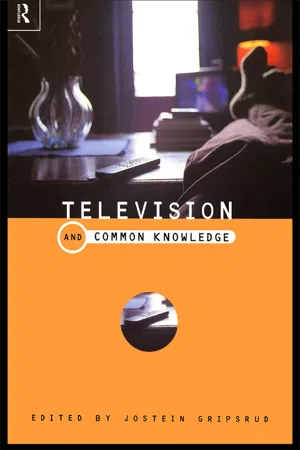
Television and Common Knowledge considers how television is and can be a vehicle for well-informed citizenship in a fragmented modern society. Grouped into thematic sections, contributors first examine how common knowledge is assumed and produced across the huge social, cultural and geographical gulfs that characterise modern society, and investigate the role of television as the primary medium for the production and dissemination of knowledge. Later contributions concentrate on specific tv genres such as news, documentary, political discussions, and popular science programmes, considering the changing ways in which they attempt to inform audiences, and how they are actually made meaningful by viewers.
- 224 pages
- English
- ePUB (mobile friendly)
- Available on iOS & Android
eBook - ePub
Television and Common Knowledge
About this book
Information
Subtopic
Media StudiesIndex
Social SciencesPart I
PUBLIC SPHERE(S)
1
RIGHTS AND REPRESENTATIONS
Public discourse and cultural citizenship
Graham Murdock
A TALE OF TWO NARRATIVES
One of the most seductive themes running through debates around postmodernity is the story of the collapse of grand narratives and their totalizing projects. This tale finds its most dramatic moment in the dynamiting of the Pruitt-Igoe housing development in St Louis in 1972. This demolition is widely presented as marking the moment when modern architecture ‘died’ (Jencks 1984:9) and the clean, austere machines for living in gave way to the plural, personalized styles of suburbia and the playfulness and excess of Las Vegas. The prisoners in modernity’s Bastilles of the imagination are freed from their incarceration. The general yields to the local, the standardized to the customized. Identities proliferate. The repressed return. As Jean-François Lyotard argued in 1985, ‘the grand narratives that characterise western modernity… [were] concerned precisely with the overstepping/ surpassing of particular cultural identity towards a universal civic identity’ (quoted in Kahn 1995:8). Now there is only the endless play of difference.
It is narrative set in a landscape of affluence. If he had looked ‘beyond the confines of the prosperous European Union’ to societies about to enter a period of dissolution and reconstitution he would have seen questions of civic identity being pushed to the centre of debate (Bulmer and Rees 1996:281)—by the crowds that tore down the Berlin Wall, by the solitary student who stood in front of a row of tanks on their way to crush the pro-democracy movement in central Beijing and by Nelson Mandela on the day of his release from prison, walking alone down the road that led away from apartheid towards the new democracy in South Africa. They were laying claim to the Enlightenment’s most potent political legacy—the ideal of full and equal citizenship and its extension to the general notion of human rights.
The claim to citizenship found enduring expression in the French Revolution’s militant demand for liberty, equality and fraternity, but because the relations between these terms were never properly defined they have generated continual disputes. When the French philosopher Alexis de Tocqueville journeyed around America, the other modern ‘revolutionary’ republic, in the 1830s he was struck by the tension between the integrating qualities of empathy and mutuality—the ‘habits of the heart’ as he called them— fostered by the rich network of civil institutions and the spirit of competitive individualism that increasingly separated citizens from one another. This balance, or imbalance, has been an abiding concern in American political philosophy ever since. It finds its most recent expression in the battle between liberals— who emphasize personal autonomy and the right to individual choice—and communitarians, who stress the need for shared ties of loyalty and reciprocity (see Mulhall and Swift 1992).
It is no accident that the revival of philosophical debate about the proper relationship between liberty and fraternity has coincided with the rise of neoliberal economic and social policies in America and a number of other Western democracies. The New Right’s progressive reduction of citizenship to questions of individual choice in the marketplace created by the enterprise economy has led ‘radical liberals’ like Ralf Dahrendorf to insist that ‘the social entitlements of citizenship are as important a condition of progress as the opportunities for choice which require entrepreneurial initiative and an innovative spirit’ (Dahrendorf 1990:38). As a riposte, conservatives argue that the promotion of ‘the civic or social virtues (“the caring virtues”, as they are sometimes called)’ may well ‘undermine the “vigorous virtues” associated with the free market—self-reliance, self-sufficiency, entrepreneurship, ambition’— and so weaken the essential conditions of personal freedom (Himmelfarb 1996:13).
The fact that the relationships between liberties and loyalties, rights and responsibilities are matters of continuing contest makes the organization of television central to the constitution of contemporary citizenship. Because it is a pivotal ‘theatre of discourse…that enters the life of the entire public’, society has an obvious stake ‘in which speakers have the opportunity to take their turn on this platform of public narrative’, who they speak for, whose experiences, viewpoints and arguments they articulate, and which questions they ask (Price 1995:75). Before exploring the shifting relationship between citizenship and television in more detail, however, we need to specify the dimensions of citizenship a little more carefully.
FROM SIMPLE TO COMPLEX CITIZENSHIP
In general terms we can define the basic entitlement of citizenship as the right to participate fully in social life with dignity and without fear, and to help formulate the forms it might take in the future. Definitions of what specific rights need to be guaranteed in order to underwrite this ideal have not remained static, however. Rights have been progressively extended to new spheres of social action and to new social groupings (such as children), and the nature and distribution of the resources required to render them substantial rather than simply nominal have been matters of continual argument, as have the forms of social responsibility that accompany rights. As a consequence, conceptions of citizenship have moved from the relatively simple to the increasingly complex.
The original definition grew out of debates about the relationship between two major social domains of modernity—the state and government, on the one hand, and civil society, on the other. This produced claims to two major sets of rights.
Rights in relation to the state revolved around the right to protection from the arbitrary use of force by either the state and its agencies (as in detention without trial or torture) or other citizens. Securing this second condition nourished the idea of the state as a ‘night-watchman’ guaranteeing the personal safety of citizens through appropriate levels of policing and military defence coupled with prohibitions against the unauthorized personal use of force (through duelling, vendettas or vigilante action, for example). Disputes between citizens and between citizens and the state were to be resolved by the rule of law. Every citizen claimed the right to equal, non-discriminatory treatment before the law, the right to participate in selecting representatives to those forums that decided on new laws and revoked old ones (most typically through universal adult franchise), and the right to participate in the practical application of law to specific cases through the jury system.
These rights were instituted as core components of liberal democracies only after bitter and extended struggles, and even now there are a number of unresolved issues. For example, is capital punishment an unacceptable exercise of state power? What are the proper limits to the state’s right to maintain surveillance of its citizens in the interests of internal security? There is even less consensus over the responsibilities that accompany these rights, or on how best to secure them. Should there be a legal requirement to vote, with penalties for non-compliance (as in Australia), for example?
At first sight, rights in relation to civil society appear less disputable. Certainly there is general agreement that in democracies citizens’ rights must include freedom of conscience and belief, freedom of association and freedom of expression. But there are difficulties. Rights of expression involve the rights of listeners as well as of speakers. The proliferation of identities within contemporary cultures poses particular problems. The argument that everyone should enjoy the ‘freedom to belong to an identity and to contribute to its definition’ (Melucci 1988:258) and the freedom ‘to withdraw from belonging in order to create new meanings’ (Melucci 1989:173) is central to the idea that contemporary politics is increasingly centred on the politics of identity—the struggle over forms of belonging, loyalty and solidarity. This, in turn, ‘requires the conditions which enable individuals and social groups to be recognised for what they are or wish to be’ (ibid.: 172). But what if the construction of one identity requires the dismissal or denial of others? What if the repressed exercise their own forms of repression? What are the limits to ‘free’ speech in the major arenas of public discourse? As the principal stock exchange of public discourse, television has to negotiate the politics of difference on a daily basis, looking to balance assertion against injury.
One seductive solution to this dilemma is to avoid confrontations by parcelling out differences into specially demarcated ‘minority’ programmes or streamed channels—to move from broadcasting addressed to everyone to ‘narrowcasting’ serving self-defining groups. But this immediately raises another problem. It makes it impossible to create a shared cultural space which combines respect for difference with a commitment to developing a workable contemporary conception of the ‘common good’. Achieving this requires the recognition of solidarities as well as separations, the renegotiation of communality as well as difference. It depends on bringing diverse experiences, identities and positions together in the same symbolic arena, exploring their interplay, and balancing recognition and respect for particular identities against the renewal of a culture held in common. As Stuart Hall has argued, in today’s conditions of fracture and fragmentation it is more necessary than ever that we ‘create…enough of a shared culture to mean that we can exist in the same space without eating one another’ (Hall quoted in Sanders 1994:18).
In response, many of those working in television would argue that they are helping to create a ‘shared culture’ on a daily basis. They are, but it is a culture more and more based around the figure of the consumer and the ideology of consumerism; the notion that identity and fulfilment can be purchased in the marketplace, and that the good life is to be found through total immersion in the world of goods, postmodernity’s new baptism. This development undermines citizenship in two ways. First, it privileges personal spending over social and political participation, and addresses viewers as shoppers rather than as members of intersecting moral communities. Second, by equating social differences with variations in choice and style it negates any attempt to arrive at a conception of the ‘common good’ based on the negotiation of differences in their full complexity.
UNDERWRITING RIGHTS
The tensions between ‘consumers’ and ‘citizens’ are part of a problematic general relationship between the requirements of democracy and the dynamics of capitalism. As originally conceived, civil society was a comfortably copious, baggy concept. Because it covered all institutions and associations that were not part of the state, it included the nascent organizations of capitalism as well as the dense network of voluntary and community groups and social movements. However, as the nineteenth century wore on and corporate ownership became more concentrated, it became increasingly clear that the activities and aims of the major capitalist companies were antithetical to the extension of citizenship.
If people were to become full citizens they had to have access to the material and symbolic resources that secured social inclusion and facilitated participation. Rights had to be publicly underwritten. This required that the state abandon its minimalist night-watchman role and intervene in the workings of market capitalism. Many of these initiatives were aimed at protecting citizens as workers and consumers from the arbitrary use of corporate power and ensuring a minimal basis for social participation. They included interventions in areas such as minimum wages, health and safety, holiday and sick-leave entitlements, and trade union rights. Despite over a century of struggle, arrangements in these areas are far from settled. Rights are always precarious. They can be weakened or reversed. They are continually contested by corporations arguing for greater ‘flexibility’. These moves are met, in return, with resistance and counter-claims for new rights in areas such as equal opportunities, positive discrimination and corporate responsibility for environmental pollution or the health hazards of smoking.
Alongside attempts to curb corporate power in the public interest, positive initiatives were launched to compensate for market failures by publicly funded core resources for citizenship that the market could not or would not provide. The material basis necessary to underwrite social participation with dignity—a lifelong basic income, a reasonable level of health care, safe domestic and public space—became the business of the welfare system. It was a practical strategy for securing inclusion, based on the assumption that ‘In a good society there cannot, must not, be a deprived and excluded underclass’ and that those ‘who heretofore have made it up must become fully a part of the larger social community’ (Galbraith 1994:15).
But it was clear that, in addition to guaranteeing basic material conditions for participation, full citizenship also required access to relevant symbolic resources and the competences to use them effectively. Efforts to secure full cultural rights centred on the development of an array of public institutions—the education system, museums and galleries, public libraries and public broadcasting. They were to be paid for out of taxes and to be equally open to all. Judging how well they have succeeded in delivering cultural rights, however, depends on how these rights are defined.
DEFINING CULTURAL RIGHTS
We can begin by outlining four basic sets of cultural rights:
- Rights to information. Citizens have rights of access to the widest possible range of relevant information about the conditions that structure their range of choices, and about the actions, motivations and strategies of significant social, political and economic actors, particularly those with significant power over people’s lives. These would include state agencies, the government, corporations, opposition parties and social movements, and transnational agencies and organizations.
- Rights to experience. Citizens have rights of access to the greatest possible diversity of representations of personal and social experience. Whereas in television information has been primarily the preserve of actuality programmes—news, current affairs and documentary—the exploration of experience has been mainly accomplished through fiction. As John Mepham (1990) has argued, sharing stories is an essential resource for fostering the capacities and reciprocities of full citizenship. They offer:
A form of inquiry to which people can turn in their efforts to answer questions which invariably spring up in their lives. What is possible for me, who can I be, what can my life consist of, how can I bring these things about? What is it like to be someone else, to be particular kinds of other people? How does it come about that people can be like that? We have to make an unending effort to answer questions like this so that we can…make imaginatively informed choices and responses to other people…. These questions and these capacities and skills are basic to having a sense of self, an identity, and to fair dealing with others within a system of social relationships.(Mepham 1990:60) - Rights to knowledge. Access to information and experience offers ‘thick descriptions’ of the world, and ‘structures of feeling’ based on empathy and the capacity to view the world through other people’s eyes, but it does not provide explanations. It does not reveal how particular events and lives have been shaped by deep-seated processes of inertia and change, how biographies are anchored in history. Connecting the particular to the general, the micro to the macro, requires access to frameworks of interpretation that point to links, patterns and processes, and suggest explanations. They translate information and experience into knowledge. By explaining the forces shaping the present and tracing its links to the past, they open up ways of formulating strategies for change. At the same time, the postmodernists are right to insist that the contemporary intellectual field is more fractured and contested than ever before. Knowledge is no longer a gift, carefully wrapped by experts. It is the stake in a continual contest of positions. Consequently, cultural rights in the contemporary situation must guarantee access to the key debates and arguments in this contest, but what kind of access?
- Rights to participation. Traditionally, public broadcasting has constructed its audiences as listeners rather than speakers, spectators rather than image-makers. Over the last fifteen years or so, however, these asymmetric relationships have been progressively challenged by viewers demanding the right to speak about their own lives and aspirations in their own voice, and to picture the things that matter to them in ways they have chosen. These claims to participation in the making of public meaning raise difficult issues of representation.
QUESTIONS OF REPRESENTATION
In thinking about representation we need to hold on firmly to...
Table of contents
- COVER PAGE
- TITLE PAGE
- COPYRIGHT PAGE
- TELEVISION AND COMMON KNOWLEDGE
- CONTRIBUTORS
- TELEVISION AND COMMON KNOWLEDGE
- Part I: PUBLIC SPHERE(S)
- Part II: SOCIOCULTURAL FUNCTIONS
- Part III: GENRES
Trusted by 375,005 students
Access to over 1.5 million titles for a fair monthly price.
Study more efficiently using our study tools.
Frequently asked questions
Yes, you can cancel anytime from the Subscription tab in your account settings on the Perlego website. Your subscription will stay active until the end of your current billing period. Learn how to cancel your subscription
No, books cannot be downloaded as external files, such as PDFs, for use outside of Perlego. However, you can download books within the Perlego app for offline reading on mobile or tablet. Learn how to download books offline
Perlego offers two plans: Essential and Complete
- Essential is ideal for learners and professionals who enjoy exploring a wide range of subjects. Access the Essential Library with 800,000+ trusted titles and best-sellers across business, personal growth, and the humanities. Includes unlimited reading time and Standard Read Aloud voice.
- Complete: Perfect for advanced learners and researchers needing full, unrestricted access. Unlock 1.5M+ books across hundreds of subjects, including academic and specialized titles. The Complete Plan also includes advanced features like Premium Read Aloud and Research Assistant.
We are an online textbook subscription service, where you can get access to an entire online library for less than the price of a single book per month. With over 1.5 million books across 990+ topics, we’ve got you covered! Learn about our mission
Look out for the read-aloud symbol on your next book to see if you can listen to it. The read-aloud tool reads text aloud for you, highlighting the text as it is being read. You can pause it, speed it up and slow it down. Learn more about Read Aloud
Yes! You can use the Perlego app on both iOS and Android devices to read anytime, anywhere — even offline. Perfect for commutes or when you’re on the go.
Please note we cannot support devices running on iOS 13 and Android 7 or earlier. Learn more about using the app
Please note we cannot support devices running on iOS 13 and Android 7 or earlier. Learn more about using the app
Yes, you can access Television and Common Knowledge by Jostein Gripstrud in PDF and/or ePUB format, as well as other popular books in Social Sciences & Media Studies. We have over 1.5 million books available in our catalogue for you to explore.