- 224 pages
- English
- ePUB (mobile friendly)
- Available on iOS & Android
eBook - ePub
Managing an Effective Operation
About this book
All managers have a responsibility for the successful operation of their business. Managing an Effective Operation shows how you can effectively: * set departmental objectives within the context of an organisation * measure the competitive advantage of your business * manage the operational task * balance resources and demand * develop facilities and systems to ensure quality * achieve continual improvement * accomplish change management * manage your time
Throughout Managing an Effective Operation, practical illustrations and examples are used to show you how to achieve high operational standards, quality performance and maximum profit. Managing an Effective Operation is designed to provide underpinning knowledge and understanding required for any competency based management course. It is based upon the Management Charter Initiative's Occupational Standards for Management NVQs and SVQs at Levels 4 & 5 and is also particularly suitable for managers on Certificate and Diploma in Management programmes, including those accredited by BTEC. Paul Graves is a Managing Consultant at Sundridge Park Management Centre. Eddie Fowler is an independent consultant and an Associate of Sundridge Park.
1 What business are you in – and does your operation match it?
Introduction
For most of our managerial lives we are asked to take custody of a ‘running’ operation – i.e. the operating unit, group or department was already in existence before we took responsibility for it and it will continue after we have moved on. Ours is a custodial role, to manage it for a period of time. We take over systems designed by other people; routines chosen by predecessors to suit their way of doing things. The equipment for which we become responsible may have been in place some time, selected then, we trust, to suit the business needs as someone at that time saw them. Our staff were chosen – recruited, promoted, trained – by former managers and organized in a way to suit their (the previous managers’) way of working. All these aspects of the operation for which we are now responsible would have been influenced by the financial state of the company when all these former decisions were made. Lean times usually mean low-cost decisions, richer times maybe more expansive but possibly less considered solutions. Sometimes corporate policies would have ruled – ‘this organization will standardize on XYZ company’s computer equipment, or US Inc’s advertising services’.
A whole host of influences impacted, controlled, guided, forced our predecessors to make decisions for the operation for which we have now been made responsible. It is highly unlikely we will know of all these influences, even if we’ve been in the company or department before. Maybe no one individual does know all the history and the rationale for the selections that have been made. But whether we know that history or not, we are now responsible for the results of all those decisions – namely the operation itself. Our job now is to keep it all running smoothly. Or is it? We think it is worth checking a few things about the structure and organization of an operation, and in this chapter we aim to help you do that.
This chapter is concerned with:
• assessing the need for change;
• achieving focus;
• key tasks and determining customer needs;
• strategy alignment and team work;
• aligning the sales operation;
• internal and external customers; and
• responsiveness.
The chapter relates to the MCI standards as follows:
• M1/1.1: Maintain operations to meet quality standards.
• M1/1.2: Create and maintain the necessary conditions for productive work.
• M2/1.1: Identify opportunities for improvement in services, products and systems.
• M2/2.2: Establish and agree customer requirements.
Assessing the need for change
Keeping things running smoothly is essential and there is always a strong temptation to avoid unnecessary disturbance. Such an attitude is understandable and obviously stems from the need to ensure that the operation does its best to support the business. However, our concern is that it probably leads to managers continuing to run operations in the way they were running when they took them over, without due consideration for whether or not that is the right thing to do. On day one of the ‘new ownership’ there is really no other way. The operation runs and you are new – you do not know enough to change anything even if you wanted to. It is highly likely instant changes would cause things to grind to a halt because you and your people need time to adjust to one another. Anyway, who said anything needs changing at all? If the operation is running, why this talk of change?
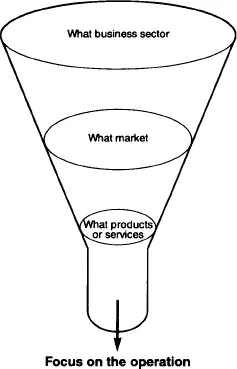
Figure 1.1 The focus funnel
Indeed, things may well be fine. The operation may be well chosen, the result of sound decisions which collectively provide for an efficient and effective unit; one that is supporting the business to its maximum capability. However, the manager needs to know how to judge these issues for him- or herself as the essential precursor to deciding if any change is required. So how might you go about this assessment?
To try to provide some answers we would like you to consider a situation few of us are lucky enough to experience, namely that of the new or ‘green field’ operation. In such a situation there is no operation to take over; we have to design it and we need a framework to help us.
Figure 1.1 illustrates a process which can begin to help us to think through the design of an operation in such a ‘green field’ situation.
Achieving focus
In a ‘green field’ situation, the first task for the management is to decide the sector of the market on which it is going to focus. For a hotel business, for instance, this would involve decisions such as whether the aim is towards business or tourist trade; short-term or long-term clientele, high quality or low cost. For a manufacturing business, it would involve such aspects as commodity or niche markets, high or low volumes, single or multiple products.
Having made our decision about the market sector in which we are going to operate, we are then in a position to decide on the essential features of the products or services which we are going to offer.
As an example, if we were setting up a ‘business’ hotel we would need to consider the services that business clients would expect, such as late check-in, early check-out, communication systems (telephone, fax, business video conferencing), secretarial services, conferencing/meeting facilities. This thinking process then leads us to consider the type of operation that has to deliver those products or services. We are attempting to ‘focus’ our minds upon the essentials of the deliverables from the operation. Although it is our own minds we are trying to focus, we are actually making an attempt to put ourselves in someone else’s mind, namely that of our customer. The operation we are going to design must deliver what our customer values, not what we think is important. We would hope that if we are in tune with our customer(s) we would value what they value, but this is certainly not universally the case. Many, many operations have been set up to provide what the company decides is important rather than what its customers need. Low market share and low margins are almost always the result and, in severe cases of mismatch, eventual failure of that operation if not the company. This phase of focusing minds, therefore, should not be rushed, as everything flows from the results of these crucial decisions, and it usually takes time to research and understand what customers really value. Our aim is to deliver on these customer-valued aspects better than any of our competitors, and our operation must be set up to do this. Focus is the vital first step in this process – that is why we have called Figure 1.1 ‘The focus funnel’.
Box 1.1
The UK business press reported on a trend in volume hotel operations within the UK. This is the provision of low-cost commodity type hotel accommodation aimed primarily at the business traveller. The major chains, such as Trust House Forte and Granada, are introducing these new hotels as rapidly as they can. Location is vital, and they are always sited at strategic road travel points, excellent access by car being crucial. Accommodation is standard, and satisfies the majority of overnight needs; it includes families, so as not to eliminate an important section of the market. Running such an operation as this particular type of hotel requires specialized systems and staff; twenty-four hour coverage is essential for very late arrivals and very early departures; simple, fast billing; straightforward restaurants, not ‘a la carte’ are required here. And so on – the whole operation geared to the market need. Its success shows it is just that.
At this point, let us revert to the more common situation of managers – maybe you, who are running a longstanding operation rather than our ‘green field’ hypothesis. If you are in this situation, are you clear about the focus of the organization and your own operation? What market have you chosen to operate in? Is it one clear market segment or several? Does your own operation serve more than one market through the products and services you provide? And are you clear about the inference behind this latter point, namely, just what are the products and/or services your own operation is in place to provide? We think it is more difficult to be clear about these issues when the business has a long history because the original focus may well have become blurred to the managers now running the operation. This is why we are using the green field example as people often find this a simpler concept.
Try to project your current business into a green field situation and focus in on these vital aspects of your current products or services. You may need to talk to others in your business to get at this information – obvious choices would be marketing, sales, your boss, the MD, design, product managers, branch managers, and customer service groups. Indeed, many departments have a contribution to this discussion and you will be surprised, if not confused, by some of the views expressed. You may find they differ widely and this will not make it easy to produce the focus you need. Persist – it is vital for your successful contribution to the business through your operation that you succeed in this search. Indeed, your probing questions may promote a business and management team discussion that will help everyone through better business focus. Remember, you are not out to be provocative – you are simply trying to give a better service from your operation. We will return to this issue later as the whole picture becomes clearer; but before moving on, try completing Box 1.2.
Box 1.2
1 Our chosen market sector is:
2 The products/services I provide are:
3 My customers are:
Key tasks and determining customer needs
Returning to Figure 1.1, we have so far considered the market focus of the business or organization and how this helps us to understand what we are trying to achieve. We now need to carry out a further check on the quality of this focus – is it sharp enough? To do this we can use some thinking expounded in the West by Professor Wickham Skinner from the USA, who has provided much food for thought to those employed in the field of operational management. In this particular area of focus for the operation, Skinner uses the idea of the ‘key task’, and we will spend a few minutes explaining this useful concept.
Skinner believes that in any operation there is one single critical performance factor which can make or break the business. Concentrating on this activity ensures the success of the operation and the business. The key task is identified in relation to customer need.
If we consider the customers served by the operation, we must be clear about their needs if we are to serve them well. If we are not clear about this, our business performance owes as much to luck as to any planning we might do. We must be clear on this issue if we are to improve our operation’s ability to serve the market well and from that to improve customer service levels and, eventually, our market share. These are the aspects of our total business we need to improve for survival and growth, and the improvements must target the areas the customers truly value.
It is essential to ‘know your customer and your customer’s needs’ before setting about the design of an effective operation. We address this topic in more depth later when we look at quality and performance assessment. Right-minded management teams constantly seek to learn more about their customers’ needs and how they are changing. This is a fast-moving age, and assumptions that we understand our customers, markets, products and services without a regular process of updating could lead us into business dead-ends.
So in this quest for our customers’ needs, we will produce, from whatever source, a list of product and service characteristics which could be seen as benefits. These would include:
• high quality;
• reliability of products and services;
• meeting promises;
• courtesy;
• low prices;
• after-sales service;
• regional/national/international coverage;
• leading-edge technology;
• respected image;
• wide range of products or services;
• ‘one-stop’ shopping – ‘we meet all your needs’;
• twenty-four-hour coverage; and
• fastest, i.e. shortest timescales.
The list, while not comprehensive, is reasonably long, embracing – as we are trying to – any and every type of business. For your individual business it will still be long, and the wider the range of services, products and customers served by your operation, the longer the list will be. (Usually, this occurs with older, established businesses and operations where the business has expanded to absorb and take advantage of new business opportunities as they have arisen.)
Does a long list matter? Surely all it shows is that all customers have become much more demanding? They want everything! And we must provide it if we are to survive and win their business. To a certain degree this is correct. However, even if all things are equal, some things are more equal than others! Not all items in the needs list are equally important and this brings us back to Wickham Skinner’s thinking process. He challenges us to be clear about the ...
Table of contents
- Cover
- Halftitle
- Title
- Copyright
- Contents
- Series adviser’s preface
- Preface
- 1 What business are you in – and does your operation match it?
- 2 Get your operation in context
- 3 Matching resources to demand
- 4 Quality, and how to maintain it
- 5 Supplies and supplier management
- 6 Organization and systems
- 7 The right working environment
- 8 Keeping track of your operation
- 9 Changing for improvement
- 10 Getting things done
- Bibliography and further reading
- Index
Trusted by 375,005 students
Access to over 1.5 million titles for a fair monthly price.
Study more efficiently using our study tools.
Frequently asked questions
Yes, you can cancel anytime from the Subscription tab in your account settings on the Perlego website. Your subscription will stay active until the end of your current billing period. Learn how to cancel your subscription
No, books cannot be downloaded as external files, such as PDFs, for use outside of Perlego. However, you can download books within the Perlego app for offline reading on mobile or tablet. Learn how to download books offline
Perlego offers two plans: Essential and Complete
- Essential is ideal for learners and professionals who enjoy exploring a wide range of subjects. Access the Essential Library with 800,000+ trusted titles and best-sellers across business, personal growth, and the humanities. Includes unlimited reading time and Standard Read Aloud voice.
- Complete: Perfect for advanced learners and researchers needing full, unrestricted access. Unlock 1.5M+ books across hundreds of subjects, including academic and specialized titles. The Complete Plan also includes advanced features like Premium Read Aloud and Research Assistant.
We are an online textbook subscription service, where you can get access to an entire online library for less than the price of a single book per month. With over 1.5 million books across 990+ topics, we’ve got you covered! Learn about our mission
Look out for the read-aloud symbol on your next book to see if you can listen to it. The read-aloud tool reads text aloud for you, highlighting the text as it is being read. You can pause it, speed it up and slow it down. Learn more about Read Aloud
Yes! You can use the Perlego app on both iOS and Android devices to read anytime, anywhere — even offline. Perfect for commutes or when you’re on the go.
Please note we cannot support devices running on iOS 13 and Android 7 or earlier. Learn more about using the app
Please note we cannot support devices running on iOS 13 and Android 7 or earlier. Learn more about using the app
Yes, you can access Managing an Effective Operation by Eddie Fowler,Paul Graves in PDF and/or ePUB format, as well as other popular books in Business & Business General. We have over 1.5 million books available in our catalogue for you to explore.