At a time when political interest in mathematics education is at its highest, this book demonstrates that the issues are far from straightforward. A wide range of international contributors address such questions as: What is mathematics, and what is it for? What skills does mathematics education need to provide as technology advances? What are the implications for teacher education? What can we learn from past attempts to change the mathematics curriculum?
Rethinking the Mathematics Curriculum offers stimulating discussions, showing much is to be learnt from the differences in culture, national expectations, and political restraints revealed in the book. This accessible book will be of particular interest to policy makers, curriculum developers, educators, researchers and employers as well as the general reader.
- 270 pages
- English
- ePUB (mobile friendly)
- Available on iOS & Android
eBook - ePub
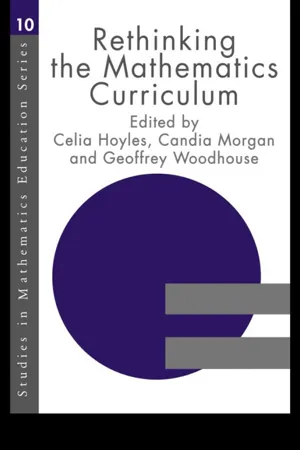
Rethinking the Mathematics Curriculum
About this book
Information
Section Two
Curriculum and Classrooms for the Future
Chapter 6
One Mathematics for All?
Margaret Brown
Aims of Mathematical Education
It is customary to separate educational aims into two complementary categories:
- furthering the development of society
- furthering the development of the individual.
Further subdivisions, and in particular decisions as to differential weighting, are likely to introduce ideological biases (discussed fully, for instance, by Ernest, 1991). Nevertheless most countries find it useful to attempt some more detailed statement in order to provide a basis for discussion of the curriculum.
Some countries (for example, Norway) provide a set of general educational aims in their curriculum documents, which link with more specific mathematical aims, which in turn feed into curriculum detail. In other countries (for example, the UK) aims of education have the appearance of being a later appendage unrelated to the curricular substance.
Aims may have very different emphases in different countries. Results from the IEA Third International Mathematics and Science Survey (TIMSS) indicate that the proportions of secondary mathematics teachers who feel that mathematical success requires, for example, creative thinking, or understanding of real-world applications, range from 20 per cent in some countries to over 80 per cent in others (Beaton et al., 1996).
Similarly, as part of the Second International Mathematics Survey (SIMS) a typical set of mathematical aims was selected which teachers in different countries were asked to rank:
- To understand the logical structure of mathematics.
- To understand the nature of proof.
- To become interested in mathematics.
- To know mathematical facts, principles, and algorithms.
- To develop an attitude of inquiry.
- To develop an awareness of the importance of mathematics in everyday life.
- To perform computations with speed and accuracy.
- To develop an awareness of the importance of mathematics in the basic and applied sciences.
- To develop a systematic approach to solving problems.
(Burstein, 1992, p. 41)
The exercise elicited significant cross-cultural differences in the relative emphases given to these mathematical aims by teachers of 13-year-olds in 1980–2. For example, where US teachers prioritized the importance of mathematics in everyday life together with knowledge, computation and problem solving, the French preferred to nurture intellectual enquiry and the understanding of proof. Howson (1991) also contrasts the rationalist-inspired aims of mathematics teaching in France with the more pedestrian aims of Northern Ireland.
Most curricula are, in practice, a compromise between competing aims within a particular society at a particular point in time. Furthermore, different priorities will be claimed even within the same society in relation to students of different ages, different perceived mathematical abilities, and different career aspirations. Covertly, different priorities within the various aims are likely to be attached to students of different class, culture and gender backgrounds.
The question to be addressed in this chapter is whether the priorities within a developed post-millennial society should differ sufficiently for different students to require the provision of different curricula. In many ways it follows on from an excellent discussion of the situation over 10 years ago (Howson and Wilson, 1986).
Differentiated Aims and Curricula
Some western societies have traditionally differentiated strongly between the kinds of mathematical education which they have provided for different pupils. For example, most German pupils are directed at age 11 into one of three types of school, each providing different types of mathematics curriculum: the Gymnasium for intending graduates and professionals, the Realschule for skilled technical workers, and the Hauptschule for the remainder. Other European countries like France and the Netherlands have directed students to different types of school at older ages. Although in other countries such stark divisions between schools have been abandoned and the overwhelming majority of students are in comprehensive secondary schools, they may still be differentiated within the school. The US has had an elective system of differentiation via ‘tracking’, with students progressively dropping out of specialist mathematics courses into ‘general mathematics’ options, while in the UK almost all students are in differentiated sets for mathematics by age 12, with some elementary schools ‘setting’ at age 7.
The mathematical aims for the highest groups have traditionally emphasized concepts and techniques of use in the physical sciences and engineering (aim 8 in the list above) for example, trigonometry, functions; together with these there have been varying levels of introduction to pure mathematical notions such as structure and proof (aims 1 and 2). For the middle groups, technical mathematics at a reduced level such as simple algebra and mensuration formulae have predominated, while the lower groups, expecting to enter unskilled occupations at best, have concentrated on computations (aim 7) and the use of mathematics in everyday life (aim 6). Such curricular differences have been associated with a relatively stable occupational structure linked to social hierarchies, which in practice reflected divisions based mainly on class, race, and gender.
However, the results of IEA surveys (Postlethwaite, 1967; Robitaille and Garden, 1989; Beaton et al., 1996) have highlighted the fact that the mathematical ‘yield’ from such western countries is poor in overall terms in comparison with eastern Europe and the Far East. Although in western countries a small élite have a high mathematical attainment on leaving school, the vast majority of the population have a comparatively rather low attainment, either leaving school after following an unambitious curriculum, or staying on at school or college but studying little mathematics. This varies from countries with a strong vocational/technical tradition like Germany, in which mathematics is taken seriously in the courses of most students, to those like the UK where most students cease any study of mathematics after the age of 16. In communist (and newly ex-communist) countries and in the new ‘Asian Tiger’ economies the emphasis given to mathematics, combined with the decision to educate all to the highest possible level, produce a higher overall ‘yield’.
Common Aims and Curricula (Up to Age 16)
More recently the rigid hierarchical structure underpinning education and, in turn, mathematical curricula in the West has been undermined owing to:
- radical changes in the nature of work, with a disappearance of unskilled jobs, more temporary and part-time posts, and more self-employment
- the prevalence of technology, with many jobs requiring computer skills, including use of spreadsheets, data bases, and statistical representation
- equal opportunities legislation and awareness, leading to greater aspirations among wider groups
- widening access to higher education, for example, in the UK, university entry moving from 6 per cent to over 30 per cent.
In spite of attempts by some govemments to introduce or maintain selective schooling or early vocational differentiation, it seems likely that the long-term trends favour a more open and egalitarian curricular pattern.
The need to change the mathematics curriculum to reflect such structural changes in society started to be addressed in the UK with the Cockcroft Committee of Inquiry (DES/WO, 1982). It was agreed that it was important that all pupils should follow a broad curriculum, including mathematical investigation and real-world problem solving, and gain confidence in mathematical application. The UK National Curriculum, introduced in 1989, while still enabling curricular differentiation between pupils, at least elected to differentiate by the speed at which they followed a common curriculum rather than by allocating different pupils to distinct curricula.
The use of technology to enable wider access to mathematical ideas was acknowledged, with calculators and computer databases and spreadsheets introduced from a relatively early age. The 1995 version of the National Curriculum moves further in this direction with compulsory use of graphical calculators for all pupils and common programmes of study (although with extension material to maintain the allocation to sets based on attainment level in preparation for the differentiated three-level GCSE examination).
This type of curriculum change, favouring problem solving, application, broader content, and technology, has been introduced into many other countries, and most importantly by the National Council of Teachers of Mathematics Standards in the US (NCTM, 1989). The Standards are prefaced by aims which form a rationale for the later detail, and which reflect the underlying social and economic changes:
| Needs of society: | • an informed electorate |
| • mathematically literate workers | |
| • opportunity for all students | |
| • problem-solving skills that serve lifelong learning | |
| Goals for students | • learn to value mathematics |
| • learn to reason mathematically | |
| • learn to communicate mathematically | |
| • become confident of their mathematical abilities | |
| • become mathematical problem solvers. |
(NCTM, 1989)
The aims relating to the needs of society reflect the expectation that pupils will not be trained merely for unskilled jobs but for occupations which require mathematical and computer literacy and mathematical problem-solving skills. They also reflect equal opportunities awareness, and an expectation of frequent career change with the reference to lifelong learning.
The aims of the Standards are curious as there appear to be two important omissions from the goals for students. The first is that students should acquire a solid base of mathematical knowledge, concepts, and skills which is understood and can be used in appropriate circumstances. The second is that students should gain acquaintance with mainstream and/or minority cultural knowledge. Similarly de-emphasized is the corresponding need of society for stability, which depends on some continuity of culture and tradition. These omissions indicate, perhaps more clearly than the inclusions, the determination to break away from the past.
Post-16 Changes
The changes to widen access and to broaden the curriculum during the compulsory period of schooling are echoed also in changes post-16. In France the introduction of new, more technical/ vocational baccalaureates has encouraged a significant increase in the numbers of students continuing education to 18 and at university level; in the UK the new General National Vocational Qualifications have belatedly fulfilled the same role.
At university level, wider entry and less employment security have led to new vocational courses, for example tourism, media studies, sports science. At the same time requirements for greater flexibility in employment patterns have created a demand for broader courses, modular or including combined studies, which allow students to broaden their skills profile. An example is accountancy with Spanish and management. In contrast, some students have appreciated the lessening of pressure on vocational specialization resulting from delayed career entry, and have chosen subjects like philosophy which are seen as attractive but without immediate vocational outcomes. They accept that there is likely to be a period of casual employment or travel before they settle into a more focused field, and that most occupations require generic skills such as basic literacy and numeracy, oral communication, IT skills and teamwork rather than particular advanced subject knowledge.
Such changes in curricula and in national educational systems have produced many tensions. However, because of the differences in post-16 national structures and curricula, and rapid changes in many countries, it is difficult to survey the field. The remainder of the discussion is thus based on the problems that are arising in just one country, the UK, with the hope that this may also illuminate the sources of tension in other countries.
UK Case Study: Specialist Post-16 Courses
A problem for the 16–19 age group in England and Wales has been the Conservative Government’s reluctance (as of 1996) to change the highly specialized and rather demanding A-level (Advanced level) examination, which determines university entry. This examination was originally designed in the 1950s for under 10 per cent of the age group. Students traditionally studied only three, related, subjects in the post-16 period (for example, pure mathematics, applied mathematics, and physics, or English, French, and German), with the expectation that just one of these would be selected as a degree subject. However, by the early 1980s the proportion studying A-levels had increased to over 20 per cent of the age cohort, encouraged by schools allowing greater flexibility in the selection of subjects. The proportion studying mathematics remained fairly constant: although fewer students were specializing in physical sciences and fewer were choosing two mathematics A-levels, many now selected a mathematics-with-statistics option to accompany non-science subjects like history or economics.
Changes in t...
Table of contents
- Cover Page
- Half Title page
- Series page
- Title Page
- Copyright Page
- Contents
- Figures
- Acknowledgments
- Series Editor's Preface
- Introduction
- Section One What Is Mathematics and What Is It For?
- Section Two Curriculum and Classrooms for the Future
- Section Three Thinking about Change
- Section Four Learning from the Pacific Rim
- List of Contributors
- Index
Trusted by 375,005 students
Access to over 1.5 million titles for a fair monthly price.
Study more efficiently using our study tools.
Frequently asked questions
Yes, you can cancel anytime from the Subscription tab in your account settings on the Perlego website. Your subscription will stay active until the end of your current billing period. Learn how to cancel your subscription
No, books cannot be downloaded as external files, such as PDFs, for use outside of Perlego. However, you can download books within the Perlego app for offline reading on mobile or tablet. Learn how to download books offline
Perlego offers two plans: Essential and Complete
- Essential is ideal for learners and professionals who enjoy exploring a wide range of subjects. Access the Essential Library with 800,000+ trusted titles and best-sellers across business, personal growth, and the humanities. Includes unlimited reading time and Standard Read Aloud voice.
- Complete: Perfect for advanced learners and researchers needing full, unrestricted access. Unlock 1.5M+ books across hundreds of subjects, including academic and specialized titles. The Complete Plan also includes advanced features like Premium Read Aloud and Research Assistant.
We are an online textbook subscription service, where you can get access to an entire online library for less than the price of a single book per month. With over 1.5 million books across 990+ topics, we’ve got you covered! Learn about our mission
Look out for the read-aloud symbol on your next book to see if you can listen to it. The read-aloud tool reads text aloud for you, highlighting the text as it is being read. You can pause it, speed it up and slow it down. Learn more about Read Aloud
Yes! You can use the Perlego app on both iOS and Android devices to read anytime, anywhere — even offline. Perfect for commutes or when you’re on the go.
Please note we cannot support devices running on iOS 13 and Android 7 or earlier. Learn more about using the app
Please note we cannot support devices running on iOS 13 and Android 7 or earlier. Learn more about using the app
Yes, you can access Rethinking the Mathematics Curriculum by Celia Hoyles,Candia Morgan,Geoffrey Woodhouse in PDF and/or ePUB format, as well as other popular books in Education & Education General. We have over 1.5 million books available in our catalogue for you to explore.