![]()
INTRODUCTION
Freedom of expression is obviously a key element in a civil liberties course and therefore it may arise in more than one question on the exam paper. Examiners tend to set general essays in this area; the emphasis is usually on the degree to which a balance is struck between freedom of expression and a variety of other interests. However, problem questions are sometimes set, particularly in the area of contempt of court.
There is a large amount of overlap between this area and that of freedom of information, since freedom of information may broadly be viewed as one aspect of freedom of expression. The case of Shayler (2002), considered in Chapter 2, could readily be viewed as relating to both freedoms. Therefore, what may be termed ‘freedom of information issues’ may well be treated as aspects of freedom of expression. However, the overlap is not complete: in some circumstances, information may be sought where there is no speaker willing to disclose it and, therefore, such instances tend to fall only within the area of freedom of information. Moreover, although Art 10 of the European Convention on Human Rights (ECHR) covers the right to receive information it does not include the right to access information. Thus in cases like Leander v Sweden (1987) the European Court has rejected freedom of information claims based on Art 10 while recognising a limited right of access in some situations under Art 8. The current interest in further media regulation to protect privacy may well be reflected in civil liberties examinations; as such, you may well be called upon to consider the conflict between freedom of expression and privacy. In this book, that issue is covered in the chapter on privacy but, of course, the freedom of expression dimension is taken into account.
It is now essential in your answers to take the ECHR into account, especially Art 10, which provides the guarantee of freedom of expression. The Convention was received into UK law when the Human Rights Act (HRA) 1998 came fully into force in October 2000. Until that time, Art 10 and other Convention Articles relevant in this area were not directly applicable in UK courts, but the judiciary referred to the Convention more and more in resolving ambiguity in statutes in the run up to the inception of the HRA. The HRA has now been in force for over fifteen years and there are some significant decisions in the field of freedom of expression (such as ProLife Alliance v BBC (2003), AG v Punch (2003), Nilsen v Governor HMP Full Sutton (2005), Campbell v MGN (2004) and R (on the application of Animal Defenders International) v Secretary of State for Culture Media & Sport (2008) 1 AC 1312). Section 3 requires that: ‘So far as it is possible to do so, primary and subordinate legislation must be read and given effect in a way which is compatible with the Convention rights …’. Section 3(2)(b) reads: ‘this section does not affect the validity, continuing operation or enforcement of any incompatible primary legislation’. This goes beyond the previous obligation to resolve ambiguity in statutes (see Chapter 9 for further information about the impact of the Human Rights Act).
All statutes affecting freedom of expression and media freedom therefore have to be interpreted so as to be in harmony with the Convention if that is at all possible. Under s 6 of the HRA, Convention guarantees are binding only against public authorities. These are defined to include bodies which have a partly public function. The definition is therefore quite wide, but means that private bodies, including most of the media (apart from the ‘public bodies’, such as the BBC, Ofcom and the Press Complaints Commission) can violate Convention rights unless a part of the common law, which will also be interpreted in conformity with the Convention, bears on the matter.
Thus, exam questions will reflect this extremely significant development and will require an awareness of the Art 10 jurisprudence and of the impact of the HRA on freedom of expression. It is also important to remember that the common law contains significant protection for freedom of expression and that this has been emphasised since the passage of the Human Rights Act (see for example R v Home Secretary Ex parte Simms (1999)).
You should be familiar with the following areas:
Art 10 of the
ECHR, other relevant rights such as
Art 6,
Art 10 jurisprudence and the
HRA 1998;
common law free speech jurisprudence pre-
HRA (see, for example,
Reynolds v Times Newspapers (1999),
Derbyshire CC v Times Newspapers (1993),
R v Secretary of State for the Home Department ex p Simms (1999));
decisions taking account of the
HRA and
Art 10 such as
ProLife Alliance v BBC (2003),
AG v Punch (2003),
Campbell v MGN (2004);
key aspects of the
Contempt of Court Act 1981 and common law contempt;
the doctrine of breach of confidence;
key aspects of the
Broadcasting Acts 1990 and
1996, and the
Communications Act 2003 (‘taste and decency’, impartiality provisions);
the
Obscene Publications Act 1959 as amended; common law indecency:
Gibson (1990);
the
Cinemas Act 1985; the
Video Recordings Act 1984, as amended;
hate crimes, including amendments in the
Racial and Religious Hatred Act 2006.
QUESTION 1
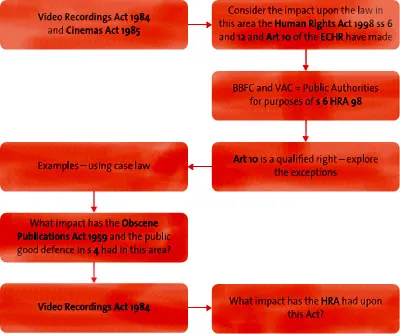
Critically evaluate the current regime governing the regulation and censorship of cinema films and videos in relation to the demands of Art 10 of the European Convention on Human Rights as received into domestic law under the Human Rights Act.
How to Answer this Question
This is a reasonably straightforward essay question about the role of the British Board of Film Classification in regulating and censoring cinema films and videos. Bear in mind the implications flowing from the fact that the ECHR has been afforded further effect in domestic law under the HRA 1998: you need to consider the key provisions of the HRA as they relate to the regulation and censorship of films and videos; you also need to examine the relevant Strasbourg jurisprudence. The mere fact that Art 10 of the ECHR has been received into domestic law under the HRA does not necessarily mean that change is needed.
Essentially, the following areas should be considered:
Art 10 of the
ECHR and the
HRA 1998;
relevant Strasbourg jurisprudence under
Art 10;
classification and censorship of cinema films;
the legal framework relating to films and videos;
conclusions regarding compatibility of the regulatory regime and
Art 10 of the
ECHR.
Answer Structure
If you are able to show an appreciation of the practical context or operation of the law your answer is likely to be viewed favourably by the examiner. Sometimes the bare legal rules provide only a partial picture and you need to explore non legal matters to provide a thorough picture of the issues. See, for example, in the answer below, the discussion about the practical operation of the film classification system of regulation and the likelihood of this leading to self-censorship for commercial motives.
ANSWER
The legislation governing censorship of films and videos (the Video Recordings Act 1984 as amended and the Cinemas Act 1985) must be read by the courts in a manner which gives effect, so far as is possible, to the Convention rights (s 3 of the HRA). Further, the HRA gives particular regard to the importance of freedom of expression in s 12, although this has been interpreted by the courts as not giving Art 10 any trump status. Under s 6 of the HRA media bodies such as the British Board of Film Classification (BBFC) and the Video Appeals Committee of the BBFC (VAC) are likely to be public authorities obliged to respect Convention rights. It is argued that the independent regulation of film and video, which clearly affects the rights of those involved in production and distribution, is a function of a public nature under s 6 of the HRA.1 Assuming that they are public authorities, these bodies must ensure that Art 10 is not infringed in...