- 576 pages
- English
- ePUB (mobile friendly)
- Available on iOS & Android
eBook - ePub
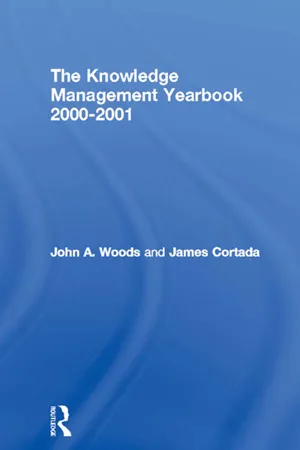
The Knowledge Management Yearbook 2000-2001
About this book
The Knowledge Management Yearbook is the most current and comprehensive resource available for knowledge management professionals; no other source of information so thoroughly surveys the state of the knowledge management discipline and industry and how they impact businesses and other organizations. Featuring both definitive articles and cutting-edge knowledge management techniques and research contributed by authorities, The Knowledge Management Yearbook covers the nature of knowledge and its management, knowledge-based strategies, knowledge management and organizational learning, and knowledge tools, techniques, and processes.
The reference section includes a set of up-to-date directories detailing on-line knowledge management resources, KM publications and organizations, and notable KM Quotes. The glossary of KM terms is increasingly perceived by the industry as a benchmark by which this evolving discipline is defined. The Knowledge Management Yearbook is an indispensable volume for any professional helping to shape his or her organization's knowledge strategy.
Part One.
The Nature of Knowledge and its Management
The Nature of Knowledge and its Management
The wise see knowledge and action as one.
—from the Bhagavad-Gita
—from the Bhagavad-Gita
This quote from India provides a foundation for why this book exists. It helps us understand why managers in every type of enterprise have come to appreciate that the knowledge possessed by the organization and by individual employees is the organization’s most important resource. What actions does the organization know, maybe better than anyone else, to satisfy its customers? The answer to this question, to a large extent, will explain business success now and in the future. Thus we see managers having a strong interest in discovering, documenting, sharing, and taking advantage of organizational and individual knowledge. And thus the value of a book like this to help them (you) do this better and better.
To begin any subject, it’s useful to have a perspective and background to understand what’s going on and to build your own expertise. That’s the purpose of Part One of The Knowledge Management Yearbook. So let’s briefly overview what we’ve included in this introduction to the practice of knowledge management.
Classics in Knowledge Management
We start this part of the yearbook with an article we call a “classic in knowledge management.” It’s an article published several years ago that pointed the direction to where we are now in this field. In this edition, we have selected a piece by Fred Nickols, a long-time consultant, trainer, and author in the area of management. The article included, with a few minor updates, was originally published in 1983 and looks at the implications for managment of the shift to “knowledge work.” Most of what he suggested then has come or is coming to pass. Thus, it still remains relevant today.
The Tacit and Explicit Nature of Knowledge
There are two types of knowledge in an organization: tacit and explicit. Tacit knowledge is the “know-how” possessed by individuals. It’s often intuitive and demonstrated more in how someone goes about his or her work in a knowledgeable way, even though this knowledge is not written down anywhere. Of course, one of the goals of knowledge management is to make tacit knowledge more widely available and to the degree possible, capture it in explicit terms. That’s what explicit knowledge is: systematically documented know-how that becomes available to everyone in the organization. To help you better understand these concepts, we’ve included three articles. The first, another piece by Fred Nickols, written especially for the yearbook, “The Knowledge in Knowledge Mangement,” provides a systematic way to distinguish between tacit and explicit knowledge, along with what he calls declarative and procedural knowledge and how you can use these ideas to get to higher levels of performance.
A second piece looks at how different executives have come to appreciate the importance of “taking time to think” and the implications of doing that. The third article in this section is also original, written for the yearbook by Joseph Horvath, called “Working with Tacit Knowledge.” Doing what the title suggests, the author includes a variety of case studies that show how various organizations take advantage of tacit knowledge to compete more effectively in the marketplace.
Classic in Knowledge Management
“What is” In the World of Work and Working: Some Implications of the Shift to Knowledge Work
This article with a very different introduction and some slight differences in wording throughout the remainder of the document, was published in the October 1983 issue of Performance & Instruction. Despite its age, the author tells us, it still applies. It’s all about understanding the shift from manual to knowledge work. He describes how this has changed the locus of control for work and offers some thoughts on what this shift portends.
What you think is, isn’t. This is at least true of the world of work and working. It has been turned topsy-turvy by a shift from manual work to knowledge work. As a result, managers, consultants, academics, and other professionals in the fields of management, performance, and instruction have two reasons to reexamine their relationship to that world: (1) as knowledge workers, it is their world; and, (2) as professionals, it is their market.
The Shift from Manual Work to Knowledge Work
What is in the world of work is that its center of gravity has sharply shifted from manual work to knowledge work (Drucker, 1980). In 1920, the ratio of manual workers to knowledge workers was 2:1. By 1980, things were the other way around. The mid-point in this shift seems to be 1956, the year white-collar workers first outnumbered blue-collar workers (Naisbitt, 1982). In recent testimony before a senate subcommittee, the percentage of knowledge workers in the computer industry was estimated at 72% (13% managerial, 15% clerical, and 44% technical and professional); and, on the other side of the coin, the percentage of the employed work force engaged in actual manufacturing operations was estimated at 13%.
More important, the pace of the shift from manual work to knowledge work seems to be slowing considerably. Bureau of Labor and Bureau of Census projections for 1990 show roughly the same ratio of knowledge workers to manual workers as was revealed by the 1980 Census. Because “growth is never exponential in a linear way, but follows an S-shaped or logistic curve” (Bell, 1979), we are probably witnessing, among other things, the “leveling off” of the shift from manual work to knowledge work.
Most important, then, it is time to stop holding our breath and start examining how the new world of knowledge work differs from the old one of manual work. To do so requires first making a distinction between work and working.
Work and Working
“The most important thing we know is that work and working are fundamentally different phenomena” (Drucker, 1973). Work is a process and it has a result. Both the process and the result exist apart from the worker. The work of an insurance claims examiner, for instance, consists of a set of information-processing operations that can be specified quite apart from the examiner (e.g., in the form of algorithms). The results of this adjudication process are adjudicated claims, which also exist apart from the examiner. In the case of an automated process, these adjudicated claims exist without the examiner.
Working is the activity of the worker in carrying out the work process and thereby producing its results. In the case of the claims examiner, working consists of carrying out the adjudication process (i.e., adjudicating claims). The worker, of course, is the claims examiner. Work, then, is roughly the equivalent of performance and working is definitely the equivalent of behavior. Work and working, in the world of knowledge work, are very different from what they are in the world of manual work.
Knowledge Work and Manual Work
A major difference between knowledge work and manual work is that knowledge work is information-based and manual work is materials-based. A manual work process, no matter how much skill and knowledge is required of the worker, consists of converting materials from one form to another (with or without the use of tools and equipment).
Because manual work consists of converting materials from one form to another, the results of a manual process are tangible. Because knowledge work consists of converting information from one form to another, the results of a knowledge work process are frequently intangible. Although it is true that both the manual worker and the knowledge worker work with knowledge and information, only the knowledge worker works on them. Consequently, the nature of working is very different for a knowledge worker than it is for a manual worker.
“The essence of the knowledge organization is that work is done in the head” (Zand, 1981). This means that working (and work, while it is in process) can’t be seen. In other words, the working behaviors of the manual worker are public and those of the knowledge worker are private. From the perspective of a supervisor or an industrial engineer, this means the visibility of working is high for a manual worker and low for a knowledge worker.
Owing to the materials-based nature of manual work and to the public nature of its working activities, it is a comparatively simple matter to observe the interactions between the manual worker, any tools or equipment being used, and the materials being processed to determine which behaviors contribute to the desired results and which do not. Moreover, results (and therefore feedback) are almost always immediate. Conversely, owing to the information-based nature of knowledge work and to the private nature of its working activities, the linkages between behavior and results are not so apparent, and they are rarely immediate.
The decreased visibility of the working activities of knowledge workers and the murky links between activities and results gives rise to concerns regarding managerial control. As Shoshanna Zuboff, a researcher at the Harvard Business School, says,
It is much easier to envision how to exert managerial control over a set of people turning bolts and screws than it is to envision such control over people who must mentally attend to and process information (Zuboff, 1983).
The issue of mentalism aside, this statement touches on the central problem brought about by the shift from manual work to knowledge work; namely, that the locus of control over work and working (at the individual task level) has shifted from the manager to the worker. How this happened is of more than passing interest.
A Shift in the Locus of Control
For thousands of years, the basic power equation (i.e., means of control) in organizations was simple and effective: “Knowledge held by a few, plus iron discipline over the many” (Bekkedahl, 1977). Nowhere is this better illustrated than in the days of “wooden ships and iron men.” As Bekkedahl observed, mutiny at sea was probably restrained more by the unlettered seaman’s inability to navigate than it was by his fear of punishment in the event of failure. After all, what is the point of taking over a ship if one cannot take it anywhere?
In modern organizations, knowledge is widely distributed instead of narrowly concentrated, thus altering one of the two variables opposite control in the ancient power equation.
The other variable, “iron discipline,” was enforced by an equally metallic device known as “the chain of command.” It, too, has been altered by the shift from manual work to knowledge work. Because the behaviors of a knowledge worker are primarily private ones, supervisors cannot supervise. Gone are the days when, as John Kenneth Galbraith wrote, “the laggard worker could easily be identified” and “then be encouraged to greater productivity by the voice of the overseer” and the sound of his whip (Galbraith, 1977).
In effect, the shift from manual work to knowledge work shears the most critical link in the chain-of-command paradigm: supervision.
The preceding discussion is only half the argument. Is shows that the locus of control over working might have moved away from the manager, but not that it has moved to the worker. Evidence in this regard is presented next.
“Perhaps what most annoys and frustrates tradition-oriented managers is that knowledge work is non-linear” (Zand, 1981). The key point to be made here is that knowledge workers must configure their responses to work situations instead of act out prefigured ones (Drucker, 1973). As a result, “the knowledge worker has almost total authority in matching individual work methods to the varying job tasks her or she faces” (Gregerman, 1981). In short, the nature of knowledge work is such that it demands a significant amount of control by the worker over work and working. It is in the nature of control that we find the fundamental reason for the shift in the locus of control over work and working from managers to workers.
Control, whether by self or others, is always against some standard. Standards, coupled with information about actual conditions, determine if one should take action or leave matters alone. As regards work and working, there are conditions that call for a response on the part of the worker and those that do not. These latter conditions are known as “reference conditions” (Powers, 1973). If conditions, as perceived by the worker, differ from the reference conditions (i.e., if results are not what they should be), the worker acts so as to make the perceived conditions consistent with the reference conditions. This formulation holds true whether the worker is performing manual work or knowledge work. The key question in this formulation is this: from whence come the standards or reference conditions that govern work and working?
When work was materials-based and working consisted primarily of public behaviors, the linkages between behavior and results were ascertainable through study and observation by people other than the worker (e.g., industrial engineers, work designers, methods and performance analysts, and job-task analysts). The ability to study the work is what made possible Frederick Winslow Taylor’s “scientific management.” Thus, others could and did establish the reference conditions that governed work and working. These standards or requirements were then communicated to the worker, frequently via a medium known as instruction, and subsequently enforced through supervision and various systems of incentives and penalties. In this way, acceptable performance was assured. This proved a viable means of controlling work and working for thousands of years because the linkages between working and work were direct, immediate and, most important, visible. In this scheme of things, the worker was viewed as an instrument, a bundle of muscles, abundant in supply and easily programmed through instruction—and easily and inexpensively replaced if outworn or worn out.
For the most part, other-developed reference conditions assured owners and managers of an adequate supply of trained and therefore skilled workers who could be counted upon to behave in reliably uniform ways in reliably uniform situations. Control over work meant control over working and the focus of managerial control gradually shifted from the work to the worker. A means became an end.
So, between 1920 and 1980, while managers, academics, and consultants in this country were occupied finding bigger, better, and more complex ways of controlling the worker, working slipped quietly out of sight, taking the control of work with it. The new breed of worker, the knowledge worker, had a new job. Instead of converting instructions and procedures into actions that in turn converted materials from one form to another, the task was to convert knowledge into actions which converted information from one form to another. It fell to the knowledge worker to figure out what did or did not produce results and it still does.
The preceding explains how the knowledge worker came to be the primary source of reference conditions for work and wor...
Table of contents
- Cover
- Half Title
- Title Page
- Copyright
- Contents
- Preface
- Part One. The Nature of Knowledge and Its Management
- Part Two. Knowledge-Based Strategies
- Part Three. Knowledge Management and Organizational Learning
- Part Four. Knowledge Tools, Techniques, and Processes
- Part Five. Knowledge Management References
- Index
Trusted by 375,005 students
Access to over 1.5 million titles for a fair monthly price.
Study more efficiently using our study tools.
Frequently asked questions
Yes, you can cancel anytime from the Subscription tab in your account settings on the Perlego website. Your subscription will stay active until the end of your current billing period. Learn how to cancel your subscription
No, books cannot be downloaded as external files, such as PDFs, for use outside of Perlego. However, you can download books within the Perlego app for offline reading on mobile or tablet. Learn how to download books offline
Perlego offers two plans: Essential and Complete
- Essential is ideal for learners and professionals who enjoy exploring a wide range of subjects. Access the Essential Library with 800,000+ trusted titles and best-sellers across business, personal growth, and the humanities. Includes unlimited reading time and Standard Read Aloud voice.
- Complete: Perfect for advanced learners and researchers needing full, unrestricted access. Unlock 1.5M+ books across hundreds of subjects, including academic and specialized titles. The Complete Plan also includes advanced features like Premium Read Aloud and Research Assistant.
We are an online textbook subscription service, where you can get access to an entire online library for less than the price of a single book per month. With over 1.5 million books across 990+ topics, we’ve got you covered! Learn about our mission
Look out for the read-aloud symbol on your next book to see if you can listen to it. The read-aloud tool reads text aloud for you, highlighting the text as it is being read. You can pause it, speed it up and slow it down. Learn more about Read Aloud
Yes! You can use the Perlego app on both iOS and Android devices to read anytime, anywhere — even offline. Perfect for commutes or when you’re on the go.
Please note we cannot support devices running on iOS 13 and Android 7 or earlier. Learn more about using the app
Please note we cannot support devices running on iOS 13 and Android 7 or earlier. Learn more about using the app
Yes, you can access The Knowledge Management Yearbook 2000-2001 by John A. Woods,James Cortada in PDF and/or ePUB format, as well as other popular books in Business & Business General. We have over 1.5 million books available in our catalogue for you to explore.