- 340 pages
- English
- ePUB (mobile friendly)
- Available on iOS & Android
eBook - ePub
About this book
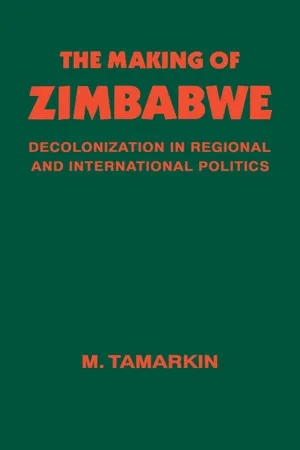
First published in 1990. This volume is essentially a study in decolonization. The approach of the author is of a conflict resolution process taken from the perspective of 1974 as the chosen point. Following the decolonization of the Portuguese colonial empire, the uniqueness of the decolonization of Rhodesia became more apparent and the conflict began to realize its full potential. The author has taken three analytical concepts- the goals' continuum, the strategic options' continuum and the interaction within and between the three levels of the conflict system.
Information
CHAPTER ONE
From the Lisbon Coup to the Crossroad Speech: the Failure of Domestic Accommodation,
April–October 1974
On April 25, 1974 a military coup in Lisbon by the Armed Forces Movement (AFM) put an end to Salazar’s New State. Caetano, the prime minister, was deposed and a Junta of National Salvation headed by the retired General Spinola was appointed to run the country. The coup, which originated in the colonial battlefields of Guinea Bissau, Mozambique and Angola, was to have a profound effect on the Rhodesian crisis. However, some six months had elapsed before it made a direct and substantial impact on the Rhodesian decolonization process.
There were some in Rhodesia who immediately grasped the implications of the coup. Muzorewa was jubilant: “The hand of God has been at work in Southern Africa bringing justice and true peace and the writing is on the wall for the enemies of freedom in this part of the world.”1 By late May 1974, a local newspaper commented that the promise of self-determination to the Portuguese colonies “could prove to be the biggest setback for Rhodesia since sanctions were imposed”. The lesson for Rhodesia was that an agreement between Smith and Muzorewa “was not only important but vital to the survival of Europeans….”2
Smith, following his principle of not believing what he read in newspapers,3 was not unduly impressed by these gloomy forecasts. At the end of May he responded to the liberation “euphoria” which possessed Africa: “I can understand this kind of irrational thinking emanating from certain countries to our north…. I hope there are no Rhodesians quite so naive as to fall for anything so stupid.”4 Smith’s own initial response betrayed total misperception of the unfolding events and the nature of the coup:
Rhodesia does not interfere in the internal affairs of the other countries and therefore the political changes in Portugal are essentially matters for the Portuguese. Rhodesia has always enjoyed the best relations with metropolitan Portugal and its provinces in Africa, and we believe these will continue.5
Such optimism may have been excusable at that early stage. A military regime headed by General Spinola, a colonial reformist, was not necessarily threatening. In fact there were those who entertained the hope that the new military government would more effectively carry out the anti-guerilla campaign.6 The attitude of the new Portuguese regime towards the colonies was not yet clear. The more radical AFM which had engineered the coup crowned a Junta whose members were certainly not determined anti-colonialists. They broadly subscribed to Spinola’s vision of autonomous colonies within the framework of a greater Lusitania.7 On May 11 General Costa Gomes, a Junta member, stated in Lourenço Marques that the people of Mozambique would be given the opportunity to choose in a referendum between “one extreme of complete independence and another extreme of total integration”. He himself favoured a compromise solution within “the great Portuguese community”. He warned FRELIMO that if they rejected this plan, “the army will have no choice but to go on with the fight and possibly intensify it”.8 Immediately after the coup, even the experienced and sober Roy Welensky did not envisage Mozambique turning into a FRELIMO country.9 One could hardly blame Smith and his colleagues for not espousing a more gloomy view of the future.
However, it soon became increasingly clear that Spinola’s ideas were out of touch with the reality both in Mozambique and Lisbon. FRELIMO had not fought for years to submit itself to a democratic process under colonial auspices when total victory was within reach. On April 28 FRELIMO rejected the Junta’s decolonization plan demanding full independence and transfer of power to them.10 As the Junta refused to capitulate, FRELIMO rejected the former’s cease-fire proposals and, in fact, expanded and intensified the war during May, June and July.11 Spinola remained unyielding, insisting on June 11 that “democracy must precede independence”.12 He was definitely out of tune with the forces that had brought him to power. The AFM, representing the commanders in the battlefield, would not entertain the thought of having to fight on for the sake of the vague and unrealistic vision of Great Lusitanian democracy. Thus, in June, Otello Cravalho and Mario Soares, representing the AFM and the temporary Socialist-Communist alliance respectively, agreed to FRELIMO’s demands. On July 27 Spinola yielded to AFM pressure and promised independence to the colonies.13 On September 7 representatives of the Portuguese government and FRELIMO signed an agreement for the transfer of power to the latter by June 25,1975, and for the establishment of a joint transitional government.14
Smith should have been informed about trends in Lisbon and the chaotic conditions prevailing in Mozambique in the aftermath of the coup. He must have known FRELIMO’s attitude towards white Rhodesia. In mid-June, Marcelino dos Santos, a prominent FRELIMO leader, said in London that a FRELIMO government would apply UN sanctions against Rhodesia and would assist in the struggle for the liberation of southern Africa.15 Yet, white Rhodesian leaders continued to generate optimism and confidence. In a BBC interview in the first half of June, Smith said he was more confident than he was a year ago. He also said that he did not envisage bigger problems for Rhodesia in the event of a FRELIMO takeover, stating confidently that Rhodesia could defend all its borders.16 On August 2, after Spinola had been forced to concede independence to the colonies, Smith made the following amazing statement regarding the situation in Mozambique:
Things to a certain degree got out of hand. However, there are new developments and some of the messages I have had out of Lisbon have given me cause for a great amount of optimism. I have had a few encouraging messages and some of the things General Spinola has said and what he is trying to do are cause for satisfaction.17
This grossly undue expression of optimism cannot be dismissed as pure propaganda designed to cheer up domestic audiences. Smith shared with the majority of his white compatriots the “colonial blindness” which affected negatively their political judgement. This was captured by a prominent Africa observer: “The majority of whites in Rhodesia seem not to have begun to face up to the true implications of the coup in Portugal or the coming changes in Mozambique.”18
Smith’s government did take some actions in response to the changes in Lisbon and Mozambique. Towards the end of May 1974, the building of the Rutenga line designed to connect Rhodesia directly to the South African railway system was speeded up.19 The difficulties caused to Rhodesia’s exports in July by the uncertain conditions in Mozambique20 further accelerated the pace of the work which was completed on September 10, 21 months ahead of schedule.21 The hastening of the transfer in July of African peasants in the north-east to “protected villages” – an operation which had begun in early 1974 – was a response to the increasing deterioration of the security situation along the Mozambique border.22 The Rhodesian army was also preparing for the possibility of opening a new front along the eastern border.23 The setting in motion of some economic and military contingency plans was well within the confines of a defensive strategy reflecting the siege mentality which had possessed white Rhodesia since UDI. It did not dawn on Rhodesian policy makers that the unfolding changes called at least for a re-evaluation of a siege strategy which had rested on the reality of an interdependent, mutually reinforcing white southern Africa. They certainly did not think that these changes warranted a more determined effort to resolve the domestic racial conflict by accommodating at least the moderate nationalists. In an interview in June, Smith reiterated his government’s standard position that “while settlement is desirable, it has not been made essential by events in Mozambique.” With his insatiable capacity for delusion, Smith told the viewers that in the aftermath of the Lisbon coup more Rhodesian Africans “are asking that Rhodesia should not go the same way as black African countries”.24 As a reflection of the general African mood, this was, of course, a colossal distortion.
In this frame of mind, Smith continued to conduct his talks, begun in March, with the ANC. On the day of the coup in Lisbon, he offered Bishop Muzorewa four additional African seats in Parliament. At a subsequent meeting on May 7 Smith was hardly more forthcoming, offering the Africans two additional seats, which would have given them 22 seats in a Parliament of 72.25 This offer was to be considered by the ANC Central Committee on June 2. The details of the offer being unknown to the public, the government created an air of expectancy implying that agreement had been reached and that its approval by the Central Committee was almost a foregone conclusion.26 As should have been expected, the Central Committee rejected unanimously this miserably inadequate offer on the basis of which the ANC calculated that it would take the Africans between 40 and 60 years to reach parity with the whites in Parliament.27 It would not even have given them a blocking third to prevent changes in the constitution by the whites. Smith subsequently claimed that on May 7 Muzorewa accepted his proposals and promised to urge the Central Committee to endorse them.28 Muzorewa’s version differs in the extreme.29 It is rather unlikely that Muzorewa accepted happily in May an offer of two additional seats compared to an offer he had rejected on April 25. It is at least as unlikely that he thought that there was a chance that the Central Committee would go along with it. Some suggest that it was part of a Smith exercise designed to discredit the ANC.30
The ANC rejected Smith’s proposals as a basis for a constitutional settlement because his concessions were miserably inadequate. Smith, however, chose to put the blame on pressures from African countries and the influence of ZANU on members of the ANC Central Committee.31 Undeniably, there were radicalizing pressures and influences on the ANC leadership and Smith should have realized this before June 2. Had he wanted a settlement, he should have made an offer enabling Muzorewa and his Central Committee to withstand pressures without losing their credibility as genuine nationalists. This Smith and his government were not prepared to do. He preferred to seek refuge in his dream of a viable alternative moderate black opinion. He indicated a shift in government settlement thinking from the ANC to “responsible” African leaders.32 Smith referred, of course, to the politically insignificant pro-settlement groups representing a fraction of the modern African elite and the chiefs in government employment. Accordingly, he stated his intention to call a round-table conference with representatives from different African sectors. This was to be a substitute for his negotiations with the ANC.33 The belief that at that juncture these collaborators, rather than the nationalist guerilla leaders, would be the alternative to the ANC was to say the least astonishing.
The climax of Smith’s major policy statement of June 19 was the announcement of a fresh general election at the end of July 1974. The election was irrelevant from an African point of view. Few of them had the right to vote and only 6,938 bothered to register as voters.34 Although the unfolding regional changes required the broadening of the political discourse, the Rhodesian government gave precedence to considerations pertaining to the circumscribed white politics. It seems that above all Smith wanted to settle the political account with the liberal opposition, and the Rhodesian Party (RP) in particular, which preached compromise and urged the government to offer more concessions to the Africans. They were certainly a major target in Smith’s June 19 statement.35 In fact, the RP, though more vocal than before, posed no challenge to RF domination. Thus, the RF electoral victory – 77 per cent of the voters and all the white seats – came as no surprise.
From the point of view of a prospective political settlement the election could only have a negative effect. It was, naturally, an occasion for the re-dedication of the RF to the goal of minority rule. Statements like “We will not sell out” and “Rhodesia speaks from a greater position of strength than ever before”36 reflected the unreal, intoxicating election atmosphere. In such an atmosphere even an RP candidate had to plead not-guilty: “We are not a sell-out party. We are basically a European party.” He also “boasted” that his party supported segregation in schools, hospitals and residential areas.37 Indeed, as the prospect of a radical nationalist option appeared on the Rhodesian horizon, the limits of white liberals’ reformism became evident. Representing more enlightened and confident elements in the white society they saw the need for political concessions, for sharing power with well disposed, yet sufficiently credible, moderate African leadership.
Even this diluted reformism was anathema to the RF which represented mainly the interests and anxieties of those segments of white Rhodesian society which felt more threatened by African nationalism. Thus, even when the fate of Mozambique became increasingly clear, the RF insisted on total political control. Smith spelled it out in the RF Congress on September 20: “If it takes one year, five years, ten years, we are prepared to ride it out rather than give way on our standards, give way on our principles…. Our stand is clear and unambiguous. Settlement is desirable, but only on our terms.”38 Reg Cowper, a Rhodesian minister, indicated that the Rhodesian government was still riding a cloud, oblivious of terrestial reality: “In the context of racial strife elsewhere, Rhodesia was as Utopian a...
Table of contents
- Cover
- Halftitle
- Title
- Copyright
- Dedication
- Contents
- Abbreviations
- Introduction
- 1. From the Lisbon Coup to the Crossroad Speech: the Failure of Domestic Accommodation, April–October 1974
- 2. From Crossroad Speech to Lusaka: Regional Initiatives and Domestic Responses, October–December 1974
- 3. From Lusaka to Victoria Falls Bridge: the Limits of Regional Patronage, December 1974 – August 1975
- 4. An Internal Interlude: the Failure of the Nkomo-Smith Negotiations, September 1975 – March 1976
- 5. Rhodesia between Guerilla War and Super-power Diplomacy, March–September 1976
- 6. The Lion’s Peep: Britain’s Geneva Interlude, October 1976 – January 1977
- 7. From International to Internal Settlement, February 1977 – March 1978
- 8. From Salisbury to Lancaster House: the Failure of the Internal Settlement, March 1978 – August 1979
- 9. Lancaster House Conference – a Victory for Diplomacy at Last
- Notes
- Bibliography
- Index
Trusted by 375,005 students
Access to over 1.5 million titles for a fair monthly price.
Study more efficiently using our study tools.
Frequently asked questions
Yes, you can cancel anytime from the Subscription tab in your account settings on the Perlego website. Your subscription will stay active until the end of your current billing period. Learn how to cancel your subscription
No, books cannot be downloaded as external files, such as PDFs, for use outside of Perlego. However, you can download books within the Perlego app for offline reading on mobile or tablet. Learn how to download books offline
Perlego offers two plans: Essential and Complete
- Essential is ideal for learners and professionals who enjoy exploring a wide range of subjects. Access the Essential Library with 800,000+ trusted titles and best-sellers across business, personal growth, and the humanities. Includes unlimited reading time and Standard Read Aloud voice.
- Complete: Perfect for advanced learners and researchers needing full, unrestricted access. Unlock 1.5M+ books across hundreds of subjects, including academic and specialized titles. The Complete Plan also includes advanced features like Premium Read Aloud and Research Assistant.
We are an online textbook subscription service, where you can get access to an entire online library for less than the price of a single book per month. With over 1.5 million books across 990+ topics, we’ve got you covered! Learn about our mission
Look out for the read-aloud symbol on your next book to see if you can listen to it. The read-aloud tool reads text aloud for you, highlighting the text as it is being read. You can pause it, speed it up and slow it down. Learn more about Read Aloud
Yes! You can use the Perlego app on both iOS and Android devices to read anytime, anywhere — even offline. Perfect for commutes or when you’re on the go.
Please note we cannot support devices running on iOS 13 and Android 7 or earlier. Learn more about using the app
Please note we cannot support devices running on iOS 13 and Android 7 or earlier. Learn more about using the app
Yes, you can access The Making of Zimbabwe by M. Tamarkin in PDF and/or ePUB format, as well as other popular books in Politics & International Relations & World History. We have over 1.5 million books available in our catalogue for you to explore.