1 Conceptualizing small cities
David Bell and Mark Jayne
There are a large number of cities around the world which do not register on intellectual maps that chart the rise and fall of global and world cities. They don’t fall into either of these categories, and they probably never will – but many managers of these cities would like them to.
(Robinson 2002: 531)
The idea for this book was conceived during the time we both lived and worked in the city of Stoke-on-Trent, UK. We were both busy spending a lot of our time delivering our employer’s mission for ‘third stream’ activity, by undertaking consultancy on behalf of the university for public-sector clients in the locality. Although broadly focused on regeneration and economic development, these projects were mostly concerned with culture-led regeneration and creative industries development. This work reflected what were at the time (and still are) significant policy agendas unfolding in the majority (if not all) of Western cities. What we observed ‘on the ground’ in our role as consultants was a desire by local actors, such as council officers or employees of assorted local and regional development bodies, for the adoption and adaptation of policies and practices proven elsewhere to the local context of that city and its sub-region. We were often engaged in acts of translation and what we might call ‘re-scaling’, attempting to make a fit between policy agendas and the scale, scope and reach of Stoke-on-Trent.
At one level this reflects the commonplace ‘me-too-ism’ produced by conditions of inter-urban competitiveness. It also reflects the obsession with ‘trading up’ that is part of the same competitiveness: the desire for upward mobility on the part of middling cities – those places Gray and Markusen (1999: 313) refer to as ‘would-be cities’ – a kind of emulation mixed with jealousy mixed, contrarily, with often obsessive parochialism. This kind of love/hate relationship between the small and large city, we want to argue here, poses all kinds of problems. We will remark on two now and others will crop up as we progress. The first concerns the adaptation of big-city policies and ideas in small-city contexts: a process labelled ‘mundanization’ (Bell 2006) in which lofty ideals and policy promises are translated into ineffectual practical outcomes as a result of a variety of local cultural factors such as staunch localism, conservatism, risk aversion, traditionalism and lack of ambition (Jayne 2003). ‘Would-be cities’ may have a vision of future greatness, but that vision is often stymied by on-the-ground resistances and reluctances which, we suggest, are all about the smallness of small cities.
The second problem is also a question of translation and relation: how are small cities to find a place for themselves, find their ‘Unique Selling Point’ (USP), tap into tradable capital, given the emphasis on the bigness of cities as their defining feature? In an urban hierarchy topped by so-called global cities, followed by so-called second-tier cities – places with national importance but moving towards global reach (Markusen et al. 1999) – can small, third-tier cities find a meaningful and valuable use of their third-tierness, their localness, their smallness (Jayne 2004b)? Caught between the bigness of the global metropolis dominating global flows of capital, culture and people, and the openness of the rural, small cities are faced with a problem of definition and redefinition, caught between bulking up and staying small.
Added to this, the woeful neglect of the small city in the literature on urban studies means that we don’t yet have to hand wholly appropriate ways to understand what small cities are, what smallness and bigness mean, how small cities fit or don’t fit into the ‘new urban order’, or what their fortunes and fates might be. Generalized accounts of ‘the city’ always imagine something big: ‘too often, single cities – most recently, Los Angeles – are wheeled out as paradigmatic cases, alleged conveniently to encompass all urban trends everywhere’ (Amin and Graham 1997: 411). Yet a quick bit of scoping and counting shows that small cities are, numerically speaking, the typical size of urban form the world over (Jayne 2004b). It was very clear to us, moreover, busily consulting away, that Stoke-on-Trent was not LA. It wasn’t London or Manchester, either. Stoke-on-Trent had its own mode of ‘cityness’ – it may be ‘a city in name only’ (see Jayne 2003), but it was made to embody cityness, to behave in a city-like way, to aspire to heightened ‘cityfication’.
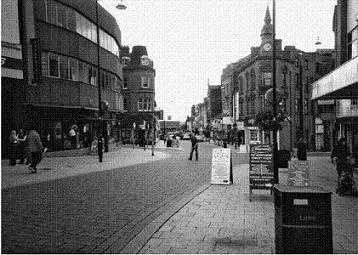
With a population of around 250,000, Stoke-on-Trent (aka The Potteries) sits between Manchester and Birmingham in the English Midlands and has a global reputation for its most famous export, ceramics (aside, that is, from pop singer Robbie Williams). However, due to the nature of the ceramics process – capital was tied up in the production process and there was little need for significant administrative, financial and banking institutions or retail infrastructure because goods were exported around the world, but people did not come in significant numbers to the city to purchase ceramic products – the city has not had a large representation of middle-class or ethnically diverse residents (see Phillips 1993; Edensor 2000). Moreover, the spatial configuration of the city, made up of six towns (seven if you include the nearby but separate political entity of Newcastle-under-Lyme, with its population of around 110,000), has ensured that there has never been a dominant city centre. Prior to unification in 1911, for example, each of the Potteries towns had developed its own cinemas, shopping streets and squares, markets, town halls, political structures and infrastructure for utilities provision. While Hanley eventually edged ahead of the other towns and was officially designated as the ‘city centre’, the combination of the dominant working-class production and consumption cultures combined with the dispersed spatial configuration has ensured that the city has failed to ‘punch its weight’ for a conurbation of its size (see Figure 1.1). Although relatively slow to respond to the dramatic economic and social change associated with de-industrialization, the city has, over the past decade, embarked on a range of attempts to undertake regeneration and instigate economic development strategies. These have tended to reproduce, rather than transcend, the historic failings of the city, further exacerbating the quantitative and qualitative gap between Stoke-on-Trent and its more successful neighbours in an urban hierarchy dominated by intense competition (Bell and Jayne 2003a and b; Jayne 1999, 2000, 2004b, 2005).
Figure 1.1 Stoke-on-Trent’s city centre. (Source: courtesy of Mark Jayne.)
Spurred by teaching, researching and consulting about cities and about Stoke-on-Trent, we resolved to commission essays for an edited volume with a focus on small cities around the world, where smallness was a qualitative thing as much as anything. Cities where smallness was a state of mind, an attitude, a disposition. Cities like Stoke-on-Trent, where small meant small-minded more than small-sized. We started to ask questions about the cultures of smallness, and the cultures of small cities. Was smallness something that could be alchemically made into gold for such places? Were these places seemingly small because of the big-city boosterist discourse that made small cities seem inadequate, underdeveloped and retarded? Was there a stubborn, perverse pride in smallness that these cities evoked and invoked? Or were such places confined to the dustbin of post-industrial urbanism, leftovers from a bygone age, still trading on worn-out ideas of cityness that others read only as smallness, as lacking in the kind of cosmopolitan urbanism and economic dynamism associated with real (large) cities?
To a certain degree, someone beat us to it by publishing a book called Crap Towns (Jordison and Kieran 2003, 2004), a sort of anti-guidebook listing the UK’s least desirable places; places too crap even to be cities. (For those who are now curious, the place ‘topping’ the Crap Towns league is Hull; in the book’s sequel, that dubious honour goes to Luton). Undeterred by having been beaten to it, we stuck with the idea which became Small Cities: urban experience beyond the metropolis, which we hope to be a more critically informed approach to the thorny problem of smallness.
SIZE MATTERS
How small is small? And what ways of measuring size are useful? Given our allergy to generalization, we decided against any minimal or maximal requirements. Just as Thrift (2000) reminds us that ‘one size does not fit all’ in ways of thinking about cities, so we didn’t want size to be an absolute. A quick scan across the scant previous work confirms this: in studies from the USA, a small city is often defined as having less than 50,000 inhabitants (Brennan and Hoene 2003); in studies from ‘developing countries’, a small urban centre might be classed as one which has 5000 to 20,000 inhabitants, although here national and regional variation make such a definition unsustainable (Hardoy and Satterthwaite 1986b). There is great difficulty in defining smallness through population size or economic growth, in the context of very different urban hierarchies in countries in Europe, Asia and North America (Prakesh 1982; Markussen et al. 1999; Bagnasco and Le Gales 2000). Attempts to schematize cities into a pecking order also tend to be inadequate due to this discursive and differential construction of cities and urban hierarchies around the world. Peter Hall’s (2004: 36) classification of a global urban hierarchy based on population size, for example, develops and adds to a number of previous schemas, all of which (beyond the global and sub-global level) fail to accommodate or account for geographically specific urban hierarchies around the world:
- Global cities – typically with 5 million people within their administrative boundaries and up to 20 million within their hinterlands, but effectively serving very large global territories.
- Sub-global cities – typically with 1–5 million people and up to perhaps 10 million in their hinterlands, performing global service functions for certain specialized services (banking, fashion, culture, media).
- Regional cities – with populations of 250,000 to 1 million.
- Provincial cities – with populations of 100,000 to 250,000.
Smallness, we would argue, needs to be assessed in other ways which are at least complementary to more standard numerical measures. Smallness is as much about reach and influence as it is about population size, density or growth. At what level in the global urban hierarchy does a small city ‘trade’? To which other cities (and nonurban places) does it link and what forms do those linkages take? It’s not size, it’s what you do with it. In a global urban order characterized at once by dense networks of interconnection and by intense inter-urban competition, absolute size is less important; ‘the value of small urban centers is not so much in their … sizes as in their functional characteristics’ (Rondinelli 1983: 385). So smallness is in the urban habitus; it’s about ways of acting, self-image, the sedimented structures of feeling, sense of place and aspiration. You are only as small as you think you are – or as other cities make you feel.
Now, there is a further dimension to the sizing of cities and that is a kind of ‘sizism’ that marks urban theory and urban policy: ‘small and intermediate urban centres remain the least studied and perhaps the least understood elements within national and regional urban systems’ (Hardoy and Satterthwaite 1986b: 6). But ‘small cities’ is not oxymoronic; small cities are typical in a quantitative sense. Too many theorists have been wooed and wowed by spectacular urbanism to notice them, however. Small cities are just not a topic that urban studies has engaged with, that theorists have seen as deserving of concerted, coherent and focused research and writing. So the discourses of cities – the ways they are talked about and thought about by different people, including academics, planners, managers, inhabitants – have tended to follow the logic that cities should be big things, either amazing or terrifying in their bigness, but big nonetheless. The very idea of cities is to be big and to get bigger: shrinkage, even stasis, is a sign of failure. Small cities, therefore, are not as good as big cities by the very fact of their size, even when those small cities (or spaces and places within them) punch above their weight. Metropolises and mega-cities are the acme of urbanism and small cities are therefore something of an embarrassment: as already noted, they are a strange in-between category, neither one thing (rural) nor the other (properly urban). Small towns and villages can stay small, where smallness is quaint, whimsical, old-fashioned; but small cities? What is the point of them?
SMALL ACTS
Jennifer Robinson’s (2002) important discussion of cities ‘off the map’ of the global cities research agenda calls for an urban theory that accounts for a wider variety of cities and, crucially, for a bridging between research on global or world cities and that focused on small cities in ‘less developed’ countries. Arguing against the view of ‘third world cities’ as ‘not [yet] cities’ and as ‘irrelevant’ to world cities theorizing, Robinson calls for alternative analytical approaches that might think of these ‘irrelevant’ cities differently. For example, in the literature on small cities in the global South, a very clear (if sometimes contested) role for small cities is often highlighted: spreading more equitably across space the ‘benefits of development’ by producing a more evenly distributed and better developed urban network (Hardoy and Satterthwaite 1986b). There is therefore a pressing research agenda here to understand the role of small cities in social and economic development though, as Robinson (2002: 540) again reminds us, this ‘developmentalist’ view of ‘third world cities’ is in itself problematic, assuming that ‘all poor cities are infrastructurally poor and economically stagnant yet (perversely?) expanding in size’. This assumption stereotypes small cities in the global South on the basis of ideas about the defining function of economic globalization in the fortunes of cities. Yet Hardoy and Satterthwaite (1986a) note that these cities perform other key functions too:
one aspect of small and intermediate urban centres which has gone virtually unmentioned [in work to date] is the fact that they so often serve as the focus for social life and social contacts in their area. … Such centres may be the place where young people in the area socialize, where there are important opportunities to meet people of the opposite sex and where there are opportunities for sport, recreation and for attending religious services and festivals. Certainly it is within many such centres that the culture of the area has its most concentrated expression.
(Hardoy and Satterthwaite 1986a: 410)
The social and cultural functions of small cities have also been flagged as important, maybe even unique, in cities in the global North, as we shall see. Moreover, the stress on economic globalization neglects what Harris (quoted in Robinson 2002: 541) called the ‘real urban economy’. This differently articulated economic function (which is also at once both social and cultural) is exemplified by Rondinelli (1983), who cites a study from the 1970s of Oaxaca, a small Mexican city (population at the time of just over 100,000) with a central market role. Rondinelli summarizes the functions of Oaxaca for its locality:
The market in Oaxaca provides outlets for agricultural produce, livestock, nonagricultural goods like fibers and firewood, and artisanal products such as pottery, baskets, mats, and household and agricultural implements. An impressive array of people find employment directly or indirectly through market activities – carpenters, stonecutters, healers and curers, butchers, blacksmiths, small-parts sellers, marriage arrangers, mechanics, and vendors of seeds and equipment. The market offers opportunities for farmers to sell their goods and for a large number of intermediaries to engage in trade. Oaxaca supports traders who buy and resell goods in the market, traders who travel to small rural markets to collect goods for resale in Oaxaca, and traders who buy goods in the market and resell them door-to-door in the city. Rural visitors have the opportunity to shop in stores along the periphery of the market and to call on doctors, dentists, lawyers, and lenders. Wholesalers collect small quantities of local products from the Oaxaca market and sell them in bulk to retailers in larger cities and bring small lots of goods back to Oaxaca. The employment network of the market is thus extended to include field buyers, agents, truckers, and small-load haulers.
(Rondinelli 1983: 387)
So here we see ways in which small cities can and do ‘work’ in the urban hierarchy; they are much more than fillers, not (yet) cities or would-be cities – they are important nodes in the networks between places of different scales, and they are seen to mediate between the rural and the urban, as well as between the local and the global. Yet in studies of small cities from the global North, they are more often figured as always facing problems, even as being problems themselves, as a result of the restructuring of economies and geographies in recent decades. Now, while we are mindful that in categorizing cities in terms of their political-economic geography, we are going against Robinson’s (2002: 549) call for a non-categorizing ‘cosmopolitan project of understanding ordinary cities’, we are interested in sketching both similarities and differences in the shapes and fortunes of small cities in different places, in their specificity. We wholly agree with Robinson that ‘simply mobilizing evidence of difference and possibly deviation … is not enough’ (ibid.); at the same time, however, we are very interested in the stories of small cities and the lessons learnt from those stories.
In post-socialist states, for example, many small cities have been twice ravaged, by de-industrialization and by ‘liberalization’. They thus face some particular challenges and enact some particular responses. Jör...