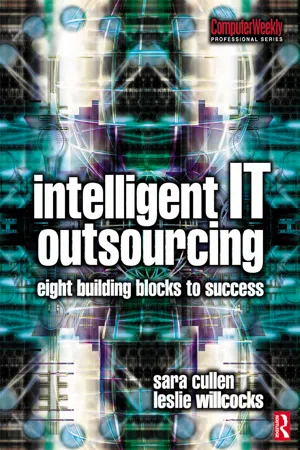
Intelligent IT Outsourcing enables practitioners to focus in on the essential issues that need to be addressed so that the fundamental structure of their sourcing strategy and its implementation is sound. The authors provide insight into the challenges likely to be faced and give detailed advice on how to pre-empt and manage these.
IT and outsourcing continue to be problematic, not least because fundamental learning about this subject fails to be applied systematically, and because IT is inherently difficult to manage. The economics are not obvious and emerging technologies have to be addressed, therefore IT goes to the heart of many enterprises and interfaces with multiple business units and processes, and there are continuous skills shortages.
Unfortunately complexities are not removed in outsourced situations where additional problems come into play, for example the supplier's capabilities, whether the IT is right for an outsourcing solution, and whether the contract is robust but flexible enough to allow for outsourcing to take place. Objectives need to be realistic, and factors such as whether the internal management is mature and capable enough in this field, and the impact of prohibitive switching costs on behaviour once an outsourcing deal has been signed all have to be taken into account.
The authors have built up over two decades of research, advisory and practitioner experience that enables them to distil the fundamental challenges in IT and outsourcing and demonstrate how these can be addressed.
- 256 pages
- English
- ePUB (mobile friendly)
- Available on iOS & Android
eBook - ePub
Intelligent IT Outsourcing
About this book
Architect Phase
 | The first building block – discard the |

There are many misconceptions about what outsourcing can and cannot do for an organization. Most have a root cause lying in an almost ideological belief that outsourcing IT is a relatively simple transaction that can more or less easily be handed over to a supplier, and that, with due monitoring, inherent benefits will follow.
But outsourcing IT is neither simple nor a transaction – it is a strategy for managing the delivery of IT services. Like all management strategies, the key lies in how the strategy is planned, implemented and managed to move the organization from its current state to its visioned future state. Outsourcing is a transition path towards that vision, not the end state. In its capacity as a management strategy, outsourcing is purely one of many strategies that may get the organization to its desired goals.
Gathering acumen is about the organization becoming an informed outsourcing purchaser and manager. Not with hindsight, as so many organizations have done, but with foresight. In this building block, the primary goal is to replace ideological concepts with realistic goals appropriate to the circumstances of the organization, its industry, and the IT markets in which it may procure services.
1.1 Discard the myths …
It is very important not to believe everything one is told about outsourcing IT. In particular, it is essential to do your own analysis based on your own rationale for outsourcing and the particular circumstances and potential suppliers that you will deal with. In particular, analyse supplier claims closely. In surveys we carried out in the 1993–2002 period, the most regular top sources of disappointment were hidden costs, followed by too much trust in espoused vendor claims. Unfortunately, the truth is that suppliers still tend to be much better at selling their services than customers are at buying them.
Consider the following myths as just some frequently observed examples. We are not saying here that these claims are necessarily untrue in certain circumstances. What we are saying is that they do not provide a safe general set of assumptions from which to make outsourcing decisions. Remember the words of one senior manager in a supplier company: ‘Outsourcing contracts are agreed in concept but delivered in detail, and that’s why they can break down.’ The message – don’t discount the promises; but analyse them very carefully indeed, and take real steps to secure the outcomes you really need, which may be different from the ones on offer.
Myth 1 – ‘Outsourcing IT is much like outsourcing anything else (e.g. premises security, catering, rubbish disposal).’
The first point to emphasize here is that IT assets and activities take many different forms. Not all IT is the same. Do not treat IT as monolithic. A portfolio approach to managing IT needs to be taken. We categorize IT into critical differentiators, critical commodities and useful commodities. A ‘critical differentiator’, for example British Airways (BA) reservation system, should be kept in-house, although external resources can be bought in where necessary but will perform under internal management control. A ‘critical commodity’, for example aircraft maintenance systems at BA, gives no competitive advantage, but are a minimum requirement to compete in the airlines sector. These can be outsourced where supplier price and quality of performance compare favourably with the in-house option. ‘Useful commodities’ – data-centres, maintenance and support, payroll, accounting administration are often defined as such – are the most obvious targets for outsourcing.
However, even useful commodities cannot be compared to other resources and activities in terms of ease of outsourcing. In particular, we would point to five distinctive characteristics of IT that make it more difficult to outsource than, say, catering or advertising:
| 1 | IT is not a homogeneous function, but comprises a wide variety of IT activities. |
| 2 | IT capabilities continue to evolve at a dizzying pace; thus predicting IT needs beyond a three-year horizon is wrought with uncertainty. |
| 3 | There is no simple basis for gauging the economics of IT activity. |
| 4 | Economic efficiency has more to do with IT practices than inherent economies of scale (see below). |
| 5 | Most distinctively of all, large switching costs are associated with IT outsourcing decisions. |
When one adds that IT is increasingly entering into the core of organizational functioning, creating connectivity issues and business knock-on effects for any IT action, it also becomes clear that management of IT outsourcing takes on another characteristic, namely it is invariably going to be a learning experience, where managers need to be highly anticipatory, but will also often find themselves in catch-up mode.
Myth 2 – ‘Vendors have inherent advantages in superior management practices and economies of scale. Therefore they will achieve lower IT costs while improving service.’
Case Study: a food and drinks company
We once witnessed an unsolicited bid to a food and drinks conglomerate anxious to outsource its data-centres. The supplier’s representative claimed that his firm could maintain service levels and achieve 20% savings on a five-year contract, while a ten-year contract could achieve 30% cost savings. The claim was based on production and labour economies of scale, together with superior management practices inherent in a world class IT supplier. The latter arose, it was claimed, from being higher up the IT learning and experience curve than the client, superior IT management expertise not affordable by the client, and the application of best practice accumulated over many contracts. A three-hour look at the claims against the actual IT performance of the potential client revealed that it was large enough to achieve similar economies of scale itself, and that its IT management was actually very experienced. Moreover, when some of the superior management practices were described, it was clear that they all could be replicated in-house. Moreover the company did not have a labour cost or retention problem.
In practice, suppliers frequently overplay the economies of scale argument. Just looking at data processing, certainly the argument does apply to small client organizations, especially where they just cannot afford, or cannot retain, IT expertise. But the larger suppliers do not always find such small organizations attractive clients. Moreover, if such small organizations do become clients, they will not always get priority treatment from the supplier.
Compass, the benchmarking firm, found economies of scale for data processing kicking in up to 800 mips, but then there are few additional gains to be had across the 800–2000 mip range, after which, in fact, diseconomies of scale are frequently experienced. Moreover, several sources, including our own analyses of their suppliers for clients, often find that vendor performance on a whole range of IT activities are not noticeably different from, let alone better than, efficient in-house IT organizations.
Superior management practices are a more likely and, indeed, usually the main source of IT outsourcing benefit. However, practices such as reorganizing work, automating tasks, employing fewer, more able staff – these have no magic about them, and can be rep...
Table of contents
- Front Cover
- Half Title
- Title Page
- Copyright
- Contents
- Computer Weekly Professional Series
- About the authors
- List of Figures
- List of Tables
- Introduction
- Part One: Architect Phase
- Part Two: Engage Phase
- Part Three: Govern Phase
- References and Brief Further Reading
- Index
Trusted by 375,005 students
Access to over 1.5 million titles for a fair monthly price.
Study more efficiently using our study tools.
Frequently asked questions
Yes, you can cancel anytime from the Subscription tab in your account settings on the Perlego website. Your subscription will stay active until the end of your current billing period. Learn how to cancel your subscription
No, books cannot be downloaded as external files, such as PDFs, for use outside of Perlego. However, you can download books within the Perlego app for offline reading on mobile or tablet. Learn how to download books offline
Perlego offers two plans: Essential and Complete
- Essential is ideal for learners and professionals who enjoy exploring a wide range of subjects. Access the Essential Library with 800,000+ trusted titles and best-sellers across business, personal growth, and the humanities. Includes unlimited reading time and Standard Read Aloud voice.
- Complete: Perfect for advanced learners and researchers needing full, unrestricted access. Unlock 1.5M+ books across hundreds of subjects, including academic and specialized titles. The Complete Plan also includes advanced features like Premium Read Aloud and Research Assistant.
We are an online textbook subscription service, where you can get access to an entire online library for less than the price of a single book per month. With over 1.5 million books across 990+ topics, we’ve got you covered! Learn about our mission
Look out for the read-aloud symbol on your next book to see if you can listen to it. The read-aloud tool reads text aloud for you, highlighting the text as it is being read. You can pause it, speed it up and slow it down. Learn more about Read Aloud
Yes! You can use the Perlego app on both iOS and Android devices to read anytime, anywhere — even offline. Perfect for commutes or when you’re on the go.
Please note we cannot support devices running on iOS 13 and Android 7 or earlier. Learn more about using the app
Please note we cannot support devices running on iOS 13 and Android 7 or earlier. Learn more about using the app
Yes, you can access Intelligent IT Outsourcing by Leslie Willcocks,Sara Cullen in PDF and/or ePUB format, as well as other popular books in Business & Business General. We have over 1.5 million books available in our catalogue for you to explore.