Word Structure, provides a complete introduction to morphology, the study of the structure of words. Word Structure:
* examines how words work as part of the language system
* encourages readers to take an objective and analytic approach
* refers to a wealth of languages, including Turkish and Latin, to illustrate points raised
* provides clear and succinct summaries at the end of each unit.
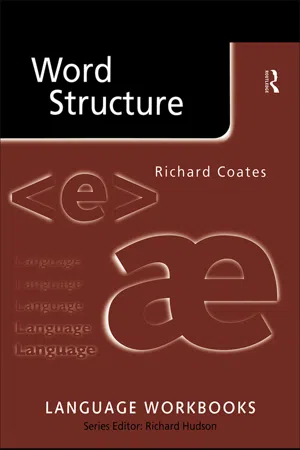
- 112 pages
- English
- ePUB (mobile friendly)
- Available on iOS & Android
eBook - ePub
Word Structure
About this book
Information
DIVIDING WORDS UP
1
An exploration of what it means for words to have parts.
Quite a lot of the material in this book assumes that you have some knowledge of the way the words of a language fall into groups, i.e. the traditional ‘parts of speech’ or LEXICAL CATEGORIES, such as noun, verb, adjective, preposition and so on. If you don’t have this knowledge, some of the data presented in this Unit will introduce you gently to the idea that there are different types of word, and to the names that have been applied to these types. Lexical categories
ONE-PIECE WORDS
Many words in many languages are complete as they are. They don’t obviously consist of smaller pieces. We’ll start with English data (which will loom large in this book) and work on to other languages afterwards, where appropriate. Here are some English examples of one-piece words.
Nouns: tea machine pilchard shoulder duty kangaroo syllabus
Verbs: steal exist possess harass develop astonish
Adjectives: small bright new straight serene
Adverbs: fast here soon ever often
Prepositions: in with to about
Pronouns: me them it you
Conjunctions: and but or that while
Discussion
Counting how many pieces a word has isn’t the same as checking how many syllables a word has. The ones in the list above have anything from one to three syllables, and you can find some even longer words that seem complete in themselves:
| didgeridoo | mulligatawny | abracadabra |
| millennium | rhododendron |
But we’ll look later on at the question of whether some such words really do have constituent parts after all.
STRUCTURE
On the other hand, lots of words in all of these classes do evidently consist of smaller pieces—they have STRUCTURE. Each of the elements that you can divide a word into is technically called a MORPHEME, for reasons that I’ll explain below. Here are some words with more than one of them. Morpheme
Nouns: teapot software flatfish tomcat placement breathlessness normality
Verbs: revalue dispossess threaten overdevelop autodestruct
Adjectives: dreadful streetwise carefree messy downcast
Adverbs: strongly sometimes yesterday hereabouts
Prepositions: into onto around upon
Pronouns: anyone yourself nobody yous or youall (for speakers of some dialects)
Conjunctions: however whereas unless
Discussion
Most of these are quite obvious. Perhaps you had to think a bit about threaten and around, but if we were to write threat-en and a-round, with the BOUNDARY marked in as a hyphen, the point would be clear. The words are related to threat and round, and were coined out of them at some remote time in the past. Did you notice those ones with three morphemes? (Breathlessness, normality, sometimes, hereabouts.) Boundary
EXERCISE
1.1 Divide these words up into their constituent parts (morphemes):
| thickset | bookshelf | thinkable | outbid | nowhere | legless |
| quickly | rooms | outer | preview | thinking | unsafe |
Discussion
That was easy in itself, and I won’t spell out the answers. But the results are different in the two sets of words. Notice that when you divide up the words in the first line, on the face of it you get two pieces which are both in themselves
English words: thick and set, book and shelf, and so on. When you divide up the words in the second line, you get an English word—quick, room, out, etc.—plus a bit that is clearly English but not a word ly, -s, -er, etc. These pieces cannot stand by themselves, and independence is one of the criteria for calling an element a word. Those elements that can stand by themselves as words are called FREE MORPHEMES; those that can’t stand alone, but need the support of other morphemes, are called BOUND MORPHEMES. But the overwhelming majority of morphemes, free or bound, have one or more meanings of their own. Typical morphemes are meaningful. That is part of the definition of the term for some analysts, though in due course we shall see some morphemes that don’t have any meaning. Free morphemes Bound morphemes
Notice that if you identify an element as a morpheme, in doing so you identify a position in a word into which other material—other morphemes—can be substituted: start with out-bid, and you can progress to out-face, -sell, -do, -play, -smart, -live and so on. In such constructions, the combinations of morphemes will often have similar types of meanings—here, all are verbs meaning roughly ‘do something more or better than someone else’. There is not just a pattern, but a meaningful pattern.
Thinkable and legless deserve another look: notice that -able and -less aren’t actually pronounced exactly like the ordinary words able and less. In fact, they don’t mean the same either. Able doesn’t have the same range of meanings as - able; people are able, but things can be X-able, as in That i...
Table of contents
- COVER PAGE
- IN THE SAME SERIES
- TITLE PAGE
- COPYRIGHT PAGE
- USING THIS BOOK
- ACKNOWLEDGEMENTS
- 1: DIVIDING WORDS UP
- 2: WORDS AND PARADIGMS
- 3: LEXICAL AND GRAMMATICAL MORPHOLOGY
- 4: ROOTS, BASES, STEMS AND OTHER STRUCTURAL THINGS
- 5: COMPOUND AND COMPLEX BASES
- 6: IDENTIFYING GRAMMATICAL MORPHEMES
- 7: WHERE TO FIX AFFIXES
- 8: WORD-FORMATION BY REDUCTION
- 9: ALLOMORPHY: BOOKS WITH MORE THAN ONE COVER
- 10: ALLOMORPHY IN OTHER LANGUAGES
- WHERE NEXT?
- ANSWERS TO EXERCISES
Trusted by 375,005 students
Access to over 1.5 million titles for a fair monthly price.
Study more efficiently using our study tools.
Frequently asked questions
Yes, you can cancel anytime from the Subscription tab in your account settings on the Perlego website. Your subscription will stay active until the end of your current billing period. Learn how to cancel your subscription
No, books cannot be downloaded as external files, such as PDFs, for use outside of Perlego. However, you can download books within the Perlego app for offline reading on mobile or tablet. Learn how to download books offline
Perlego offers two plans: Essential and Complete
- Essential is ideal for learners and professionals who enjoy exploring a wide range of subjects. Access the Essential Library with 800,000+ trusted titles and best-sellers across business, personal growth, and the humanities. Includes unlimited reading time and Standard Read Aloud voice.
- Complete: Perfect for advanced learners and researchers needing full, unrestricted access. Unlock 1.5M+ books across hundreds of subjects, including academic and specialized titles. The Complete Plan also includes advanced features like Premium Read Aloud and Research Assistant.
We are an online textbook subscription service, where you can get access to an entire online library for less than the price of a single book per month. With over 1.5 million books across 990+ topics, we’ve got you covered! Learn about our mission
Look out for the read-aloud symbol on your next book to see if you can listen to it. The read-aloud tool reads text aloud for you, highlighting the text as it is being read. You can pause it, speed it up and slow it down. Learn more about Read Aloud
Yes! You can use the Perlego app on both iOS and Android devices to read anytime, anywhere — even offline. Perfect for commutes or when you’re on the go.
Please note we cannot support devices running on iOS 13 and Android 7 or earlier. Learn more about using the app
Please note we cannot support devices running on iOS 13 and Android 7 or earlier. Learn more about using the app
Yes, you can access Word Structure by Richard Coates in PDF and/or ePUB format, as well as other popular books in Languages & Linguistics & Linguistics. We have over 1.5 million books available in our catalogue for you to explore.