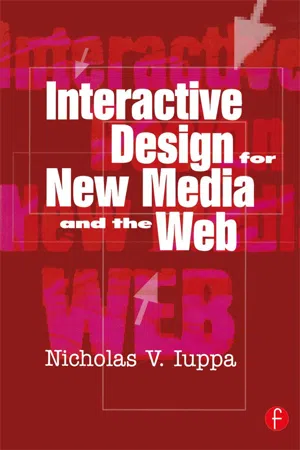
In an age where digital technology makes just about anything possible, Interactive Design for New Media and the Web demonstrates how to realize that promise through the creation of outstanding interactive programs. This hands-on, practical book examines the ever-expanding capabilities of all forms of digital presentation for increasing interactivity, and the design principles and interface guidelines needed to deliver the required message or story with this technology.
Interactive Design for New Media and the Web covers the technology as well as the tools and practices of interactive design, including the creation of site maps and flow charts, and the writing of design documents. It examines the latest interactive features of DVD, as well as the newest techniques and technologies for other forms of digital presentation. New design templates, 3D graphics and animation, polling and use of cookies, distance learning, html, and intranet learning games are among the topics covered in this book. Examples and case studies demonstrate the broad range of applications from websites to CD-ROM games to successful web commerce sites, including the capacity for user participation in e-commerce.
The companion Website shows numerous examples discussed in the text of all types of programs and their applications.
- 280 pages
- English
- ePUB (mobile friendly)
- Available on iOS & Android
eBook - ePub
Interactive Design for New Media and the Web
About this book
Information
I
Background
1
Interactivity?
Interactivity! After dozens of years of hype it is still a word that excites, attracts, sells, and confounds people.
In the game industry interactivity is very tangible. It is a key feature that helps guarantee the success or failure of a product. Just how interactive is a game? “How is the game play?” designers ask. They are asking about the level of interactivity.
The game play had better be very interactive if the game is to sell at the level that publishers require. Take Electronic Arts’ million-seller Knockout Kings, for example. If you want to take on Muhammad Ali or George Foreman or Oscar De La Hoya, you can encounter virtual adversaries who present their style, their skill, and their fighting philosophy right in a virtual ring. Select your character, choose your opponent, and see just how interactive an experience can be. Maybe you’ll be able to punch your way to a virtual world title.
One thing is certain, unless your experience is very interactive, you’ll be the one who is knocked out.
Interactive learning? In the 1950s and ′60s, educators and instructional designers realized that if students participated in the learning experience rather than just watching passively, a measurably higher degree of learning could take place. As a result, training organizations from McDonalds to the U.S. Army began developing interactive educational media. Such instruction may have reached its zenith in the massive tank, ship, and plane simulators that were created for the U.S. military. At Fort Leavenworth, Kansas, trainees enter an enormous, hangarlike building and see creatures that look like a cross between the body of a tank and an enormous hydraulic spider. Climb up the catwalk and into the monster and you feel as if you are inside a tank. Start the system running and you find yourself chugging across a vast terrain in southern France. The outside observer sees the giant spider, lurch, jerk, and twist in wild response to your driving decisions. The overall effect is exhilarating, and the military swears that trainees who use these simulators are prepared to drive tanks with far less wear and tear on the environment and on the national budget than those who received traditional training in real tanks on real terrain.
On the Internet, interactivity is so omnipresent that it is impossible to think of a passive on-line experience. You can go on-line and meet people in a chat room, research your favorite topic, check your stocks, watch a movie, listen to a baseball broadcast, or download some music. The truth is that there is so much interactivity built into the getting there and doing your thing that the broad nature of the experience is always interactive. Buying a book on Amazon.com means searching for titles, checking out reviews, loading your shopping cart, making sure your address and credit card numbers are right. You can’t do that passively.
In Online Marketing interactivity is a hallmark as well. Take motion pictures, for example. It’s never been enough to create movie Web sites that simply list the cast and crew and summarize the story. If you visited the site for South Park—Bigger, Longer, and Uncut last year, you found yourself invited to join tyke Kyle and his little brother in a rousing game of Kick the Baby! It was not really sadistic, but it was interactive.
So it does seem as though, at the dawn of this new millennium, interactivity has truly arrived. But that is not entirely the case. There are two reasons for this. First, for more than a dozen years the formats of interactivity have been evolving, and the quality of the interactive experience has been evolving as well. During that period interactive designers have sometimes tried their best to create quality experiences in an environment that was ill defined or technically incapable of providing all that they wanted. Their intentions were honest, but their products did not really deliver interactivity.
We should also admit that interactivity sounds good, and so some designers provided a less-than-ideal experience simply because they wanted to capitalize on the concept of interactivity without paying the price for all they could deliver. That sort of phenomenon is occurring right now with interactive elements of Digital Video Discs. There is far more than can be done with DVD interactivity than chaptering movies and including the coming attractions and presentations on “the making of” along with the title itself. But most DVD designers, who could be taking a cue (and some material) from the interactive Web sites for the same movies, don’t want to spend the development time or money to add real interactivity to DVD movie titles. Put some of the Web sites on the DVDs so that people can at least page through the background information on the project. How much would that cost?
The second major reason that interactivity has not yet truly arrived is that the formats and designs for interactivity have not all been defined. We know what an interactive banking Web site is. We know what an interactive game is. We know what interactive learning is. But what is interactive television?
In the entertainment business the promise of interactivity is still unfulfilled. It is hotly debated and generally misunderstood. Hollywood writers are frightened by it, movie directors long for it, and producers doubt that it will ever exist. Studio executives and entertainment entrepreneurs, on the other hand, are interested—if only for reasons of self-defense. Just to guard against the innovations of rival studios, they invest in technologies that suggest that they may be able to deliver interactive entertainment … someday.
Interactive entertainment is something of a Holy Grail: legendary, only glimpsed from afar. Some people claim to have seen it once, somewhere. “It was a truly great experience,” they say. Just don’t ask them to describe the experience.
All we are sure of is that interactive entertainment will be truly wonderful, if it ever arrives.
Of course, we have predictions from visionaries about how it will work. All the Star Trekkers out there are probably aware of what is perhaps the best example of fictional interactive entertainment: the Holodeck.
The Holodeck is the virtual playground and learning simulator that exists on most of the starships in the Star Trek series. The Holodeck is programmable and creates virtual people and places as specified by its users. The users, of course, are members of the crew of the ships. The technology that produces images within the Holodeck uses a mix of energy and force fields that allow the virtual characters and settings that emerge in the space to take on a look and feel that is very solid and very real.
Crewmembers can enter the Holodeck for extended periods and have long, complex adventures. Captain Picard and Data, for example, love to participate in Sherlock Holmes mysteries. Captain Janeway enjoys being a Victorian governess. Riker plays a trombone in a jazz band in his own virtual bar. The doctor on Star Trek: Voyager, a Vulcan himself, simulated the mating rituals of the Vulcans, because, in fact, he was the only Vulcan on the ship. Worf keeps his skills sharp with Klingon combat training exercises that he programmed into the Holodeck.
Holodecks require a great deal of energy to operate, but somehow their power sources are totally separate from the main energy driving the starships. So, even when there are problems with the fuel supply of the ship, the Holodecks keep chugging away.
No one knows the programming language of the Holodeck or much about its human interface. But, somehow, most crewmembers can enter their specifications and create the experience of their choosing. Of course, true to the principles of Consequence Remediation that will be discussed later in this book, choosing a scenario does not guarantee the outcome that a crewmember is hoping for. This is especially clear in those episodes in which the characters within the Holodeck become self-aware, escape their confines, and try to carry out their existence in the real world.
Another, very important portrait of interactive entertainment was created in the late 1940s by science fiction writer Ray Bradbury. I was fortunate enough (or unfortunate enough, perhaps) to stumble onto it when I was very young, and its clear vision of interactive entertainment has been with me ever since.
When I was about 6 years old, I happened to tune into a broadcast of the radio series Dimension X. The story presented on the radio that night was an adaptation of “The Veldt,” an episode from the science fiction book The Illustrated Man.*
I remember that my parents had gone out to the movies and left me alone in the house with a teenage babysitter and a great, big console radio. What could I do when the girl picked up the phone and called her best pal to talk the night away? I turned on the radio.
The radio drama presented on Dimension X that night had to do with a futuristic house that offered its well-to-do owners the ultimate babysitter: a “PlayRoom” whose walls were floor-to-ceiling television screens. If the parents wanted to go out for the evening (as mine had so thoughtlessly done), they simply left their children behind to be taken care of by the latest media technology (as mine had also done).
The PlayRoom in that fabulous house had the technology to create dozens of different environments for children to play in. As far as I could tell, the children controlled their play environments by sending orders with their minds, telepathically.
Of course, it wasn’t long before the little brother and sister in the story found their own favorite place to be (it happened to be my favorite place as well). It was the domain of Tarzan, Jungle Jim, and Sheena, Queen of the Jungle; it was the heart of Africa, the African Veldt.
Needless to say, after the children’s first night in the PlayRoom, the roaring of lions and trumpeting of elephants became common in the household. It kept the parents up every evening, and it wasn’t long before they became concerned about the PlayRoom and the amount of time their children were spending there.
In the end, the parents even forbade their children to play there, locking the door and insisting that they were going to have the entire PlayRoom dismantled and sent back to the manufacturer. This, of course, is not the kind of thing that parents should do to their children, at least not in a Ray Bradbury story.
Well, I was right in tune with the kids when they broke into the PlayRoom on the very last night it was part of their home. I was thrilled as they summoned up their favorite locale and saw again the prides of lions lounging in the sun and the herds of elephants lumbering across the plain. I wasn’t at all sympathetic when the hysterical parents came zooming down the stairs and into the PlayRoom to find out why their children were disobeying their directives. But I was in full support as the kids jumped out of the PlayRoom and slammed the door behind them, trapping their worried parents in the African Veldt. Remember, I, too, had been left alone to entertain myself while my parents went to the movies, and all I had to entertain me was a magical box (the radio) and the power of my own mind.
I won’t spoil the story by telling you what happened to the parents as they came face to face with those elephants and lions. Instead I’ll just say that the story does seem to be the best introduction any kid ever had to the concepts and the possibilities of interactive entertainment.
WHAT THIS BOOK WILL DO
This book will review the principal forms of interactive media. We will look at interactive formats and formulas that have been with us since the very first lessons were taught and the very first stories were told. We will see what we can learn from them, and how they fit into the new technologies and media that are available today. We will study the latest delivery mechanisms for interactivity, from wireless technology to the World Wide Web to DVD to virtual immersive experiences, and we will see how the accelerating evolution of those technologies has begun to shape the design and substance of the interactive media themselves.
We will consider successful and unsuccessful examples of interactive applications so that we can make sure that our efforts provide the most positive experiences. Ideally our efforts at interactive design should advance the evolution of interactivity. We should not contribute to the vast body of content that has led so many skeptics to insist that interactivity is a nonsense word—that it will never provide deep, rich, universal experiences.
We will look at interactive television and see if, when, and where this most promising of all interactive media will arrive.
We will review some of the tools and practices of the trade of interactive design, including the creation of site maps and flowcharts and the writing of design documents. We will see how the latest forms of digital media can now be applied to entertainment, games, information systems, and education. And finally, one more time, we will look at where the whole business can take us … ideally with the same power as the PlayRoom, but with consequences far more positive and far less dire.
* Ray Bradbury, The Illustrated Man (New York: Doubleday & Co., 1958).
2
A Short History of Interactivity
Interactivity is not new. It is one of the oldest forms of human endeavor. Commerce has always been interactive. You have something I want. I have the cash. We make a deal. You get my money. I get what you’v...
Table of contents
- Cover Page
- Half Title Page
- Title Page
- Copyright Page
- Dedication
- Dedication
- Table Of Contents
- Part I Background
- 1 Interactivity?
- 2 A Short History of Interactivity
- 3 The Internet
- 4 Distance Learning
- 5 Interactive Games
- 6 Interactive Experiences
- Part II Creating Interactive Products
- 7 The Process
- 8 Interactive Design
- 9 Human Interface Design
- 10 Flowcharts and Site Maps
- 11 Prototyping
- 12 The Technology of the Web
- Part III Interactive Instruction
- 13 Basic Structure
- 14 Exercise Design
- 15 Compendium of Distance Learning Exercises
- 16 Test Construction and Evaluation
- Part IV Interactive Entertainment
- 17 Basic Structure
- 18 The Adventure!
- 19 Comics on the Internet
- 20 Game Shows
- Part V Information, e-Commerce Systems, and Beyond
- 21 Corporate and Informational Web Sites
- 22 e-Commerce Systems
- 23 Where Is It All Going?
- Index
Trusted by 375,005 students
Access to over 1.5 million titles for a fair monthly price.
Study more efficiently using our study tools.
Frequently asked questions
Yes, you can cancel anytime from the Subscription tab in your account settings on the Perlego website. Your subscription will stay active until the end of your current billing period. Learn how to cancel your subscription
No, books cannot be downloaded as external files, such as PDFs, for use outside of Perlego. However, you can download books within the Perlego app for offline reading on mobile or tablet. Learn how to download books offline
Perlego offers two plans: Essential and Complete
- Essential is ideal for learners and professionals who enjoy exploring a wide range of subjects. Access the Essential Library with 800,000+ trusted titles and best-sellers across business, personal growth, and the humanities. Includes unlimited reading time and Standard Read Aloud voice.
- Complete: Perfect for advanced learners and researchers needing full, unrestricted access. Unlock 1.5M+ books across hundreds of subjects, including academic and specialized titles. The Complete Plan also includes advanced features like Premium Read Aloud and Research Assistant.
We are an online textbook subscription service, where you can get access to an entire online library for less than the price of a single book per month. With over 1.5 million books across 990+ topics, we’ve got you covered! Learn about our mission
Look out for the read-aloud symbol on your next book to see if you can listen to it. The read-aloud tool reads text aloud for you, highlighting the text as it is being read. You can pause it, speed it up and slow it down. Learn more about Read Aloud
Yes! You can use the Perlego app on both iOS and Android devices to read anytime, anywhere — even offline. Perfect for commutes or when you’re on the go.
Please note we cannot support devices running on iOS 13 and Android 7 or earlier. Learn more about using the app
Please note we cannot support devices running on iOS 13 and Android 7 or earlier. Learn more about using the app
Yes, you can access Interactive Design for New Media and the Web by Nick Iuppa in PDF and/or ePUB format, as well as other popular books in Design & Digital Media. We have over 1.5 million books available in our catalogue for you to explore.