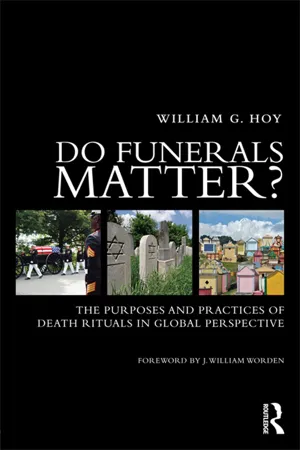
Do Funerals Matter? is a creative interweaving of historical, sociocultural, and research-based perspectives on death rituals, drawing from myriad sources to create a picture of what death rituals have been; and where, especially in the Western world, they are going. Death educators, researchers, counselors, clergy, funeral-service professionals, and others will appreciate the book's theory- and research-based approach to the ways in which different cultural groups memorialize their dead. They will also find clear clinical and practical applications in the author's exploration of the five ritual anchors of death-related ceremonial practice and help for professionals counseling the bereaved surrounding funerals. Based on nearly three decades of research and teaching on funeral rites, this volume promises to fill an important gap in the cross-cultural literature on bereavement, while answering an important question for our generation: Do funerals matter?
eBook - ePub
Do Funerals Matter?
The Purposes and Practices of Death Rituals in Global Perspective
- 210 pages
- English
- ePUB (mobile friendly)
- Available on iOS & Android
eBook - ePub
About this book
Information
1
Funerals—Where We Have Been and Where We Are Going
After multiple surgeries and treatment regimens spanning more than a year, Caylee died just one month after her third birthday. Though she had lived a short life, her funeral on a sunny winter morning drew more than 500 people, many of whom had never personally met the toddler.
In some ways, her funeral was typical of many contemporary American memorial gatherings. Funeral attendees both wept and laughed through the stirring 20-minute video montage her parents had created, a tribute that incorporated pictures, video clips, and music the toddler loved. During another part of the service, her own five-year-old sister led the way for children to gather in the front of the church for reading from one of Caylee’s favorite books. No heavy organ strains were heard; instead, contemporary Christian worship music reverberated from the strings of a single acoustic guitar and the voice of a solitary male soloist. At her grave, family and friends launched 100 helium-filled balloons.
The ritual honoring her life and marking her death comprised elements as old as time. The small pink casket was brought into the church not by funeral home staff, but by her own parents and sister. During much of the service, participants observed the arm of the little girl’s dad lovingly draped over the casket positioned to stand next to his own chair. Following the church service, she was buried on a cemetery hillside in the shadow of trees likely older than her grandparents.
The burial took much longer than the oft-observed experience of a 10-minute committal service followed by the “efficient” operation of casket “lowering device” and backhoe.
Instead, her parents lovingly bore her to the grave. The minister quietly quoted ancient words of faith, reminding family and friends, “Those who wait on the Lord will renew their strength; they will mount up with wings like eagles, they will run and not get weary; they will walk and not faint” (Isaiah 40:31). Then, with the assistance of funeral directors and cemetery attendants, parents and family lowered her small coffin into the grave and began shoveling in the earth that would cover the physical remnant of the precious child she was, a burial custom dating to the ancient world.
Observers patiently and emotionally watched while her five-year-old sister used her own small hands rather than the cemetery workers’ shovel to add handful after handful of soil to her sister’s grave. Some in attendance noted the sheer physicality of grief, causing the bereaved to literally “get their hands dirty.” The veteran funeral director, with more than three decades of experience, remarked that it was one of the most moving funerals in which he had ever participated.
The funeral was a distinctive experience created by her family with the assistance and guidance of bereavement professionals. The tribute drew together the spoken words, shared stories, and musical selections her parents wanted shared; the theme of the service testified to their values and their firmly unshakeable Christian faith. In retrospect, they reported a high level of satisfaction about how the service had helped them. While the experience of this family and community in the face of this death is a unique story, similar rituals are enacted by bereaved people hundreds of thousands of times every day.
Contemporary North Americans are not alone in according children carefully orchestrated rituals in the face of death. More than 6,000 years ago, the Cerny of today’s French Seine Valley buried their dead children with grave goods (such as arrowheads, pottery, and shell jewelry) in the same way that 21st-century parents do. The Cerny actually utilized ceramic, shell, and stone ornaments in greater concentration in children’s graves than in adult graves (Thomas, Chambon, & Murail, 2011). At the risk of Westernizing an ancient cultural group, the use of more fragile artifacts in the graves of children may imply some sense about the “fragility” of children.
Moreover, Meskell (2001) has written that in spite of the likelihood that ancient culture saw the death of children more often than North Americans do today, even a child’s death in New Kingdom Egypt (c. 1,500–1,100 BC) occasioned great care in the ritual: “the burials of children represent meaningful and careful burials, [suggesting] that they were already considered embodied beings, worthy of emotional and material outlay” (p. 28).
Much like the sage advice to “Face death so one can face life,” understanding death rituals is vital for understanding the intricacies of culture. Metcalf and Huntington (1991) have said:
The study of death rituals is a positive endeavor because, regardless of whether custom calls for festive or restrained behavior, the issue of death throws into relief the most important cultural values by which people live their lives and evaluate their experiences. Life becomes transparent against the background of death, and fundamental social and cultural issues are revealed (p. 25).
Ceremonies and the Experience of Death
The word ritual sometimes gets misinterpreted as dated and outmoded behaviors with little practical, contemporary significance. Romanoff and Terenzio (1998) refuted this understanding when they defined rituals as “cultural devices that facilitate the preservation of social order and provide ways to comprehend the complex and contradictory aspects of human existence within a given societal context” (p. 698). More than half a century ago, anthropologist Bronislaw Malinowski (1948) declared that death creates a paradox in which humans are both drawn to the dead in an attempt to stay connected and repulsed by the transformation that death brings to the body. Funeral rites, he suggested, are an attempt to reconcile those two contradictory purposes, desiring to keep the relationship alive and to break the bond immediately. Reflecting on this premise, Geertz (1973) suggested that “Mortuary rituals maintain the continuity of human life by preventing the survivors from yielding either to the impulse to flee panic-stricken from the scene or to the contrary impulse to follow the deceased into the grave” (p. 163).
The “little” everyday ritual-like behaviors of showering, dressing, and greeting other people, as well as the “big” life transition rituals marking birth, puberty (confirmation in some religious groups and high-school graduation in many North American communities), marriage, and death, all act as bridges between two life phases (Schechner, 2006, p. 66). Though dismissed by many as an “inefficient” way to move people from one place to another, the traditional funeral procession is a highly ritualized metaphor for this transitional bridge.
When former president Ronald Reagan died in 2004, a decade after being diagnosed with Alzheimer’s disease and years after last being seen in public, thousands of people lined the streets of Washington, DC, as the former president’s casket was driven from Andrews Air Force Base to lie in state in the Capitol Rotunda. On a hot, humid June day, tourists and locals, alike, surely had “better things to do.” And as the former president’s body arrived back in California for the burial at the end of that long funeral day, tens of thousands more lined roads and boulevards, participating in the funeral rituals for a leader some barely remembered. But the processions for Ronald Reagan were certainly not the first time this generation had participated in a leader’s funeral.
Nowhere is the bridging element of funerals more evident than in the funeral procession for President John F. Kennedy, made especially poignant by the suddenness of the loss and the short time intervening before the funeral. In keeping with the president’s Roman Catholic tradition, the funeral was held on the third day following death, but such a short period is not likely a long enough interval for the funeral to be most effective (Worden, 2009). The deliberate pace of a procession requires the funeral to be slowed down, an important respite from the common Western desire to “hurry and get it over.” This “slowing down” allows family, community—and even world—time for pausing and reflecting, rather than rushing through the process.
Just before 11 a.m. on that chilly November morning in Washington, DC, the president’s casket was carried from the Capitol Rotunda to the horse-drawn caisson waiting at the foot of the east steps. More than 1,800 soldiers, airmen, Marines, sailors, and coast guardsmen marched in the procession, their units representing the diversity of the American military with men and women, Black and White, officers and enlisted personnel all marching to the accompaniment of drums and somber hymns played by the Marine, Navy and Air Force bands (Leeke, 2008; Manchester, 1967).
The funeral cortège made its way from the Capitol to the White House and was led on to the grounds by a company of Marines. At the North Portico, the Kennedy family exited their limousines, were joined by dozens of foreign dignitaries, and then left the White House with the president for the last time to walk the eight blocks to St. Matthew’s Cathedral. When the funeral mass concluded, the cortège processed the “last mile of the way” to Arlington National Cemetery. As the cortège moved westward across the Arlington Memorial Bridge over the Potomac River into Virginia, the bridging imagery was unmistakeable as the president left Washington for the final time.
Turner (1969), Kollar (1989), and Romanoff and Terenzio (1998) have noted that rituals provide a sense of order and stability in the midst of chaos. Whether in a family, friendship circle, nation, or planet, every death introduces some sense of social upheaval; the deliberate cadence of ritual helps to restore balance, reminding all concerned that order will prevail. As with the death of virtually every public figure, the funeral of John F. Kennedy drew throngs to Washington simply to be part of the ceremony. The crowd, estimated at more than 1 million, lined the processional route, forming what The Washington Post referred to as a “five-mile lane of sorrow” (Leeke, 2008).
In the light of public expressions of grief at the death of John F. Kennedy, as well as more recent examples of public mourning such as the deaths of Diana, Princess of Wales, former president Ronald Reagan and pop music icon Michael Jackson, the definition of ritual rendered by Denzin (1974) makes sense:
a conventionalized joint activity given to ceremony, involving two or more persons, endowed with special emotion and often sacred meaning, focused around a clearly defined set of social objects, and when performed confers upon its participants a special sense of the sacred and the out-of-the-ordinary (p. 272).
Diversity in death-related rituals is widely assumed among scholars of sociocultural customs (Bradshaw & Melloh, 2007; Irish, Lundquist, & Nelsen, 1993; Metcalf & Huntington, 1991) as well as clinicians attempting to make practical sense of customs (Lobar, Youngblut, & Brooten, 2006). The particular actions undertaken in the face of death, the colors worn by mourners, the words that are offered by and to the primary mourners, the presence or absence of tears, the use of flowers, and the specific ways in which meaning is made by individuals and groups in the context of death all portend complete uniqueness from one social group to another.
Yet for all of the cultural diversity in the face of death, one finds an unexpected stream of commonality, attested to by Malinowski (1948): “The mortuary proceedings show a striking similarity throughout the world” (p. 30). Early 20th-century anthropologists Arnold van Gennep (1960/1909) and Robert Hertz (1960/1909) noted many similarities in the rites they observed among diverse cultural groups. According to van Gennep (1960/1909), for example, “Everyone knows that funeral rites vary widely among different people and that further variations depend on the sex, age, and social position of the deceased. However, within the extraordinary multiplicity of detail certain dominant features may be discerned…” (p. 146).
Hertz (1960/1909) suggested great unity across cultures when he wrote: “The body of the deceased is not regarded like the carcass of some animal: specific care must be given to it and a correct burial; not merely for reasons of hygiene but out of moral obligation” (p. 27). Lest one dismiss his claim as an outdated century-old observation, consider the outcry of family members and the general public upon disclosure that the U.S. military had possibly mishandled the remains of fallen soldiers (Whitlock & Jaffe, 2011) and that portions of remains of those killed in the 9/11 terrorist attacks might have been inadvertently dumped in a landfill (Bumiller, 2012).
Humans have an undeniable need to make sense of death; funeral rituals are created by social groups as potential scripts to achieve this end. While there are literally hundreds of distinct ethno-linguistic people groups, no society has yet been found that completely ignores the death of one of its own. In the words of Laqueur (2011), “as far back as people have thought about the subject, care of the dead is regarded as [the] foundation—of religion, of community, of civilization itself” (p. 801).
Scholars and clinicians have suggested that Euro-Americans tend to avoid contact with death, causing some to refer to North America as a death-denying culture and leading Giblin and Hug (2006) to conclude that funerals are “counter-cultural events,” because of the taboo nature of death and the rush for people to “get over grief quickly.” They continued, “funerals provide a structure and sense of safety that makes death real and facilitates the grieving process. Funerals create a space for death in a society that makes little or no time for death and dying” (p. 16).
Death is universally inevitable, in spite of energetic human attempts to prevent it through good nutrition, adequate exercise, and the forgoing of destructive habits, as well as the deeply held cultural belief that “medicine cures all” (Callahan, 1993; Lundgren & Houseman, 2010). Even the 2011 funeral service for Jack LaLanne, the “godfather of fitness,” mixed tears and laughter, featuring tributes from the “Who’s Who” of the bodybuilding and fitness world. At the front of Forest Lawn’s Hall of Liberty where the service was held, a 1950s-era photograph of LaLanne stood just behind an assortment of red, white, and purple flowers, arranged in the shape of a giant barbell.
LaLanne protégé and former California governor Arnold Schwarzenegger reminded the 500 mourners, “Right now he’s telling St. Peter, ‘Get up at 6am, get a juicer, take some vitamins, do some stretching…’” (Higgins, 2011). Just as death is a universal event, the desire of groups to make sense of death through ceremonies seems also to hold a universal appeal.
The Significance of Culture
In his provocative book on using the stories of others to help grieving people, Smith (2012) suggested that “the world is in my Zip Code” (p. 76). He went on to write:
Immigrants bring funeral and grief rituals and traditions with them. In fact, the narratives of many immigrants are punctuated with grief: grief for their nation or the nation they once knew, grief for family members and friends left behind, grief for family members who died in civil wars or who died in violation of human rights.… Given the expanding cultural diversity in American suburban settings because of affordable housing, and increasingly in rural communities, diverse grief practices must be understood and enfranchised (pp. 76–77).
Rosenblatt, Walsh, & Jackson (1976) were among the first scholars to compare the bereavement norms of many different cultures in any systematic way. They studied ethnographies from 78 cultural groups representing a broad diversity of the world’s cultures, looking for ways in which these groups were alike and ways in which they were different. In their work, they articulated one of the most important benefits of such cross-cultural study of deathways; namely, the discovery of greater understanding and what today we would call “cultural competency.” Without a doubt, the present volume rests on the shoulders of these pioneers in the study of cross-cultural bereavement, and their work remains a “must read” classic.
Smith (2012) said that clinicians become culturally wise by acknowledging lack of familiarity with a particular background and then by reading and reflecting on the narratives that come from ethnic groups via “testimonio, first-person accounts from the marginalized” (pp. 77–78). Cultural constructs have a profound influence on funeral rituals, so attention must be given to understanding how culture works.
For those outside the fields of social science scholarship, terms such as culture, ethnicity, tribe, race, and nationality often are used as synonyms. Leading cultural anthropologist Clifford Geertz wrote (1973) that the analysis of culture was “not an experimental science in search of law but an interpretive one in search of meaning” (p. 5). The confusion and overlap are understandable when one examines the core attributes of dictionary definitions (http://www.merriam-webster.com/dictionary): Culture can be defined as “the customary beliefs, social forms, and material traits of a racial, religious, or social group,” while ethnicity generally refers to “large groups of people classed according to common racial, national, tribal, religious, linguistic, or cultural origin or background.” Strictly speaking, race is defined by specific physical traits, but racial definitions and distinctions are often defined “by shared interests, habits or characteristics.” A tribe is generally defined as “a social group comprising numerous families, clans, or generations together with slaves, dependents, or adopted strangers … a group of persons having a common character, occupation, or interest.” But nationality, ...
Table of contents
- Cover
- Halftitle
- Title
- Copyright
- Contents
- List of Figures
- Foreword
- Acknowledgments
- Introduction
- 1 Funerals—Where We Have Been and Where We Are Going
- 2 More Treasured than Words: The Anchor of Significant Symbols
- 3 Getting Everybody Together: The Anchor of Gathered Community
- 4 Walk Out What You Can’t Talk Out: The Anchor of Ritual Action
- 5 Looking Back to Look Forward: The Anchor of Cultural Heritage
- 6 Taking the Dead to the Party: The Anchor of the Body’s Presence
- 7 North American Quests to Personalize Funeral Rituals
- 8 The Business of Funerals
- 9 Clinical Perspectives on the Value of Funerals
- 10 Farther Down the Road: Using Ritual in Grief Counseling
- Epilogue
- Glossary
- References
- Index
Trusted by 375,005 students
Access to over 1.5 million titles for a fair monthly price.
Study more efficiently using our study tools.
Frequently asked questions
Yes, you can cancel anytime from the Subscription tab in your account settings on the Perlego website. Your subscription will stay active until the end of your current billing period. Learn how to cancel your subscription
No, books cannot be downloaded as external files, such as PDFs, for use outside of Perlego. However, you can download books within the Perlego app for offline reading on mobile or tablet. Learn how to download books offline
Perlego offers two plans: Essential and Complete
- Essential is ideal for learners and professionals who enjoy exploring a wide range of subjects. Access the Essential Library with 800,000+ trusted titles and best-sellers across business, personal growth, and the humanities. Includes unlimited reading time and Standard Read Aloud voice.
- Complete: Perfect for advanced learners and researchers needing full, unrestricted access. Unlock 1.5M+ books across hundreds of subjects, including academic and specialized titles. The Complete Plan also includes advanced features like Premium Read Aloud and Research Assistant.
We are an online textbook subscription service, where you can get access to an entire online library for less than the price of a single book per month. With over 1.5 million books across 990+ topics, we’ve got you covered! Learn about our mission
Look out for the read-aloud symbol on your next book to see if you can listen to it. The read-aloud tool reads text aloud for you, highlighting the text as it is being read. You can pause it, speed it up and slow it down. Learn more about Read Aloud
Yes! You can use the Perlego app on both iOS and Android devices to read anytime, anywhere — even offline. Perfect for commutes or when you’re on the go.
Please note we cannot support devices running on iOS 13 and Android 7 or earlier. Learn more about using the app
Please note we cannot support devices running on iOS 13 and Android 7 or earlier. Learn more about using the app
Yes, you can access Do Funerals Matter? by William G. Hoy in PDF and/or ePUB format, as well as other popular books in Sozialwissenschaften & Psychische Gesundheit in der Psychologie. We have over 1.5 million books available in our catalogue for you to explore.