In The Ethical Primate, Mary Midgley, 'one of the sharpest critical pens in the West' according to the Times Literary Supplement, addresses the fundamental question of human freedom.
Scientists and philosophers have found it difficult to understand how each human-being can be a living part of the natural world and still be free. Midgley explores their responses to this seeming paradox and argues that our evolutionary origin explains both why and how human freedom and morality have come about.
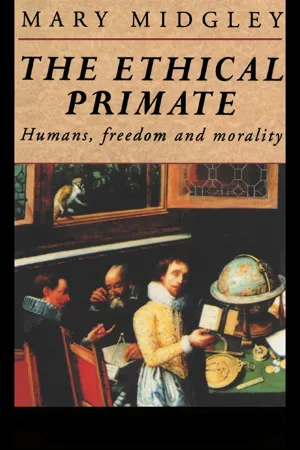
- 208 pages
- English
- ePUB (mobile friendly)
- Available on iOS & Android
eBook - ePub
About this book
Information
Part I
THE PROBLEM
1
INNER DIVISIONS
MAKING SENSE OF US
HUMAN MORALITY is not a brute anomaly in the world. Our moral freedom is not something biologically bizarre. No denial of the reality of ethics, nothing offensive to its dignity, follows from accepting our evolutionary origin. To the contrary, human moral capacities are just what could be expected to evolve when a highly social creature becomes intelligent enough to become aware of profound conflicts among its motives.
In a way, this may seem obvious. After all, our actual characteristics have got to make evolutionary sense, and though there are still wide disputes about the details of evolutionary theory, all serious scientists agree on the central fact of our descent from other social animals. Yet clearly many people today are still most uneasy about it. The vast tide of print that has flowed for more than a century round the shores marked ‘Darwinism’ has never really succeeded in making this particular sandbank navigable.
For instance, my title may well disturb some readers. Is it perhaps unduly reductive to call Homo sapiens an ethical primate? It may seem so, in the same sort of way in which the title of Desmond Morris’s book The Naked Ape did twenty-five years ago. Critics complained then, with some reason, that nakedness was not a specially significant distinguishing property of our species, and also that humans were not literally apes. What I am saying now, however, is literal fact. Most of us agree that we literally are primates who possess ethics, and also that the capacity for ethics is an extremely significant property of our species.
Neither of these propositions seems really implausible, yet – as I am suggesting – current ways of thinking still make it hard to bring them together. This book is one more instalment in an attempt to make that process a little easier. That is needed, not just so that we can accept our history but also (what matters more) so as to help us towards a more integrated notion of ourselves. In trying to map the neglected connection between the two brightly-lit patches that we normally look at on our vast, confusing, half-lit intellectual landscape – the scientific world-view and the world as we see it every day – I am also trying to bridge a similar gap that splits our idea of our own nature.
I began that reconciliatory attempt in my first book Beast and Man 1 and I have continued it in Heart and Mind2 and in Wickedness3 – indeed to some extent in all my books. This present book concentrates on problems about the nature of inner freedom and its relation to personal identity. These – along with the moral issues discussed in Wickedness – seem to me the most central business left over from Beast and Man. Here, as elsewhere, I look primarily at the howling mistakes in which we are now involved, and try to suggest ways of curing them. Attention to the imaginative aspect of those mistakes – to the symbolism by which they pervade our lives – seems needed as well as attacks on the official arguments involved. I want to examine the way in which over-simple ideas about the relation between the inner and the outer standpoint, between subjective and objective, make it seem that we cannot have certain crucial kinds of freedom. I want to see how we can avoid these misleading kinds of reduction without becoming unintelligible.
In this project, it has seemed necessary to revisit some points discussed in Beast and Man. I have found that these ideas still evidently startle many people, and may yet need some time to become familiar. But I hope that readers who are at ease with them can easily skip these passages. Apart from that, some of the things I am saying are certainly obvious. But then, retrieving obvious things that have got lost can be important philosophical business, and I think it is so here. This whole area is so difficult and so easily generates paradox that even very obvious truths often get forgotten in it.
DIVERGENT VISIONS
Darwin himself worried deeply about the evolutionary meaning of morality, and many other people have shared his concern. They have tried hard to find some intelligible relation between human moral consciousness and the patterns underlying the long development of life. But the people doing this quickly divided themselves into two extreme camps – one reductive and the other obscurantist. That split, which persists strongly to this day, is not just a debate between theorists. It works at an everyday level and obscures matters vitally important to our lives. This book will try to attend to this feud in some detail, to light up the ways in which it misleads us, and to suggest how we can deal with them.
As with many such feuds, the two sides are kept apart not just by their views, but more deeply by a determined contrast of style and tone. The reductive party – in its early stages embodied in Social Darwinism – likes to shock. It is positively pleased to sound harsh, strident and paradoxical, since it views these qualities as marks of realism. Its basic project is to unite humans to the rest of the biosphere by following Procrustes, by paring all human peculiarities down to a size which fits easily into the supposedly universal evolutionary pattern.
Even before Darwin, that pattern was seen as one of cut-throat competition for survival, a model set by an older reductive approach in political philosophy. Nineteenth-century Social Darwinists were following Hobbes’s lead in preaching that human conduct was wholly directed by self-interest. But this kind of crude psychological egoism has never been wholly convincing, in spite of its political uses. Accordingly, in the last few decades the sociobiologists have moved the thesis away from empirical falsification to the safer, more metaphorical doctrine of gene-selfishness. They have not, however, softened its crude, cocky, omniscient, debunking tone at all. Thus E.O. Wilson:
Human behaviour – like the deepest capacities for emotional response which drive and guide it – is the circuitous technique by which human genetic material has been and will be kept intact. Morality has no other demonstrable ultimate function.4
The organism is only DNA’s way of making more DNA.5
Similarly Richard Dawkins:
We are survival machines – robot vehicles blindly programmed to preserve the selfish molecules known as genes. This is a truth which still fills me with astonishment.
We, and all other animals, are machines created by our genes . . . Like successful Chicago gangsters, our genes have survived, in some cases for millions of years, in a highly competitive world. I shall argue that a predominant quality to be expected in a successful gene is ruthless selfishness . . . We are born selfish. 6
The opposing party – the party that stresses mystery and discontinuity with other species – has been formed in direct response to this attack, and it has therefore tended to speak in the style that always answers such challenges. Its tone is grieved, parental, mature, concerned, in fact genuinely outraged. It has replied that human morality is so totally unlike the travesty of it offered by the reducers as to be evidently disconnected from everything else in evolution. Morality can therefore never be brought into any kind of intelligible relation with its earthly surroundings. It is a distinct, unassimilable pattern at odds with all else on this planet, and perhaps with everything in the universe.
THE WRONG DRAMA
This dispute is often seen as a simple tribal clash between scientists and Christians. But that pattern is doubly mistaken. On one side, Social Darwinism and its descendants have had very little connection with physical science. They were born in economics and nurtured by political theory. They have always owed much of their force to thoughts about commercial freedom – a connection which is still strongly marked, now that they have fed back into biology, by the sociobiological language of ‘investment’.
On the other side, the resistance to seeing morality as merely a weapon in an egoistic contest for survival is quite independent of religion. Religious people have certainly raised these objections, but they have not been alone in doing it, nor have they needed special religious grounds for their protest. Strongly pro-Darwinian and anti-religious sages have stressed exactly the same point. In fact, its most vigorous early spokesman was ‘Darwin’s bull-dog’, T.H. Huxley. Huxley reacted explosively against Herbert Spencer’s complacent evolutionary ethic, which taught not only that evolution was for the best, but that it was the sole guide to morals, since what was right was simply whatever furthered evolution through ‘the survival of the fittest’, giving this as a reason for not helping the unfit poor. 7 Much though Huxley hated Christianity, he hated this reduction of morality to evolutionary processes far more. So he declared uncompromisingly that:
Ethical nature, while born of cosmic nature, is necessarily at enmity with its parent . . . The ethical process is in opposition to the principle of the cosmic process, and tends to the suppression of the qualities best fitted for success in that struggle . . . [Man must therefore be] perpetually on guard against the cosmic forces, whose ends are not his ends . . . Laws and moral precepts are directed to the end of curbing the cosmic process.8 (Emphasis mine).
Darwin’s collaborator Alfred Wallace objected quite as strongly, and, not being anti-religious, he proposed a supernatural solution for this emergency, saying that God had created human mental powers separately in the course of an otherwise natural evolution. But Huxley’s original difficulty arises quite independently of any such efforts to resolve it. Important though the religious angle may be for other reasons, it is not the source of the trouble here. That source lies deeper. There is a real, insuperable difficulty in making the actual facts of human life fit into crudely reductive pictures such as the Social Darwinist one.
SECULAR SEPARATISM AND THE MINIMAL SELF
Throughout this book I shall concentrate on the problems that arise within a secular approach rather than on those raised within the religions. This is not because questions involving religion are unimportant, but because, once they are raised, people tend to hare off after them as if merely getting rid of religion would solve all our problems. It will not. Secular thinkers as well as religious ones need to find an alternative to unrealistic reductive views of personal identity. They have often felt that they could only meet this difficulty by separating the essential self altogether from the biological body. That body is, after all, certainly a part of the cosmic process which alarmed Huxley so much. The formula for a drastic separation had already been shaped by Descartes, who cleared the conscious mind out of the physical sciences by ruling that it was a non-physical substance, a mere passenger in the body.
This drastic division has indeed often been thought of as part of Christian thought, though it actually conflicts with much of the Christian tradition, notably with the doctrine of the resurrection of the body. That doctrine means that soul and body, at a deep level, are one. As Arthur Peacocke puts it, both in the Old and the New Testament ‘a human being is regarded as a psycho-somatic unity, a personality whose outward expression is his body and whose centre is his “heart”, “mind” and “spirit”’. 9 What is envisaged at the resurrection is not, then, that corpses revive, but that the soul develops other faculties to replace the body. Though this idea about mind–body relations may be puzzling as regards the next life, for the present life it seems to be a good deal more intelligible than the kind of neo-Cartesian separatism that has prevailed in recent secular thinking.
We will look at this separatism more closely later, but a few examples may be useful now. One case of it is Jean-Paul Sartre’s Existentialist morality. That morality treats the human will as a spontaneous, independent force, completely detached from all natural motives and capable of opposing them all. (This idea of its independence seems also to have been implied, though in more muted terms, in the accounts given by some emotivist and prescriptivist philosophers). A second case is the prolonged refusal of many social scientists to admit that genetic factors can have any influence at all on people’s mental lives, especially in such crucial matters as sex roles. About sex differences, the orthodox doctrine for several decades was that, as Dr John Money put it in 1955,
Sexuality is undifferentiated at birth and . . . it becomes dif ferentiated as masculine or feminine in the various experiences of growing up.10
Only very gradually is this dogmatic insistence now changing. It has of course had the honourable political motive of supporting women’s equality. But equality is not sameness. A belief in sameness here is both irrelevant to the struggle for equal rights and inconsistent with the facts. It ignores massive evidence of sex differences in brain and nerve structure occurring long before birth, and also of behavioural differences which are evidently independent of culture and sometimes contrar y to it. It amounts to an extraordinarily abstract notion – evidently held on moral grounds – of the original human being as something neutral, sexless and indeterminate, something wholly detached from the brain and nervous system.11
Nicholas Dent, discussing most helpfully this strange contraction of the self and its supposed connection with the idea of freedom, cites an advertisement for the ‘fifth and final volume’ in the ‘award-winning series A History of Private Life’ in which (it is promised) ‘nine noted historians chart the remarkable inner history of our times . . . when personal identity was released from its moorings in gender, family, social class, religion, politics and nationality.’12 Dent comments,
One cannot represent all specific circumstances which impinge on an individual, all attributes ascribed to an individual . . . as limitations on, constraints upon, the self. For what then remains, to comprise the concrete actuality of the self’s existence, is nothing, or almost nothing, a will without grounds, a power of choice without objectives.13
Hegel (he remarks) called this ‘the freedom of the void’, and it is surely not what anybody really aims at. But the idea of it is easily reached as we go on counting up the various external influences that we might sometimes want to disown. As Dent says,
One is apt, particularly under the pressure of more and more discoveries about formative influences, inherited and circumstantial, on intelligence, personality, temperament etc., to represent more and more as external to the constitution of oneself, as mere barnacles that encrust the surface of the soul.14
This process goes on today on an industrial scale, but curiously little attention is paid to the shrinking image of personal identity that it produces.
VIRTUAL PEOPLE
A third, still more striking example of separatism is the position that comes so naturally to many champions of artificial intelligence – the belief that not only will computers (or their programmes) one day be made conscious in exactly the sense in which human beings are conscious, but that human beings are already, in some fairly literal sense, themselves programmes run on computers made of meat. Many people today find this kind of proposition so obvious that they do not even bother to argue for it, but confidently put the burden of proof on anyone who suggests otherwis...
Table of contents
- COVER PAGE
- TITLE PAGE
- COPYRIGHT PAGE
- ACKNOWLEDGEMENTS
- PART I: THE PROBLEM
- PART II: THE REDUCTIVE ENTERPRISE
- PART III: THE SOURCES AND MEANING OF MORALS
- PART IV: WHAT KIND OF FREEDOM?
- NOTES
Trusted by 375,005 students
Access to over 1.5 million titles for a fair monthly price.
Study more efficiently using our study tools.
Frequently asked questions
Yes, you can cancel anytime from the Subscription tab in your account settings on the Perlego website. Your subscription will stay active until the end of your current billing period. Learn how to cancel your subscription
No, books cannot be downloaded as external files, such as PDFs, for use outside of Perlego. However, you can download books within the Perlego app for offline reading on mobile or tablet. Learn how to download books offline
Perlego offers two plans: Essential and Complete
- Essential is ideal for learners and professionals who enjoy exploring a wide range of subjects. Access the Essential Library with 800,000+ trusted titles and best-sellers across business, personal growth, and the humanities. Includes unlimited reading time and Standard Read Aloud voice.
- Complete: Perfect for advanced learners and researchers needing full, unrestricted access. Unlock 1.5M+ books across hundreds of subjects, including academic and specialized titles. The Complete Plan also includes advanced features like Premium Read Aloud and Research Assistant.
We are an online textbook subscription service, where you can get access to an entire online library for less than the price of a single book per month. With over 1.5 million books across 990+ topics, we’ve got you covered! Learn about our mission
Look out for the read-aloud symbol on your next book to see if you can listen to it. The read-aloud tool reads text aloud for you, highlighting the text as it is being read. You can pause it, speed it up and slow it down. Learn more about Read Aloud
Yes! You can use the Perlego app on both iOS and Android devices to read anytime, anywhere — even offline. Perfect for commutes or when you’re on the go.
Please note we cannot support devices running on iOS 13 and Android 7 or earlier. Learn more about using the app
Please note we cannot support devices running on iOS 13 and Android 7 or earlier. Learn more about using the app
Yes, you can access The Ethical Primate by Mary Midgley in PDF and/or ePUB format, as well as other popular books in Philosophy & Ethics & Moral Philosophy. We have over 1.5 million books available in our catalogue for you to explore.