eBook - ePub
Technology, Outsourcing & Transforming HR
- 480 pages
- English
- ePUB (mobile friendly)
- Available on iOS & Android
eBook - ePub
Technology, Outsourcing & Transforming HR
About this book
This book examines the progress made in e-enabling the HR function and the relationship with outsourcing. The editors will review and analyse recent developments in the application of outsourcing and ICT to the HR function and its overall contribution to organizational aims.
This text aims to fill the gap in current literature, by providing accessible guidance on how to tackle the e-enablement of the function and on the factors associated with successful outsourcing. There is no single text that adequately deals with this increasingly important problem and which has been recognised by the CIPD as a key area of research for their forward programme. The contributors all have leading-edge knowledge and practical experience and aim to provide practical guidance for organizations and HR professionals.
Chapter 1
Technology, Outsourcing, and HR Transformation: An Introduction
Introduction
The contemporary human resource (HR) function in for-profit and not-for-profit organizations faces a number of competing challenges, so creating ambiguities and tensions in what it delivers, how it delivers, how effectively it delivers, and to whom it delivers (Ulrich and Brockbank, 2005; Huselid et al., 2005; Paauwe, 2004). The drivers of HR have traditionally been described in three-fold terms (Lepak and Snell, 1998):
- Making itself more cost effective by reducing transaction costs, headcount, and/or improving its efficiency of its services (the operational driver);
- Improving its transactional (e.g. payroll) and traditional services (e.g. advice on selection, legal matters, etc.) to increasingly demanding line managers, employees, business partners, and contractors (the relational driver);
- Addressing the strategic objectives of the business or organization.
However, for HR functions in developed economies, we can now add a fourth driver relevant to the technology and HR transformation debate. This is best summed up by John Kay (2004), a well-known British economist, who cogently argued it is not only knowledge for innovation but also brands and reputations that are the major sustainable bases on which modern organizations and modern nation states can compete with those in the developing world. This reputational driver means that the HR function is also faced with:
- Meeting the longer-term demands placed on corporations in society at large for being different from the ‘normal’ in terms of reputations with key stakeholders (external and internal brands) while remaining legitimate (Boxall and Purcell, 2007; Martin and Hetrick, 2006). In this context, legitimacy is fast extending to reputations for ethical and sustainable practice, good governance and leadership, and for being a good employer in the eyes of regulatory institutions, the increasingly influential business press, existing and potential customers, clients and employees.
The tensions underlying these challenges reflect two distinctive and often divergent sets of pressures on organizations. The first set is the external versus internal pulls that exercise the minds of managers, often embedded in the distinction between operational and strategic management. The second set relate to the goals of strategic or operational activity inside an organization – whether these are principally aimed at satisfying unitary objectives, associated with the concept of shareholder value, or whether these are more plural in nature (Whittington, 2000), and associated with the notion of stakeholder management and with modern forms of networked organizations (Figure 1.1).
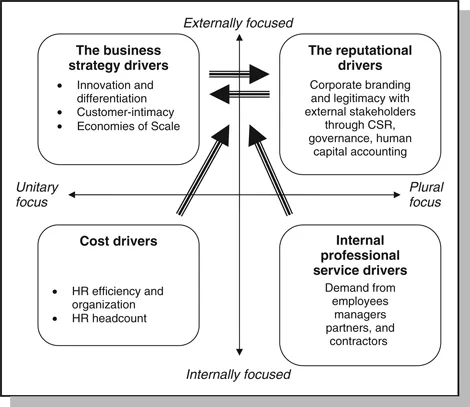
Figure 1.1
Competing claims on HR and their relationships.
Note: Corporate Social Responsibility.
These dimensions, related orthogonally, produce a matrix which helps us understand how contemporary human resource management (HRM) teams in a number of organizations have developed a set of interrelated, internal delivery and professional service strategies to meet the external challenges set by the business strategies of modern organizations and the longer-term branding and reputational drivers (Reilly and Tamkin, 2006). The first of these internal strategies is the re-organization of the HR function itself, combining so-called HR transformations (new HR delivery models based on a tripartite model of shared services, centers of excellence, and strategic or business partnering) along the lines recommended by Ulrich and Brockbank (2005) with outsourcing and, in some cases, off-shoring of key services, especially shared service centres (CIPD, 2005; Cooke, 2006; Reddington et al., 2005). The second, like other business functions, is the turn to information and communications technologies (ICT), often introduced in combination with HR transformations and outsourcing to rationalize or radically change HR’s internal operations (Gueutal and Stone, 2005; Martin, 2005; Shrivastava and Shaw, 2004).
It should be noted at the outset that these organizational, process re-engineering and technological solutions are interdependent (Keebler, 2001). Without progressively sophisticated ICT, outsourcing and HR transformations would not be as effective: indeed it is the increased reach and richness of ICT-enabled information and organizational learning that have facilitated simultaneous centralization and delegation of decision making in HR, the single most important claimed distinctive capability of new HR transformation models (Ulrich and Brockbank, 2005). And, according to some academics and leading practitioners, one of the logical consequences of these developments is the potential ‘virtualization’ or, at least, significant ‘leaning’ of HR (Keebler, 2001; Reilly and Tamkin, 2006; Snell et al., 2001). This virtualization results from simultaneously reducing the numbers of specialists required to deliver HR services internally while improving the quality of these same services and developing new HR business models for innovative organizations (Taylor and LaBarre, 2006; see also Chapter 15: Using Technology to Transform HR at Surrey County Council for some case data).
The claims for new organizational solutions to HR and for the increased application of ‘e’ to HR seem to be much more acceptable as a novel, compelling, and credible message in the marketplace for management knowledge. In line with the predictions of the institutional theory and the ‘bandwagon effect’, which sheds light on the tendency of organizations to become similar in structure, often through mimicry of ‘best practices’ (Abrahamson, 1991; Lavie, 2006), there is strong peer pressure on organizations, including many in the public sector, to replace their integrated HR functions with the tripartite ‘Ulrich’ framework of shared services, centers of excellence, and business partnering. For example, a report by Mercer Consulting claimed that in response to a survey of client organizations ‘nearly 80% of companies have completed or are in the process of undergoing HR transformation’ (Theaker and Vernon, 2006). At the same time, in line with the predictions of agency theory, supply chain management thinking has been applied to HR, especially in the USA, in the form of increased contracting out of non-core and low-value added HR services such as payroll and partnering with other providers to provide other non-core but higher value-added services such as legal advice, recruitment, and training (Keebler, 2001). By 2004, academics were pointing out that outsourcing of HR services was on the minds of most global companies (Brewster et al., 2004), in part driven by the question asked by financial analysts not on whether companies have an outsourcing strategy but what it is.
Thus, the e-HR bandwagon seems to be growing at a rapid rate driven by some evidence of promising practices and positive evaluations of technology and outsourcing projects. As a result, both of the largest HR professional bodies in the world – the Chartered Institute of Personnel and Development (CIPD) and the US-based Society of Human Resource Management (SHRM) – have made this issue one of their key areas for research and for educating members. Furthermore, HR and information systems academics have also begun to see the application of ICT to HR as a key area of interest and the subject of specialist conferences in Europe and tracks in the Academy of Management Annual Conferences.
However, this bandwagon is also fuelled by some ‘dangerous half truths’ or ‘total nonsense’ (Pfeffer and Sutton, 2006), resulting in irrational forms of imitation fuelled by the persuasive powers of the growing number of consulting firms selling e-HR as part of a package of enterprise resource planning (ERP) solutions (Lengnick-Hall and Lengnick-Hall, 2006; Walker, 2001). Notwithstanding the rhetoric and groundswell of opinion among the HR community in support of e-HR, re-engineering the HR function and outsourcing, progress in the form of the more transformational benefits and pay-off in terms of cost reductions seems to have been more piecemeal and problematic (Caldwell, 2004; Reilly and Williams, 2006). Again to quote the Mercer Consulting report:
‘Over half the survey respondents report that they are ineffective or very ineffective at realising the expected ROI [return on investment] from technology investments. HR people openly acknowledge that they frequently under-use technology and therefore do not gain full benefit’ (Theaker and Vernon, 2006).
On HR transformations, Reilly and Tamkin (2006), in a report for the CIPD, claimed there was not much evidence of the adoption of Ulrich model (see also Chapter 16: Strategic Amplification of HR: New Forms of Organization or Social Disintegration?), at least in the UK where it had a lot of ‘air time’. Finally, recent evidence suggests that the outsourcing bandwagon may have slowed down due to firms being unable to realize the claimed cost advantages or because of complications arising from contractual and governance arrangements (Hesketh, 2006; CIPD, 2007). Indeed, recent international survey evidence suggests that the global trends in outsourcing may have always been overstated (by consultants seeking to fuel demand for their own services?) (Brewster et al., 2007).
Such evidence raises important questions about e-HR, and the associated developments in HR transformations and outsourcing, which we attempt to address in this book. These are:
- To what extent have the claims made by advocates of new forms of professional service delivery for improved cost effectiveness and reductions in HR headcount been realized without reducing service delivery, and what are the key impediments to realizing these cost benefits?
- To what extent have the claims made for improved professional service delivery to managers and employees been realized and are there significant negative effects in moving from a face-to-face to a virtual and/or more distant relationship in HR and people management that have not been apparent to systems specifiers and developers? For example, how do significant injections of technology mediation influence the jobs of HR specialists, many of whom had entered the profession because they wanted to ‘deal with people’, and what new skills will they require? How are the jobs of line managers affected when they are progressively required to deal with their own HR problems as a consequence of the introduction of self-service e-HR systems and physical separation from HR specialists with whom they used to have face-to-face contact? And, how will employees, again used to face-to-face relationships with HR staff, cope with technology mediation and the extra ‘distance’ imposed on them by the setting up of in-house or outsourced call or service centers?
- To what extent have these forms of professional service delivery helped realize transformations in HR and new ways of people management, including freeing up HR staff to work on more strategic-level issues, such as the design and development of more sophisticated e-HRM systems and improved utilization. What is the potential for such developments in the near future, and how are they likely to change the nature of HR work, managerial work, and employee relationships?
- Why is it that some organizations’ HR departments are more effective at continuous innovation in the field of professional service delivery than others? Are those HR department and organizations that are best suited to innovation in e-HR also least suited to exploiting such learning?
- To what extent are there innovative new HR business models beyond the inevitable mimicry of the Ulrich model, brought about by so-called best practice diffusion, and to what extent are we witnessing real innovations in HR practices?
To help provide some preliminary answers to these questions and to do some further scene-setting, we have developed a framework to show how internal HR delivery and professional service strategies, particularly e-HR, fit into overall HR strategies. This framework also helps show how the following chapters in this book relate to one another; in so doing it provides a rationale for the text. Thus we draw on some of our previous attempts to map out the territory of e-HR and HR service delivery that some academics and practitioners have been kind enough to suggest were useful in thinking about the subject (Martin et al., 2006; Reddington and Martin, 2006).
Introducing e-HR and Associated Forms of Service Delivery
e-HR, Service Delivery, and Strategic HRM: A Definition
As we have already claimed, e-HR is one of the most important recent developments in HRM (Gueutal and Stone, 2005; Lengnick-Hall and Lengnick Hall, 2003; Reilly and Tamkin, 2006; Snell et al., 2001). Yet, despite the growing body of literature devoted to e-HR, there is a dearth of useful frameworks to help our intended audience (HR practitioners, academics, consultants, and vendors) think about what might lead to successful implementation, or, indeed, what successful implementation might even look like. Given the potential for virtualization, a useful starting point is to see e-HR as a key element of e-business in the form of the ‘virtual value chain’, this time with a focus on the inside rather than outside of the firm (Rayport and Sviokla, 1995). By creating added value for managers and employees through more effective information flows in its ‘marketspace’, HR can claim to create competitive advantage and align the function more closely with business/corporate strategy and the longer-term branding and reputational aims of organizations.
The arguments for these claims are four-fold. First, e-HR can reduce HR transaction costs and headcount, for example, by supplying the same HR information to large numbers of people on a virtual rather than physical basis. Second, e-HR can substitute physical capability by leveraging the ‘law of digital assets’ to re-use information flexibly on an infinite number of occasions at little or no marginal cost. For example, this is most notable in the real time delivery of e-training and e-learning to large numbers of people across the globe. Third, e-HR can facilitate more effective virtual ‘customer relationships’ and internal labor markets by increasing the reach and richness of two-way information. Illustrations of such improved information flows are already evident in certain applications, including enabling internal/external recruitment and search by ‘deep-web mining’, online-career development and performance management, employee engagement surveys to tailor specific ‘employee value propositions’ to small groups of employees, more flexible working to attract people from nontraditional recruitment pools, and outsourcing of key HR services. Fourth, it can transform the traditional HR ‘business model’ by e-enabling HR to provide strategic value to organizations which it previously could not do, for example, by using the facilities of Web 2.0, including online learning to ‘feed-forward’ into o...
Table of contents
- Cover Page
- Half Title Page
- Title Page
- Copyright Page
- Dedication
- Contents
- List of Contributors
- Preface
- Acknowledgements
- 1 Technology, Outsourcing, and HR Transformation: An Introduction
- Outsourcing and Shared Services
- The Theory and Practice of e-HR in Different Countries
- Practitioners Forum
- Index
Trusted by 375,005 students
Access to over 1.5 million titles for a fair monthly price.
Study more efficiently using our study tools.
Frequently asked questions
Yes, you can cancel anytime from the Subscription tab in your account settings on the Perlego website. Your subscription will stay active until the end of your current billing period. Learn how to cancel your subscription
No, books cannot be downloaded as external files, such as PDFs, for use outside of Perlego. However, you can download books within the Perlego app for offline reading on mobile or tablet. Learn how to download books offline
Perlego offers two plans: Essential and Complete
- Essential is ideal for learners and professionals who enjoy exploring a wide range of subjects. Access the Essential Library with 800,000+ trusted titles and best-sellers across business, personal growth, and the humanities. Includes unlimited reading time and Standard Read Aloud voice.
- Complete: Perfect for advanced learners and researchers needing full, unrestricted access. Unlock 1.5M+ books across hundreds of subjects, including academic and specialized titles. The Complete Plan also includes advanced features like Premium Read Aloud and Research Assistant.
We are an online textbook subscription service, where you can get access to an entire online library for less than the price of a single book per month. With over 1.5 million books across 990+ topics, we’ve got you covered! Learn about our mission
Look out for the read-aloud symbol on your next book to see if you can listen to it. The read-aloud tool reads text aloud for you, highlighting the text as it is being read. You can pause it, speed it up and slow it down. Learn more about Read Aloud
Yes! You can use the Perlego app on both iOS and Android devices to read anytime, anywhere — even offline. Perfect for commutes or when you’re on the go.
Please note we cannot support devices running on iOS 13 and Android 7 or earlier. Learn more about using the app
Please note we cannot support devices running on iOS 13 and Android 7 or earlier. Learn more about using the app
Yes, you can access Technology, Outsourcing & Transforming HR by Graeme Martin, Martin Reddington,Heather Alexander, Martin Reddington, Heather Alexander in PDF and/or ePUB format, as well as other popular books in Business & Human Resource Management. We have over 1.5 million books available in our catalogue for you to explore.