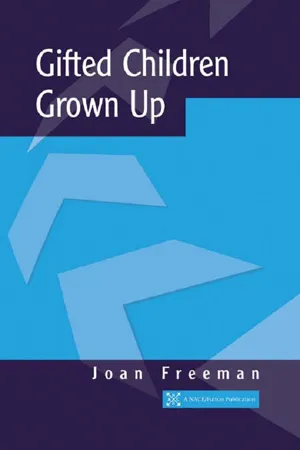
More than a quarter of a century ago, Joan Freeman began this study of 210 children, comparing the recognized gifted, the unrecognized gifted and their classmates. This book: describes what happened to them and their families as they grew up and coped with their different circumstances. It also looks at the problems they faced, often described in their own words and contains personal details from in-depth interviews in homes and schools all over Britain, which are at times startling and sometimes depressing. It lays to rest many myths about the development of gifted children.
The book offers insights into the special situations of the gifted and points out much needed changes in their care and education. It is not only important for their own fulfillment and happiness, but for the future of society.
- 256 pages
- English
- ePUB (mobile friendly)
- Available on iOS & Android
eBook - ePub
Gifted Children Grown Up
About this book
Information
CHAPTER 1
Being gifted
Golden lads and girls all must,
As chimney sweepers, come to dust
William Shakespeare, Cymbeline.
Sometimes people ask why there should be any particular concern for gifted lads and girls. Is it true, as Shakespeare implied, that these golden ones are in the end just like the others? Yes, in the sense that all potential needs help to reach its fulfilment, but no they are not because the gifted need specific and focused help. They need material help — you can't play a violin without a violin. They need teaching — no one can reach the concert platform without expert tuition, as well as the facilities and encouragement for long hours of practice. Knowledge too is the essential foundation for high-level creative work — Einstein had a sound Swiss education to build his discoveries on. Most children need an example to follow, even though some will go on to discover new ways of doing things. And every human being needs emotional support.
Gifted children are defined here in two ways. Firstly, as those who either demonstrate exceptionally high-level performance, whether across a range of endeavours or in a limited field. Secondly, as those whose potential for excellence has not yet been recognised by either tests or experts. There is a distinction between the recognised gifts of children and those of adolescents and adults. The children's are usually seen in the form of precociousness, in comparison with others of the same age, whilst adults' are seen in performance based on many years of dedication in a chosen area. Unlike gifted adults, however precocious they are, children cannot change the nature of their area of expertise because they lack the time needed to gain sufficient experience.
There are two major reasons for being concerned about helping children to realise their gifted potential:
- Individually — so that each human being may reach personal fulfilment.
- To serve the wider needs of the community. Although gifts are personal, they are also a national resource, and the future course of every society depends on developing the potential of its young. No country can afford to lose it.
Barriers to fulfilling gifted potential
There were many wonderful parents in this study. Without them, both mothers and fathers, many of the young people would not have had the confidence and education to negotiate their ways through the maze of obstacles and opportunities to reach their high levels of achievement and happiness. Now, in 2001 they can pass those benefits on to their own growing families. Their positive effective outlooks were not at all dependent on money, but on dedication to finding the best they could for their children, fired by love.
There is no lack of evidence to show that children's development, outlooks and achievements are influenced by the lifestyle of the families in which they grow up, and that from the beginning, the urge to learn is tempered by opportunity (Freeman 2000a). But unfortunately there is no ideal family for producing giftedness, and no formula to follow.
In this study, how much of the proffered help the children took up varied considerably. Where one might grasp at a small chance and work hard to better themselves, another would let the benefits dribble away. When parents became distressed at seeing their children fail to thrive, they did their best to help. Sometimes they succeeded in righting the downward spiral and sometimes they did not.
Exercising individual choice, though, is different from coming up against social obstacles, which not only put real barriers in the way, but have an effect on children's developing self-concepts and ambitions. There are five major social barriers, which, to a greater or lesser extent, exist everywhere in the world — political and social attitudes, poverty, gender, social disapproval and handicap — and they were all present in this study.
Political and social attitudes
National outlook can be more important in education than the wealth of a nation. Whereas in the USA, for example, millions of dollars are spent annually on programmes for the gifted, in Scandinavian countries it has not been acceptable to distinguish and provide for outstanding potential. In much poorer countries, though, such as China and the ex-Soviet Union, gifted children have for many decades received generous government-sponsored help.
What is more, some gifts are more welcome and so better provided for. Who has ever heard of talented footballers being obliged to keep their kicks at the average level so as not to embarrass the others? Far from it. The clubs' football scouts are always on the lookout for young talent. In schools, talented children are given extra tuition outside school hours, including team clothing, transport and arrangements to play with others like themselves. They are not identified by any test, but instead are encouraged and given practice provision so that those who have the potential to shine may be seen to shine and bring popular honour to the school.
Aesthetic talent is particularly sensitive to cultural encouragement. Fortunately, in most parts of the world there are out-of-school musical activities. Instrument teachers may come into schools to provide lessons and search out talent for local children's orchestras. There are also specialist schools for music and dance, though fewer for drama and fine art. Foreign languages or mathematics may be encouraged in school societies, and there are national and international mathematics contests and get-togethers. But opening up the school laboratory for a Saturday morning practice for keen chemists must be rare, if it happens at all.
The widespread charge of élitism also acts as a barrier to special provision for the gifted. Local education authorities, pressed for more money from many sides, often find pleas for provision for the gifted the easiest to refuse. Compared with slow learners, their needs do not seem to merit an effective portion of the education budget.
The key to altering that negative, old-fashioned élitist view of giftedness is to change the perspective from achievement to potential. Instead of gifted children being considered as different or even superior to others in terms of their examination passes or musical performances, they should be recognised as the carriers of much greater than normal potential. Indeed, thinking of children in terms of future rather than present performances encourages teachers to raise their expectations for all pupils. For the gifted especially, it alerts teachers to look out for those who are just coasting along at average level, to recognise them as capable of better work, and to help them develop their abilities more fully.
Growing up poor
Poor children usually live in less healthy places than rich children. They can lose out in every way — physical health, education and balanced psychological development. The low self-esteem that accompanies poverty is a sort of family tradition. Children learn it in their daily lives. It is like a disease that rots the roots of personal progress, eating away at the confidence to plan ahead and the courage to aim high. It damages children's growing feelings of control over their own lives. On the surface, children living in poverty may appear very ‘grown-up’. But that is not real maturity which has been built on the firm foundations of steady trial-and-error learning, which leads to adult competence and creative endeavour. It is more of a bravado, a veneer of the street-smartness needed for survival.
Gender
Ideas of what is suitable for boys and girls can push each into learning areas which may not suit their natural abilities. These have been found to be so similar for each sex that it is in fact possible to compare achievements directly to see the effects of social influences. Spatial abilities, for example, provide a clear example of an area where boys generally do better than girls, so we could expect twice as many male engineering graduates as females — but there are 30 times as many.
There are, however, major changes taking place, at least in the developed world. Girls are now achieving more highly than boys in many subjects: in Britain in all subjects at school, (see Chapter 9, section headed ‘Gender’) This is not true, though, for science and mathematics in the two countries which produce most of the research data on gifted children, the USA and Germany, which shows why it is extremely important to take a cross-cultural look at any evidence. Gender differences are important because of the light they throw on every single aspect of gifted achievement — particularly the effects of expectations and opportunities.
Cultural reasons
It is unfair but true that children who fit-in with their society stand a much better chance of success within it. Being part of a minority culture can be a handicap, though certainly not in all cases: the many great immigrant successes have also shown the power of its impetus. Language provides the first barrier. Children's self-expression may be fluent and creative in their home language but poor at school, and differently cultured and maybe little-educated parents are not always able to help their children at school.
Forms of handicap
Other factors which put the potentially gifted at risk are physical handicap and learning disabilities, such as dyslexia, from which even the most gifted can suffer. Whatever the educational system, there are always some children, however packed with potential, who fail to take advantage of it because something has gone wrong in their lives. This could be as little as a long-running disagreement with an important teacher, or as big as being born in a poor area where obstetric facilities are poor and birth injury brings a lifetime of spasticity to those who will never be recognised for their potential gifts. There were two spastic boys in this research, both of whom has been dismissed by their doctors as of low intelligence. In both cases it was only thanks to their mothers that the boys were able to go on to university and lead full lives.
The development of intelligence
An exceptionally high intelligence is by far the most popular criterion among teachers, parents, pupils and researchers for defining children as gifted. In its broadest sense, everyday intelligence is an individual's power to cope with his or her personal world. This might be the immediate basic objective of getting enough to eat, or a more distant one such as passing exams for a future career. Intelligence is used to assesses the choices available and then work out the most likely effective action in the circumstances.
Everyday intelligence can be improved with practice (like most things in life), in the sense that the more frequently you do something the better you will be at doing it. To a limited extent, measurable intelligence can also be increased by training in the kind of learning that is tapped by intelligence tests, that is by the very act of study, of almost any subject. This idea that learning can of itself improve intelligence, is sometimes given as the reason why the measured intelligence level of Japanese schoolchildren is steadily going up. They stay at school longer than any other nation and work harder while they are there. Certainly, most people's intelligence can be used more efficiently and effectively (see p. 203). No one, though, has yet discovered the answer to increasing the power of people's mental abilities to the extent that would, for example, help slow learners function at even average level.
The differences between people's abilities, including intelligence, are due to the interaction of heredity (the capacity they are born with) and environment (circumstances before and after birth). Give or take ten per cent, the currently accepted figure is that about 70 per cent of the variance between people in intellectual ability is due to inherited differences and the rest to environmental effects. (A few psychologists disagree, saying that we can all reach the highest levels of genius if only we work hard enough!) About 50 per cent of personality is inherited.
But for the intellectually gifted, the situation is somewhat different because input from the environment seems to play a relatively greater role. Though genetic endowment cannot be changed, the environmental proportion of an intelligence test score is relatively greater when a child has extra mental power to absorb and make more effective use of information and ideas (Freeman 1983). It follows, that as brighter children can absorb more, they have a need for high-level educational provision if their potential is to be fully developed.
The development of intelligence
Confusingly, children's intellectual development is not a smooth continuous process. The many interacting aspects neither develop at the same time nor necessarily in the same direction. Theorists such as Howard Gardner (1985) and Robert Sternberg and Davidson (1986) have proposed that instead of one general intelligence there are different kinds of intelligences — which importantly do not overlap. These new theories have encouraged the idea of a kaleidoscope of human abilities which has had a liberating impact on understanding. The template for these modern ideas was formulated in the early part of the twentieth century by Spearman who proposed a general intelligence, ‘g’, with strengths and weaknesses, a view still accepted and used today by most psychologists.
Whether specific or across the board, gifted-level abilities usually unfold very early (Freeman 1995b). How well little children develop whatever they were born with depends greatly on the environment they live in, and most importantly on that vital mediator of intellectual growth — the language they hear and use (Freeman 2000b). From birth, babies start to learn how to cope with their environments. There is some evidence that demanding babies trigger special family attention and that this extra interaction can stimulate their intellectual development. It is as though potentially gifted babies are thirsty for learning.
But the option is not open to all babies — both they and their parents must be good communicators. Mere stimulation is not the springboard of intellectual growth. In fact, loud clashing noises or screaming at a baby can be confusing or even detrimental, and demanding babies in poorly responding homes are not advantaged. In good homes, a highly intelligent child often demands and gets more stimulation from the family, for instance by initiating conversation. Even by the age of five, a child's measured intelligence is clearly related to the quality of language spoken in the family. In that way, a child can actually contribute to his or her own environment.
The efficient use of intelligence also depends on feelings of self-esteem. These are shaped by emotional security and by protection from stress, since adventures into new ways of thought call for confidence. Intellectual growth therefore thrives best in a setting of steady, balanced, positively responsive relationships, rather than a series of disconnected encounters.
Intelligence tests
An intelligence test can provide a safe harbour in a rough sea of opinion because, unlike people, it doesn't pick up antisocial behaviour or an unfashionable accent. We measure children's abilities to help guide them to an appropriate education, and the tests are extremely helpful in this. A good test can sometimes identify a gifted child who parents and teachers have missed. It can discover, for example, when a child is working above the average at school and yet still be underachieving in terms of measured gifted potential. This could be because emotional distress is getting in the way, or schoolwork seems to have no relevance.
I once measured a whole class with a broad-based test of reasoning in a school in a poor district and discovered that many of the pupils scored in the top five per cent. The class teacher eyeing the results, spotted Jane, one of her dirtier, cheekier and less attractive pupils, among the top few. She obviously didn't think much of Jane's abilities, because she said sharply, ‘She must have copied the answers’. ‘Impossible,’ I replied. But my spirits sank as I left the classroom. It seemed unlikely that Jane would ever be able to show what she was capable of, at least with that teacher. Jane's fami...
Table of contents
- Cover
- Full Title
- Copyright
- Contents
- Acknowledgements
- About the author
- Preface
- 1 Being gifted
- 2 The study
- 3 Some problems in being gifted
- 4 Growing up gifted
- 5 Inside gifted minds
- 6 The flowering of talent
- 7 Schooldays
- 8 Goodbye to school
- 9 The wider social world
- 10 The challenge
- 11 Educating for gifts and talents
- Appendix 1: The British educational system
- Appendix 2: Questionnaires
- Appendix 3: The sample at school
- Appendix 4: Useful contacts/addresses
- References
- Index
Trusted by 375,005 students
Access to over 1.5 million titles for a fair monthly price.
Study more efficiently using our study tools.
Frequently asked questions
Yes, you can cancel anytime from the Subscription tab in your account settings on the Perlego website. Your subscription will stay active until the end of your current billing period. Learn how to cancel your subscription
No, books cannot be downloaded as external files, such as PDFs, for use outside of Perlego. However, you can download books within the Perlego app for offline reading on mobile or tablet. Learn how to download books offline
Perlego offers two plans: Essential and Complete
- Essential is ideal for learners and professionals who enjoy exploring a wide range of subjects. Access the Essential Library with 800,000+ trusted titles and best-sellers across business, personal growth, and the humanities. Includes unlimited reading time and Standard Read Aloud voice.
- Complete: Perfect for advanced learners and researchers needing full, unrestricted access. Unlock 1.5M+ books across hundreds of subjects, including academic and specialized titles. The Complete Plan also includes advanced features like Premium Read Aloud and Research Assistant.
We are an online textbook subscription service, where you can get access to an entire online library for less than the price of a single book per month. With over 1.5 million books across 990+ topics, we’ve got you covered! Learn about our mission
Look out for the read-aloud symbol on your next book to see if you can listen to it. The read-aloud tool reads text aloud for you, highlighting the text as it is being read. You can pause it, speed it up and slow it down. Learn more about Read Aloud
Yes! You can use the Perlego app on both iOS and Android devices to read anytime, anywhere — even offline. Perfect for commutes or when you’re on the go.
Please note we cannot support devices running on iOS 13 and Android 7 or earlier. Learn more about using the app
Please note we cannot support devices running on iOS 13 and Android 7 or earlier. Learn more about using the app
Yes, you can access Gifted Children Grown Up by Joan Freeman in PDF and/or ePUB format, as well as other popular books in Education & Education General. We have over 1.5 million books available in our catalogue for you to explore.