eBook - ePub
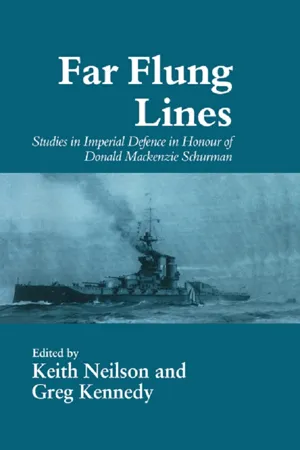
Far-flung Lines
Studies in Imperial Defence in Honour of Donald Mackenzie Schurman
- 240 pages
- English
- ePUB (mobile friendly)
- Available on iOS & Android
eBook - ePub
Far-flung Lines
Studies in Imperial Defence in Honour of Donald Mackenzie Schurman
About this book
These studies show how the British Empire used its maritime supremacy to construct and maintain a worldwide defence for its imperial interests. They rebut the idea that British defence policy in the late 19th and early 20th centuries was primarily concerned with the balance of power in Europe.
Economy or empire?
The fleet unit concept and the quest for collective
security in the Pacific, 1909-14
NICHOLAS LAMBERT
The efforts by Great Britain before the First World War to forge a system of collective security with the self-governing Dominions for the defence of their common maritime interests have been largely ignored by historians. Indeed, the formation of Australian and Canadian navies in 1909 and 1910 barely rates a mention in most standard accounts. Arthur Marder, for instance, devoted just one line to the 'offer of some dreadnoughts by some of the Dominions' in 1909 which he dismissed as a 'by-product' of the navy scare.1 Such attitudes are attributable to the presumptions that Britain's defence policy was driven by an anti-German imperative, and that questions of imperial defence in peripheral regions such as the Pacific were by comparison regarded as insignificant. The standard political and diplomatic accounts of the period reinforce this impression.2 Generally, the negotiation of a naval treaty with Japan in 1902 is held to mark the end of Britain's 'splendid isolation'.3 The renegotiation of the Anglo-Japanese Alliance in 1905 for another ten years is generally regarded as sufficient explanation for imperial defence policy east of Suez.4
The parentage of these 'daughter' navies has been studied in more detail in the Dominions.5 Many writers of these studies, however, have tended to focus upon naval development in the context of emerging national identities.6 All share one common weakness; namely a superficial treatment of the British side of the story and of the relationship between imperial policy and naval policy in general. The standard interpretation of the Admiralty's views is that Britain's naval leadership remained steadfastly opposed to the creation of independent colonial navies. Even the best works on the subject insist that throughout this period the Admiralty remained wedded to the strategic formula of 'one ocean, one empire, one navy'.7 When in 1909 the decision was taken to form the Royal Australian and Royal Canadian Navies, it is argued the Admiralty co-operated only reluctantly and provided little encouragement.8 This simply was not the case.
While Sir John Fisher was First Sea Lord (from 1904 and 1910) the Board of Admiralty maintained that the formation of local navies was inevitable and tried to persuade the British Government that it would be a mistake to stand in the way.9 As early as 1906, the admirals recognized that the creation of a 'national' navy had assumed a 'political complexion' in the Commonwealth of Australia.10 Documents from this period show that the majority of senior Admiralty officials did not object to the idea of a Dominion Navy, and expressed themselves willing to support any reasonable plan. Unfortunately their definition of reasonable usually involved the expenditure of comparatively large sums.11 At that time the Australians were unable or unwilling to allocate more than a 'token' sum, sufficient to pay for a couple of small ships manned by a handful of reservists.12 The Admiralty, meanwhile, consistently refused to have anything to do with what they termed 'sentimental navies'.13 Such forces, they argued with justification, would be more a source of weakness than strength to the empire. Dominion politicians (and many subsequent historians) mistakenly interpreted their negative remarks as amounting to no more than obstruction.14
In July 1909, however, the Admiralty suddenly conceived an ambitious and coherent plan to serve as the basis for a system of naval defence designed to protect all imperial interests in the Far East. In effect, they proposed to re-establish a large British fleet in the Pacific. More importantly, the Admiralty also devised an acceptable formula for Britain and her Colonies to share the incidental expenditure. At the Imperial Defence Conference the 'fleet unit' concept was put forward as the model for adoption by Dominions that wished to create navies of their own. That the Admiralty was planning in mid-1909 (at the height of the 'navy scare'!) to send a significant proportion of its newest warships to the Pacific does not fit easily into the theory that Britain's naval leadership at this time was fixated by the growing German fleet. This article will attempt to address this lacuna by examining the attitude towards Britain's defence commitments in the Pacific held by the Board of Admiralty as distinct from the views of the Cabinet or Foreign Office. It will show that the Admiralty possessed a far broader strategic outlook than previously suspected, belying the notion that questions of imperial defence were being more or less ignored at this time.
***
Many assessments of Britain's strategic position in the Far East during this period fail to take proper account of the nature of naval operations that then prevailed. Until the end of the nineteenth century, the Pacific squadrons of all the principal naval powers were comprised of gunboats and cruising vessels— perhaps supported by an old battleship—and were organized to police seaborne trade and protect commercial interests.15 At the turn of the century, however, the situation changed. Russia, Japan and France began stationing first class naval units in the region. By 1900, the Russian squadron at Port Arthur had grown into a fleet of six modern battleships.16 Despite the formidable costs involved, the British Government believed it had no alternative but to follow suit. The simultaneous development of the side-armoured cruiser compounded the Royal Navy's growing difficulties in defending a sprawling global empire.17 These fast, long range, and well protected new model warships were specially designed by the French for raiding commerce. Overnight they rendered obsolete all existing trade protection vessels.18 By 1902, the British state was already struggling to finance the construction of battleships to maintain the Two Power Standard, build adequate numbers of armoured cruisers, and at the same time respond to the threat to imperial interests in the Far East. Largely because of financial limitation, the Admiralty agreed as an interim measure to the suggestion of a naval treaty with Japan.19
The early months of the Russo-Japanese War which began in February 1904, quickly revealed the vulnerability of old ships when matched against new, and the foolishness of handicapping a squadron comprised of modern warships with obsolete craft. When in October 1904, Sir John Fisher was appointed Senior Naval Lord, he immediately recalled from overseas all cruisers 'too old to fight and too slow to run away'.20 Shortly afterwards, despite fierce criticism, he also brought home the five battleships of the China squadron. In their place, Fisher had planned to re-equip the station fleets with modern armoured cruisers.21 But he was only half way through redistributing the fleet when the strategic situation in the Pacific dramatically changed. In May 1905 the Russian Fleet was annihilated at Tsushima. Shortly thereafter France and the United States recalled their modern battleships and cruisers to home waters. As a result, except for the Japanese navy, the Pacific became virtually deserted of modern armoured warships. In the autumn, the British Government renegotiated and extended the naval treaty with Japan until 1915. Finally, at the end of 1905, a radical Liberal ministry came to power in Britain with the declared intent of cutting naval expenditure to pay for social reform.22 With no obvious threat to British interests in the Pacific, and not wanting to appear profligate, the Admiralty suspended the dispatch of new ships to the Far East. Obviously, to ha...
Table of contents
- Cover
- Half Title
- ROUTLEDGE SERIES: NAVAL POLICY AND HISTORY
- Full Title
- Copyright
- Contents
- Notes on Contributors
- INTRODUCTION
- PERCEPTION IN THE MIDST OF CHAOS
- STEAM, STRATEGY AND SHURMAN: IMPERIAL DEFENCE IN THE POST-CRIMEAN ERA, 1856-1905
- ECONOMY OR EMPIRE? THE FLEET UNIT CONCEPT AND THE QUEST FOR COLLECTIVE SECURITY IN THE PACIFIC, 1909-1914
- THE EMPIRE AND THE USA IN BRITISH STRATEGY IN THE SPRING OF 1917
- 'FOR DIPLOMATIC, ECONOMIC, STRATEGY AND TELEGRAPHIC REASONS': BRITISH IMPERIAL DEFENCE, THE MIDDLE EAST AND INDIA, 1914-1918
- 'IT IS OUR BUSINESS IN THE NAVY TO COMMAND THE SEAS':THE LAST DECADE OF BRITISH MARITIME SUPREMACY, 1919-1929
- THE ROYAL NAVY AND THE DEFENCE OF THE BRITISH EMPIRE, 1928-1934
- 1935: A SNAPSHOT OF BRITISH IMPERIAL DEFENCE IN THE FAR EAST
- Bibliography
Trusted by 375,005 students
Access to over 1.5 million titles for a fair monthly price.
Study more efficiently using our study tools.
Frequently asked questions
Yes, you can cancel anytime from the Subscription tab in your account settings on the Perlego website. Your subscription will stay active until the end of your current billing period. Learn how to cancel your subscription
No, books cannot be downloaded as external files, such as PDFs, for use outside of Perlego. However, you can download books within the Perlego app for offline reading on mobile or tablet. Learn how to download books offline
Perlego offers two plans: Essential and Complete
- Essential is ideal for learners and professionals who enjoy exploring a wide range of subjects. Access the Essential Library with 800,000+ trusted titles and best-sellers across business, personal growth, and the humanities. Includes unlimited reading time and Standard Read Aloud voice.
- Complete: Perfect for advanced learners and researchers needing full, unrestricted access. Unlock 1.5M+ books across hundreds of subjects, including academic and specialized titles. The Complete Plan also includes advanced features like Premium Read Aloud and Research Assistant.
We are an online textbook subscription service, where you can get access to an entire online library for less than the price of a single book per month. With over 1.5 million books across 990+ topics, we’ve got you covered! Learn about our mission
Look out for the read-aloud symbol on your next book to see if you can listen to it. The read-aloud tool reads text aloud for you, highlighting the text as it is being read. You can pause it, speed it up and slow it down. Learn more about Read Aloud
Yes! You can use the Perlego app on both iOS and Android devices to read anytime, anywhere — even offline. Perfect for commutes or when you’re on the go.
Please note we cannot support devices running on iOS 13 and Android 7 or earlier. Learn more about using the app
Please note we cannot support devices running on iOS 13 and Android 7 or earlier. Learn more about using the app
Yes, you can access Far-flung Lines by Greg Kennedy,Keith Neilson in PDF and/or ePUB format, as well as other popular books in History & Military & Maritime History. We have over 1.5 million books available in our catalogue for you to explore.