![]()
Introducing American Conservatism
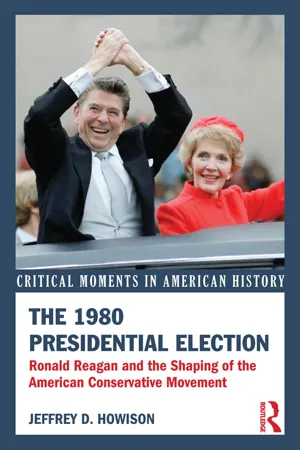
From the first moments of the Reagan presidency, it was clear that change had arrived in Washington. After his narrow 1976 victory, on the day of his own inaugural ceremony, Jimmy Carter opted to walk down Pennsylvania Avenue rather than to ride in the limousines of the presidential motorcade. He did this to symbolize his humility and the reduced stature of the office of the presidency in the aftermath of the Watergate affair. Carter was casual: he often dressed informally and prepared his own meals during the time he spent in the White House. Four years later, as Ronald Reagan was inaugurated, the festivities could hardly have been more different. Reagan's swearing-in ceremony on January 20, 1981, was held on the stately West Front of the Capitol Building, a site that his advisors and the president-elect himself thought better suited to emphasize the grandeur of the American presidency than the traditional location of the inaugural ceremonies, the more banal East Front of the building. The celebrations later that evening featured black-tie galas, Hollywood celebrities, and five-star menus. “The President's thousand-dollar morning suit, the First Lady's $10,000 gown, the sixteen-million-dollar inaugural price tag, the private planes landing at National (soon to be Reagan) Airport, the limousines deployed on the ground… all signified Reagan's new direction.”1
The ritzy atmosphere of Reagan's inauguration prompted many observers—including some of his historic allies—to remark on what they considered to be offensive displays of wealth during difficult economic times. Barry Goldwater, the conservative Republican senator from Arizona whose 1964 presidential campaign changed the direction of the party and launched Reagan's career in politics, seethed, “When you've got to pay $2,000 for a limousine for four days, $7 to park, and $2.50 to check your coat, at a time when most people in this country just can't hack it, that's ostentatious.”2 In addition to the glamour of celebrity, Reagan's formality contrasted with Carter's folksiness even in the most mundane tasks of the presidency. “Reagan, despite his views that he was ‘one of the people’ and inseparable from them, suspected that… calculated displays of ordinariness detracted from the dignity and purpose of the presidency… his approach… was consciously respectful, reflected in [his] refusal to take off his coat whenever he worked in the Oval Office.”3
But Reagan's 1980 victory, and what it came to symbolize, was much more than a stylistic departure from earlier protocols of presidential behavior—although, as will be seen, style and the use of imagery is a crucial aspect of Reagan's rise to power, his presidency, and his legacy. It was also much more than the usual celebrations that mark the “change” brought about by the election of a new president. Instead, Reagan's election signified a critical moment in American history for more profound reasons: it represented the ascendance of the American conservative movement as one of the key historical outcomes of the social changes that had taken place in American society during the long post-WWII period. Furthermore, not only was Reagan's election a culmination of these changes, it was also a watershed moment in the “conservative turn” in American politics: it helped to legitimize conservative positions in relation to a wide range of social, political, and economic issues.
In order to understand Ronald Reagan and his relationship to the American conservative movement, we should first define exactly what we mean by these terms. Of course, Ronald Reagan is one of the most recognizable Americans of the twentieth century, so it might seem redundant to “define him.” But to appreciate his relation to the American conservative movement, it is necessary to chart the course of his personal biography and the historical forces that shaped his life and his political views. Additionally, it is important to “get to know him” on a somewhat more personal level before examining the significance of his election and presidency, for one of the keys to Reagan's success has to do with the features of his personality, which in turn informed how he understood his role as a politician.
RONALD REAGAN: A BIOGRAPHICAL PORTRAIT
Ronald Wilson Reagan was born on February 6, 1911, in Tampico, Illinois, to a Protestant mother and an Irish Catholic father; he grew up in the nearby town of Dixon. His family was not wealthy, and although they would struggle under the conditions of economic crisis during the 1930s, they were squarely part of that ambiguous American category, the “middle class.” Despite graduating from the obscure and socially conservative Eureka College during the height of the Great Depression, Reagan's background in the performing arts, coupled with his persistence and quick wits, helped him soon find work as a radio broadcaster in Davenport, Iowa. By all accounts, Reagan had a natural talent as a sports announcer, not so much because of his interest in sports, which was considerable, but because of his background in the theatre, his easy Midwestern charm, and his vivid imagination, all of which enabled him to absorb the storylines of the players and teams quickly, even in contests with which he had been entirely unfamiliar. Reagan was soon promoted to the larger market of nearby Des Moines, and it was there, through his work in sports radio at the NBC affiliate station WHO, that he began his career as a public figure. By 1934, although not exactly a household name, “Dutch” Reagan (in his early years he was known by the nickname bestowed upon him by his father) had emerged as an affable small-time celebrity as the voice of the Chicago Cubs baseball team in the Midwest:
[Reagan's] success had not diminished his extreme modesty, the way he had of holding a slightly receding posture so that people often had to lean toward him to hear what he was saying (a manner that created an almost instant sense of intimacy). And then there was his distinctive voice—hospitable and at the same time persuasive, seductive and without sham. An investigative reporter could search long and hard and not find one man, woman or child who disliked Dutch Reagan in the 1930s.4
In March of 1937, under the pretext of covering a Cubs spring training game in California, Reagan, through the help of his agent, set out to test the waters of Hollywood and the prospects of a career in film. Reagan seemed personally immune to the effects of the Depression, a feature of his biography that likely contributed to the later development of his individualistic worldview. After his first audition he was offered a contract with Warner Brothers (who advised that he should use his given name of Ronald, rather than “Dutch”), and he began to appear in films almost immediately. In his first film role, Reagan aptly portrayed a Midwestern radio announcer, and he would continue to portray throughout his film career characters who reflected his own personality and reputation as a good natured “all American.” Reagan's life—his general outlook, the people with whom he associated, and, as some have suggested, his perception of reality—would be tremendously influenced by his Hollywood career. It was in the entertainment industry that Reagan met both of his wives: his marriage to the actress Jane Wyman ended in divorce in 1949; he married his second wife and life partner, the actress Nancy Davis, in 1952.
Although Reagan's poor eyesight kept him out of combat during the Second World War, he served as an officer in the Cavalry Reserve in Fort Mason, California, during which time he appeared in and narrated several U.S. Army propaganda films. It should come as no surprise that the Second World War and its aftermath had a deep impact on Reagan's political views. Prior to the war, Reagan had been, like many Americans during the 1930s, a New Deal Democrat who idolized Franklin D. Roosevelt. And indeed, even after his ideological conversion to conservatism and growing opposition to New Deal social programs, Reagan remained a great admirer of FDR, albeit on a personal rather than ideological level. Over the course of his presidency, Reagan borrowed liberally from several FDR speeches, including the line “rendezvous with destiny,” which Roosevelt had used at the 1936 Democratic National Convention.
Despite his eternal admiration for FDR, after the war Reagan morphed into a hard-line anticommunist and increasing opponent of the central premises of New Deal liberalism: namely, he came to oppose state intervention in the economy and a range of “collectivist” federal social programs. The reasons for Reagan's personal transformation from a New Deal Democrat to a conservative Republican have been the subject of much debate. Historians and Reagan biographers have largely failed to come up with a convincing singular explanation as to why this change in his personal political beliefs occurred, although one general factor is beyond dispute: Reagan's views were shaped by the same historical forces that transformed the views of countless other Americans, and these social changes would slowly reconfigure the ideologies and constituencies of both the Democratic and Republican parties and would culminate in Reagan's election as President of the United States in 1980. These forces will be explored at length throughout the pages of this book, but suffice it to say that the Cold War, a general reaction against the “consensus” politics of the 1950s and the social movements of the 1960s and 70s (including radical and conservative mobilizations) all played a part in shaping Reagan's views.
In the immediate postwar years, Reagan increased his role in the labor politics of Hollywood through the Screen Actors Guild (SAG), where he joined the administrative board of directors before going on to serve as president an unprecedented seven times during the late-1940s and 50s. During this period, Reagan was increasingly associated with the rising tide of anticommunism, which, as will be seen, was one of the three ideological pillars of American conservatism in the twentieth century. Through his leadership position inside SAG, Reagan worked as an FBI informant (as did his brother, Neil) and as a friendly witness before the House Select Committee on Un-American Activities (HUAC), during which time he secretly “named names,” directly contributing to the larger purges of suspected communists in Hollywood that occurred through the creation of the infamous “blacklists.”5
During the second half of the 1950s, as Reagan's career in Hollywood was in decline, he began a new position for which he was well suited, one that allowed him to continue his balancing act of keeping one foot in the world of show business and the other in the world of politics. In a position that perhaps foreshadowed twenty-first century attempts at the seamless integration of corporate advertising into “real life” through product placement and “guerilla marketing” campaigns, Reagan accepted the lucrative position he once described as his own “postgraduate education in political science”: a multifaceted role as the public face and spokesperson for the General Electric Company. From 1954 to 1962, Reagan was the host of the General Electric Theatre television program, while acting as a “symbol and spokesman for the entire GE endeavor, what a publicist called the company's ambassador of goodwill to the public at large.”6 Furthermore, Reagan also advertised and represented the lifestyle of the “modern American consumer.” In addition to his hefty salary, he was given a house complete with the latest technological gadgets and appliances, with which he frequently appeared and which he endorsed both on screen and in print. Reagan embarked upon extensive tours of the United States to make personal appearances at each and every one of GE's 135 production facilities across the country. During these tours, he spoke with workers, managers, and their families about a wide range of social issues. Through both the television program and the factory tours, Reagan had a dual platform to deliver the company's and, increasingly, his own vision for America.
It was through Reagan's work at GE that he became a student and practitioner of “Boulwarism,” a management and public relations method named after Lemuel Boulware, a fellow executive at General Electric. Boulware's main objective at GE was to break the power of the United Electrical Workers (UE), the labor union whose massive 1946 strike rocked the company and set the tone for the rising power of organized labor in the post-WWII era. In earlier periods of American history, the violent clashes between unions and corporations had taken place in the streets. For Boulware, however, the most important terrain of the conflict was the mind. He embarked upon a wide-reaching campaign to shape the political ideology of GE workers toward antiunion positions. “Boulware made fighting the unions come to seem moral, a righteous cause, forward looking, necessary to make a better America.”7 Although Boulware was vehemently opposed to labor unions, he believed “it was not enough to win over company employees on narrow labor issues… but [to] pass on GE's essentially conservative message… helping the company to win voters at the grass roots who would elect officials and pass legislation” that would ultimately serve the corporation's political and economic interests.8 Through Boulwarism, General Electric developed the field of corporate public relations as it went “over the heads of union officials directly to the blue-collar workers, their families, and their neighbors” in an effort to influence the opinions and mold the political ideology “within the company and in other companies, and the public at large.”9 Under the tutelage of Lemuel Boulware, Reagan's views moved increasingly to the right, as he stood in a unique position to appear as a television personality and corporate front man, while simultaneously working to shape the political ideology of his audiences.
Throughout the 1950s, Reagan polished his public speaking and finalized his break with New Deal liberalism while solidifying the principles that would define his political legacy: in addition to his fierce opposition to communism, he developed a growing opposition to labor unions, to the federal regulation of business, and to taxes—principles that were indistinguishable from those advocated by GE and other major American corporations. Reagan sought to convince his audiences of the merit of these positions through a standard stump speech, which he delivered countless times across the country, inside factories, at banquet dinners, and in more informal settings. During the eight years of Reagan's employment at GE, he “was giving the same speech year after year, making it vivid and enjoyable, though its message was apocalyptic: a slow invisible tide of socialism was engulfing America, held back only by a few brave businessmen.”10 These speeches laid the foundations for Reagan's political style. Through his innumerable conversations with GE workers and their families, Reagan mastered the art of reducing complex issues to simplified arguments that appealed to the traditional sensibilities of many ordinary Americans. This way of addressing his audiences became the hallmark of Reagan's rhetorical style, and he would use it effectively throughout his political career, including during the course of his presidency.
“The Speech,” as it is known among Reagan's biographers, was characterized by its abundant and scattershot use of anecdotal rather than well-documented evidence. It invariably centered upon the evils of communism and the ways in which the principles of Soviet totalitarianism were increasingly reflected in the monolithic power of the United States federal government bureaucracy, which, from Reagan's point of view, arbitrarily tormented the lives and productive capacities of the American people through an array of illogical and stifling regulations, all of which were underwritten by excessive taxation. For Reagan, there were always simpler solutions to be found for the problems of modern American society, solutions other than government action. Instead, social problems were best solved through individualistic common sense. For some of Reagan's contemporaries, “the Speech” was political ideology delivered with the silver-tongued confidence of a traveling salesman. Lawrence Williams, an actor who worked with Reagan during the 1930s, remarked:
Statistical information of all sorts was a commodity Ronnie always had in extraordinary supplies… Not only was this information abundant, it was stunning in its catholicity. There seemed to be absolutely no subject, however recondite, without its immediately accessible file. Ron had the dope on just about everything: this quar...