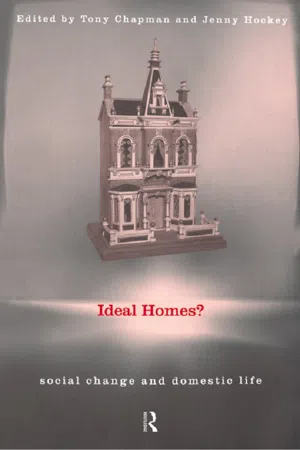
Ideal Homes? shows how both popular images and experiences of home life relate to the ability of society's members to produce and respond to social change.
The book provides for the first time an analysis of the space of the home and the experiences of home life by writers from a wide range of disciplines, including sociology, architecture, geography and anthropology. It covers a range of subjects, including gender roles, different generations relationships to home, the changing nature of the family, transition and risk and alternative visions of home.
eBook - ePub
Ideal Homes?
Social Change and the Experience of the Home
- 248 pages
- English
- ePUB (mobile friendly)
- Available on iOS & Android
eBook - ePub
Ideal Homes?
Social Change and the Experience of the Home
About this book
Information
1
THE IDEAL HOME AS IT IS IMAGINED AND AS IT IS LIVED
Tony Chapman and Jenny Hockey
Since 1908, London has hosted the Daily Mail sponsored Ideal Home Exhibition. While the exhibition has changed a great deal since its early years, it remains an occasion where people can go along and find out what the latest fashions are in domestic architecture, interior design and house furnishing, and see on display all of the latest labour saving gadgets. From a sociological point of view, the Ideal Home Exhibition provides interesting insights into the way that big companies attempt to persuade show visitors to subscribe to a particular model of the ideal home. As the purpose of this book is to explore the way that the ideal home is imagined, as well as the way that it is actually lived, this exhibition proves a unique model of the home as it has been popularly imaged and idealised in society. Not only does it reflect popular representations of the ideal home, but also it attempts to project the way that it should develop so that people can live ideal lives. By definition, this means that the exhibition organisers need to sow a seed of doubt in the minds of visitors about their quality of life in their current homes. This was achieved at the 1995 Ideal Home Exhibition by the principal feature, entitled ‘Yesterday’ Homes’, which presented to the public a mock-up terrace of four houses which were constructed to depict the changing design of housing across the twentieth century.
Instead of celebrating a nostalgic view image of ‘Yesterday’ Homes’ the exhibition designers went to some lengths to suggest that these houses were fundamentally inadequate for modern living — the antithesis of the ideal home. This process of undermining confidence in existing houses began at the rear of the houses, where the viewing public queued up along a path. The backs of the houses were purposely presented in dingy condition with greying net curtains and stained, flat, white-painted window frames. The back gardens gave further clues about the dismal existence that old-fashioned houses were likely to afford. For example, the back garden of a 1967 dormer bungalow with a steeply pitched roof and large picture windows featured outmoded ‘ranch-style’ fencing, a rotary washing line and an orange ‘space hopper’ sitting forlornly on a rank patch of grass. The back garden of the next house, a plainly designed 1944 semi-detached house with white-painted concrete rendering and Crittall style metal window frames, had been dug up to plant white cabbages — that most loathed vegetable among a generation of wartime children. At the end of the garden, an Anderson shelter had been sunk — suggesting that this house was fit only for bombing.
Although the Show Guide (1995: 33) hoped that ‘you enjoy it, and that many of you will indulge yourselves in a bit of good, old fashioned nostalgia’, it was made plain that the nostalgia that people might feel was to be tempered by the negative aspects of old houses. As visitors were herded into a mock-up of a 1908 terraced house in cohorts of twenty, spotlights picked out in turn each of four rooms: the bathroom, bedroom, kitchen and sitting room. The visual display was accompanied by a pre-recorded narrative read by the late Sir Michael Hordern, together with the supposedly contemporaneous dialogue of the inhabitants performed by actors. In the bathroom of the 1908 house, the narrator drew attention to the cast-iron roll-top bath and single cold tap, while in a dimly gas-lit parlour, the visitors heard the hacking coughs of the inhabitants who complained, morosely, about the state of the guttering.
In the next house, a 1926 semi-detached, the visitors were reminded by the narrator that this was the year that Houdini and Rudolph Valentino died ‘and the country was brought to a standstill by the General Strike’. The Show Guide issued stark warnings of the dangers of buying such a house:
the house’ hot pipes and heated water combined with poor insulation means that it loses even more heat than its predecessor, giving George and Daisy higher fuel bills. Also, George doesn’t realise, of course, that the clever electric lighting is served by metal conduits which will gradually degrade. Heaven help any future buyer — rewiring the entire house isn’t going to be cheap!(Show Guide 1995: 35)
In the wartime house, visitors were reminded about flying bombs in the same breath as the corroded condition of the metal windows was discussed. As if all this were not enough, the Show Guide sarcastically referred to the inhabitants’ taste: ‘the charming sideboard/drinks cabinet [which] has pride of place in the living room. And the bathroom sports the very latest in sanitaryware — a fetching bath, WC and pedestal basin, all finished in tasteful green’ (Show Guide 1995: 35, original emphases).
Finally, in the 1960s house, the narrator fuelled notions of 1960s decadence by mentioning the Rolling Stones on drug charges, while the visitors surveyed the contents of a late 1960s sitting room with a ceramic tile coffee table, Dansette record player, vinyl-fronted mini bar and the once popular Blue Lady print.
Taste aside, this house isn’t without its problems either. The central heating system, some basic insulation and the absence of a chimney flue mean that the house is warmer and cheaper to heat, but it also leads to more condensation caused by poor ventilation. And while building techniques had improved, the materials used were often of poor quality. Untreated timber often led to rotting window frames and the plastic gutters tended to leak badly. The unexpected bonus of a paddling pool of rainwater on the garage’ flat roof could also lead to damp penetrating the adjoining house walls.(Show Guide 1995: 36)
Just in case the visitors missed the point, the Show Guide reminded them of the purpose of the exhibition and the appropriate interpretation:
Our memory tends to be selective, and we often look back through rose-tinted spectacles. We may remember our first 1920s-built house as being ‘solid’ and having ‘character’, while forgetting that it was cold, draughty and cost us an arm and a leg to run! Sunny days spent relaxing in our gardens are more easily remembered than the amount of time we had to put in painting window sills, repairing broken gutters or fixing roof tiles … We also forget that we could hear our next door neighbour sneeze because sound-proofing was non-existent at the time, and we may look back fondly at the amount of time it took us to save for a new cooker.(Show Guide 1995: 34)
As the show visitors left the darkened terrace, they emerged onto the patterned brick drive of a brand new show home — the so-called ‘House of Tomorrow’. This was a large ‘state of the art’ 1990s ‘L shaped’ executive show home with integral double garage. The house was constructed in brick and tile, rather than a mock up of hardboard and timber as was the case in the terrace of ‘Yesterday’ Homes’, and so provided the public with an extremely favourable impression. Inside the freshly painted and decorated house, visitors viewed a gleaming new hi-tech kitchen, a bathroom with power shower and Jacuzzi, while the rest of the house was furnished with the best new furniture and fabric that British Homes Stores could muster. As the Show Guide stated:
The reality is that housebuilding has come a long way this century, and the owner of a brand new home will never have to put up with these and the many other easily forgotten problems associated with older properties … should a similar feature ever be staged at the Ideal Home Exhibition in 2095, the equivalent turn-of-the-millennium house’ imaginary family won’t be prompting memories of cold bathrooms, damp walls, broken gutters and heating bills that break the bank.(Show Guide 1995: 34)
When analysed in the context of an academic book like this, the strategy of the exhibition designers looks transparently manipulative. But in the context of the Ideal Home Exhibition, it is a subtle marketing technique that implants a notion that the visitors’ own homes provide an inadequate level of comfort, security and facility (see Chapman 1999).
The above discussion suggests that manufacturers, advertisers, marketing professionals, retail psychologists and others can persuade people to buy into prescribed images of the ideal home. Indeed, there is much evidence to demonstrate that capital is successful at achieving these ends (see Chapman, Chapter 4 in this book; see also, for example, Lodziak 1995; Kellner 1982, 1989; Corrigan 1997; Falk and Campbell 1997). But capital cannot place desires in people’ minds as if it were painting on an empty canvas. As this book will demonstrate, other important cultural, economic and personal experiential factors come into play when we consider the way that people envisage the ideal home. When visitors pour into the exhibition, they bring with them a well-developed if unspoken set of personal aspirations, as well as individual frustrations and fears. It is from this perspective that they consume manufacturers’ images.
Before we begin our study of the ideal home as it is lived, it is therefore important to explore other factors which shape popular images of the ideal home. As we have seen from the discussion of the Ideal Home Exhibition, images change over time, but these transformations may have less to do with technological factors, as the exhibit suggests, than with changing social relationships between, for example, husbands and wives, parents and children, householders and servants. Transformations in the design of houses also come about in response to changed patterns of urban life, employment, expectations of leisure, privacy, respectability, community, security and the projection of social status. It is beyond the scope of this chapter, and indeed beyond the scope of the book, to explore the cross-cultural variations in the development of models of the ideal home (for a useful cross-cultural analysis, see Rapoport 1969; Kent 1990). Instead, we concentrate on the Western model of the ideal home in general, but emphasise in particular transformations in Britain.
Confining ourselves to the British experience for the moment, we begin by asking to what extent is the model of the ideal home shaped by the needs of the individual in isolation from or in opposition to the cultural prerequisites of society more generally? That tired old adage, ‘an Englishman’ home is his castle’, suggests that while individuals and families might face a lifelong struggle for survival in the hot-house of public life, the private home is a ‘haven’ or ‘retreat’ where we are free to express our individualism in whatever way we choose. While there are many possibilities for individuals to do what they want in their home — however creative or terrible the consequences might be for the rest of the people living there — evidence presented in this volume reveals strong social pressures from the public world which constrain that behaviour. That home should be a focus for the sociological gaze is therefore highly appropriate and indeed somewhat overdue. In the second half of this chapter, we turn our attention to the problems people encounter when attempting to realise the dream of the ideal home, but for now we shall concentrate on the way that the ‘model’ of the ideal home has been shaped.
Beginning with individual options, we can state that most people do not have much choice over the fundamental design characteristics of houses — although there are many variations on a theme — because these characteristics are defined by social and cultural factors. Even the very wealthy need planning permission or the advice of the professional architect and interior designer who, likely as not, will have something to offer in the way of advice on structure, function and aesthetics. For people who cannot afford to buy their own home, the issue of what kind of place they should live in is determined by housing officers, planners, architects, politicians and social philanthropists; the criteria that these professionals use to define an ‘appropriate’ living space impose a significant constraint on personal choice (see Brindley, Chapter 3). For the rest, the great middle mass of private home owners, now amounting to around 70–75 per cent of households in, for example, the UK, USA and Australia (Balchin 1995: 194), can choose from a range of styles of existing houses or opt for a new home.
In Britain, however, there is relatively little scope for building a new home according to one’ personal requirements (see Chapters 4 and 15). In this respect, the British experience is different from that of North America, much of Europe and Australia, for instance, where householders have more control over the design of their homes. This can be explained partly by the restrictions the state has imposed upon new building, such as the establishment of conservation areas, green belts, preservation orders, building regulations and so forth. But more importantly, the range of ‘models’ of the ideal home is relatively limited in Britain, which is something that has been achieved by the successful identification of ‘what people want’ by speculative builders. If we take a critical look at our own built environment, we find evidence of ‘pattern book’ models of the ideal home, a trend which has emerged because speculative builders have identified a popular view of how the ideal home should be constituted. Over time, these ideals have changed and we need, therefore, to examine the way they have been transformed to meet different social expectations.
Changing images of the ideal home
Since the eighteenth century, British speculative builders have been producing homes according to pattern book designs. Rather than asking their potential clients what kind of house they wanted to live in, builders have been prepared to take a gamble — buy some land — and then build houses on it which they hoped people would buy or rent. The eighteenth century witnessed the first large-scale phase of speculative house building in England. The process began with the development of neo-classical terraces, crescents and squares in west London and the spa town of Bath. This pattern of building reflected a significant shift in the pattern of urban life from what Heer (1990: 46) described as the ‘ebullient, raucous and quarrelsome’ life of towns in the earlier medieval period to the relatively ‘polite’ society of the spa and the suburb. Girouard (1990) has described this transformation:
The eighteenth century evolved in reaction against the seventeenth. Many people felt that the traumas of the latter must be avoided at all costs; the heat had to be taken out of the system … Civilisation was the result of [people] learning to act together in society. The polite [person] was essentially social, and as such, distinguished them from arrogant lords, illiterate squires and fanatical puritans.(Girouard 1990: 76)
Simply put, the creation of elegant terraces with everyone’ house looking the same as their neighbours’ helped reinforce the image of the new ‘polite society’ where people learned the art of tolerance and equality, rather than drawing their sword at the slightest insult. It is not that people asked the builders to provide terraces, because that model did not yet exist. Instead it depended upon the entrepreneurial and social vision of speculators like Beau Nash, who cashed in on the opportunities arising from the new social confidence created by the rise of the polite society. The building of houses in a new way, then, arose from changing social attitudes and was realised in real estate as a consequence of the foresight of speculators (Borsay 1990; Reed 1984; A. Morris 1994).
By the end of the eighteenth century, most English towns had developed new suburbs of elegant terraces, while existing home owners often concealed the original façades of their houses and refronted them to make them look as if they were built in the new style (Clifton-Taylor 1984). The rise of these new spas and suburban developments was led by the significant growth in the number of merchants, manufacturers and professionals such as lawyers and doctors, a response to rising trade, the developing commercial and industrial economy and the expanded functions of the state (Porter 1990; Hobsbawm 1969; Hill 1969). Architectural historians suggest that this was a society where very wealthy people felt secure enough to move relatively freely between country house and town house; where the emergent middle class gained access to and helped develop polite society by socialising in private domestic drawing rooms and the town assembly rooms, and by taking holidays at the spas (Girouard 1990; Cruickshank and Burton 1990; Borsay 1990). It is dangerous to read too much meaning into the restrained style of the domestic architecture, of course, for the eighteenth-century town remained a lively, debauched and dangerous place. Then, as now, images and external façades concealed ways of life which were at odds with home as idealised. As Porter (1990) puts it:
Life was raw. Practically all youngsters were thrashed at home, at school, at work — and child labour was universal. Blood sports such as cock-fighting were hailed as manly trials of skills and courage. Felons were publicly whipped, pilloried and hanged, traitors were drawn and quartered. Jacobites’ heads were spiked on Temple Bar till 1777. Work-animals were driven relentlessly; England was notoriously ‘hell for horses’, and cruelty to animals worsened with industrialization and the craving for speed.(Porter 1990: 17)
Within the houses themselves life was also often far from polite.
Hardly any houses boasted a bath. Before cottons became cheap, clothes were difficult to wash; children were sometimes sewn into theirs for the winter. Vermin were not just metaphorical; rat-catchers royal and flea catchers royal made good livings. Chamber-pots were provided in dining-room sideboards, to save breaking up post-prandial conversation among the men …...
Table of contents
- Cover
- Half Title
- Full Title
- Copyright
- Contents
- List of illustrations
- Notes on contributors
- Preface
- 1 The ideal home as it is imagined and as it is lived
- PART I Changing images of the ideal home
- PART II Betwixt and between: homes in transition
- PART III Anxieties and risks: homes in danger
- PART IV Changing perceptions of home
- Bibliography
- Index
Trusted by 375,005 students
Access to over 1.5 million titles for a fair monthly price.
Study more efficiently using our study tools.
Frequently asked questions
Yes, you can cancel anytime from the Subscription tab in your account settings on the Perlego website. Your subscription will stay active until the end of your current billing period. Learn how to cancel your subscription
No, books cannot be downloaded as external files, such as PDFs, for use outside of Perlego. However, you can download books within the Perlego app for offline reading on mobile or tablet. Learn how to download books offline
Perlego offers two plans: Essential and Complete
- Essential is ideal for learners and professionals who enjoy exploring a wide range of subjects. Access the Essential Library with 800,000+ trusted titles and best-sellers across business, personal growth, and the humanities. Includes unlimited reading time and Standard Read Aloud voice.
- Complete: Perfect for advanced learners and researchers needing full, unrestricted access. Unlock 1.5M+ books across hundreds of subjects, including academic and specialized titles. The Complete Plan also includes advanced features like Premium Read Aloud and Research Assistant.
We are an online textbook subscription service, where you can get access to an entire online library for less than the price of a single book per month. With over 1.5 million books across 990+ topics, we’ve got you covered! Learn about our mission
Look out for the read-aloud symbol on your next book to see if you can listen to it. The read-aloud tool reads text aloud for you, highlighting the text as it is being read. You can pause it, speed it up and slow it down. Learn more about Read Aloud
Yes! You can use the Perlego app on both iOS and Android devices to read anytime, anywhere — even offline. Perfect for commutes or when you’re on the go.
Please note we cannot support devices running on iOS 13 and Android 7 or earlier. Learn more about using the app
Please note we cannot support devices running on iOS 13 and Android 7 or earlier. Learn more about using the app
Yes, you can access Ideal Homes? by Tony Chapman, Jenny Hockey, Tony Chapman,Jenny Hockey in PDF and/or ePUB format, as well as other popular books in Social Sciences & Residential Architecture. We have over 1.5 million books available in our catalogue for you to explore.