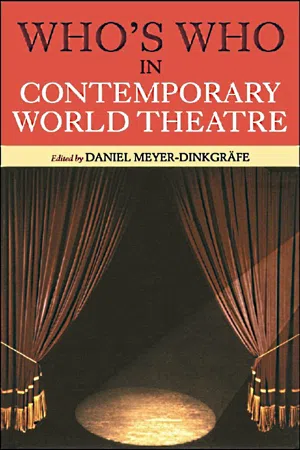
Who's Who in Contemporary World Theatre is a lively and accessible biographical guide to the key figures in contemporary drama. All who enjoy the theatre will find their pleasure enhanced and their knowledge extended by this fascinating work of reference. Its distinctive blend of information, analysis and anecdote makes for entertaining and enlightening reading. Hugely influential innovators, household names, and a whole host of less familiar, international figures - all have their lives and careers illuminated by the clear and succinct entries. All professions associated with the theatre are represented here - actors and directors, playwrights and designers. By virtue of the broad range of its coverage, Who's Who in Contemporary World Theatre offers a unique insight into the rich diversity of international drama today.
- 360 pages
- English
- ePUB (mobile friendly)
- Available on iOS & Android
eBook - ePub
Who's Who in Contemporary World Theatre
About this book
Information
S
Sabban, Rafik (1933–) Director and scriptwriter, Syria. Sabban’s work as a director was heavily influenced by Jean Villar (under whom he trained), and Jean-Louis Barrault. In Damascus, Sabban introduced Shakespeare and Molière to a Syrian audience accustomed to low comedies. From 1960 onwards he was the dominant force in the newly founded National Theatre, and later with Syrian State Television. With an average of twelve new productions a year, major credits include Sophocles Antigone and Electra, El-Hakim’s Al-Sultan’l-Ha’er (The Sultan’s Dilemma), The Merchant of Venice, Twelfth Night, Macbeth, Much Ado About Nothing, Molière’s Tartuffe and Calderón’s La vida es sueño (Life is a Dream). In the 1970s he emigrated to Egypt, taking up a professorship in drama and cinema while pursuing an active career as scriptwriter for film and television. He is still considered by many as the true founder of the National Theatre in Damascus, and certainly the first director to establish the public’s appreciation of the classics, bringing innovative spirit of modern theatre with him from France.
Sa’ed, Jihad (1953–) Actor, director, Syria. Sa’ed was trained in Egypt. On his return, he started as a theatre actor in Georges Schehade’s The Emmigrant of Brisbane. His breakthrough as actor was first on the television mini-series, The Artist and Love, written and directed by Riad ISMAT. His debut as stage director was with an acclaimed production of Albert Camus’s Caligula (1986, revived in 1996). He adapted, acted and directed Jason and Medea from the famous Greek tragedy. His play Awacs (1995) was a forward step in experimental theatre, both as a dramatist, director and actor. The play was made of fragmented scenes about the need for freedom in a world of suppression and persecution by local and international forces. He was appointed artistic director for Damascus National Theatre in the 1990s. His latest production is Mohamed El-Magout’s Kharej’l-Serb (Astray from the Flock, 1998).
Saez, Gloria (1949–) Designer, Puerto Rico. Gloria Saez was born in Asturia, Spain and studied at the Escuela de Bellas Artes in Salamanca (1968–9) before continuing her studies in Art and Design in Belgium. After arriving in Puerto Rico, she began her career as a professional costume designer for the television station WPR. A passionate theatre artist, Saez is particularly noted for her detailed period costumes in works by Shakespeare, García Lorca and the dramatists of Golden Age Spain, as well as more recent designs for works by Puerto Rican and Latin Ameri- can authors such as Rene Marqués, Premier Maldonado and Luis Rechani Agrait. She also designed costumes forthe world premiere production of García Lorca’s El Público under the direction of Victoria ESPINOSA (1978). Recent work includes costume designs for Lope de Vega’s Fuente Ovejuna (University of Puerto Rico, 1998), Moliere’s Tartuffe (Teatro Tapia, 1998) and Verdi’s opera Il Trovatori (The Troubadours, Centro de Bellas Artes, 1998).
Sagiroglu, Duygu (1932–) Designer and director, Turkey. Educated at the Faculty of Architecture, University of Istanbul, Sagiroglu joined the State Theatre in 1956 as a designer. From 1959–76, he worked in the film industry as a director, artistic director and scriptwriter. In 1979, he started to work as an instructor at the Institute of Cinema and Television, Academy of Fine Arts in Istanbul. Theatre design work includes Ben Elton’s Take a Deep Breath (1991–2), Gogol’s Zapiski Sumasshedshego (The Diary of a Madman, 1992–3), Insanlarim (My People, a collage of the poetry of Nazim Hikmet, 1994–5) and Ronald Duncan’s Abelard and Heloise (1996–7). As a designer, he does not work independently from the playtext, aiming at a creation that translates the playtext rather than overwhelming the production. At present, he is working an an instructor at the Faculty of Fine Arts, Cinema-Television Department of Mimar Sinan University, Istanbul.
Sagoe, Abeiku (1957–) Actor, dramatist and director, Ghana. Among the roles Sagoe has played are Mlanga in Chaka, the Zulu, Dubois in The Trial of Kwame Nkrumah, Mambo in Mambo and White Oppressor in Struggling Black Race. He has also written and directed some very successful plays/productions including Samori, The President’s Wife, Tale of Aids, Hand of God and Devil’s Influence. Sagoe has been involved in numerous films as an actor and as director, including Son of the Thundergod, Avengers, Not Again and Passionate Woman. He is the director of the theatre company Living Echoes Drama. Sagoe’s theatre is highly sociopolitical as it attempts to engage with contemporary issues of Ghanaian society.
Saint-Eloy, Luc (1955–) Actor, director and author, France and Guadeloupe. Saint-Eloy came to Paris and studied drama at the Studio Charpentier, and film at the University of Paris VIII. In 1982 his first play Le Prix de la Terre (The Price of the Earth) achieved favourable notice, and he has continued to compose fiction and drama. His early acting experience was with Jules-Rosette’s Théâtre Noir, and his own work with his group Théâtre de l’Air Nouveau, founded 1983, shows a similar orientation towards imaginative texts. In addition to adaptations and poetic ‘montages’, often with a strong musical component, such as Bwa brilé (Burnt Wood, 1996), a tribute to Eugène Mona. He had a particular success with his prizewinning drama of urban alienation, Trottoir Chagrin (Pavement of Sorrows, 1991), starring Mylène Wagram. Chemin d’école (School Days, 1997) is based on Patrick Chamoiseau’s bittersweet memoir. Since 1994, Saint-Eloy has been active in Yasmina HO-YOU-FAT’S ‘Pitt a Pawol’, which organizes regular encounters with French Caribbean writers through dramatic readings and discussion of new work, and has worked in film and television.
Sakate Yôji (1962–) Dramatist and director, Japan. Sakate first joined the theatre Group Teni 21 and then formed Rinkôgun Theatre Company with members of the theatre research group of Keiô University in 1982. All the productions of the Rinkôgun TC were written and directed by Sakate. His plays include Tokyo Saiban (Tokyo Trial, 1988), Come Out (1989), Breathless (1990), Kujira no Bohyô (The Epitaph for the Whales) and Kamigami no Kuni no Shuto (The Capital of the Gods’ Country, 1993). The latter toured in Europe in 1994 and 1996. An English adaptation of The Epitaph for the Whaleswas staged at the Gate Theatre, London in 1998. Sakate writes political and social plays in the mixed style of fantasy and absurdist theatre. He focuses on such controversial issues as whale hunting, cult religions, the Emperor system and the problem of waste.
Salibur, Lucette (1955–) Actor, dramatist and director, France and Martinique. Born of Guadeloupean parents in France, where she studied psychology, Salibur ‘discovered’ theatre in Martinique through the SERMAC theatre workshop, acting in several of their inaugural productions as well as working with Existence, Théâtre de La Soif Nouvelle and the founders of Poutyi pa teyat. Subsequent roles include Emilia in Othello (1983, Limoges Festival de la Francophonie), Léna in Fugard’s Boesman and Lena (1984), parts in SOYINKA’S The Trials of Brother Jéro (1984) and several television productions. The credibility of her portrayal of Madame Léonce in the film Black Shack Alley (1983) betrays the determination behind her 1984 directing debut and her 1989 founding of Nowtéat, a group including many unemployed from the SERMAC theatre workshops. Initially producing educational and children’s theatre, and adaptations of literary and poetic texts, Nowtéat aims at financially independent professionalism. The success of Boum et Aïda rencontra Mutant (Boom and Aida meets Mutant, 1991), her allegorical satire on international politics, Masters of the Dew (1992), and her interest in collaboration, reflect her commitment to breaking new ground in Martinican theatre.
Salminen, Esko Kullervo (1940–) Actor, Finland. Salminen trained at the Theatre School of Finland, and has worked as an actor with the Finnish National Theatre (1961–9 and since 1992), Helsinki City Theatre (1969–71 and 1977–92) and Turku City Theatre (1971–7). Apart from work for film and television, major stage roles include Lopakhin in Chekhov’s Visnevyi sad (The Cherry Orchard), Danton in Büchner’s Danton’s Tod (Danton’s Death), Trigorin in Chekhov’s Cajka (The Seagull), the title roles in Ibsen’s Peer Gynt, Othello and Macbeth, and Eddie Carbone in Arthur MILLER’S A View from the Bridge. ‘The dominant feature of Esko Salminen’s work is that he questions traditional interpretations, giving them complexity and inner conflict which increases their believability and somehow brings them closer to the audience. But at the same time he has preserved the curious, captivating twinkle in the corner of his eye of the young man who is seeking his own way and assessing the state of the world.’
Samel, Udo (1953–) Actor, Germany. Samel trained in Frankfurt am Main. After seasons in Darmstadt and Düsseldorf, he was a member of the Schaubühne in Berlin from 1978–92. Samel is a master of transformation, who is at home equally with cunning or foolish characters in comedy and as a split, brooding hero in tragedy. Important roles include Kalldewey in Kalldewey Farce by Botho STRAUSS (1982, directed by Luc BONDY), Trofimov in Chekhov’s Visnevyi sad (The Cherry Orchard 1989, directed by Peter STEIN) and Sosias in Kleist’s Amphitryon (1991, directed by Klaus Michael GRÜBER).
Sánchez-Gijón, Aitana (1969–) Actor, Spain. Sánchez-Gijón studied acting at the RESAD, the Drama School of Madrid. Although she is perhaps most recognized for her work in film, she remains an accomplished theatre actor who has exercised wise restraint in her choice of roles. Her work in theatre includes Jacinto Benavente’s La malquerida (The Non-Wanted Woman) in an acclaimed production by Miguel Narros in the mid-1980s and more recently a controversial high-profile staging of Tennessee Williams’s Cat on a Hot Tin Roof directed by Mario GAS (1995). Her delicate, dark beauty, exquisite poise and steely presence have seen her work increasingly abroad. Like the generation that precedes her, including Antonio Banderas, Veronica Forqué, Cristina Marcos and Ana Belén, Aitana Sánchez-Gijón is as comfortable working within theatre as in film and indeed has forged parallel careers in both. In 1998 she replaced film director José Luis Borau as President of the Spanish Academy of Film.
Sanchís Sinisterra, José (1940–) Dramatist, Spain. Sanchís Sinisterra founded the important Aula de Teatre at the University of Valencia in 1964. In 1977 he created the theatre company El Teatro Fronterizo in Barcelona, and began a practical exploration of the relationship between narrative and theatre, through a series of projects using prose writers such as Kafka, Melville and Cortázar. His plays include La leyenda de Gilgamesh (The Legend of Gilgamesh) produced in 1978, followed by Ñaque o de piojos y actors (Ñaque or Louses and Actors) in 1980, La primera de la clase (The Best in Class) in 1984, and one of the most commercially successful plays of the new democratic Spain, ¡Ay, Carmela! (1987). His work is marked by a prolific versatility which encompasses popular comedy, vaudeville, historical drama and mythology. In 1989, Sanchís Sinisterra founded the Sala Beckett in Barcelona, which has evolved into a space facilitating ongoing research into performance and dramaturgy. Here he has nurtured a whole new generation of dramatists including Sergi BELBEL. His most recent plays include Pervertimento (Perversion, 1988), Pérdida en los Apalaches (Lost in the Apalaches, 1990) and El cerco de Leningrado (The Leningrad Siege, 1994). He lectures at the Institut del Teatre of Barcelona.
Sander, Otto (1941–) Actor and director, Germany. Sander trained at the Otto Falckenberg Schule in Munich. After seasons in Düsseldorf, Heidelberg and with the Freie Volksbühne in Berlin, he was a member of the Schaubühne in Berlin from 1970–81, returning in later years for guest performances. At home in both tragedy and comedy, he excels equally with passive, depressive and cynical characters and completely intolerable philistines. Major parts include the Dovre Master in Peter STEIN’S production of Ibsen’s Peer Gynt (1971), Suslov in Gorki’s Dacniki (Sommergäste, 1974, directed by Stein), Vershinin in Chekhov’s Tri sestry (Three Sisters, 1984, dircted by Stein) and the title role in Kleist’s Amphitryon (1991, directed by Klaus Michael GRÜBER. Sander has also directed and pursued a career in film.
Santagata, Alfonso (1947–) Director, dramatist and performer, Italy. After training at the Civica Scuola D’Arte Drammatica in Milan, Alfonso Santagata worked with Dario FO, Luca RONCONI and Carlo CECCHI. In 1979, together with Claudio Morganti, he founded the theatre company Katzenmacher. Influenced by Antonin Artaud, Santagata developed a challenging politicized practice focused around the notion of alienation. Often working with found objects, Santagata has reinterpreted a number of classical texts in the light of what could be described as romantic neorealism. Among his most interesting productions with Morganti are Katzenmacher (1979), Büchner Mon Amour (1981), Hauser/ Hauser (1986), Dopo (After, 1987), Beckett’s Endgame (1990), Manlio Sgalambro’s Schopenhauer Song (1995) and King Lear (1996).
Santiago Lavandero, Leopoldo (1912–) Director, Puerto Rico. Leopoldo Santiago Lavandero is considered by most theatre professionals in Puerto Rico to have been the primary force behind the proliferation of modern theatrical activity there. He pursued postgraduate study in theatre at Yale University in the late 1930s, eventually earning an MA in 1948. Don Leopoldo (as he is known among his students and collaborators) founded the group Areyto with Emilio Belaval in 1940, and the Department of Drama at the University of Puerto Rico in 1941, both of which were aimed toward the creation of a theatre with uniquely ‘Puerto Rican’ character. Together with Rafael Cruz Eméric, he instituted the Teatro Rodante de Puerto Rico (Puerto Rican Travelling Theatre) in 1946, a group composed of professional actors as well as scholarship students, which brought classics of world theatre to the people of Puerto Rico, using a truck which was converted on location into a stage (a practice which Joseph Papp adapted for some of his productions in New York some years later). He retired from the theatre in 1972 and is currently living in Florida.
Santos, Carles (1940–) Director, composer, performer and musician, Spain. Trained as a pianist at Barcelona’s Conservatoire, Santos made his reputation as a concert pianist before moving on to specialize in contemporary music in the early 1970s. Since 1978 he has been associated almost exclusively with his own compositions. La Pantera Imperial (The Imperial Panther, 1998), forged from the music of Bach, is a marked exception, and it has been a search for a visual performance language for music which moves beyond the parameters of concert recitals or operatic rendition which has fuelled Santos’s own evolution from pianist to choreographer of opulent, elegant spectacles infused with a raucous sensuality. His trajectory has been marked by a resistance to reductive or conclusive categorizations and the need, in his own words, to ‘make music visible’. Working closely with choreographer Montserrat Colomé, he has created a company which has questioned the very parameters of music theatre. The exuberant t...
Table of contents
- Cover Page
- Title Page
- Copyright Page
- Contributors
- Preface
- Acknowledgements
- A
- B
- C
- D
- E
- F
- G
- H
- I
- J
- K
- L
- M
- N
- O
- P
- Q
- R
- S
- T
- U
- V
- W
- X
- Y
- Z
Trusted by 375,005 students
Access to over 1.5 million titles for a fair monthly price.
Study more efficiently using our study tools.
Frequently asked questions
Yes, you can cancel anytime from the Subscription tab in your account settings on the Perlego website. Your subscription will stay active until the end of your current billing period. Learn how to cancel your subscription
No, books cannot be downloaded as external files, such as PDFs, for use outside of Perlego. However, you can download books within the Perlego app for offline reading on mobile or tablet. Learn how to download books offline
Perlego offers two plans: Essential and Complete
- Essential is ideal for learners and professionals who enjoy exploring a wide range of subjects. Access the Essential Library with 800,000+ trusted titles and best-sellers across business, personal growth, and the humanities. Includes unlimited reading time and Standard Read Aloud voice.
- Complete: Perfect for advanced learners and researchers needing full, unrestricted access. Unlock 1.5M+ books across hundreds of subjects, including academic and specialized titles. The Complete Plan also includes advanced features like Premium Read Aloud and Research Assistant.
We are an online textbook subscription service, where you can get access to an entire online library for less than the price of a single book per month. With over 1.5 million books across 990+ topics, we’ve got you covered! Learn about our mission
Look out for the read-aloud symbol on your next book to see if you can listen to it. The read-aloud tool reads text aloud for you, highlighting the text as it is being read. You can pause it, speed it up and slow it down. Learn more about Read Aloud
Yes! You can use the Perlego app on both iOS and Android devices to read anytime, anywhere — even offline. Perfect for commutes or when you’re on the go.
Please note we cannot support devices running on iOS 13 and Android 7 or earlier. Learn more about using the app
Please note we cannot support devices running on iOS 13 and Android 7 or earlier. Learn more about using the app
Yes, you can access Who's Who in Contemporary World Theatre by Daniel Meyer-Dinkgrafe in PDF and/or ePUB format, as well as other popular books in Media & Performing Arts & Drama. We have over 1.5 million books available in our catalogue for you to explore.