- 96 pages
- English
- ePUB (mobile friendly)
- Available on iOS & Android
eBook - ePub
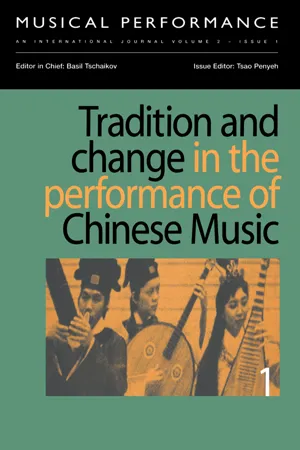
Tradition and Change in the Performance of Chinese Music
About this book
First published in 1998. As a cultural entity of over five thousand years of history, Chinese music is a multi-faced phenomenon consisting of diverse regional and transregional traditions. Two large categories of Chinese music can be distinguished: music(s) of the Han nationality and music(s) of the ethnic nationalities. The present volume brings together ten articles written largely by native scholars, with the general aim of presenting a dialogue about Chinese music from 'insider's' view-points.
Information
Subtopic
Music“The Running Waters”: Traditional Chinese Instrumental Music*
This article is a general introduction to traditional instrumental music primarily of the Han people in China mainland. It is divided into the following sections: the history and classifications of instruments and music are briefly stated; the performance and transmission of court music, religious music, literati’s music and folk music in traditional contexts are discussed; recent changes in the performance, transmission and preservation of traditional music are discussed.
KEY WORDS: traditional instrumental music, performance, transmission, preservation, context.
History and Classification
Chinese musical instruments and instrumental music have a long history. The ancestors left a large number of instruments and colorful instrumental music (see Yang, 1981; Guo, 1989; Zhongguo Yishu Yanjiuyan Yinyue Yanjiusuo, 1988). The history of Chinese music can roughly be divided into the following large overlapping periods.
Pre-Qin Dynasty ( –221 B.C.)
The earliest instruments can be traced back to about 6000 B.C. according to archeological findings. A batch of gudi (bone flute) was unearthed from the Jiahu ruins in the Wuyang area in Henan Province in 1986–1987. They were sacrificial objects in a tomb. According to the Carbon-14 date, they existed 7920 (±150) years before the present, and they are the earliest instruments found in China so far. They were made from the leg bones of large birds. Most of them have seven finger-holes, so that different types of heptatonic scales can be played on them. This indicates that there was a well-developed musical culture in China at that time.
Many ancient instruments from the Neolithic Age, 8000–4000 years ago, have been unearthed in various places in China. Besides gudi found in different ruins, there are different shapes of xun (an egg or ball shaped wind instrument, comparable to the ocarina), qing (L-shaped sonorous stone), taozhong (pottery bell), and so on. Bronze making techniques were well developed during the Shang (c. 1600–1100 B.C.) and West Zhou (c. 1100–771 B.C.) Dynasties, and various bronze instruments appeared during that time. The most important were the zhong (bronze bell) and bianzhong (bell chime). The bronze technique provided sharp tools for instrument making, thus allowing for the development of new types of instruments. According to historical records there were around seventy kinds of instruments in the West Zhou Dynasty; the earliest classification of musical instruments appeared in China at that time. The classification system had eight categories based on the materials which the instruments were made. They were jin (metal), such as zhong; shi (stone), such as qing; si (silk), such as qin (seven string plucked zither); zhu (bamboo), such as di (bamboo flute); pao (gourd), such as sheng (mouth organ); tu (earth), such as taoxun (pottery ocarina); ge (hide), such as gu (drum); and mu (wood), such as yü (scraped wooden block).
Until the Spring and Autumn (770–476 B.C.), and the Warring States Periods (475–221 B.C.), the manufacture of instruments developed to a very high level. Instruments unearthed from the tomb of Marquis Yi of the Zeng state (buried in 433 B.C.) indicate how well those instruments were developed and how refined and skillful the manufacture was. Take the bianzhong from this tomb as an example, it has 64 bells, with each bell able to generate two tones of different pitches. It has 12 half tones within three octaves in the middle register, and the chromatic scale can be played on it. Its timbre is clear and pure, and the tuning is accurate according to the traditional Chinese temperament system used at that time. As well as the bianzhong, bianqing (stone chime), gu, qin, se (large plucked zither) sheng, di and paixiao (pan pipe) were unearthed from this tomb; in ensemble all these instruments composed a large performing ensemble with the bianzhong as the leading instrument.
Naturally, if there were musical instruments, there was also instrumental music, however, in ancient times, instruments were generally played to accompany vocal music and dance, and pure instrumental music was less common. Examples of instrumental music include solo qin (seven-string plucked zither) music and a band used at the court of Qi which consisted of 300 yü (a type of ancient sheng, mouth organ). The yü was also used to play solo music for entertaining the king. From these early records, we can see that instrumental music had started to develop independently at that time.
From the Qin to the Five Dynasties (221 B.C.–960 A.D.)
Musical instrument development came about partly as the result of frequent international cultural exchanges during this period of time. Various instruments of different origin (both from foreign countries and ethnic minorities in the border areas) came to the central plain. Important instruments appearing during this period were the pipa (short neck plucked lute with pear-shaped soundbox), ruan (long neck plucked lute with round soundbox), wo konghou (plucked zither with frets on the soundboard), shu konghou (angular harp), fengshou konghou (arched harp), yazheng (rubbed half-tube zither), xiqin (rubbed lute), hujiao (horn), suona (conical oboe), bei (conch), bili (a double-reed cylindrical instrument), chiba (vertical bamboo flute), tongbo (brass cymbals), luo (gong), paiban (clappers), and various shaped drums including column shaped, hour-glass shaped, frame shaped, and so on.
Instrumental music also had new developments. Some large suites of vocal music, such as xianghe ge (song, accompanied by instruments) performed in the court of the Han Dynasty (206 B.C. –220 A.D.) and the Three Kingdoms (220–265 A.D.), which often included instrumental ensemble sections. Also from the Han Dynasty, guchui yue (drum and wind music) appeared as martial and court banquet music, and this tradition continued through to the Qing Dynasty (1644–1911). Besides, qin and pipa solo music also continued to develop and a number of famous players appeared during this period of time. The court banquet musics of the Sui (581–681 A.D.) and the Tang (618–907 A.D.) Dynasties were divided into nine or ten ensembles according to different origins, and every ensemble had different instrumentation. The performance of the court banquet music, especially the daqü (large suite), was usually a combination of vocal, instrumental music and dance, with independent instrumental sections in the performance. For example, the sanxü (prelude in free rhythm) in daqü usually consisted of sections for instrumental solos as well as ensemble sections. The development of instrumental music was strongly influenced by singing and dancing music through performing together with them and accompanying them.
From the Song to the Qing Dynasty (960–1911 A.D.)
Throughout this period it was the folk musicians rather than those within the Court (as in the past) who were responsible for passing on and exchanging musical instruments. The most important development during this period was that of the bowed string instruments. Various types of bowed lutes appeared throughout the country. Their soundboxes were made of wood, bamboo, brass, gourd, coconut shell or buffalo horn; and came in a variety of shapes such as a tube, bowl or box. The faces of their soundboxes were covered by the skins of snake, frog, buffalo, horse, sheep, camel, or a thin piece of wood, bamboo leaves, and other leaves. In short, the materials were taken from local objects, and their shape and timbre varied. Among the commonly played bowed lutes, was the erhu, which was a two-string bowed lute with a tube-shaped wooden sound-box, with its face covered in snake skin. Other examples of bowed lutes include the sihu, which had four strings in two pairs of same pitch, with some sihu soundboxes being made of brass; the two-stringed banhu, with a bowl shaped soundbox being made of coconut shell, and covered by a thin piece of wood; the jinghu, which is much smaller than an erhu, with a soundbox made of bamboo, that was mainly used for accompanying Peking opera. All these instruments are in...
Table of contents
- Cover
- Title Page
- Copyright Page
- Table of Contents
- Guest Editor’s Preface
- Romanization and Pronunciation
- Chinese Musical Instruments
- ‘The Running Waters’: Traditional Chinese Instrumental Music
- The Music Associations of Hebei Province
- Han Folk Song in China
- Nuo-Culture and Music: Traces of Chinese Primitive Music in Nuoyi and Nuoxi
- Taoist Ritual Music in China
- Notes on Contributors
- Index
Trusted by 375,005 students
Access to over 1.5 million titles for a fair monthly price.
Study more efficiently using our study tools.
Frequently asked questions
Yes, you can cancel anytime from the Subscription tab in your account settings on the Perlego website. Your subscription will stay active until the end of your current billing period. Learn how to cancel your subscription
No, books cannot be downloaded as external files, such as PDFs, for use outside of Perlego. However, you can download books within the Perlego app for offline reading on mobile or tablet. Learn how to download books offline
Perlego offers two plans: Essential and Complete
- Essential is ideal for learners and professionals who enjoy exploring a wide range of subjects. Access the Essential Library with 800,000+ trusted titles and best-sellers across business, personal growth, and the humanities. Includes unlimited reading time and Standard Read Aloud voice.
- Complete: Perfect for advanced learners and researchers needing full, unrestricted access. Unlock 1.5M+ books across hundreds of subjects, including academic and specialized titles. The Complete Plan also includes advanced features like Premium Read Aloud and Research Assistant.
We are an online textbook subscription service, where you can get access to an entire online library for less than the price of a single book per month. With over 1.5 million books across 990+ topics, we’ve got you covered! Learn about our mission
Look out for the read-aloud symbol on your next book to see if you can listen to it. The read-aloud tool reads text aloud for you, highlighting the text as it is being read. You can pause it, speed it up and slow it down. Learn more about Read Aloud
Yes! You can use the Perlego app on both iOS and Android devices to read anytime, anywhere — even offline. Perfect for commutes or when you’re on the go.
Please note we cannot support devices running on iOS 13 and Android 7 or earlier. Learn more about using the app
Please note we cannot support devices running on iOS 13 and Android 7 or earlier. Learn more about using the app
Yes, you can access Tradition and Change in the Performance of Chinese Music by Tsao Penyeh,Tsao in PDF and/or ePUB format, as well as other popular books in Media & Performing Arts & Music. We have over 1.5 million books available in our catalogue for you to explore.