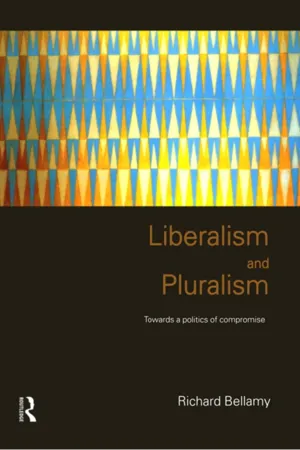
In Liberalism and Pluralism the author explores the challenges conflicting values, interests and identities pose to liberal democracy. Richard Bellamy illustrates his criticism and proposals by reference to such topical issues as the citizens charter, constitutional reform, the Rushdie affair and the development of the European Union.
- 256 pages
- English
- ePUB (mobile friendly)
- Available on iOS & Android
eBook - ePub
About this book
Information
Notes
Introduction: the challenge of pluralism
1. For a full exposition and defence of the following characterisation of liberalism, see my Liberalism and Modern Society: An Historical Argument, Cambridge: Polity Press, 1992. Those seeking full chapter and verse should look there, I offer only a few indicative references here.
2. Gender-neutral language is generally used in this book. However, this usage is sometimes historically inaccurate (as it would be here) and often represents (albeit unwittingly) what Susan Muller Okin calls ‘false gender neutrality’ (Justice, Gender and the Family, New York: Basic Books, 1989, pp. 10–13), wrongly implying a fair balance of power exists between men and women. One of the criticisms of contemporary ‘neutralist’ liberalism made below is that it inadequately tackles this problem of structural domination.
3. For example, the French Declaration of the Rights of Man and the Citizen of 1789, especially Articles 1, 2, 4, 6, 14 and 16, I. Kant, ‘On the Common Saying: “This May be True in Theory, But It Does Not Apply in Practice” ’, in H. Reiss (ed.), Kant’s Political Writings, Cambridge: Cambridge University Press, 1970, p. 73 and J. Rawls, A Theory of Justice, Oxford: Clarendon Press, 1971, p. 60.
4. For an excellent example of such thinking, see E. Durkheim, ‘Individualism and the Intellectuals’, trans. S. Lukes and J. Lukes, Political Studies 17 (1969), pp. 19–30.
5. See, for example, J. Tully, Strange Multiplicity: Constitutionalism in an Age of Diversity, Cambridge: Cambridge University Press, 1995, especially Ch. 3, and B. Parekh, ‘Superior People: The Narrowness of Liberalism from Mill to Rawls’, Times Literary Supplement (25 February 1994), pp. 11–13.
6. James Mill’s A History of British India offers the classic example.
7. For example, J. S. Mill, Utilitarianism, On Liberty and Considerations on Representative Government, ed. H. B. Acton, London: Dent, 1972; On Liberty, p. 73; Considerations on Representative Government, pp. 178–80.
8. J. Raz, The Morality of Freedom, Oxford: Clarendon Press, 1986, pp. 369–70, 394.
9. Parekh, ‘Superior People’, p. 12.
10. For example, F. Fukuyama, Trust: The Social Virtues and the Creation of Prosperity, New York: The Free Press, 1995.
11. Raz makes a good case for seeing multiculturalism as part of the more general pluralist challenge in his ‘Multiculturalism: A Liberal View’, in Ethics in the Public Domain, Oxford: Clarendon, 1994, pp. 178–83, though his expectation that certain illiberal cultures will simply die strikes me as too neat and somewhat at variance with the tenor of much of his argument.
12. Tully, Strange Multiplicity, Ch 1 makes this point well.
13. See J. Tully, ‘The Agonic Freedom of Citizens’, Economy and Society, forthcoming.
14. See R. Vernon, ‘Moral Pluralism and the Liberal Mind’, in J. M. Porter and R. Vernon (eds), Unity, Plurality and Politics: Essays in Honour of F. M. Barnard, London and Sydney: Croom Helm, 1986 and G. Crowder, ‘Pluralism and Liberalism’, Political Studies 42 (1994), pp. 293–305, who show that the liberal belief in autonomy, toleration and diversity does not necessarily follow from a commitment to pluralism.
15. This definition of pluralism follows J. Kekes, The Morality of Pluralism, Princeton, NJ: Princeton University Press, 1993. The ensuing discussion also draws on I. Berlin, Four Essays on Liberty, Oxford: Oxford University Press, 1969; Idem, Against the Current, Oxford: Oxford University Press, 1979; Idem, The Crooked Timber of Humanity, London: Fontana Press, 1991; J. Gray, Post-liberalism: Studies in Political Thought, London: Routledge, 1993, pp. 287–306; Idem, Isaiah Berlin, London: HarperCollins, 1995, Chs 2 and 6; S. Hampshire, Morality and Conflict, Oxford: Blackwell, 1983; Idem, Innocence and Experience, Harmondsworth: Penguin, 1989; C. Larmore, Patterns of Moral Complexity, Cambridge: Cambridge University Press, 1987, Ch. 6; Idem, ‘Pluralism and Reasonable Disagreement’, Social Philosophy and Policy 11 (1994), pp. 61– 79; T. Nagel, Mortal Questions, Cambridge: Cambridge University Press, 1979, Ch. 9; B. Williams, Moral Luck, Cambridge: Cambridge University Press, Ch. 5; S. Lukes, Moral Conflict and Politics, Oxford: Clarendon Press, 1991, Chs 1 and 3; Raz, The Morality of Freedom, Ch. 13; J. D. Moon, Constructing Community: Moral Pluralism and Tragic Conflicts, Princeton NJ: Princeton University Press, 1993, Ch. 2; and R. Chang (ed.), Incommensurability, Incomparability and Practical Reason, Cambridge Mass.: Harvard University Press, 1997.
16. For this distinction between primary and secondary goods, see Kekes, Morality of Pluralism, p. 18.
17. M. Walzer, Spheres of Justice, Oxford: Martin Robertson, 1983, p. 8.
18. Berlin, Against the Current, pp. 70–9.
19. M. Weber, ‘Science as a Vocation’, in H. H. Gerth and C. W. Mills (eds), From Max Weber, London: Routledge, 1948, p. 148.
20. C. Larmore, Patterns of Moral Complexity, Cambridge: Cambridge University Press, 1987, Ch 6; T. Nagel, Mortal Questions, Cambridge: Cambridge University Press, 1979, Ch. 9.
21. N. Machiavelli, Discorsi sopra la prima deca di Tito Livio in Il Principe e Discorsi ed. S. Bertelli, Milan: Feltrinelli, 1960, Bk 1, Ch. IX, p. 153.
22. H. L. A. Hart, ‘Between Utility and Rights’, in A. Ryan (ed.), The Idea of Freedom, Oxford: Clarendon Press, 1979.
23. Weber, ‘Science as a Vocation’, pp. 147–8.
24. J. Rawls, Political Liberalism, Columbia: Columbia University Press, 1993, pp 56–7.
25. See W. B. Gallie, ‘Essentially Contested Concepts’, Proceedings of the Aristotelian Society 56 (1955–6), pp. 167–98.
26. Lukes, Moral Conflict, p. 14. Lukes places Marxists in this category.
27. Raz, Morality of Freedom, p. 352, emphasis in the original.
28. Larmore, Patterns of Moral Complexity, p. 140 and Raz, Morality of Freedom, p. 328 on ‘marginal’ and ‘significant’ incommensurability.
29. Raz, ‘Multiculturalism: A Liberal Perspective’, p. 179.
30. Raz, ‘Multiculturalism: A Liberal Perspective’, p. 179. J. Gray attributes a similar ‘agonistic liberalism’ to Berlin and has adopted it himself: see his Berlin, Ch. 6 and Enlightenment’s Wake, Ch. 6.
31. I have examined Weber’s argument in detail in Liberalism and Modern Society, Ch. 4.
32. Martha Nussbaum makes a similar error with her ‘Aristotelian Social Democracy’, in R. Douglas et al., Liberalism and the Good, New York: Routledge, 1990, pp. 234–7. Recognition that human flourishing draws on a diversity of goods is different to an acceptance of pluralism, and in Aristotle’s case was consistent with a ranking of goods that is inconsistent with the notion of incommensurability. See Hampshire, Innocence and Experience, p. 34 and, for a more detailed critique of Raz along these lines, Bellamy, Liberalism and Modern Society, pp. 244–8.
33. What follows draws on many of the essays in ...
Table of contents
- Cover Page
- Half Title page
- Title Page
- Copyright Page
- Dedication
- Contents
- Preface and acknowledgements
- Introduction: the challenge of pluralism
- Part I Liberal democracy and the exclusion of politics
- Part II Democratic liberalism and the politics of compromise
- Part III Pluralism, liberalism and democracy in Britain
- Notes
- Index
Trusted by 375,005 students
Access to over 1.5 million titles for a fair monthly price.
Study more efficiently using our study tools.
Frequently asked questions
Yes, you can cancel anytime from the Subscription tab in your account settings on the Perlego website. Your subscription will stay active until the end of your current billing period. Learn how to cancel your subscription
No, books cannot be downloaded as external files, such as PDFs, for use outside of Perlego. However, you can download books within the Perlego app for offline reading on mobile or tablet. Learn how to download books offline
Perlego offers two plans: Essential and Complete
- Essential is ideal for learners and professionals who enjoy exploring a wide range of subjects. Access the Essential Library with 800,000+ trusted titles and best-sellers across business, personal growth, and the humanities. Includes unlimited reading time and Standard Read Aloud voice.
- Complete: Perfect for advanced learners and researchers needing full, unrestricted access. Unlock 1.5M+ books across hundreds of subjects, including academic and specialized titles. The Complete Plan also includes advanced features like Premium Read Aloud and Research Assistant.
We are an online textbook subscription service, where you can get access to an entire online library for less than the price of a single book per month. With over 1.5 million books across 990+ topics, we’ve got you covered! Learn about our mission
Look out for the read-aloud symbol on your next book to see if you can listen to it. The read-aloud tool reads text aloud for you, highlighting the text as it is being read. You can pause it, speed it up and slow it down. Learn more about Read Aloud
Yes! You can use the Perlego app on both iOS and Android devices to read anytime, anywhere — even offline. Perfect for commutes or when you’re on the go.
Please note we cannot support devices running on iOS 13 and Android 7 or earlier. Learn more about using the app
Please note we cannot support devices running on iOS 13 and Android 7 or earlier. Learn more about using the app
Yes, you can access Liberalism and Pluralism by Richard Bellamy in PDF and/or ePUB format, as well as other popular books in Politics & International Relations & Political Philosophy. We have over 1.5 million books available in our catalogue for you to explore.